How to Verify Authenticity of Supplier Test Reports When Sourcing Kids Sunglasses?
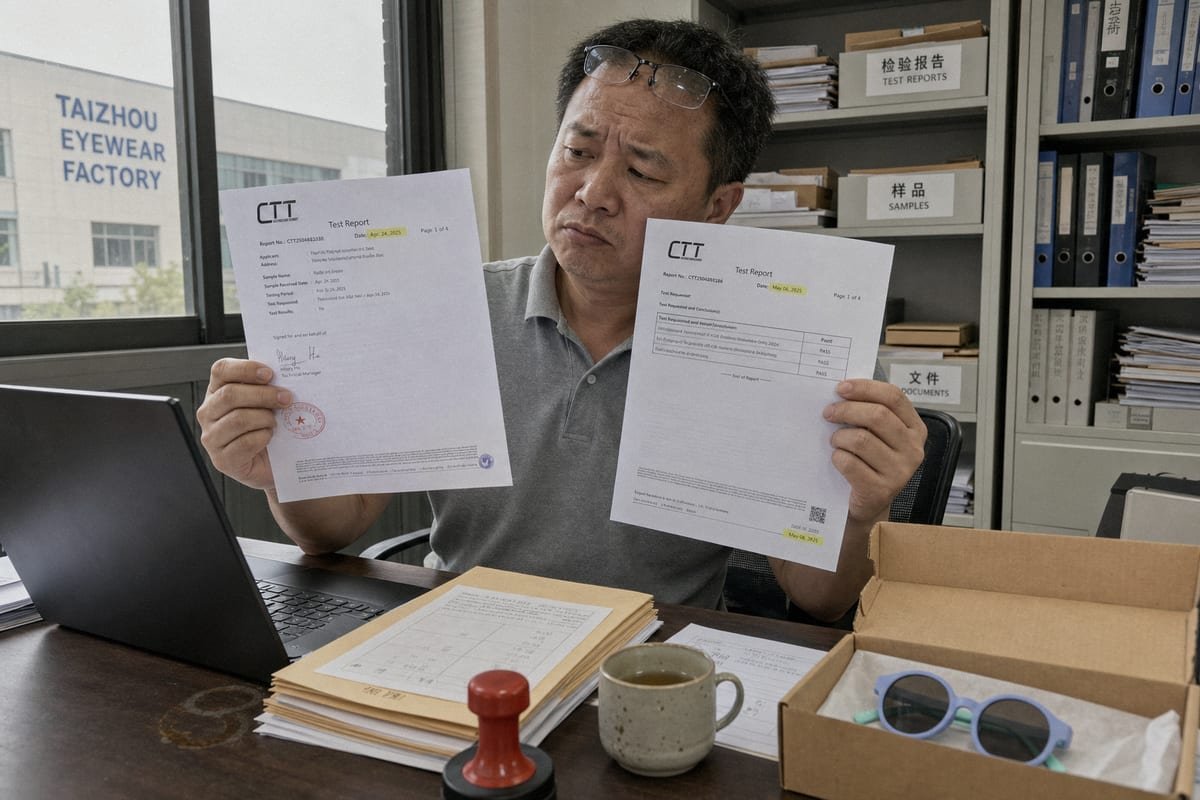
Learning how to verify authenticity of supplier test reports 1 saved several of our buyers from disaster. Fake paperwork looks convincing until customs, or a lawsuit, exposes it.
Pour vérifier l'authenticité des rapports de test des fournisseurs pour les lunettes de soleil pour enfants, confirmez trois niveaux : le document est authentique, le laboratoire émetteur est accrédité et peut valider le numéro de rapport, et le rapport couvre votre SKU exact, les matériaux et les normes requises telles que CPSIA, EN 71 et ISO 12312-1.
That three-layer model sounds simple. In practice, most buyers only check the first layer. Below, I break down each layer into steps you can run before you ever wire a deposit.
Que dois-je rechercher sur un véritable rapport de test CPSC ou EN71 pour confirmer qu'il n'est pas fabriqué ?
A buyer from Australia once forwarded me a competitor's "CPSC report" for review. Our compliance team in Taizhou spotted the problem in two minutes: the header date and footer date did not match.
Un véritable rapport de test CPSC ou EN 71 comprend un numéro de rapport unique, le nom et le logo du laboratoire accrédité, les détails du demandeur, le modèle exact du produit, les normes de test détaillées, les résultats de réussite/échec par test, la date d'émission et une signature autorisée. Les champs manquants ou incohérents signalent une falsification.

After fifteen years of preparing documentation for children's eyewear exports 2, I can tell you that most fake reports fail on details, not on the big picture. Forgers copy the layout of a real SGS or Intertek certification document. But they get sloppy with the fields that labs generate automatically.
The Core Fields Every Real Report Contains
Start with a field-by-field review. Every legitimate report from a CPSC accredited laboratory or an ISO 17025 lab will show these elements clearly.
| Champ | What It Should Show | Fabrication Warning Sign |
|---|---|---|
| Numéro de rapport | A unique lab report tracking number in the lab's format | Number missing, generic, or reused across documents |
| Applicant / held by | Your supplier or the actual factory name | An unrelated trading company with no explanation |
| Product description | Exact model, frame material, lens type, color | Vague terms like "plastic sunglasses" |
| Standards tested | CPSIA lead and phthalates, EN 71 safety testing, ISO 12312-1 | Outdated standard versions or wrong market rules |
| Test results | Itemized results with limits and measured values | Only a single "PASS" with no data table |
| Date d'émission | Recent enough for the current production run | Dates that conflict between pages |
| Signature | Authorized signatory, often with a digital seal | Blurry, pasted, or missing signature |
Format Matters More Than Buyers Think
Request the original PDF, not a JPG, PNG, or Word file. Image files and re-saved scans are far easier to alter. Modern labs issue PDFs with server-side digital signatures. Open the file in a professional PDF reader 3 and check the signature panel. If the cryptographic seal is broken, someone edited the file after issue. Also inspect the PDF metadata. A "Creator" tag showing Adobe Photoshop is a serious warning. Real lab systems generate reports through report software, not image editors.
Finally, check scope. For kids sunglasses, the report must cover Phthalates and lead content in the frame, small parts and mechanical safety under EN 71, and optical performance against les normes de protection UV400. A lens-only report is not enough for a children's product.
Comment puis-je vérifier le rapport de test d'un fournisseur par rapport à la base de données du laboratoire d'essai d'origine ?
When we send test reports for our TR90 and TPEE kids frames to new clients, I include the lab's verification link in the same email. I want buyers to check us. That habit came from watching honest factories lose orders to forgers with prettier paperwork.
Vérifiez un rapport en saisissant son numéro de rapport unique dans le portail de vérification officiel du laboratoire émetteur, tel que la validation de certificat d'Intertek ou le TÜV SÜD Certificate Finder. S'il n'existe pas de portail, envoyez un e-mail directement au laboratoire en utilisant les coordonnées de son site web officiel, jamais celles du fournisseur.
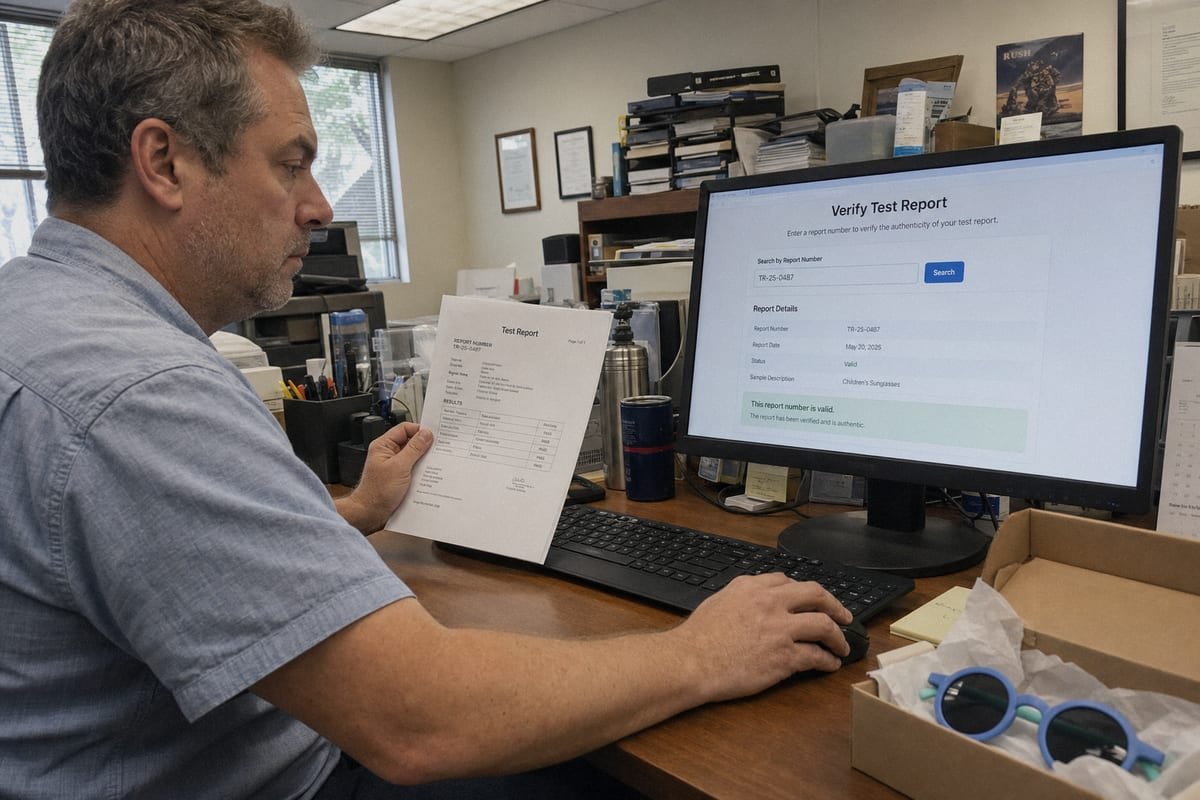
Third-party lab verification is the single strongest step in the whole workflow. A forger can fake a document. A forger cannot fake the lab's own database. So treat the lab, not the paper, as the source of truth.
Step-by-Step Database Verification
- Identify the lab independently. Search the lab's name yourself. Do not click links inside the supplier's email or PDF. Spoofed verification pages that mimic a real lab's interface are a known fraud tactic, so check any QR code's underlying URL before trusting it.
- Confirm accreditation first. Look up the lab in the accreditor's official directory 4, such as ILAC-member bodies, CNAS, or the CPSC's list of accredited laboratories. An unaccredited lab makes the report worthless even if it is "real."
- Use the lab's validation tool. Major labs offer portals: Intertek certificate validation, Bureau Veritas e-certificates, TÜV SÜD Certificate Finder, and UL Product iQ. Enter the lab report tracking number and compare every field against your copy.
- Contact the lab if no portal exists. Many legitimate labs have no public database. Email or call using details from their official site. Ask them to confirm the report number, applicant, product, and issue date.
- Record everything. Save screenshots of the portal result or the lab's confirmation email. This audit trail protects you internally if the shipment is ever questioned.
One nuance I always share with buyers: absence from a public database does not automatically mean fraud. Smaller regional labs often verify only by email. The red flag is a supplier who blocks or delays your direct contact with the lab, not the lack of a portal itself.
Quels drapeaux rouges suggèrent qu'un fournisseur de lunettes pour enfants pourrait réutiliser ou modifier d'anciens rapports de test ?
The trickiest case our sales team ever handled involved a real report for the wrong product. A trader had taken a valid EN 71 report for an adult wraparound sport style and presented it for a toddler round-frame model. The document was authentic. The compliance claim was not.
Les principaux signaux d'alarme comprennent les rapports fournis uniquement sous forme de captures d'écran ou de numérisations de mauvaise qualité, les photos de produits ou les références SKU qui ne correspondent pas à votre commande, les noms de candidats qui diffèrent de ceux de votre fournisseur, les normes expirées ou non pertinentes, les polices ou les dates non concordantes, et les rapports plus anciens que le lot de matériaux actuel.
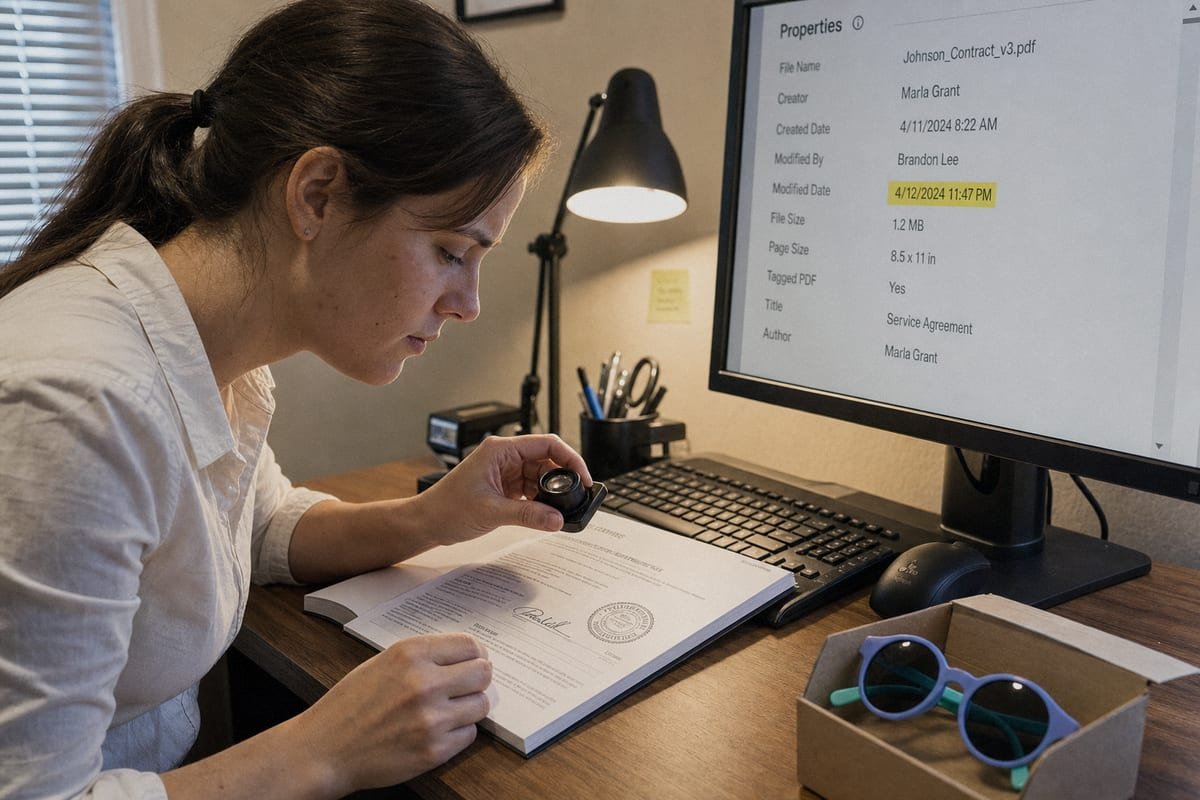
Most fraudulent documentation in our industry is not invented from scratch. It is a genuine report misused: swapped onto a different SKU, edited to change a model number, or stretched to cover a new production run with different materials. That is why relevance checks matter as much as authenticity checks.
The Most Common Red Flags, Ranked by Risk
| Drapeau rouge | Likely Meaning | Your Response |
|---|---|---|
| Report only available as JPG or screenshot | Possible editing to hide changes | Demand the original signed PDF |
| Lab cannot find the report number | Forged document or spoofed lab | Stop the order; escalate immediately |
| SKU or product photo mismatch | Report swapped from another product | Require testing on your exact model |
| Le demandeur est un tiers inconnu | Trader borrowing a factory's report | Ask for the chain of ownership in writing |
| Standards outdated or wrong market | Reused report from an old order | Require retesting to current standards |
| Fonts, dates, or logos inconsistent | Manual tampering in an editor | Check PDF metadata and digital signature |
| Report predates a material or color change | Results no longer represent the product | Request batch-relevant testing |
Why Component-Level Scope Is a Hidden Red Flag
Children's sunglasses contain more than lenses. Hinge screws, internal metal temple wires, coatings, and decorative parts all carry chemical risk. A generic lens-only report often omits these high-risk components. When we develop a new TPEE-temple style at our factory, the metal hinge screw goes into the chemical test scope 5 alongside the frame material, because that is exactly what CPSIA compliance and REACH regulation compliance 6 demand for children's products. If a supplier's report never mentions metal components, ask why. Also verify that the Children's Product Certificate, where required for the US market, traces back to the underlying third-party test report and matches your import batch.
Dois-je demander un nouveau test indépendant par une tierce partie avant de faire confiance à la documentation de sécurité d'un fournisseur ?
Price pressure creates a real trade-off here, and I weigh it with buyers constantly. Retesting a kids sunglasses style at an accredited lab costs a few hundred dollars. A recall, a customs seizure, or an injured child costs infinitely more.
Yes, for first orders, high-volume programs, or any verification doubt, commission independent retesting at a CPSC accredited laboratory. Pull samples from actual production, not supplier-provided "golden samples," and test against CPSIA, EN 71, ISO 12312-1, and impact requirements for your market.
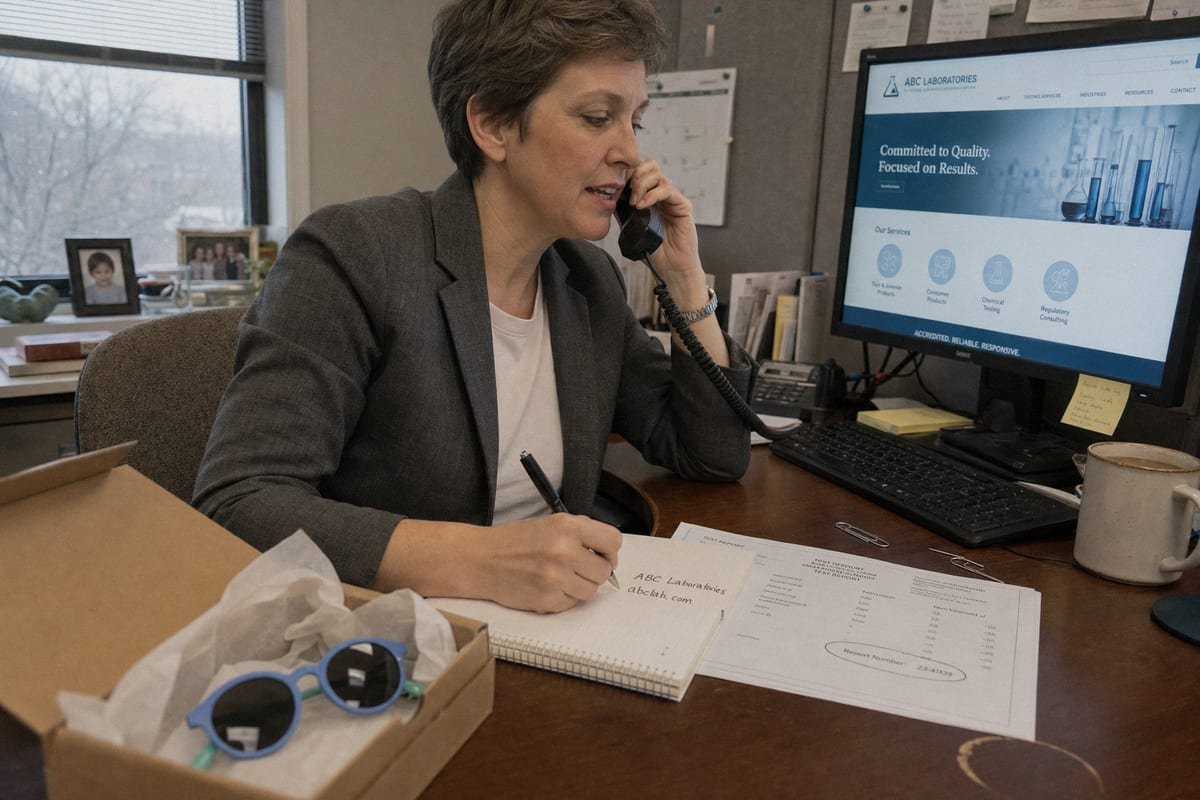
Retesting is not an insult to a good supplier. When our clients in Europe or Japan order their own SGS or Intertek certification testing on our frames, we welcome it. It shortens trust-building and gives both sides a shared, neutral reference. A supplier who resists independent testing is telling you something important.
When Retesting Is Worth the Cost
Not every order justifies a fresh lab invoice. Use a risk-based approach.
| Scénario | Retesting Recommendation |
|---|---|
| First order with a new supplier | Always retest core safety and optical parameters |
| Supplier report failed or stalled verification | Mandatory retest before any payment milestone |
| New colorway or material on an existing style | Retest chemical parameters like lead and phthalates |
| Repeat order, verified supplier, same batch materials | Rely on existing verified reports; spot-check periodically |
| Large program or private-label launch | Retest plus documented ongoing surveillance testing |
What Your Retest Should Cover
For the US, include CPSIA lead and phthalates testing 7, the FDA impact resistance test for lenses, and ANSI Z80.3 or ISO 12312-1 certification for optical performance and UV400 protection standards. For the EU, cover EN 71 safety testing where applicable, ISO 12312-1, and REACH regulation compliance for chemicals. Insist that the lab draws or receives sealed production samples, ideally selected during a pre-shipment inspection, so the tested units truly represent your goods.
Then build this into a repeatable process. Validate the first lot fully. Re-verify documents at every reorder. Schedule periodic retests annually or when anything changes. Verification is an ongoing workflow, not a one-time checkbox at onboarding.
Conclusion
Fake or misused test reports are a solvable risk. Verify the document, verify the lab, verify the product match, and retest when in doubt. That workflow protects children and your brand.
Notes de bas de page
1. Official site of Intertek, providing global testing and certification services for consumer goods and safety. ↩︎
2. Wikipedia overview of sunglasses, including safety standards and market requirements for global exports. ↩︎
3. Wikipedia overview of the Portable Document Format (PDF) and its capabilities for secure documentation. ↩︎
4. Official CPSC search tool for verifying if a laboratory is accredited for specific safety standards. ↩︎
5. Wikipedia overview of chemical analysis and testing scopes used to identify substances in consumer products. ↩︎
6. Official European Chemicals Agency guide on the REACH regulation for product safety and chemical compliance. ↩︎
7. Official CPSC overview of rules requiring third-party testing for children’s products, including lead and phthalates. ↩︎
Plus d'articles que vous pourriez aimer
1 août 2026
L'usine doit-elle gérer l'emballage et l'étiquetage des lunettes pour enfants, ou utiliser un fournisseur désigné ?

1 août 2026
Entrepôt propre vs. exécution directe par le fournisseur : lequel réduit les coûts de retour pour les marques de lunettes pour enfants ?

1 août 2026
Entrepôt direct au port ou staging outre-mer : lequel permet d'économiser le plus sur l'expédition des lunettes pour enfants ?
Vous recherchez un partenaire fiable en lunetterie pour enfants ?
Explorez plus de 800 styles prêts et un support OEM/ODM complet adapté à votre marque.
Contactez-nous English
  Español de México
  Deutsch
  Français
  日本語
日本語  العربية
  Português do Brasil