What Does CE Certification Test for Kids’ Sunglasses?
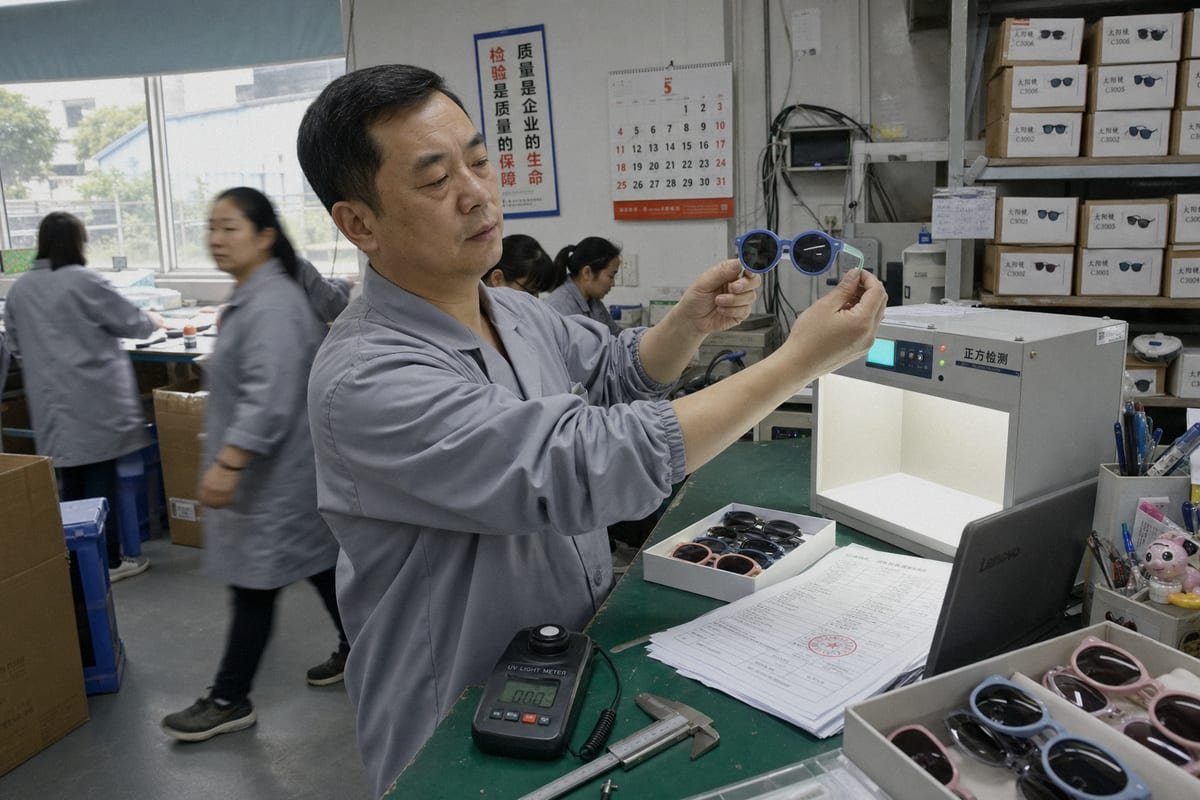
CE certification for kids’ sunglasses confuses many buyers I talk to refractive and prismatic power 1. They fear failed customs checks, recalls, and unhappy retailers. On our production line, we solve that fear before molding even starts.
CE certification tests kids’ sunglasses for UV transmittance, luminous transmittance by lens filter category, optical power requirements, impact resistance, frame durability, and material safety under EN ISO 12312-1 and the PPE Regulation 2016/425, plus correct labeling and technical documentation proving conformity.
That is the short answer. But each of those tests hides details that can make or break your product launch in Europe. Let me walk you through them one by one.
What Safety Standards Do I Need to Meet for CE Certification on Kids' Sunglasses?
During a recent project for a European baby brand, our QC team spent a full week aligning one pastel round frame with the EU rulebook before sampling. That week saved months later.
Kids' sunglasses sold in the EU must comply with the PPE Regulation 2016/425 as Category I personal protective equipment and meet the harmonized standard EN ISO 12312-1, which replaced EN 1836 and defines UV protection, transmittance, optical, and mechanical requirements.
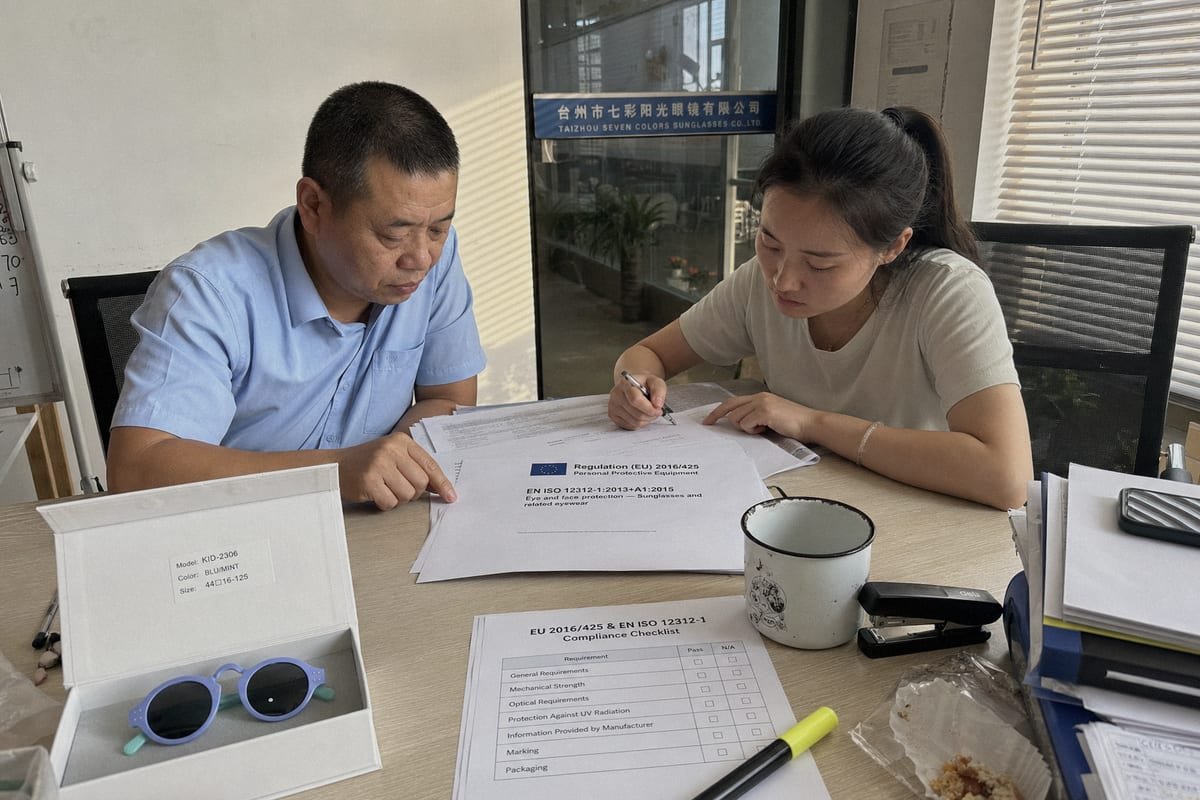
Many buyers assume CE is a single certificate you buy once. It is not. CE is a conformity marking. It states that the product meets every applicable EU requirement, and that the manufacturer holds documentation to prove it. For kids' sunglasses, two legal layers matter most.
The Regulation Layer: PPE Regulation 2016/425
Sunglasses protect the eyes from solar radiation. So the EU treats them as personal protective equipment, not as fashion accessories. Under the Règlement EPI 2016/425 2, sunglasses fall into Category I, the simplest risk class. That means self-declaration is allowed, but the manufacturer must still keep a full technical file and issue a Declaration of Conformity.
The Standard Layer: EN ISO 12312-1
EN ISO 12312-1 3 is the harmonized standard that gives the pass/fail numbers. It sets limits for UV transmittance 4, transmission lumineuse, refractive and prismatic power, robustness, and flammability. Older listings may still mention EN 1836. That standard is withdrawn, and testing today should reference EN ISO 12312-1.
The Material Layer: Chemical Safety
Frames touch a child's skin for hours. So REACH compliance applies too. Labs check for restricted substances like lead, cadmium, and phthalates, and run nickel release testing on any metal parts such as hinge screws.
| Legal Layer | Ce qu'elle couvre | Type of Requirement |
|---|---|---|
| Règlement EPI 2016/425 | Classification, CE marking, documentation | Legal framework |
| EN ISO 12312-1 | UV, transmittance, optics, mechanics | Performance testing |
| REACH / EN 71-3 references | Heavy metals, phthalates, nickel release | Sécurité chimique |
One more nuance from our export experience: never let a supplier certify kids' sunglasses as toys. Toy testing does not verify UV protection. Real sunglasses need the eyewear standard.
How Does CE Testing Check UV Protection and Lens Quality in Children's Eyewear?
The trade-off we weigh most often in lens sourcing is tint darkness versus true UV blocking. The two are not the same thing, and buyers mix them up constantly.
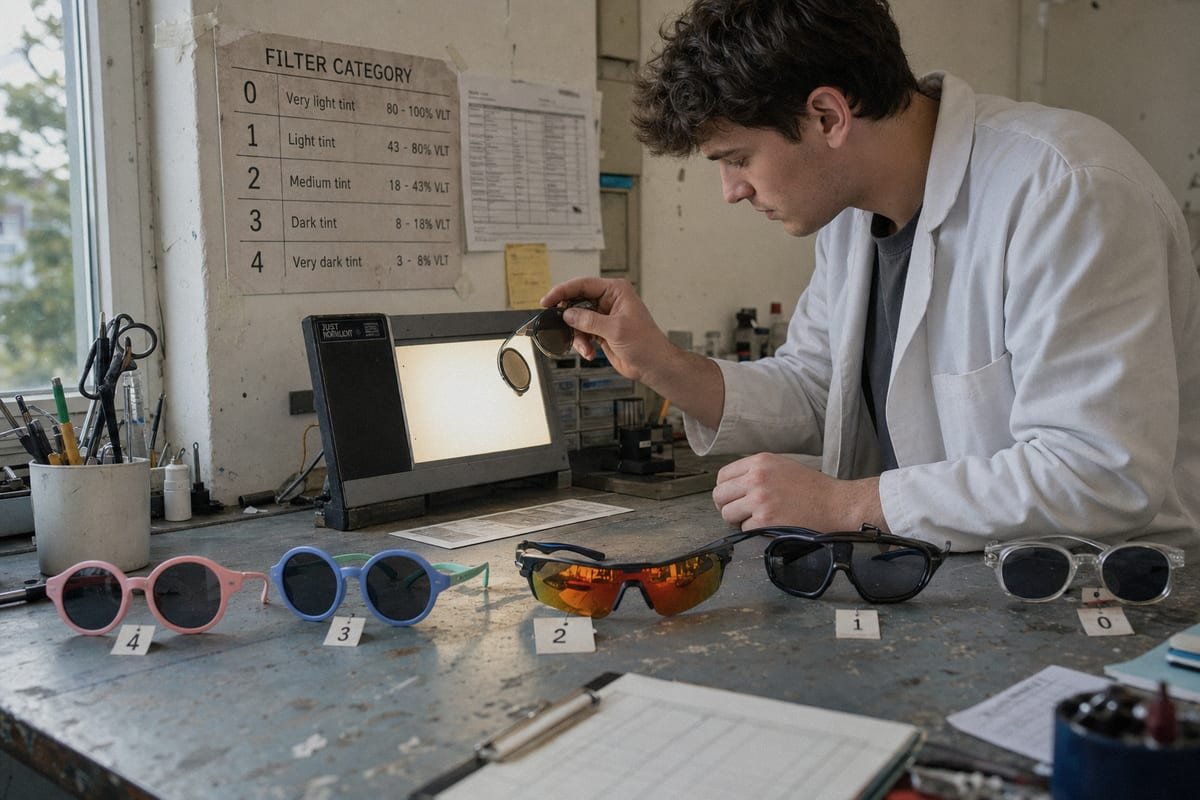
CE testing measures UV transmittance to confirm UV400 protection, classifies lenses by luminous transmittance into filter categories 0–4, verifies optical power requirements to prevent vision distortion, and checks impact resistance so lenses will not shatter dangerously on a child's face.
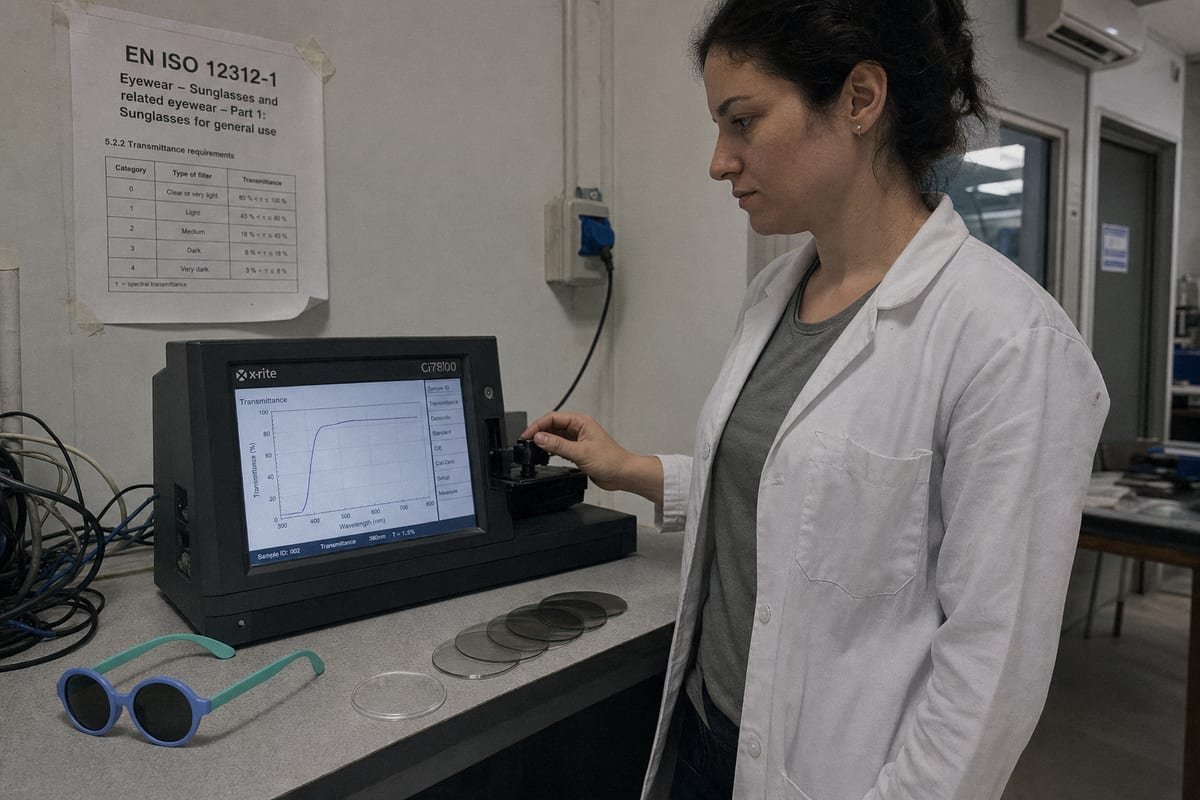
Let me break the lab work into four test families, in plain English.
UV Transmittance: The Test That Matters Most
The spectrophotometer measures how much ultraviolet light 5 passes through the lens. Children's ocular media are still developing, so more UV reaches their retina than an adult's. EN ISO 12312-1 sets strict UV limits. A lens marked UV400 blocks radiation up to 400 nm, covering both UVA and UVB. In our factory, we specify UV400 protection on every kids' lens, whether standard tinted or polarized, because it removes any ambiguity at the lab.
Luminous Transmittance: The Lens Filter Category System
Visible light transmission determines the lens filter category. Darkness controls glare comfort, not UV safety. A clear lens can block 100% UV. A very dark lens can block none.
| Catégorie de filtre | Lumière visible transmise | Utilisation typique pour les enfants |
|---|---|---|
| 0 | 80–100% | Fashion, indoor, overcast |
| 1 | 43–80% | Light sun |
| 2 | 18–43% | Medium sunlight |
| 3 | 8–18% | Soleil intense, plage, la plupart des lunettes de soleil pour enfants |
| 4 | 3–8% | High mountains and glare; never for driving |
Most children's sunglasses we produce are category 3. Category 4 is rarely appropriate for everyday kids' products.
Optical Quality and Refractive Accuracy
Labs check spherical, cylindrical, and prismatic power. A cheap lens with distortion can cause headaches and eye strain in children. The optical power requirements ensure the lens behaves like a true plano lens with no unintended prescription effect.
Mechanical Strength and Robustness
Kids drop, sit on, and throw their sunglasses. The standard includes robustness testing, et la résistance aux chocs 6 matters even more for sport styles like our wraparound shield designs. Lenses must not break into sharp fragments. Flexible frames also help here, which is one reason we build with TPEE and TR90.
What Documents Should My Supplier Provide to Prove CE Compliance?
A procurement manager from Australia once asked me for "the CE certificate" and expected one sheet of paper. What we sent her was a complete documentation package instead.
A compliant supplier should provide a Declaration of Conformity, third-party test reports against EN ISO 12312-1, chemical test reports covering REACH compliance and nickel release, technical file access, and correct product labeling showing the CE mark and lens filter category.
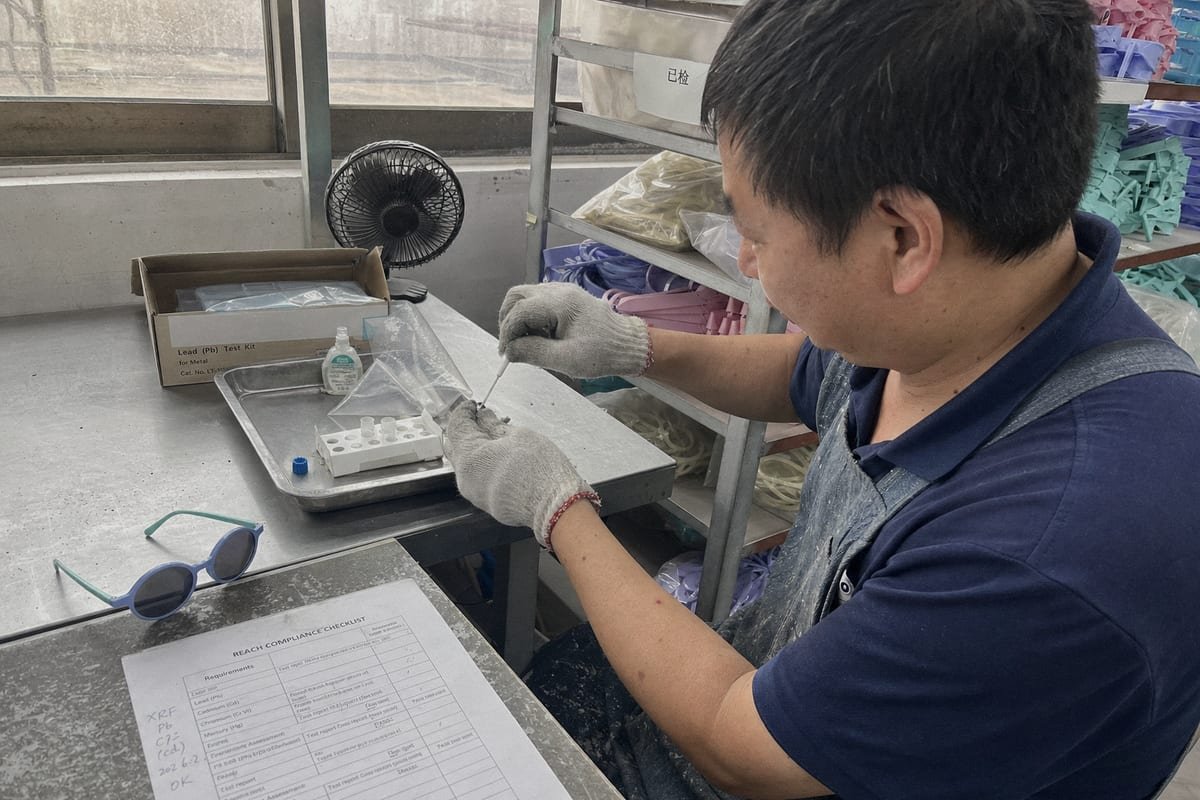
Documentation is where weak suppliers get exposed. Anyone can print a CE logo on a temple arm. Only a genuine factory can back it with a paper trail. Here is what you should request, and what each document actually proves.
| Document | Ce qu'il prouve | Signal d'alarme si absent |
|---|---|---|
| Déclaration de conformité (DoC) | Legal statement that the product meets PPE Regulation 2016/425 | Supplier may not understand EU law at all |
| EN ISO 12312-1 test report | UV, transmittance, optical, and robustness performance | UV claims are unverified marketing |
| REACH / heavy metals report | No restricted lead, cadmium, phthalates | Material safety unknown for skin contact |
| Nickel release testing report | Metal parts safe for prolonged skin contact | Allergy risk from hinges and screws |
| Labeling and user information | Filter category, care notes, CE mark shown | Product may be rejected at retail or customs |
How to Verify the Reports Are Real
Check three things quickly. First, the lab name: reports should come from a recognized third-party laboratory. Second, the product description: the report must match your actual style, lens type, and materials, not a "similar" model. Third, the date: materials change, so a five-year-old report on a different colorway proves little.
Batch-Level Traceability Is Coming
The market is moving toward batch-level transparency, including QR-coded digital product passports that let parents verify test data for their specific production run. In our export practice, we already keep batch records tied to incoming lens and material inspections, because European buyers increasingly ask for that traceability. If your brand plans to grow in the EU, choose a partner whose documentation habits are already ahead of the curve, not one who scrambles after each order.
Why Should I Choose a Manufacturer That Already Has CE-Certified Kids' Sunglasses Styles?
Fifteen years of building children's eyewear taught our team one hard lesson: compliance designed in from the first mold costs far less than compliance patched on afterward.
A manufacturer with existing CE-certified kids' sunglasses styles removes mold investment, shortens testing timelines, reduces the risk of failed lab results, and lets your brand launch in Europe faster with proven UV400 lenses, compliant materials, and documentation already in place.
Think about what a from-scratch project really involves. New tooling. New material sourcing. First-round lab testing with no guarantee of passing. If the lens fails luminous transmittance limits, or a hinge screw fails nickel release testing, you redesign and retest. Every loop adds weeks and cost. That is why starting from a proven style base changes the economics for new brands and importers.
The Practical Advantages, Step by Step
- No heavy mold investment. Our catalog holds roughly 800 existing styles, from soft pastel rounds for toddlers to sporty wraparound shields with mirrored lenses. You pick a base and customize colors, logos, lenses, and packaging.
- Faster, lower-risk testing. When the frame material, TPEE or TR90, has already passed chemical screening, and the lens supplier already delivers UV400 protection, your batch testing becomes confirmation rather than gambling.
- Design maturity you cannot see on a spec sheet. Frame durability, hinge fatigue over thousands of open-close cycles, and vertical lens coverage for a child's upward gaze are all refined through years of production feedback.
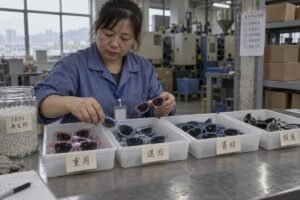
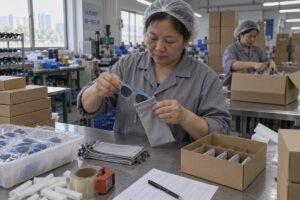
- Consistent quality control. Our 5S-managed workshop and roughly 120 workers run incoming inspection on every lens batch, so the transmittance you tested is the transmittance you ship.
- Présentation prête pour la vente au détail. Full OEM/ODM support means compliant labeling, filter category marking, and branded packaging arrive done, not as your problem to solve.
A Real Trade-Off to Consider
Existing styles limit total design freedom compared with fully custom tooling. But for a brand testing the European market, the wiser sequence is usually this: launch with certified existing styles, learn what sells, then invest in custom molds for proven winners. We have watched buyers from more than 20 countries follow that path successfully, and it protects both their budget and their timeline.
Conclusion
CE certification tests kids' sunglasses for real protection: UV400 blocking, correct filter categories, optical accuracy, impact resistance, and safe materials. Partner with a factory that proves all of it on paper.
Notes de bas de page
1. Explains the optical properties and power measurements of lenses. ↩︎
2. Official EU regulation defining safety requirements for personal protective equipment like sunglasses. ↩︎
3. Official ISO standard page verifies the harmonized eyewear safety requirements cited. ↩︎
4. Technical explanation of how lenses filter UV radiation to protect eyes. ↩︎
5. NASA’s scientific overview of ultraviolet radiation and its properties. ↩︎
6. US Federal regulation regarding impact-resistant lenses in eyeglasses and sunglasses. ↩︎
7. Scientific definition of transmittance and its application to light-filtering materials. ↩︎
Plus d'articles que vous pourriez aimer

Vous recherchez un partenaire fiable en lunetterie pour enfants ?
Explorez plus de 800 styles prêts et un support OEM/ODM complet adapté à votre marque.
Contactez-nous English
  Español de México
  Deutsch
  Français
  日本語
日本語  العربية
  Português do Brasil