Does Exporting Kids’ Sunglasses to the US Require FDA Approval?
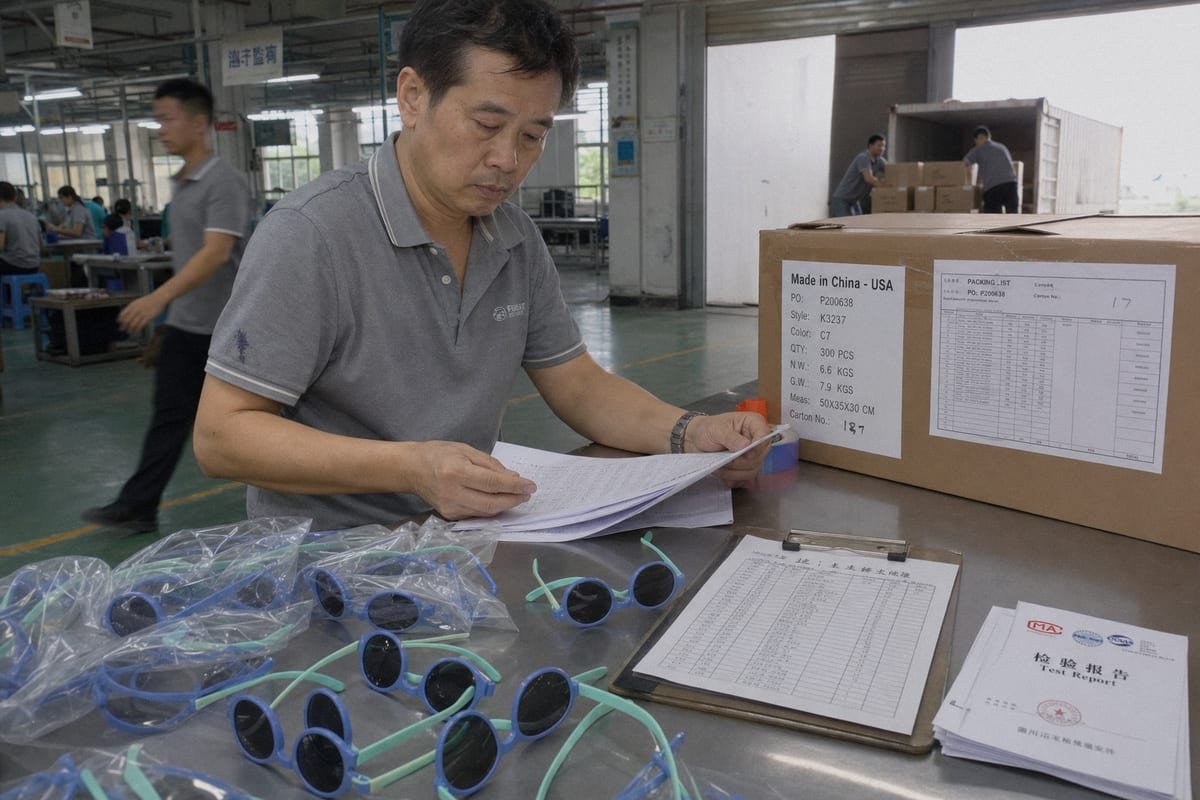
Exporting kids’ sunglasses to the US worries many buyers who ask us about “FDA approval.” One missing document can freeze a shipment at customs. Our export team faces this question weekly.
Kids’ sunglasses exported to the US do not require FDA premarket approval or 510(k) clearance. However, they must comply with FDA rules: establishment registration, device listing, and impact-resistance certification under 21 CFR 801.410, plus CPSIA children’s product requirements enforced by the CPSC.
That short answer hides a lot of detail. Let me walk you through what compliance actually looks like, step by step, from the factory floor to US customs clearance.
What FDA and Impact Resistance Standards Apply to Kids' Sunglasses in the US?
A buyer from a baby-product brand once asked me why sunglasses need FDA oversight at all. The answer surprised her: the FDA treats sunglasses as medical devices.
The FDA classifies all sunglasses, including children's styles, as Class I medical devices because they mitigate UV radiation. They are 510(k)-exempt, but lenses must pass the impact resistance test under 21 CFR 801.410, and voluntary ANSI Z80.3 standards cover UV transmittance and optical quality.
The medical device classification catches many exporters off guard. Sunglasses are not fashion accessories in the eyes of US regulators. They are devices intended to protect the eyes from harmful light. That intent is what triggers FDA jurisdiction. The good news is that Class I medical devices 1 face the lightest regulatory burden. There is no premarket review, no clinical data, and no approval letter. What remains are the "general controls" and one very specific rule about lenses.
The Core Rule: 21 CFR 801.410
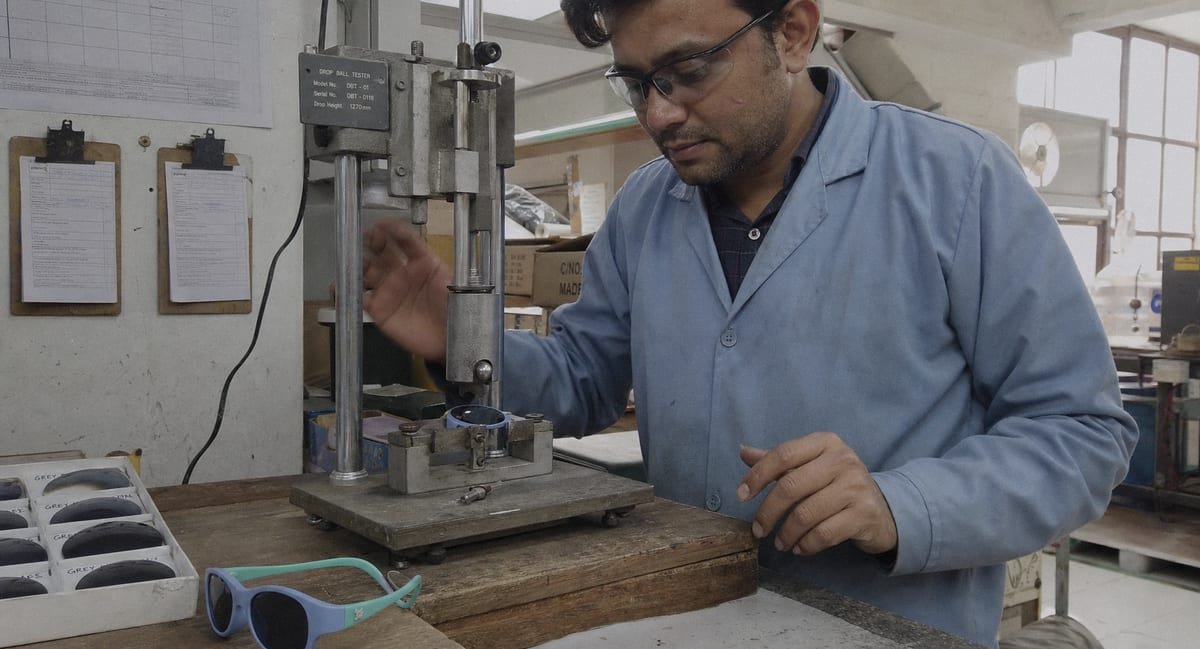
This regulation requires that all sunglass lenses 2 sold in the US be impact resistant. The standard method is the drop ball test. A 5/8-inch steel ball is dropped from a height of 50 inches onto the lens. The lens must not fracture. FDA guidance states clearly that children's sunglasses 3 are subject to this requirement. There is no exemption for small sizes or toy-like designs with UV claims.
When our factory produces UV400 lenses for children's frames, we run this impact resistance test on samples from each batch before export. Statistical batch testing is permitted for non-prescription lenses, which keeps the process practical for volume production.
How the Standards Fit Together
| Standard | Type | What It Covers | Mandatory? |
|---|---|---|---|
| 21 CFR 801.410 | FDA regulation | Lens impact resistance (drop ball test) | Yes |
| ANSI Z80.3 | Industry standard | UV transmittance, optical quality, labeling categories | Voluntary, but expected by retailers |
| 16 CFR 1500/1501 | CPSC rules | Small parts, hazardous substances for children | Yes, for kids' products |
| CPSIA | Federal law | Lead and phthalates testing, tracking labels | Yes, for kids' products |
Notice the pattern. FDA covers the lens as a device. CPSC and CPSIA cover the product as a children's item. Kids' sunglasses live under both regimes at once, which is why I call them a dual-compliance product.
Do I Need FDA Registration or Just Compliant Lens Testing Before I Import?
Confusion between "registration" and "testing" comes up in almost every first call with a new US importer. In our experience exporting to 20+ countries, the US system rewards those who understand both.
You need both. The manufacturing facility must complete FDA establishment registration and device listing, with foreign factories appointing a US Agent. Separately, every lens batch needs drop ball test certification under 21 CFR 801.410. Registration alone, or testing alone, is not enough for smooth entry.
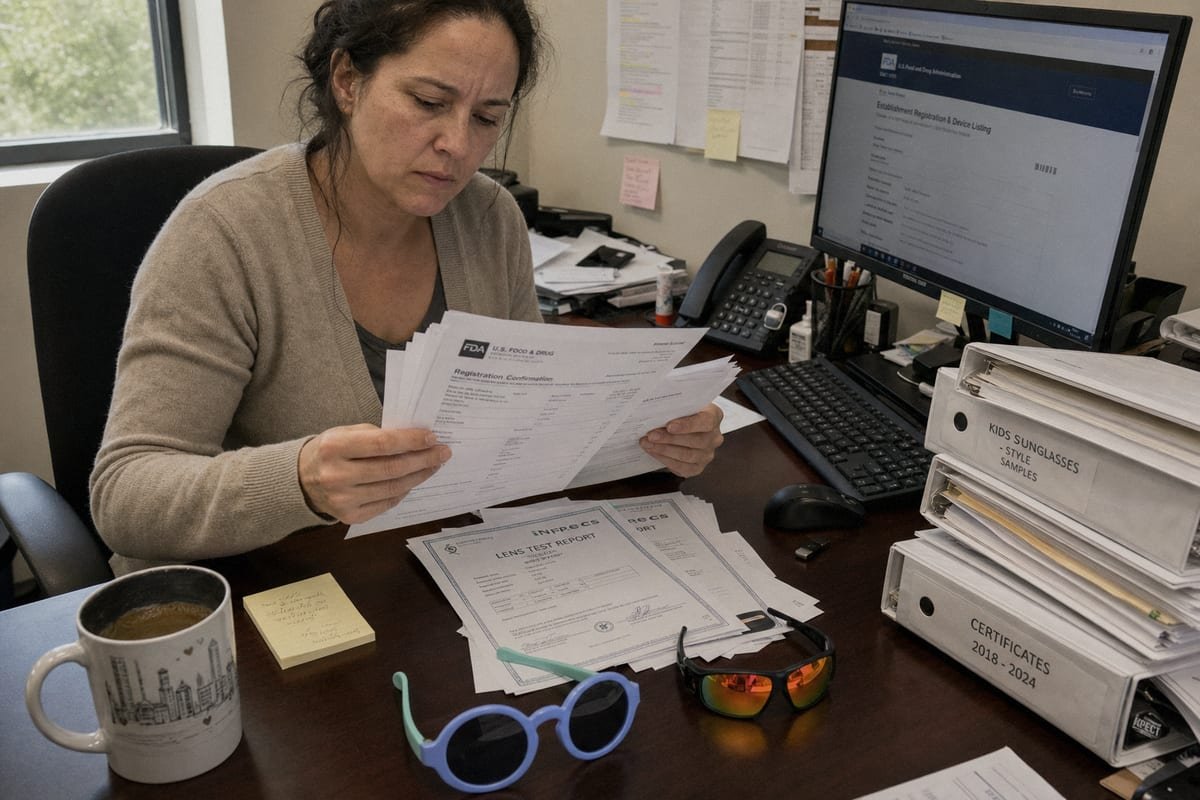
These are two different obligations that answer two different questions. Registration tells the FDA who you are and where you make devices. Testing proves the product itself is safe. Customs and FDA reviewers can check either one when your shipment arrives.
What Registration and Listing Involve
Device registration and listing is an administrative process, not a quality judgment. The foreign manufacturer registers its establishment in the FDA database 4, pays the annual fee, lists the sunglasses under the correct product code, and names a US Agent who lives in the United States. The US Agent is the FDA's official contact point for that foreign facility. Some importers must also register, depending on their role in the supply chain.
One important point I always stress: registration is not approval. The FDA itself says that registration does not mean a product is "FDA approved," and using that phrase on packaging or marketing can itself create a labeling violation.
The Difference at a Glance
| Term | What It Actually Means | Applies to Kids' Sunglasses? |
|---|---|---|
| FDA approval | Premarket approval for high-risk devices | No |
| 510(k) clearance | Premarket notification for moderate-risk devices | No, sunglasses are exempt |
| FDA establishment registration | Facility registers annually with the FDA | Yes |
| Device listing | Product is listed in the FDA database | Yes |
| Drop ball test certification | Lens impact testing documented per shipment | Yes |
So the practical sequence before you import is simple. First, confirm your factory holds current registration and listing. Second, confirm the lenses have passed the impact resistance test and that certification travels with the shipment. Third, keep both records accessible, because a missing piece on either side can trigger a hold. Manufacturers with a history of missing impact documentation can even end up on Import Alert 86-07 5, which lets customs detain future shipments automatically without physical inspection. That is a costly place to be, and it is entirely avoidable.
What Documents and Test Reports Should My Manufacturer Provide for US Customs Clearance?
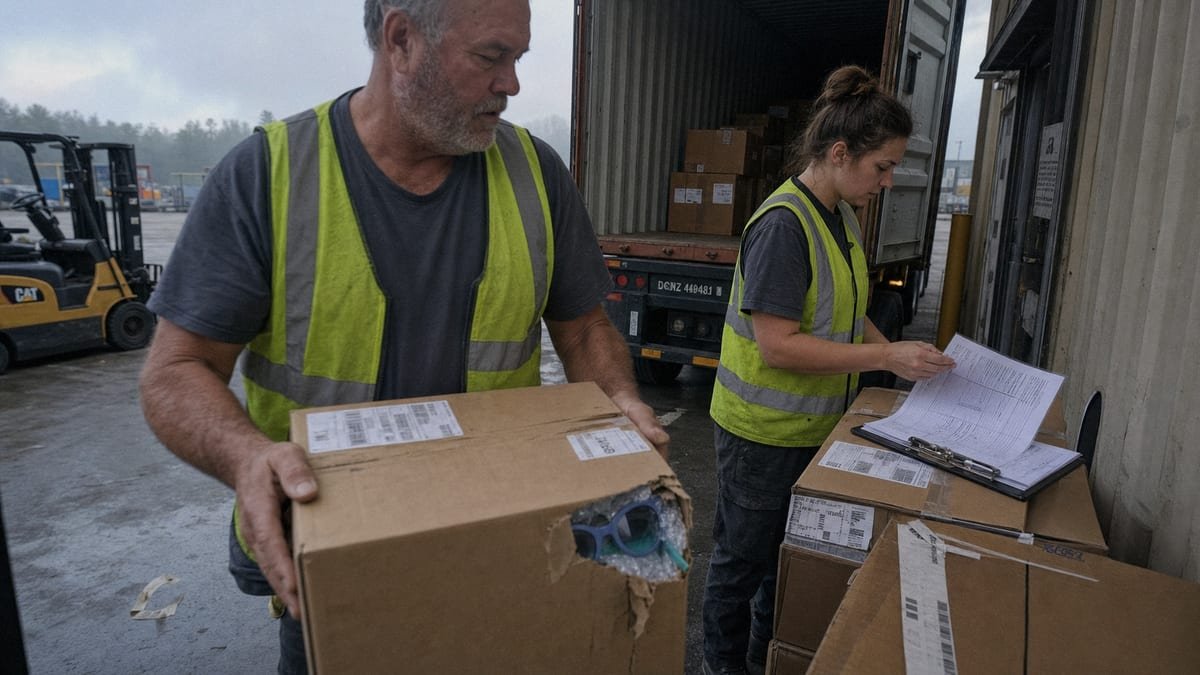
A few years ago, a first-time importer asked us for "the FDA certificate." There is no such single document. What exists is a document package, and we prepare it for every US-bound order.
Your manufacturer should provide a drop ball test certification per 21 CFR 801.410, proof of FDA establishment registration and device listing, third-party CPSIA test reports for lead and phthalates, and the data needed for your Children's Product Certificate, plus commercial invoices with accurate product descriptions.
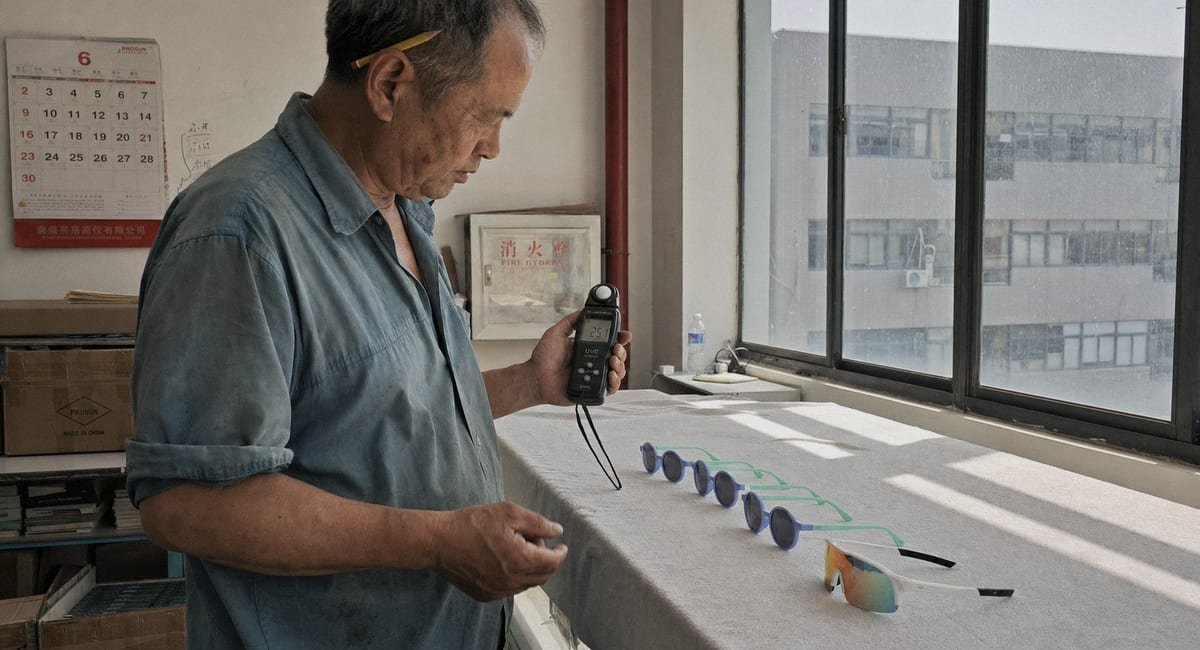
Think of the paperwork as three stacks: FDA documents, CPSC documents, and standard trade documents. Each stack answers a different regulator, and US Customs and Border Protection can ask about any of them at entry. Meeting US Customs import requirements is much easier when the stacks are prepared before the goods ship, not after a detention notice arrives.
The Complete Document Checklist
| Document | Issued By | Purpose |
|---|---|---|
| Impact resistance (drop ball) certification | Foreign manufacturer | Proves lenses meet 21 CFR 801.410 |
| FDA registration and listing confirmation | Manufacturer via FDA database | Verifies facility and product are on file |
| US Agent designation | Manufacturer | Names the FDA contact in the US |
| Third-party lab reports | CPSC-accepted laboratory | Lead and phthalates testing for children's products |
| Children's Product Certificate CPC | US importer of record | Certifies compliance with all applicable CPSC rules |
| Tracking label details | Manufacturer | CPSIA traceability on product or packaging |
| Commercial invoice and packing list | Manufacturer/exporter | Standard customs entry documents |
Who Issues What
Note the division of labor. The foreign factory tests the lenses before export and includes the impact resistance certification with the shipment, exactly as FDA guidance describes. The accredited third-party lab handles CPSIA compliance testing 6 on samples of the finished product. But the Children's Product Certificate CPC is issued by the importer of record, based on those lab reports. We supply the test data; our customers issue the CPC. Also keep an eye on the CPSC's eFiling initiative, which will require certificate data to be submitted electronically through the CBP system 7 at the time of entry. Buyers who organize their data now will find that transition painless.
One more warning from experience: any material change in production, such as a new paint supplier or a different plastic resin, legally triggers new third-party testing and a revised CPC. Tell your factory to notify you of any such change.
How Can I Choose a Factory That Already Understands US Safety Requirements for Children's Eyewear?
The hardest lesson I have learned in fifteen years of eyewear production is this: compliance problems are usually supplier-selection problems in disguise. The right factory prevents them before they exist.
Choose a factory with current FDA establishment registration, in-house drop ball testing, documented CPSIA experience, and child-safe materials like TPEE and TR90. Ask for sample impact-resistance certificates, third-party lab reports from past orders, and evidence of consistent quality control before committing.
Price lists tell you nothing about compliance capability. Questions do. When buyers visit our Taizhou workshop, the ones who end up with trouble-free US launches are the ones who ask about testing routines, material traceability, and documentation before they ever ask about unit cost.
Questions That Reveal Real Capability
- Is your facility currently registered with the FDA, and who is your US Agent? A capable factory answers in one email, with its registration details.
- How do you perform the impact resistance test? You want to hear about in-house drop ball equipment and batch sampling, not a vague promise to "send to a lab if needed."
- Can you share redacted CPSIA lab reports from previous children's orders? Past reports prove the factory has actually navigated lead and phthalates testing, small-parts rules, and tracking labels.
- What materials do you use for kids' frames? Flexible, environmentally friendly materials matter here. We build most children's frames in TR90 with TPEE temples because they bend instead of snapping, which reduces both injury risk and breakage claims.
- How do you handle material changes? A compliant factory notifies you before switching resins or coatings, because it knows a material change invalidates existing test reports.
Why Existing Styles Lower Your Compliance Risk
There is a practical shortcut many new brands overlook. Starting from a factory's existing catalog, rather than a fresh mold, means the construction has already been produced, tested, and shipped. Our roughly 800 existing styles let brands launch with lower mold investment and adapt colors, lenses, logos, and packaging through OEM/ODM customization while keeping a proven, tested base design. Whether the product is a pastel round frame for toddlers or a sporty wraparound shield with mirrored lenses for older kids, the compliance pathway stays the same: registered facility, certified lenses, tested materials, complete paperwork. A factory that treats that pathway as routine, not as a special request, is the partner you want for the US market.
Conclusion
No FDA approval is needed, but FDA compliance is. Registration, drop ball certification, and CPSIA documents keep kids' sunglasses moving through US customs. Choose a factory that handles this daily.
Footnotes
1. Official FDA page explaining the classification of medical devices into Class I, II, and III. ↩︎
2. Official 21 CFR 801.410 regulation text detailing the impact resistance requirements for sunglass lenses. ↩︎
3. General overview of sunglasses, including their function as protective eyewear against ultraviolet radiation. ↩︎
4. Official FDA database for searching and verifying medical device establishment registrations and product listings. ↩︎
5. Official FDA import alert regarding the detention without physical examination of non-compliant impact-resistant lenses. ↩︎
6. Official CPSC resource explaining the Consumer Product Safety Improvement Act and its requirements for children’s products. ↩︎
7. Official CBP page for the Automated Commercial Environment system used for electronic import data submission. ↩︎
More Articles You Might Like
Looking for a Reliable Kids Eyewear Partner?
Explore 800+ ready styles and full OEM/ODM support tailored to your brand.
Get in Touch English
  Español de México
  Deutsch
  Français
  日本語
日本語  العربية
  Português do Brasil