What Is the Ideal Weight for TPEE Kids’ Sunglasses to Boost Wearability?
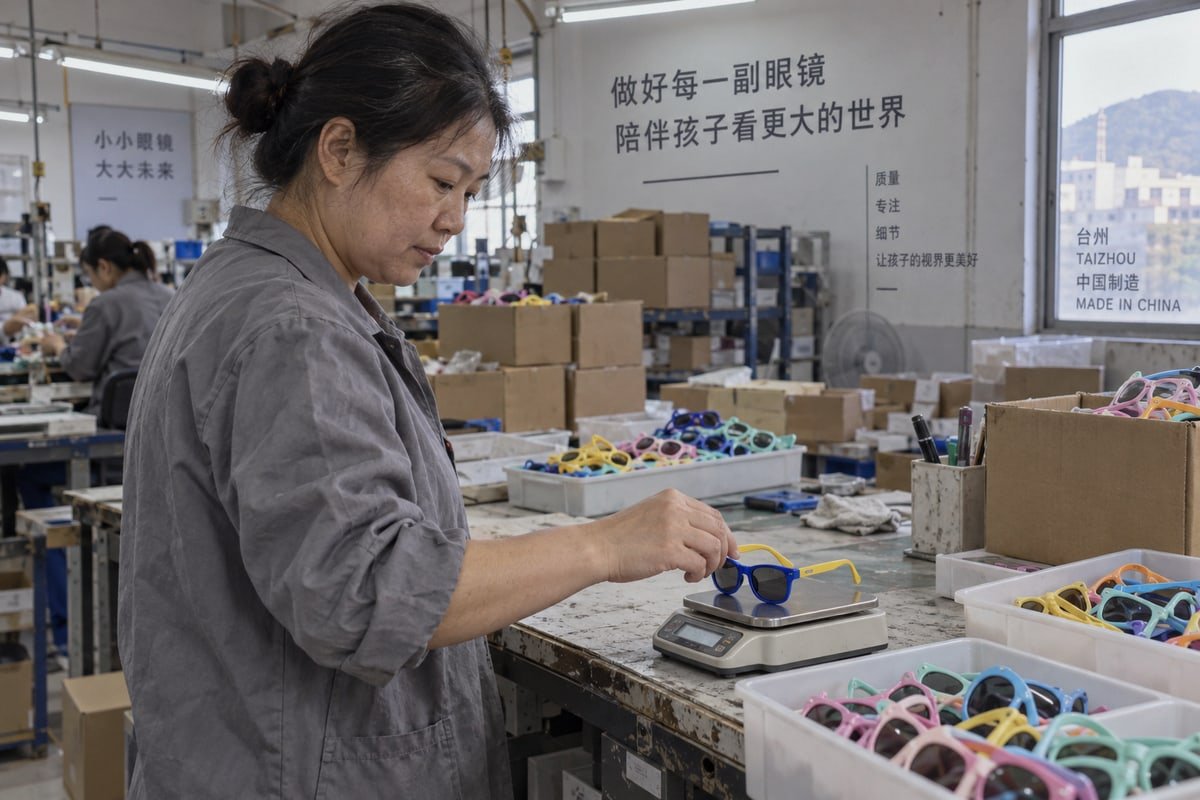
Buyers often ask me about the ideal weight for TPEE kids’ sunglasses. On our production line in Taizhou, we see one hard truth: kids simply rip off heavy frames.
The ideal weight for TPEE kids’ sunglasses is 8–14 grams for toddlers and under 20 grams for most children, with 20–22 grams acceptable for sport styles. Frames in this range reduce nose and ear pressure, so children keep their sunglasses on far longer.
That answer gives you the numbers. But weight is only half the story. Below, I will break down how weight, fit, and durability work together, based on what we build every day.
How Do I Know If My Kids' Sunglasses Are Too Heavy for Comfort?
During a fitting session with a distributor's sample group last spring, one detail stood out to me: every child who removed their glasses within five minutes was wearing a frame over 25 grams.
Kids' sunglasses are too heavy when they leave red marks on the nose bridge, slide down during play, or get removed within minutes. Any children's frame above roughly 22–25 grams typically causes visible pressure points, ear fatigue, and frequent rejection by the child.
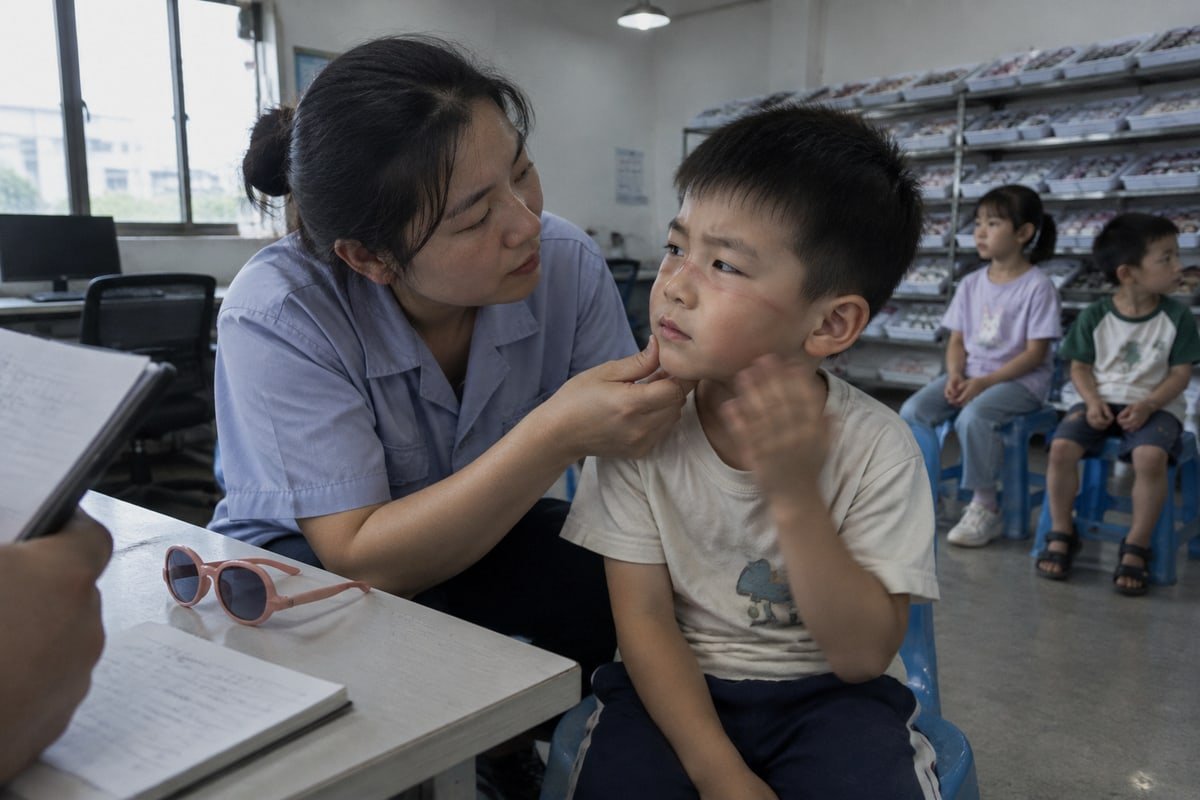
Weight-related discomfort is the leading cause of kids frequently removing their eyewear. That is not a marketing line. It is what we hear from brand buyers in Australia, Japan, and Europe again and again. A child cannot articulate "this frame has poor weight distribution." They just take the glasses off. So you, as the buyer, need to read the physical signs instead.
The Three Warning Signs We Check First
In our QC room, we run every new sample through a simple comfort review. Here is what we look for, and what you should look for too.
| Signo de advertencia | Lo que significa | Causa probable |
|---|---|---|
| Red marks on the nose bridge | Too much weight concentrated on soft cartilage | Heavy front frame or poor ergonomic bridge design 1 |
| Frames sliding down when running | The "lever effect" pulling lenses forward | Center of gravity too far forward |
| Child removes glasses within 5–10 minutes | Sensory rejection of a foreign object | Total weight above the comfort band |
The lever effect deserves special attention. When lens weight sits too far forward, the frame pivots on the nose like a seesaw. Every step the child takes makes the frame bounce. That bouncing increases perceived weight, even if the actual grams are moderate. This is why wearability is optimized when the center of gravity shifts toward the mid-temple. TPEE's density lets us mold slightly weighted temple tips that counterbalance the lenses and stop the seesaw motion.
There is one more nuance I want to raise honestly. Some buyers assume a very light frame is automatically comfortable. It is not. If an ultra-light frame is too loose or too wide, it slides constantly, and the child fusses with it just as much as with a heavy pair. Weight alone does not guarantee compliance. Weight plus secure fit does.
What Weight Range Should I Look for When Sourcing TPEE Frames?
A procurement manager from a European baby brand once sent me a spec sheet asking for "the lightest frame possible." I pushed back, because the right question is not "how light," but "how light for which age group."
Source TPEE frames at 8–14 grams for babies and toddlers, under 20 grams for general kids' styles, and 20–22 grams for sport-oriented designs. Standard TPEE kids' sunglasses on the market typically land between 10 and 18 grams, confirming this comfort band.
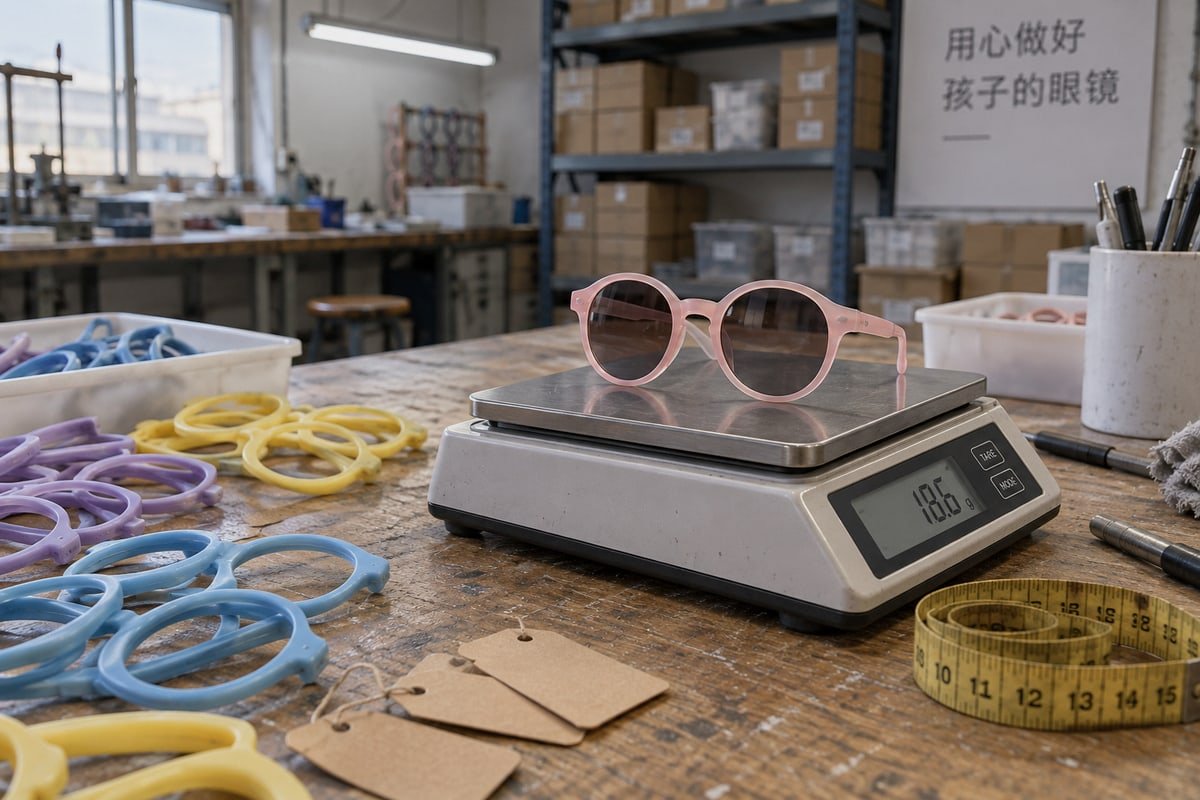
The market has already converged on these numbers. Real-world TPEE product listings commonly weigh in at 14 g, 18.3 g, and 18.8 g. Material comparisons put the TPEE average at 8–14 g and call that an excellent comfort range for children. Consumer guides repeat that anything under 20 grams feels barely noticeable on a child's face. When we develop new styles from our library of roughly 800 existing designs, we hold ourselves to these same targets.
Age-Based Weight Targets
Here is the sourcing table I share with new B2B clients before they pick styles.
| Grupo de edad | Peso objetivo | Why This Range |
|---|---|---|
| Under 3 years (toddlers/babies) | 8–12 g | Below 12 g is the sensory invisibility threshold where the child stops noticing the frame |
| 3–7 years (general wear) | 12–18 g | Balances comfort with slightly larger lenses and sturdier temples |
| 7–12 years (everyday) | Under 20 g | The widely accepted lightweight benchmark for kids' eyewear |
| Active/sport styles | 20–22 g | Acceptable when the frame has strong wrap, grip, and temple contact |
The toddler threshold matters most for habit-forming. For children under age three, keeping total weight below 12 grams is the point where the frame stops registering as a foreign or intrusive object. Once a toddler forgets the glasses are there, wearing them becomes a habit rather than a battle. That is the single strongest argument for lightweight construction in your product line.
One caution on the upper end. A 21–22 gram sport frame can absolutely work for all-day wear, but only if the fit is excellent. Do not accept that weight in a loose, flat-fitting casual style. Weight tolerance rises only when grip rises with it.
How Does TPEE Material Help Me Achieve a Lighter, Safer Fit?
Fifteen years of eyewear work has taught our team that material choice decides comfort before design ever does. That is why we built our children's range around Elastómero de poliéster termoplástico 2 in the first place.
TPEE, or Thermoplastic Polyester Elastomer, achieves a lighter, safer fit through low density, soft-touch elasticity, and high impact resistance. It grips small faces without pressure, flexes instead of snapping, self-adjusts to head shape, and supports BPA-free, hypoallergenic construction for sensitive skin.
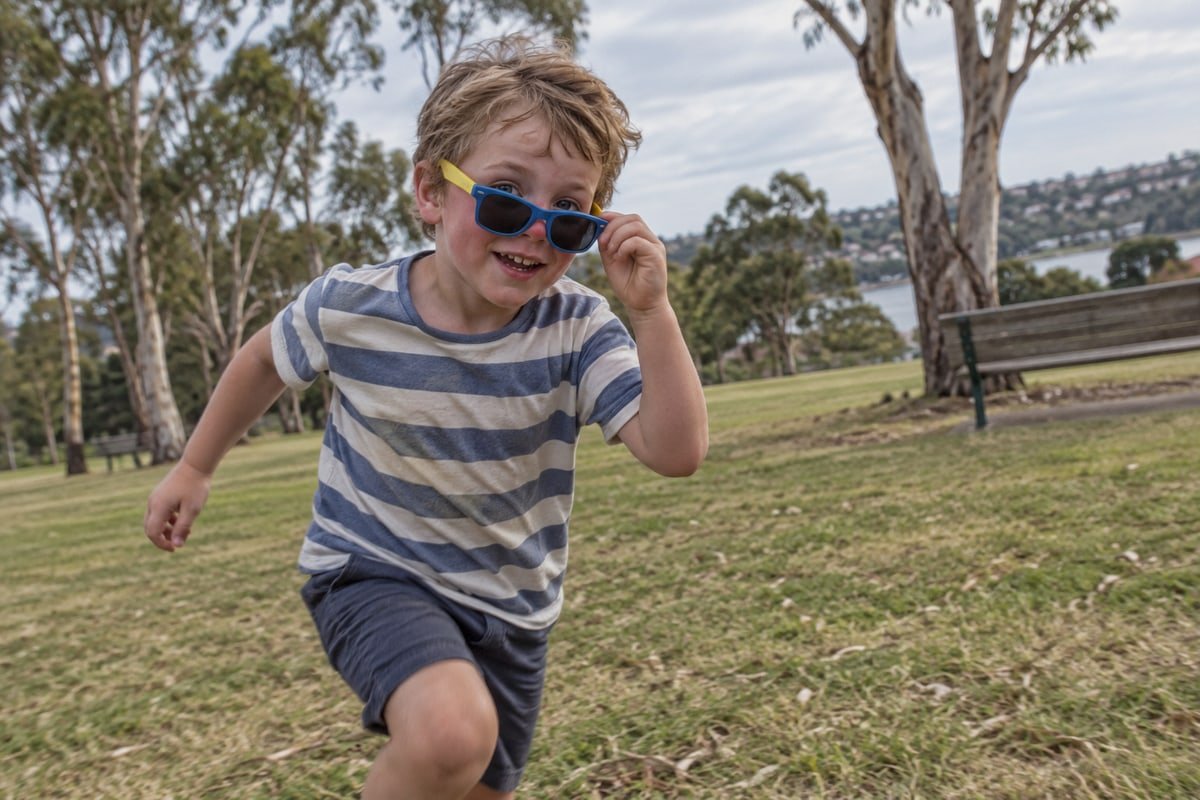
Let me unpack why this material earns its place in toddler eyewear safety discussions. TPEE is an elastomer, which means it behaves partly like rubber and partly like rigid plastic. That dual character solves several problems at once.
Grip Without Pressure
Toddlers often have flat or underdeveloped nose bridges. Hard plastic frames slide right off them. TPEE's soft-touch surface creates natural high-friction grip, so even a very light frame stays put without squeezing. Combined with an ergonomic bridge design, the result is a genuinely pressure-free fit. In our sampling process, we test this by having frames sit on silicone head forms at multiple angles, then adjusting the bridge curve until contact is even.
Even Weight Distribution
TPEE's inherent flexibility lets the frame self-adjust to the child's head shape. Instead of pressing on two points behind the ears, the temples distribute weight along the temporal bone. Our engineers can also mold ultra-thin temple arms, because TPEE's high strength-to-weight ratio does not require bulk for strength. Thinner temples mean less ear fatigue and less skin irritation during long outdoor play.
Safety Under Impact
Kids fall. Frames get sat on, stepped on, and thrown. TPEE's molecular structure acts as a mechanical dampener, absorbing impact rather than transferring it to the child's face. It also reduces the jarring bounce of frames during running, which lowers perceived weight even when actual grams stay the same. Pair the frame with shatterproof lens technology, specifically policarbonato 3 with UV400 protection, and you have the industry benchmark: a fully impact-resistant pair under 20 grams total.
There is one more practical benefit buyers rarely think about. TPEE's low thermal mass means the frame never feels hot, heavy, or sticky in humid summer weather. For brands selling into warm climates, that removes a real psychological barrier to all-day wear. And because the material is environmentally friendly and supports BPA-free construction with hypoallergenic materials, it satisfies the safety documentation 4 that baby brands in Europe and Japan demand.
I should be fair here. TR90 is also lightweight and comfortable, and we produce plenty of TR90 kids' optical frames ourselves, often with TPEE temples for extra softness. TPEE is not uniquely superior on grams alone. Its edge is softness and grip on the smallest faces, which is why we position pure TPEE for babies and toddlers, and TR90 or hybrid constructions for older kids.
Can I Balance Lightweight Design With Durability in My Product Line?
The trade-off we weigh most often in development is simple: every gram we remove has to come from somewhere, and it must never come from structural integrity or lens retention.
Yes, you can balance lightweight design with durability by using flexible elastomer frames, polycarbonate lenses, reinforced hinge zones, and one-piece molded construction. TPEE frames flex under stress instead of cracking, so an 8–20 gram frame can still survive twisting, drops, and daily play.
A common buyer objection goes like this: "If the frame is that light, won't it break faster?" It is a fair worry, and with brittle materials it would be true. Extremely minimal designs in rigid plastics can sacrifice lens retention and fit stability. But flexible frame durability works on a different principle. TPEE does not resist force by being thick. It resists force by bending and returning to shape. A toddler can twist one of our TPEE frames into a spiral, and it springs back. A thick, heavy acetate frame subjected to the same twist would snap at the hinge.
Where the Grams Should Come From
When we help brands trim weight without weakening the product, we focus on specific zones. This is the framework we apply.
| Design Element | Lightweight Approach | Durability Safeguard |
|---|---|---|
| Lentes | Polycarbonate, the lightest shatterproof option | 100% impact resistance with UV400 protection built in |
| Varillas | Ultra-thin TPEE arms | High strength-to-weight ratio prevents snapping |
| Bisagras | Simplified or hinge-free flex designs | Reinforced molding at stress points |
| Frente de la montura | Slim rims, one-piece molding | Deep lens grooves for secure lens retention |
How We Verify It Before Shipment
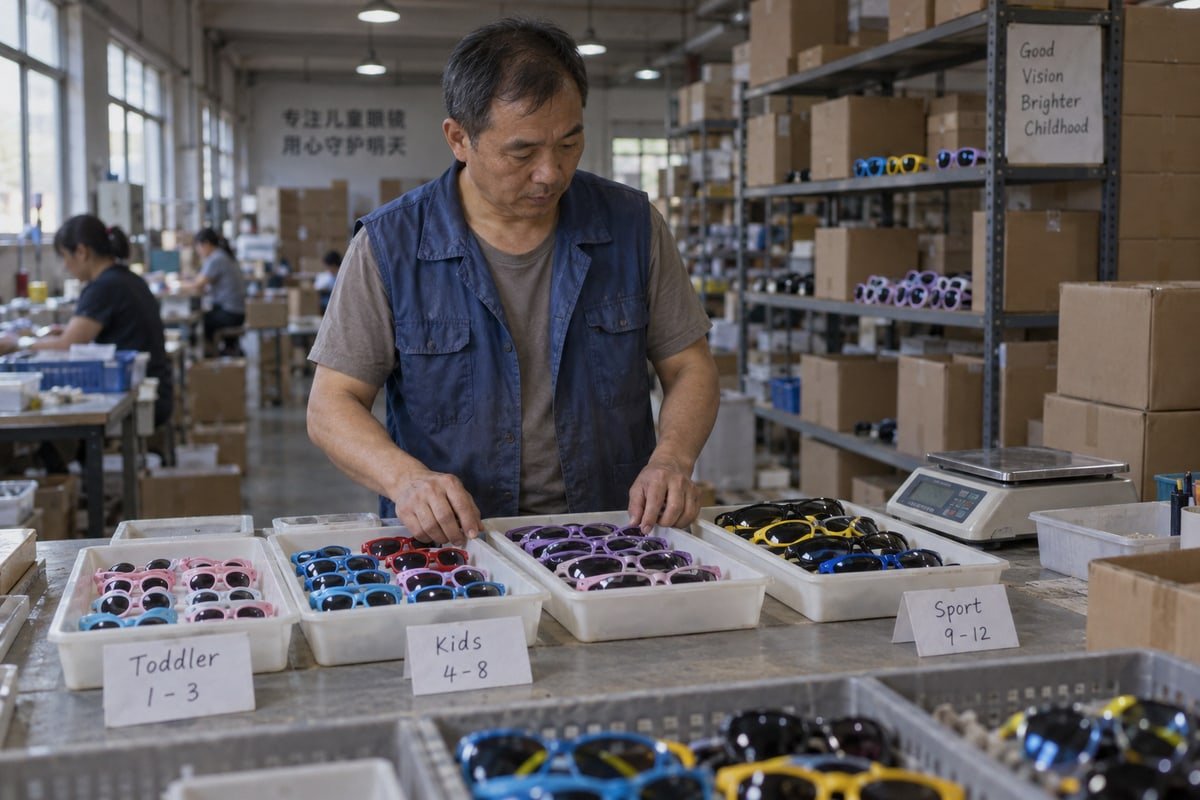
Numbers on a spec sheet mean nothing if the frame fails in a backpack. In our 5S-managed workshop, samples go through repeated flex cycles, drop checks, and lens push-out tests before any order ships. With around 120 workers and dedicated QC stations, we can hold these standards consistently across large orders, not just golden samples.
For brands building a product line, my honest advice is this: do not chase the absolute minimum weight. Chase the lightest frame that passes twist, drop, and retention testing for its age group. A 10-gram toddler frame and an 18-gram kids' sport frame can both be "ideal" if each survives real play. Because we offer roughly 800 existing styles, buyers can test several weight points in the market with low risk, then invest in custom OEM/ODM development once the data shows which comfort band their customers prefer.
Conclusión
The ideal weight for TPEE kids' sunglasses is a comfort band, not one number: 8–14 grams for toddlers, under 20 grams for most kids, and 20–22 grams for secure sport styles. If your current frames leave red marks or get pulled off within minutes, the fix is not just fewer grams. It is the lightest frame that still fits securely and survives play. That is exactly what we help brands build every day, from stock styles to fully customized designs.
¿Interesado en obtener los productos mencionados en este artículo? Ver detalles y solicitar un presupuesto aquí:
Notas al pie
1. Technical overview of eyewear bridge types and their importance for fit and weight distribution. ↩︎
2. Scientific database providing technical properties and engineering applications of TPEE materials. ↩︎
3. Medical authority explaining the safety benefits of polycarbonate lenses for impact resistance and UV protection. ↩︎
4. Authoritative European Commission source on safety documentation and compliance requirements for consumer products. ↩︎
5. Authoritative source on lens material safety standards supports impact-resistance claims for children’s eyewear. ↩︎
Más artículos que te podrían gustar
28 de septiembre de 2026
¿Pueden las gafas de sol para niños TR90 y TPEE utilizar materiales reciclados o de base biológica?
28 de septiembre de 2026
¿Son reciclables las gafas de sol para niños TR90 y TPEE? Explicación de los consejos de eliminación.
28 de septiembre de 2026
¿Cómo evitar deformaciones y arañazos al enviar gafas de sol para niños TR90 y TPEE?
¿Buscas un socio confiable en gafas para niños?
Explore más de 800 estilos listos y soporte OEM/ODM completo adaptado a su marca.
Ponte en contacto English
 Español de México
 Deutsch
 Français
 日本語
 العربية
 Português do Brasil