¿Son reciclables las gafas de sol infantiles TR90 y TPEE? ¿Explicación de los consejos de eliminación?
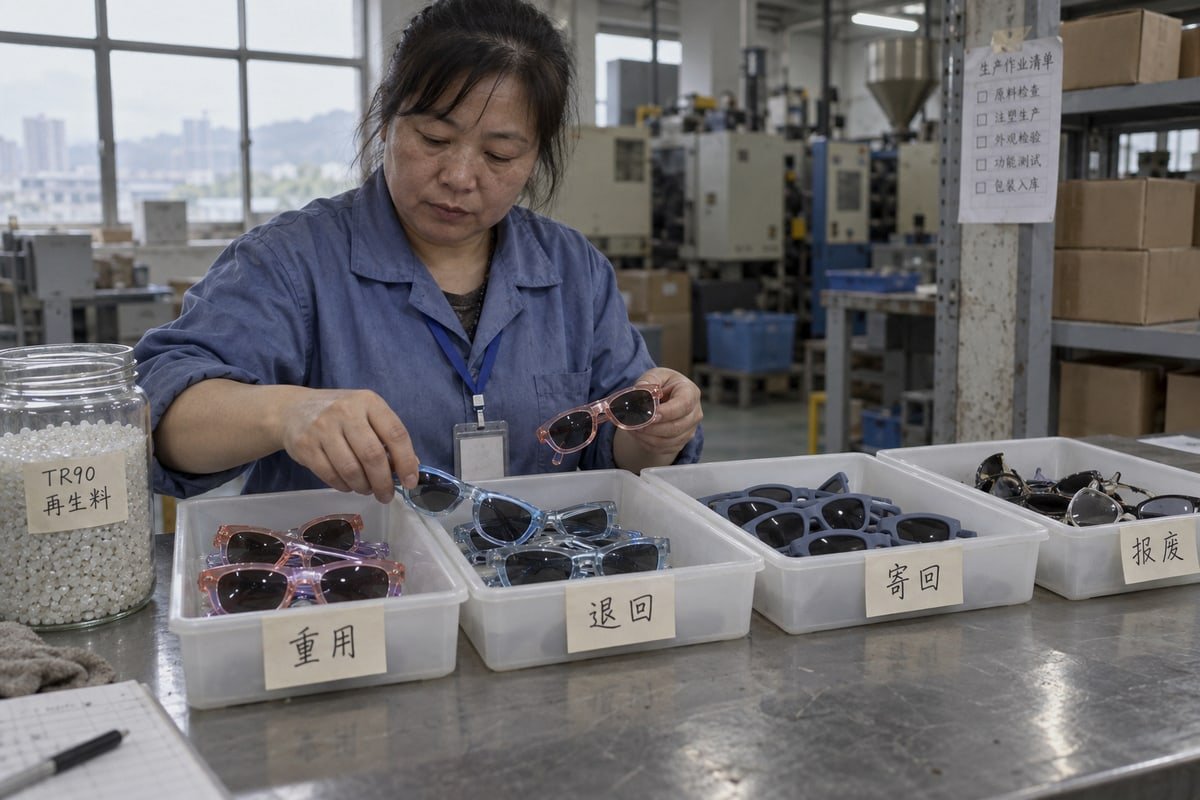
Cada temporada, los compradores nos preguntan si las gafas de sol infantiles TR90 y TPEE que salen de nuestra línea Taizhou son reciclables. La respuesta honesta preocupa a algunos. No debería, una vez que entiendas la eliminación.
Las gafas de sol infantiles TR90 y TPEE son reciclables en principio porque ambos son termoplásticos que se pueden volver a fundir. En la práctica, la mayoría de los programas de recogida en acera los rechazan debido a materiales mixtos y códigos de resina faltantes. La mejor vía de eliminación es la reutilización primero, la devolución a la marca segundo, el reciclaje por correo tercero y los residuos generales al final.
Esa brecha entre “reciclable” y “realmente reciclado” es toda la historia. A continuación, lo desgloso sección por sección. Cubro la montura, las patillas, las alternativas y cómo hablar de todo ello con sus clientes.
¿Cómo puedo saber si mis gafas de sol TR90 son realmente reciclables al final de su vida útil?
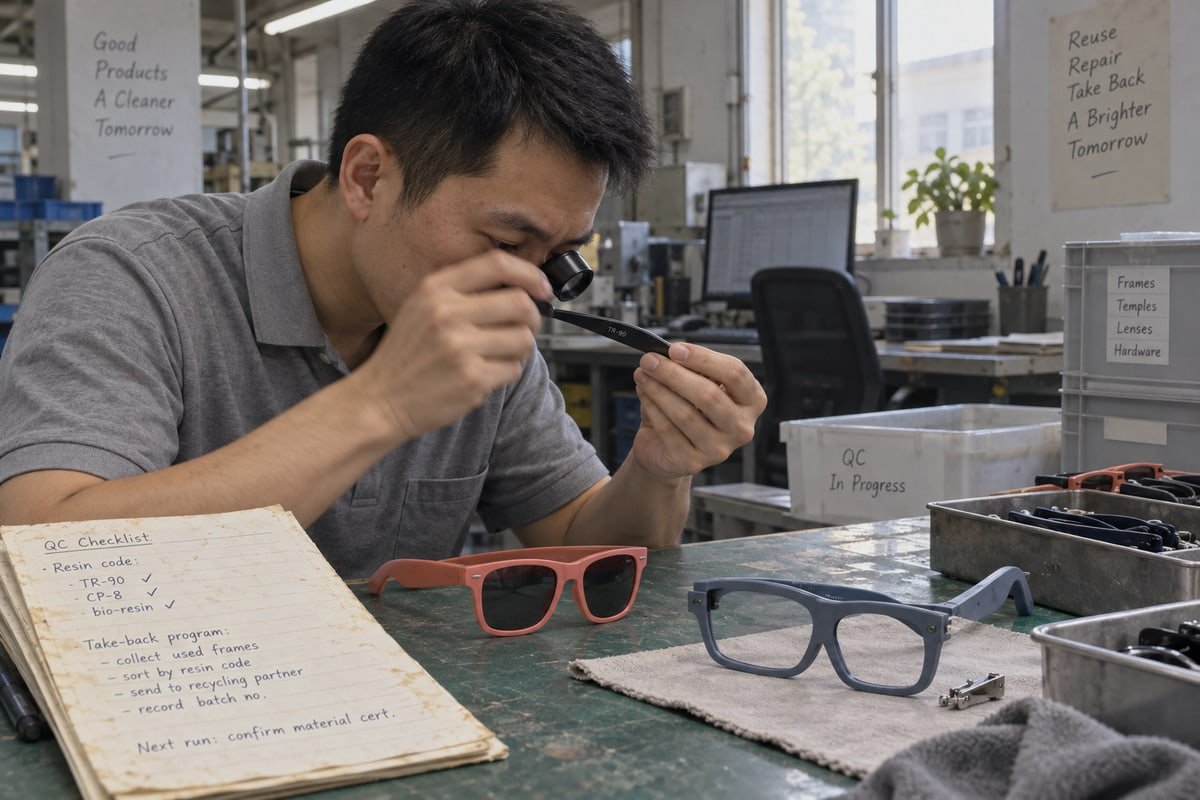
El año pasado, nuestro equipo de control de calidad rastreó un lote de gránulos triturados de desechos de bebederos de TR90 hasta monturas de prueba. Ese experimento me enseñó dónde comienza realmente la reciclabilidad.
Comprueba tres cosas: si la montura está marcada como TR90 o poliamida termoplástica, si tu reciclador local acepta el código de resina 7 o plásticos de ingeniería, y si la marca tiene un programa de devolución. Si las tres fallan, tus gafas de sol TR90 son reciclables en teoría pero no en tu sistema local.
Qué es realmente el TR90
TR90 es un nombre comercial. Proviene de Grilamid TR90, una poliamida termoplástica a base de nailon. La mayoría de los grados se basan en química del nailon 12. Las propiedades del nailon 12 son importantes aquí. La resina es de baja densidad, flexible, químicamente estable y muy difícil de romper. Por eso la usamos para la parte frontal de nuestras monturas infantiles. Un niño puede sentarse encima de un par y la montura vuelve a su sitio. 1 También es un termoplástico, no un termoestable. Un termoestable se cura una vez y no se puede volver a fundir. Un termoplástico se puede fundir y remodelar muchas veces. En nuestro propio taller, los desechos limpios de los bebederos de.
vuelven al proceso. Por lo tanto, el material en sí mismo supera la primera prueba. inyección de plástico 2 Por qué la montura todavía falla en la acera.
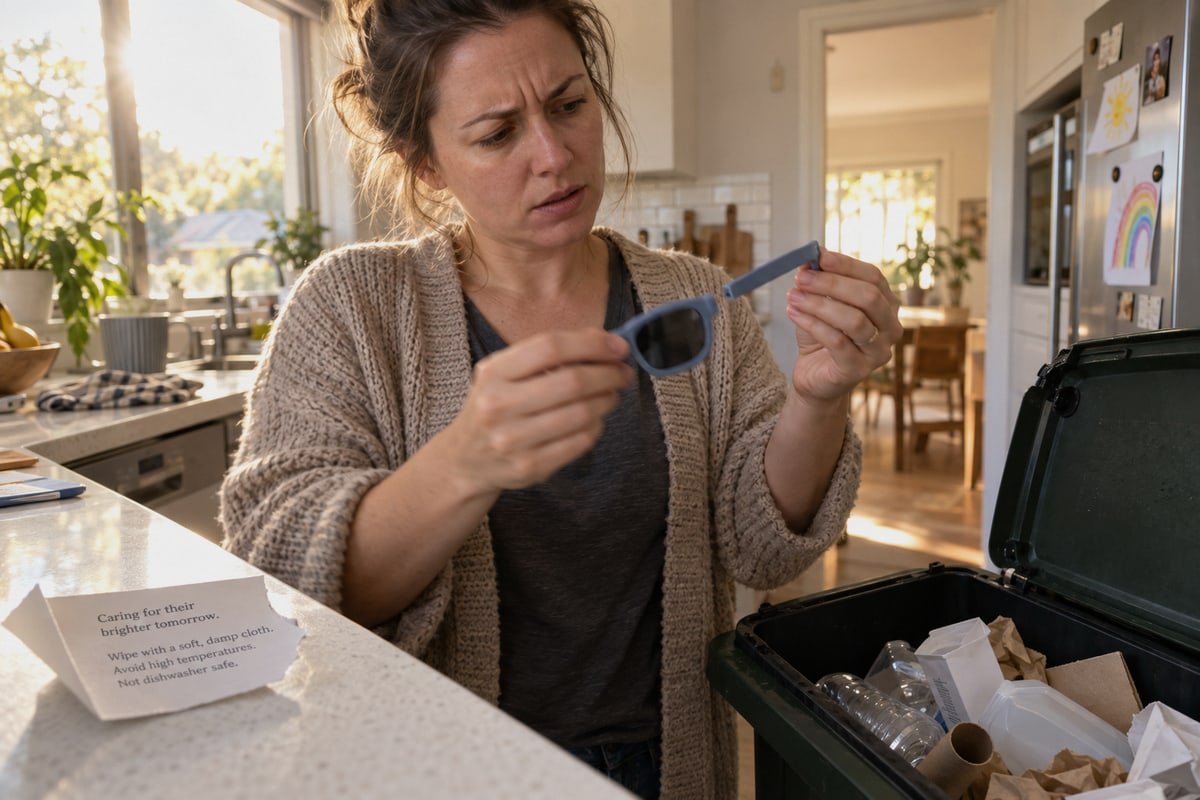
La clasificación municipal depende de los códigos de identificación de resina plástica. Esos son los números del 1 al 7 dentro del triángulo. El TR90 no tiene un código dedicado. La mayoría de los centros locales lo clasifican bajo el 7, que significa "otros". En la práctica, los artículos del código 7 casi siempre se envían al vertedero o a la incineración. Una montura infantil también es pequeña, de color y se mezcla con lentes y metal. Los equipos de clasificación no pueden separarla de forma económica.
Así es como las afirmaciones de marketing se alinean con el mundo real:.
Afirmación que leerás
| Lo que realmente significa | Lo que no significa | "El TR90 es 100% reciclable" |
|---|---|---|
| "La resina se puede volver a fundir" | Su ayuntamiento lo aceptará | "Se puede reciclar a través de programas industriales de plásticos" |
| "Existen recicladores de plásticos de ingeniería" | Se llevan pares individuales de hogares | "Gafas completamente reciclables" |
| "Afirmación a nivel de material" | Se incluyen lentes, bisagras y recubrimientos | "Reciclaje molecular para TR90" |
| "procesos químicos" | Emergente pueden devolver el TR90 a monómeros 3 La tecnología está disponible hoy en su depósito local | Una prueba rápida que puede realizar |
Busque una marca TR90 o PA en el interior de la patilla. Si no hay ninguna, pregunte a la marca.
- Llame o busque en su reciclador local "plásticos de ingeniería" o "poliamida" para su aceptación.
- Compruebe si la marca o el minorista ofrecen reciclaje de monturas ópticas o un sobre de devolución.
- Si nada de esto funciona, trate el par como reutilizable primero y como residuo general al final.
- El punto del reciclaje molecular merece una nota. Los procesos químicos más nuevos pueden descomponer el TR90 en monómeros crudos sin pérdida de calidad. Eso es prometedor para los ciclos cerrados. Pero es un proceso industrial a escala de planta, no uno de recogida en acera. Así que, por ahora, la respuesta honesta sigue siendo: material reciclable, producto difícil de reciclar.
El TR90 es una poliamida termoplástica que se puede volver a fundir y reprocesar.
¿Qué debo saber sobre la eliminación segura de patillas de TPEE y componentes de goma?
en nuestro estilo wayfarer de coral podía ir en el contenedor de plásticos blandos de su ayuntamiento. Respuesta corta: no. Templo TPEE El TPEE no es caucho, aunque lo parezca.
Las patillas de TPEE son un elastómero de poliéster termoplástico, no caucho vulcanizado, por lo que no contienen BPA y son no tóxicas. Necesitan procesamiento industrial en lugar de reciclaje doméstico. Sepárelas de las lentes y las bisagras metálicas, consulte si existe un programa de devolución o envío postal, y de lo contrario, deséchelas con los residuos mixtos generales.
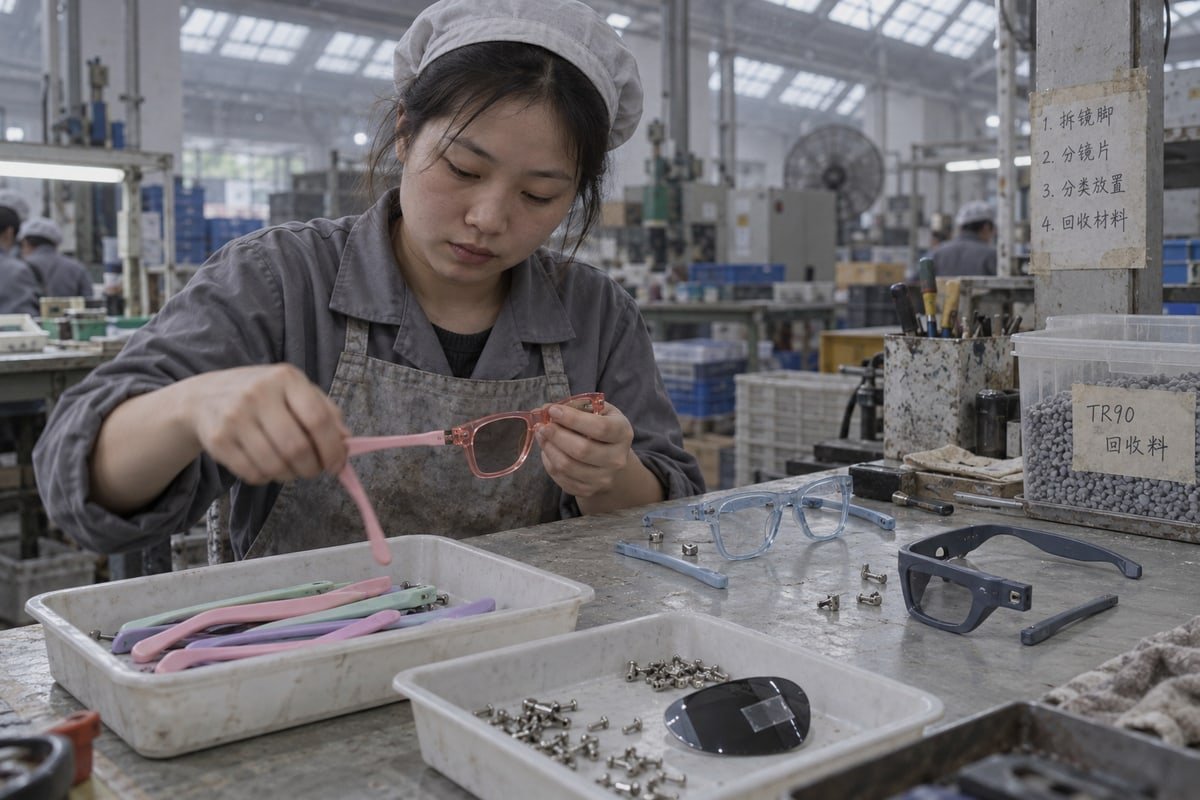
El TPEE se comporta como el caucho pero se procesa como el plástico. Por eso lo elegimos para las patillas. Se dobla alrededor de la oreja de un niño, resiste el sudor y vuelve a su forma después de un maltrato. A diferencia del
caucho vulcanizado , no tiene enlaces de azufre reticulados. Por lo tanto, se puede volver a fundir. Su estabilidad térmica es alta y es uno de los materiales libres de BPA que especificamos para cualquier cosa que toque la piel de un niño. También usamos plásticos libres de ftalatos en toda nuestra gama infantil, porque los componentes blandos son los que los niños muerden. 4, 'Seguro" tiene dos significados aquí. El primero es la seguridad personal. El TPEE y el TR90 no son residuos peligrosos. No necesita un manejo especial. Simplemente no los queme en casa, porque cualquier plástico libera humos cuando se quema al aire libre. El segundo significado es la seguridad ambiental, que es donde entra el trabajo de clasificación.
"Desmonte el par en sus partes.
Un par de gafas de sol infantiles es un pequeño ensamblaje, no un solo material. Cada parte va a un lugar diferente:
Un par de gafas de sol para niños es un ensamblaje pequeño, no un solo material. Cada parte va a un lugar diferente:
| Componente | Usual material | Where it can go |
|---|---|---|
| Frente de la montura | TR90 thermoplastic polyamide | Take-back, mail-in, or engineering-plastic recycler |
| Varillas | TPEE thermoplastic polyester elastomer | Take-back, mail-in, or general waste if none exists |
| Lentes | Polycarbonate or TAC, often coated and polarized | Not accepted with frame plastics; general waste |
| Hinges, rivets, screws | Steel or nickel alloy | Scrap metal, if your center accepts small metal |
| Almohadillas nasales | Silicona o TPEE | General waste unless a program accepts them |
A simple disposal sequence
- Confirm the pair is truly beyond reuse. A loose hinge or scratched lens is often repairable.
- Pop the lenses out. Polycarbonate and TAC lenses are incompatible with frame recycling streams.
- Unscrew or push out the metal hinges. Keep metal and plastic apart.
- Look for a mail-in option. TerraCycle-style zero-waste boxes are often the only route that actually diverts these polymers from landfill.
- If no program exists, place the parts in general mixed waste, not the recycling bin. A wrong item in the recycling stream can contaminate a whole load.
One more idea worth passing to your customers: TPEE is stable enough for closed-loop upcycling. Industrial recyclers have turned it into flexible cable organizers and garden ties. That only works at scale, but it shows the material has a second life when it is collected properly.
¿Existen alternativas más ecológicas al TR90 y TPEE para la línea de gafas de mis hijos?
Durability versus recyclability is the trade-off our engineers weigh most often. A frame that survives three summers on an active child may beat a recyclable one that breaks in one.
Sí. Existen mezclas de TR90 reciclado y nailon reciclado, PET reciclado con certificación GRS y Bio-TR90 parcialmente de origen vegetal. Sin embargo, ninguna es automáticamente más fácil de reciclar que el TR90 o el TPEE estándar. Para las gafas infantiles, la durabilidad, la reparabilidad y un canal de devolución suelen reducir más residuos que el simple cambio de resinas.
The main eco-friendly eyewear alternatives at a glance
| Opción | Qué es | Sustainability claim | Recycling reality | Fit for kids' frames |
|---|---|---|---|---|
| Recycled TR90 / recycled nylon | Post-consumer or industrial nylon regrind blended with virgin resin | Lower virgin-resin demand | Same as standard TR90; no curbside path | Good; near-identical flexibility and impact resistance |
| Bio-TR90 | TR90 with partial plant-derived content | Reduced fossil input | Not more recyclable than TR90; not compostable | Good; same nylon 12 properties |
| GRS-certified recycled PET | Recycled polyester, often from bottles | Verified recycled content with chain of custody | Better known resin, but eyewear still a specialty stream | Fair; stiffer than TR90 for active use |
| Standard TR90 with TPEE temples | Virgin engineering thermoplastics | Long product life, BPA-free and phthalate-free | Thermoplastic, industrial recycling only | Excellent; our core spec |
Why durability is the greener lever
The sustainable fashion lifecycle for a child's sunglasses is short. Kids outgrow frames. They also lose and break them. The biggest environmental cost is not the resin type. It is the number of pairs bought and thrown away per child. That is where the extreme impact resistance of TR90 and TPEE pays off. A frame that survives being dropped, bent, and sat on does not need replacing. Fewer replacements means less resin, less packaging, and less shipping.
When I look at our translucent sky-blue style, or the chunky slate-blue frame we make for younger kids, the eco argument is the same. The material is chosen so the pair lasts. That is not a marketing line. It is the reason we run flex and drop checks on every production batch.
How to reduce waste without a new resin
Switching materials is not the only move. A brand can cut waste in three quieter ways:
- Skip new molds. Choosing from our existing 800 styles means no steel tooling for a test launch and no dead stock if a color does not sell.
- Design for repair. Screw hinges instead of glued joints let a retailer swap a temple rather than bin the pair.
- Plan the return path. A take-back envelope or a partnership with a mail-in recycler turns a "recyclable" claim into a real one.
If you still want a recycled or bio-based resin, we can develop it through our ODM process. Just go in with clear eyes. Bio-TR90 is not fully plant-based, and nailon reciclado does not make the pair easier for a parent to recycle at home.
¿Cómo puedo comunicar información sobre sostenibilidad y eliminación a mis clientes?
I learned this the hard way when a European brand returned our first packaging draft because it said "recyclable" with no explanation. Honest, specific wording earns more trust.
Communicate sustainability by stating the exact materials, saying clearly that curbside recycling is unlikely, and giving a ranked disposal path: donate, return, mail-in recycle, then general waste. Print it on packaging, the product page, and a hangtag. Avoid unqualified words like "100% recyclable" without a program behind them.
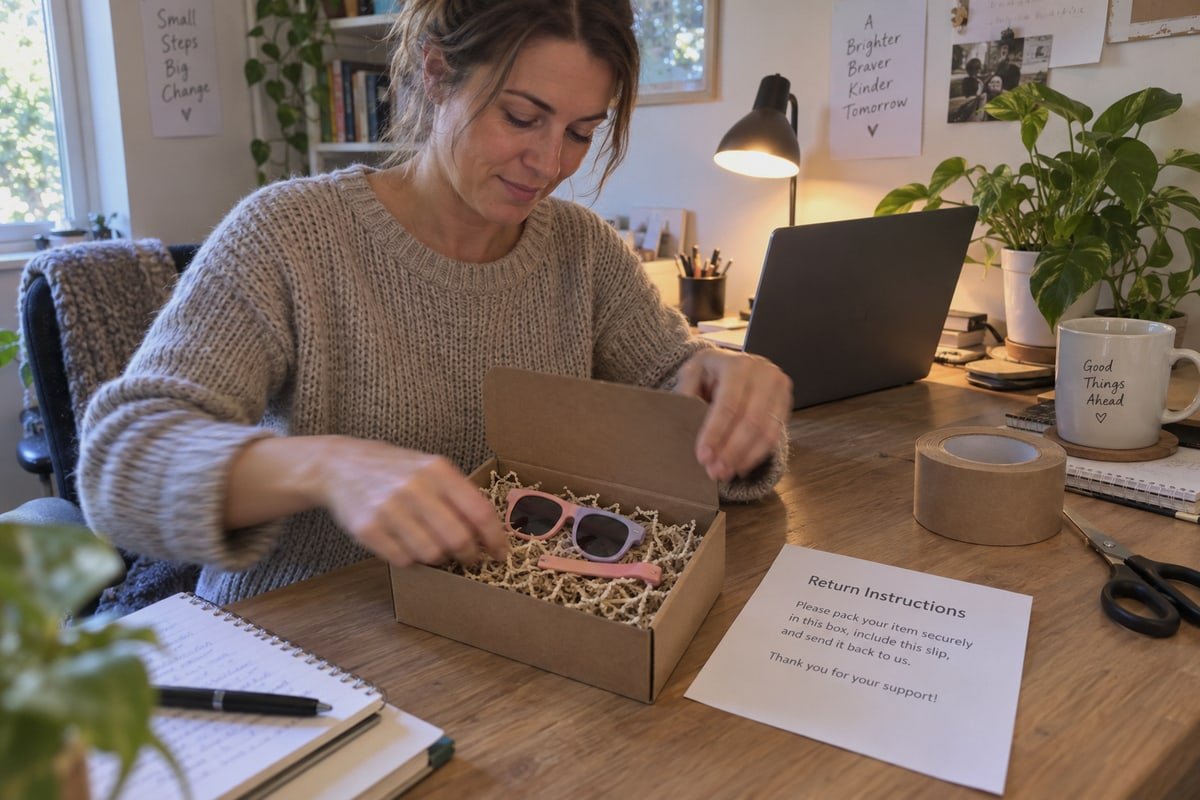
Say what it is, then say what to do
Parents do not need chemistry. They need a decision. So the message has two parts. First, name the materials plainly: TR90 front, TPEE temples, polycarbonate polarized lenses. Second, give a ranked action list. We build this into the retail-ready packaging we produce for clients, and the wording is always the same order.
- Still usable? Donate. Eyewear donation programs such as Lions Club International collect frames and repurpose them for communities that need them.
- Broken but returnable? Send it back. If the brand runs an Extended Producer Responsibility scheme, say so, and mention any credit or discount offered for returned frames.
- No return option? Use a mail-in recycler that accepts mixed eyewear.
- None of the above? Place it in general waste, not the recycling bin.
Claims to use and claims to avoid
| Say this | Not this | Por qué |
|---|---|---|
| "Made from thermoplastic TR90 and TPEE, which can be recycled through specialist programs" | "100% recyclable" | The first is true at the product level; the second implies curbside acceptance |
| "Not accepted in most household recycling; please return or donate" | "Please recycle" | Directs the parent to the path that actually works |
| "BPA-free and phthalate-free materials" | "Non-toxic eco plastic" | Specific, checkable safety claims beat vague ones |
| "Built to last: impact-resistant frame for active kids" | "Sustainable design" | Durability is the real environmental benefit and it is provable |
Where the message should live
Put the short version on the hangtag. Put the full version on the product page and inside the case. Add a QR code linking to your take-back instructions if you run one. When we develop custom packaging, we leave a clear panel for this text so the disposal note is not buried under the barcode.
One last point for buyers in markets like Japan, Australia, and the EU. Regulators there are tightening rules on green claims. A specific, modest statement protects your brand. A bold, unproven one creates risk. Honest disposal guidance 5 is not a weakness. It signals that you understand the product from the injection machine to the end of its life.
Conclusión
Kids' sunglasses rarely fit the blue bin, and that frustrates parents. But durable TR90 & TPEE frames, honest labels, and a take-back plan turn that problem into brand trust.
¿Interesado en obtener los productos mencionados en este artículo? Ver detalles y solicitar un presupuesto aquí:
Notas al pie
1. International standard for polyamides like nylon 12 used in high-performance eyewear frames. ↩︎
2. Technical standards and research on precision manufacturing processes including plastic injection molding. ↩︎
3. Government agency information on advanced recycling methods and chemical processing for plastic waste. ↩︎
4. Authoritative source defining vulcanization as a thermoset process, providing a clear contrast to recyclable thermoplastics like TR90. ↩︎
5. Federal authority providing guidelines on environmental marketing and the substantiation of product disposal claims. ↩︎
Más artículos que te podrían gustar
28 de septiembre de 2026
¿Pueden las gafas de sol para niños TR90 y TPEE utilizar materiales reciclados o de base biológica?
28 de septiembre de 2026
¿Cómo evitar deformaciones y arañazos al enviar gafas de sol para niños TR90 y TPEE?
28 de septiembre de 2026
¿Cómo elegir el embalaje minorista para gafas de sol para niños de TR90 y TPEE?
¿Buscas un socio confiable en gafas para niños?
Explore más de 800 estilos listos y soporte OEM/ODM completo adaptado a su marca.
Ponte en contacto English
 Español de México
 Deutsch
 Français
 日本語
 العربية
 Português do Brasil