How to Prevent Deformation and Scratches When Shipping TR90 & TPEE Kids Sunglasses?
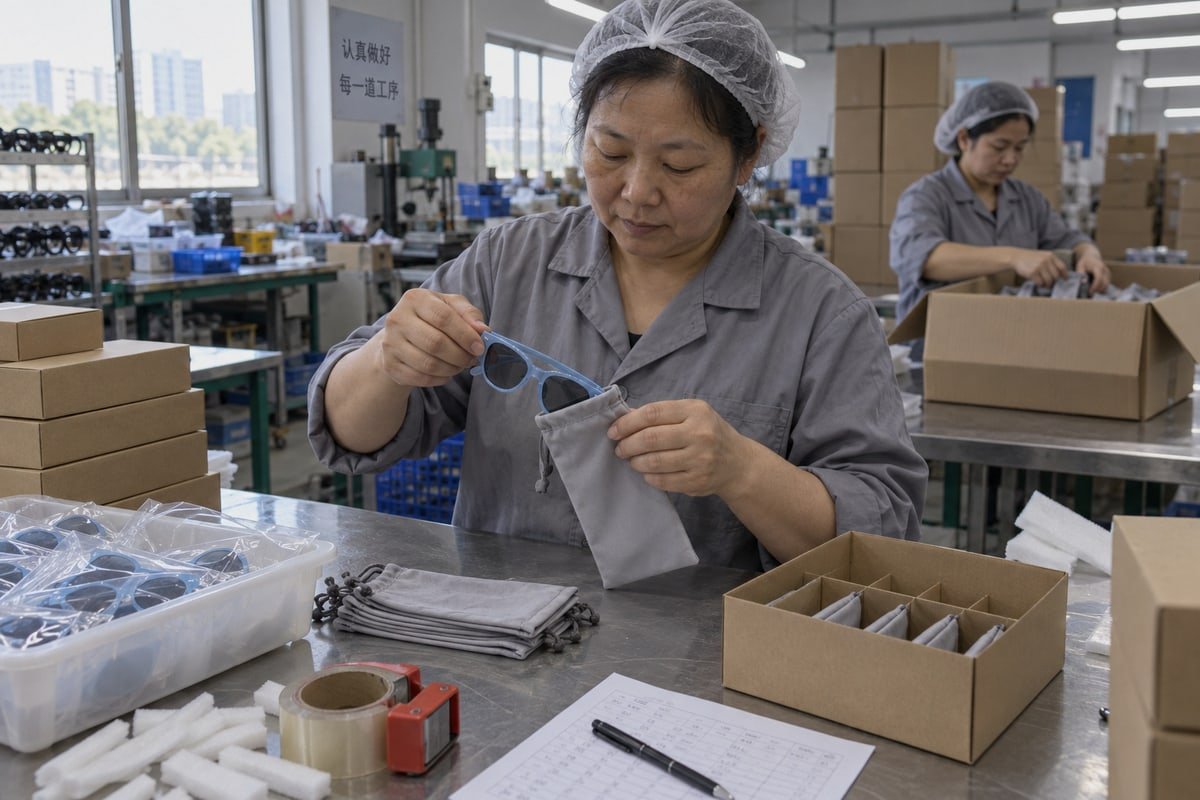
[Shipping TR90 & TPEE kids sunglasses](https://okayeyewear.com/?p=5859) seems easy until bent temples and scratched lenses trigger returns corrugated master carton 1. Our Taizhou production line fixed this with a [packaging system](https://okayeyewear.com/how-packaging-design-prevent-transport-damage-tr90-kids-sunglasses/), not luck.
Prevent deformation and scratches when shipping TR90 & TPEE kids sunglasses by packing each pair in a microfiber pouch or hard case, keeping temples in their natural position, separating units with dividers, using double-walled cartons, adding heat and moisture buffers, and completing pre-shipment QC.
Flexible frames survive playground drops. They do not automatically survive a hot container or a loose carton. Below, I walk through the materials, the heat problem, the QC checks, and the box design that keep our kids’ eyewear intact from Taizhou to your warehouse.
What packaging materials keep my TR90 & TPEE sunglasses safe during long-distance shipping?
A procurement manager from Australia once asked me why her sample pairs arrived with faint temple marks. The answer was the paper sleeve, not our TR90.
The safest packaging stack for long-distance shipping of TR90 & TPEE sunglasses combines a dust-proof polybag, a microfiber pouch or protective hard case, a color box with a fitted insert, cell dividers inside a double-walled corrugated master carton, and desiccant packets.
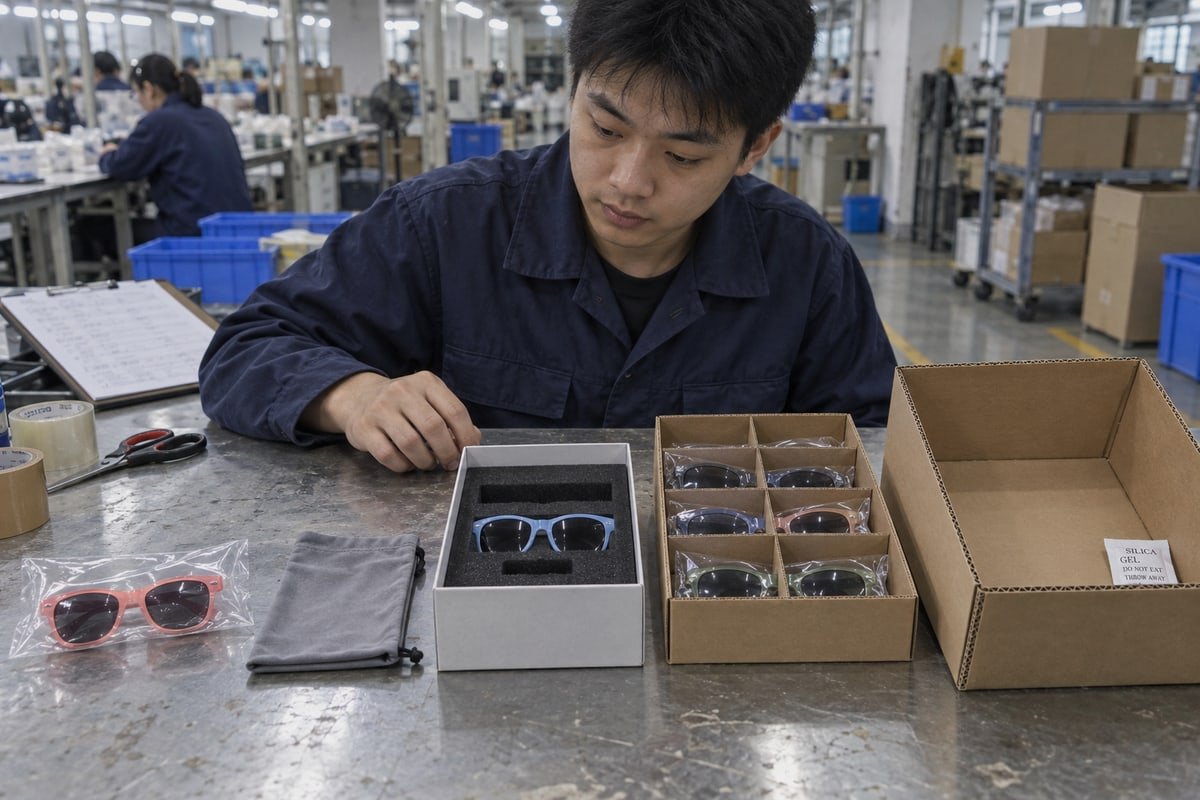
That sample incident taught us something simple. Every layer that touches the frame is either a barrier or an abrasive. Plain kraft paper feels harmless, but in a vibrating carton it rubs a glossy translucent frame thousands of times. Our coral-pink gradient wayfarer style shows those micro-marks clearly because the finish is smooth and high-gloss. So we build the packaging from the frame outward, and we ask one question at each layer: does this material protect, or does it rub?
The five-layer stack we use for bulk shipping solutions
| Capa | Material | Job it does | Common mistake |
|---|---|---|---|
| 1. Lens barrier | Removable electrostatic film on both lens faces, plus the polarized sticker | Blocks dust that slips past pouches | Skipping film and trusting the pouch alone |
| 2. Unit wrap | Dust-proof polybag, then a microfiber storage bag | Stops lens-to-temple contact and moisture | Using a coarse fabric pouch that abrades coatings |
| 3. Retail unit | Color box with fitted insert, or a protective hard case | Holds the frame in a neutral shape | Forcing temples into a cavity that is too tight |
| 4. Inner carton | Cardboard cell dividers, EPE foam or bubble wrap where needed | Immobilizes each unit, absorbs shock | Loose fill that lets boxes shift |
| 5. Master carton | Double-walled corrugated board, desiccant packets inside | Crush resistance under stacked pallets, humidity control | Single-wall cartons on cross-border sea freight |
Why the microfiber matters more than people think
Microfiber storage bags do two jobs. They stop scratches, and they give your end customer a cleaning cloth. But not every microfiber is equal. We test pouch fabric against our anti-scratch lens treatments 2 before approving it, because a cheap weave can dull a polarized coating over months of use. This is a small detail. It is also one of the first things a parent notices.
Impact-resistant packaging is not the same as pressure-resistant packaging
Here is a buyer objection I hear often: TR90 and TPEE are flexible, so lighter packaging is fine. That view is half right. Flexible frame durability handles impact well. It does not handle sustained compression or friction. A soft polybag alone will let a temple press against a lens for three weeks at sea. That is how you get a hazy arc on the lens and a temple that opens wider than spec. Transit damage mitigation starts with separation, not just cushioning.
How can I prevent frame deformation caused by temperature changes inside shipping containers?
Years ago we learned a hard lesson: a summer sea shipment reached a distributor with several frames slightly wider than spec. Heat inside the container was the culprit.
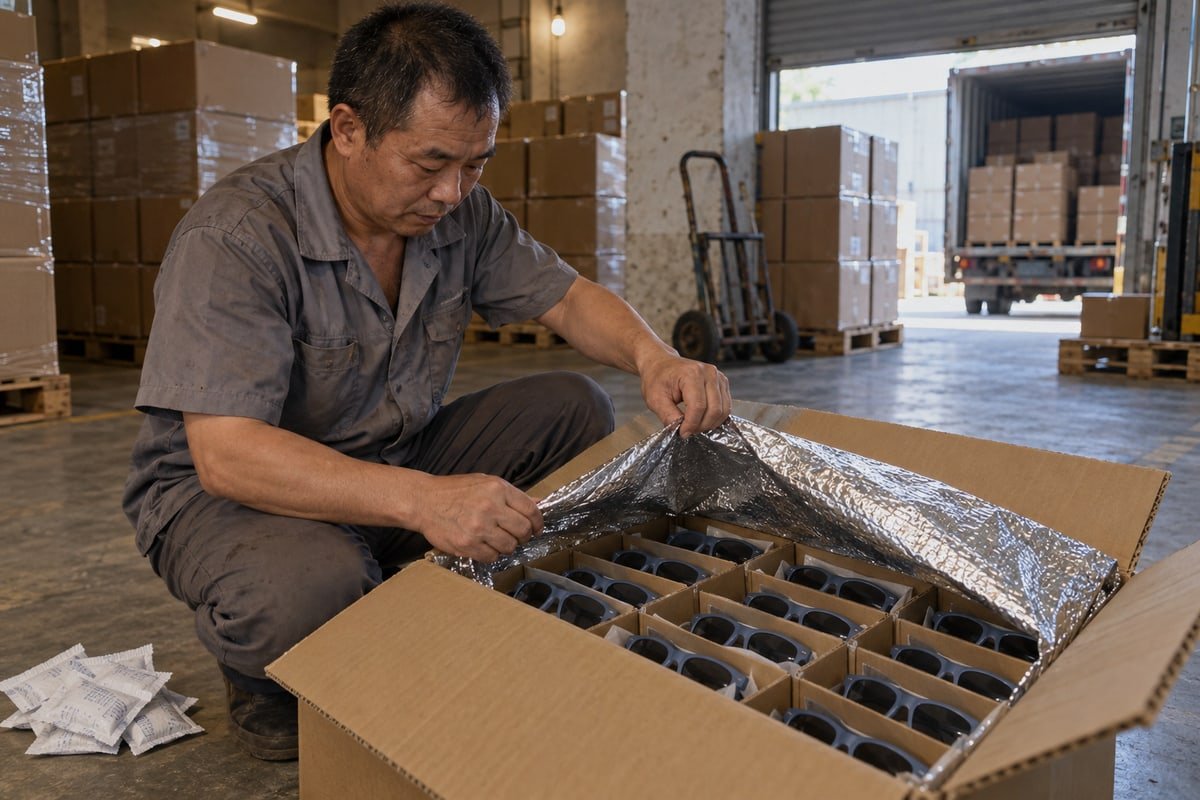
Prevent heat-related frame deformation by keeping frames in a neutral, unforced position, never compressing temples against the lens front, adding reflective foil liners as a thermal buffer for sea freight, using desiccant packets, and avoiding storage in hot, sealed warehouses or truck beds.
Thermoplastic material properties explain the problem. TR90 and TPEE are shape-recovery materials. When you twist a frame at room temperature, it springs back. That recovery depends on the material staying below the point where it softens. A sealed steel container sitting on a dock intermodal shipping containers 3 in July can get much hotter than the air outside. If a frame is held in a bent position inside that heat, and then cools in that same position, the bent shape becomes the new resting shape. The material did not fail. The packaging simply told it what shape to remember.
Temporary flex versus permanent deformation
| Sol directo más fuerte reflejo del agua y la arena | Qué le sucede al armazón | Outcome after unpacking |
|---|---|---|
| Twisted briefly at normal temperature | Elastic flex, full recovery | Frame returns to spec |
| Held compressed for weeks at normal temperature | Slow creep begins | Slight opening, usually recoverable with rest |
| Held compressed for weeks in a hot container | Softening plus creep | Wider temples or flattened front curve, often permanent |
| Stored loose and neutral in a hot container | Some softening, no forced position | Frame usually returns to spec once cool |
The table shows the real risk. Heat alone is rarely the killer. Heat plus forced position is.
Four steps we take on every long-haul order
- Pack in the resting shape. Temples are folded naturally. We never bend them past their resting angle to fit a box. If a color box is too short, we resize the box, not the frame.
- Add bridge supports where needed. For lightweight TPEE fronts, a small biodegradable bridge support keeps the front curve from flattening under stacked weight. This works with the material's elastic memory instead of against it.
- Line the master carton. For sea freight in warm seasons, a reflective foil liner 4 acts as a thermal buffer. It slows the temperature swing inside the carton.
- Control humidity. Desiccant packets go in every carton. Long humid transit can affect the surface texture of TPEE temples, and moisture makes cartons soft, which leads to crushing.
Where the heat actually hits
Our engineers have found that the worst exposure is not the ocean crossing. It is the truck bed and the last-mile warehouse. A container spends days at sea with a fairly stable temperature. A parked truck in the sun spikes fast. So we ask our freight partners to avoid leaving cartons on open docks, and we advise buyers to move pallets inside quickly on arrival. This is a logistics habit, not a packaging cost.
What quality checks should I request before my kids' sunglasses order leaves the factory?
Every morning on our 5S-managed floor, the inspection team twists a random TR90 frame, pulls the temples apart, and watches it spring back. That routine catches problems before packing.
Before your kids' sunglasses order ships, request checks for frame symmetry, temple alignment, hinge movement, flexibility without whitening or cracking, scratch-free polarized lenses, correct labels and warnings, packaging integrity, carton strength, and photographed packing records from random sampling.
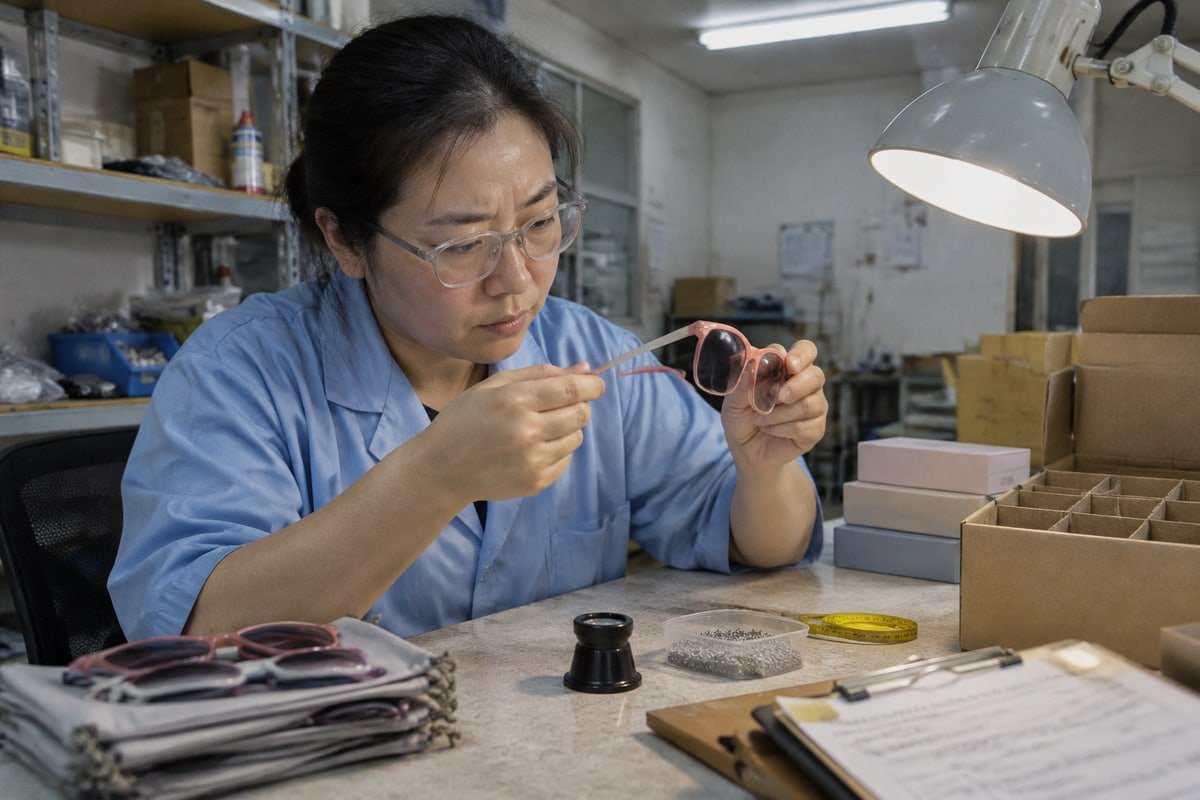
Fifteen years of making eyewear taught us that quality assurance standards 5 have to cover the package, not just the product. A perfect frame in a weak carton is still a return. So our pre-shipment inspection has two halves. The first half looks at the sunglasses. The second half looks at everything around them. When a buyer from Japan or Germany asks what to request, I give them this list and tell them to ask for photos of each step.
Product checks
| Comprobar | What we look for | Pass condition |
|---|---|---|
| Frame symmetry | Front viewed flat on a table | Both lens rims sit level, no rocking |
| Temple alignment | Temples opened and viewed from above | Both temples parallel, no splay |
| Hinge movement | Rivet hinges opened and closed | Smooth action, no loose or stiff joints |
| Flex and pressure test | Frame twisted and temples pulled outward | No cracking, no stress whitening, full return to shape |
| Superficie de la lente | Polarized lens inspected under light, sticker lifted at one corner | No scratches, no coating haze, no dust under film |
| Acabado | Glossy and matte surfaces checked, including translucent gradient colors | No sink marks, no rub marks, consistent color |
Packaging and labeling checks
Children's eyewear packaging carries information as well as protection. Missing or wrong labels can stop an order at customs or on a retail shelf, even when every frame is perfect. We check:
- Model number and SKU match the order sheet.
- Age band and safety warnings are printed correctly for the destination market.
- Care instructions and importer or distributor details are present.
- Barcode scans correctly on the color box.
- Carton markings show quantity, carton number, and handling symbols.
- Master carton passes a simple crush and drop check before sealing.
Why random sampling beats a final glance
We pull samples at random across the whole run, not just from the top layer of the last pallet. Our team photographs the packing sequence: pouch, box, divider, carton. Those photos go to the buyer before the goods leave. This turns product-only quality into end-to-end shipping quality. For a brand launching its first kids' line from our existing styles, that photo record is often the thing that gives the founder confidence to place a larger second order.
How do I choose the right box and case design to avoid scratches during transit?
Choosing between a foldable EVA case and a printed color box is a trade-off we weigh with almost every new brand: shelf appeal versus scratch protection versus landed cost.
Choose a box and case design that immobilizes each pair without pressure: a hard or foldable case lined with non-abrasive microfiber, a color box with a molded insert that leaves no dead space, and a master carton with a reinforced center pillar.
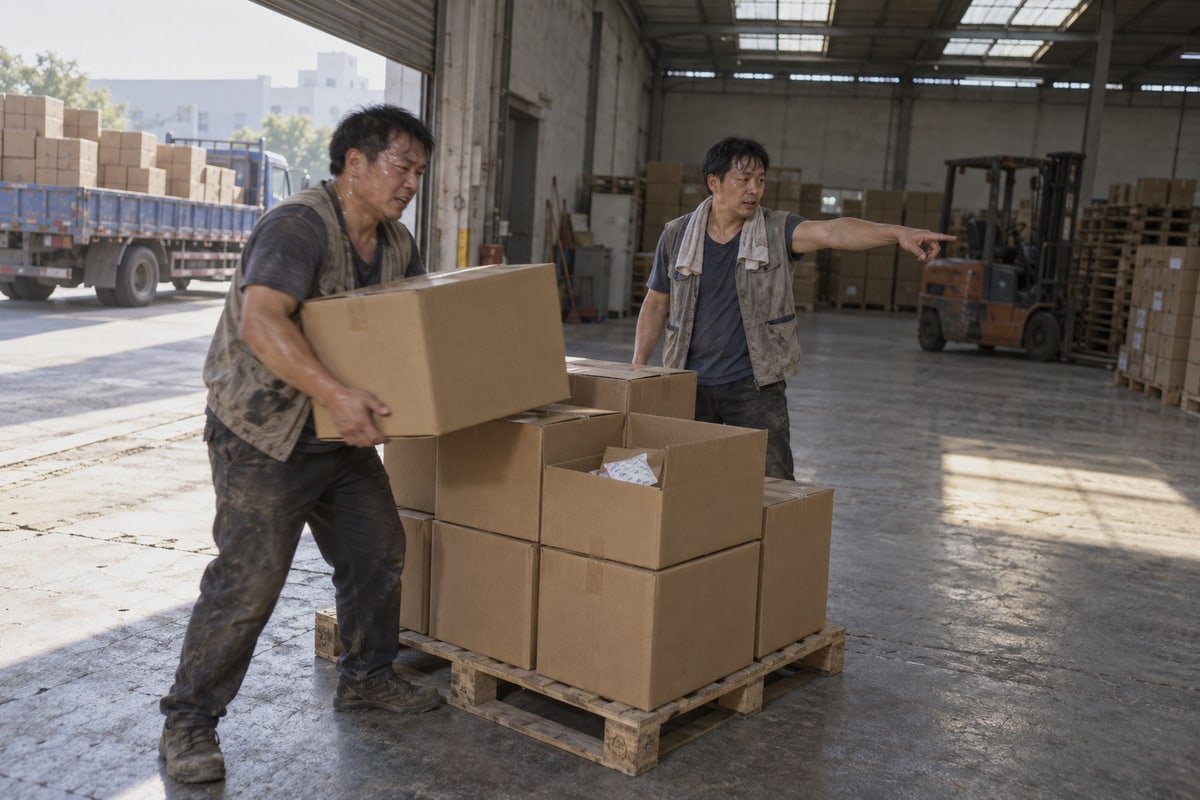
The core rule is simple. A frame that cannot move cannot rub. A frame that is squeezed will deform. Good box design lives in the narrow zone between those two failures. Every insert we cut for a new style, whether it is our sky-blue translucent square or a chunky slate-blue kids' frame, is tested for exactly that fit. The frame should drop in, sit still, and lift out without resistance.
Three packaging levels compared
| Level | Setup | Scratch risk | Deformation risk | Mejor uso |
|---|---|---|---|---|
| Básico | Polybag only, bulk in carton | High, frames touch each other | Medium to high, no shape control | Short domestic trips, promotional giveaways |
| Norma | Polybag, microfiber pouch, color box with insert, cell dividers | Baja | Low, if insert is neutral-fit | Most e-commerce and retail orders |
| Premium | Polybag, microfiber, protective hard case or foldable case, printed outer box, dividers | Muy bajo | Muy bajo | Cross-border shipping, private-label kids' brands, gift sets |
Some buyers push back on the premium level as an unnecessary cost. I understand that. But the math changes with distance. A local order can survive basic packing. A cross-border shipment through two warehouses and a hot truck cannot. One return with a scratched lens costs more than the case that would have prevented it.
Design details that decide the outcome
- Dead space. Empty room lets the box or case slide inside the carton. Cell dividers or a custom-fit grid fix this without adding pressure.
- Insert material. Molded pulp or EVA holds shape well. Thin folded card can collapse and let the frame shift.
- Case lining. Protective hard cases must be lined with soft, non-abrasive fabric. A hard interior wall is just another scratch source.
- Center pillar. For stacked pallets, a reinforced center support in the master carton stops the middle from sagging onto the frames below.
- Electrostatic lens film. This is a cheap second barrier on both lens faces. Dust that gets past a pouch will not reach the coating.
Meeting e-commerce packaging requirements
Direct-to-consumer brands need a box that looks good on unboxing and survives a courier network built for speed, not care. We now offer paper-based sleeves and foldable cases that balance presentation with anti-dust and anti-moisture protection. The design is part of our OEM/ODM support, so a brand can match the case color to a coral, blue, or slate frame while keeping the interior lining consistent.
Conclusión
Bent temples and scratched lenses cost brands trust and money. TR90 and TPEE are tough, but packaging, heat control, and pre-shipment QC are what actually deliver your sunglasses intact.
Interested in sourcing the products mentioned in this article? See details and request a quote here:
Notas al pie
1. Detailed explanation of corrugated fiberboard construction used for durable shipping containers. ↩︎
2. Technical overview of protective coatings applied to optical lenses to prevent surface damage. ↩︎
3. Authoritative Wikipedia entry detailing the construction and standards of steel shipping containers. ↩︎
4. U.S. government resource for international trade logistics and export packaging requirements. ↩︎
5. Official site for international standards governing quality management and manufacturing consistency. ↩︎
Más artículos que te podrían gustar
¿Buscas un socio confiable en gafas para niños?
Explore más de 800 estilos listos y soporte OEM/ODM completo adaptado a su marca.
Ponte en contacto English
  Español de México
  Deutsch
  Français
  日本語
日本語  العربية
  Português do Brasil