How to Tell If Kids’ Sunglasses Use Cheap PC Lenses?
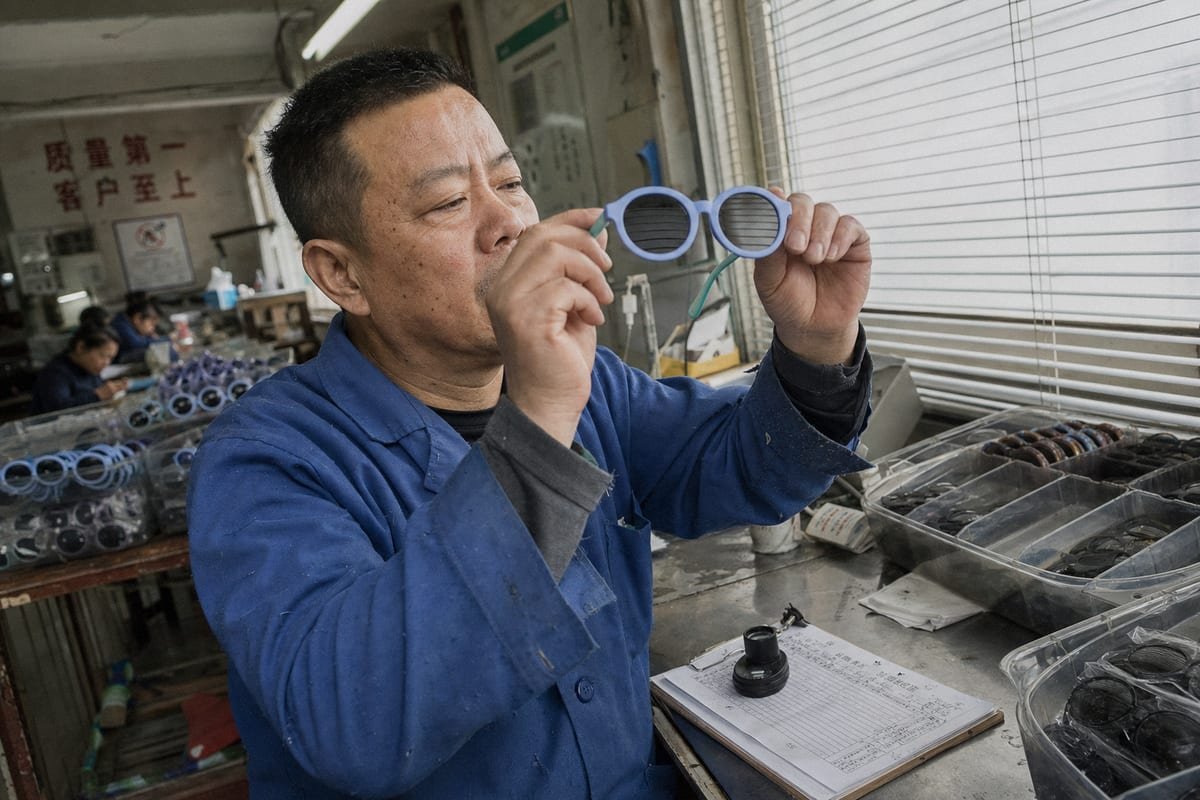
Buyers ask me weekly how to spot cheap PC lenses in kids’ sunglasses. On our production line, I’ve seen bargain lenses distort vision, fail UV claims, and quietly damage a brand’s reputation.
Cheap PC lenses in kids’ sunglasses reveal themselves through wavy distortion when viewed against straight lines, uneven tint, bubbles, rough gate marks on lens edges, chaotic rainbow stress patterns under polarized light, and missing UV400 test reports or impact resistance documentation.
Polycarbonate itself is not the problem. It is actually a great lens material for children. The real issue is how it is made. Let me show you exactly what to check, step by step.
What Visual and Physical Signs Reveal Low-Quality PC Lenses in Kids' Sunglasses?
During a QC round last spring, our inspectors rejected an entire lens batch from a new sub-supplier. The tint looked fine, but the edges told a different story. Small details expose big shortcuts.
Low-quality PC lenses show visible bubbles, pits, uneven tint, and unpolished gate marks on the edges. They bend straight lines into waves, feel flimsy or warped in the frame, and display chaotic rainbow stress patterns when rotated in front of an LCD screen.
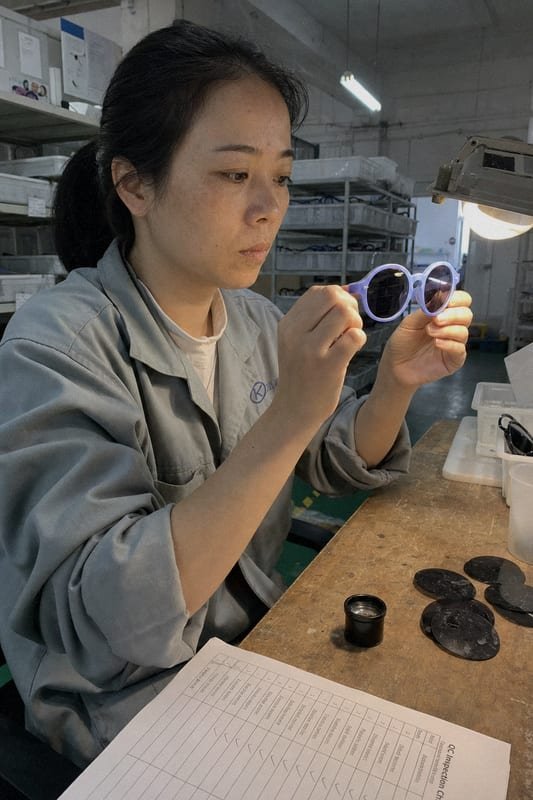
The fastest way to judge a lens is to trust your eyes and hands before trusting any label. In our 5S-managed workshop, we train inspectors to run a fixed sequence of checks on every incoming lens lot. You can copy most of these checks with no equipment at all.
The Straight-Line Optical Distortion Test
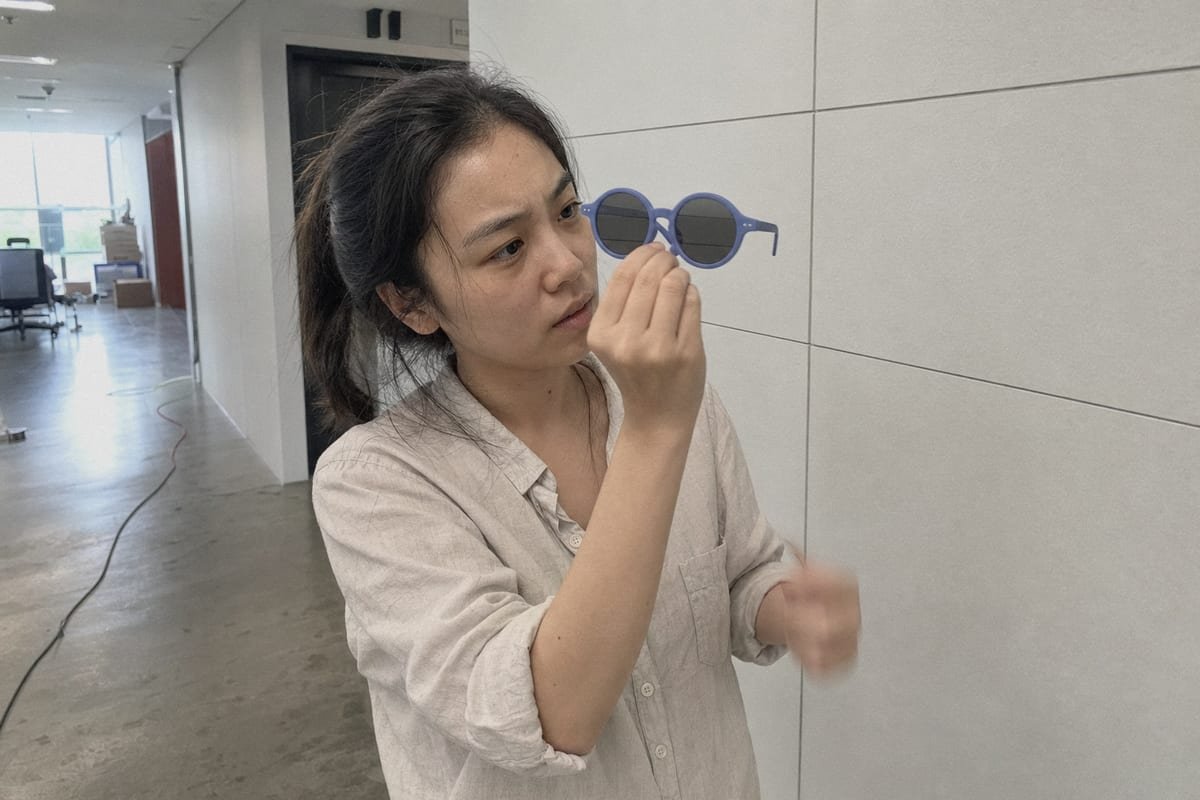
Hold the sunglasses at arm's length. Look through one lens at a door frame, window frame, or tile line. Move the glasses slowly from side to side. On a quality injection-molded lens 1, the line stays straight. On a cheap sheet-cut lens that was heat-bent from flat plastic, the line will wave, bend, or jump. That waviness causes eye strain and headaches 2 in children, and it is the single most reliable home test for optical distortion.
Edge and Surface Inspection
Next, examine the lens under bright light. Look for these red flags:
| Sign | Cómo se ve | Lo que significa |
|---|---|---|
| Gate marks | Small unpolished bumps on the lens edge | Mass production with no hand finishing |
| Bubbles or pits | Tiny dots trapped inside or on the surface | Poor injection molding control |
| Uneven tint | Blotchy or streaky color across the lens | Cheap dip-tinting instead of controlled coating |
| Warping | Lens sits loose or twisted in the frame | Sheet-cut lens forced into a curved frame |
| Orange-peel texture | Slightly bumpy surface reflection | No proper hard-coat or polishing step |
The Screen Stress Test
Hold the lens in front of a phone or LCD screen and rotate it slowly. Well-annealed polycarbonate shows uniform, minimal color patterns. Poorly made PC shows chaotic rainbow swirls. Those swirls indicate internal stress, which weakens shatterproof safety and can distort visual clarity over time.
One caution I share with every buyer: a lens can pass the look-and-feel test and still fail on UV. Physical checks catch molding defects, not filtration performance. That is why the next section matters just as much.
How Can I Test UV Protection and Optical Clarity Before Placing a Bulk Order?
A procurement manager from Australia once sent me competitor samples that were beautifully dark yet blocked almost no UV. Dark tint without UV filtering is worse than no sunglasses at all for children's eye health.
Request pre-production samples and verify them with a UV transmittance meter or third-party lab test targeting UV400 protection. Then check visual clarity with the straight-line test, confirm even light transmission levels across the lens, and validate polarization separately using an LCD screen.
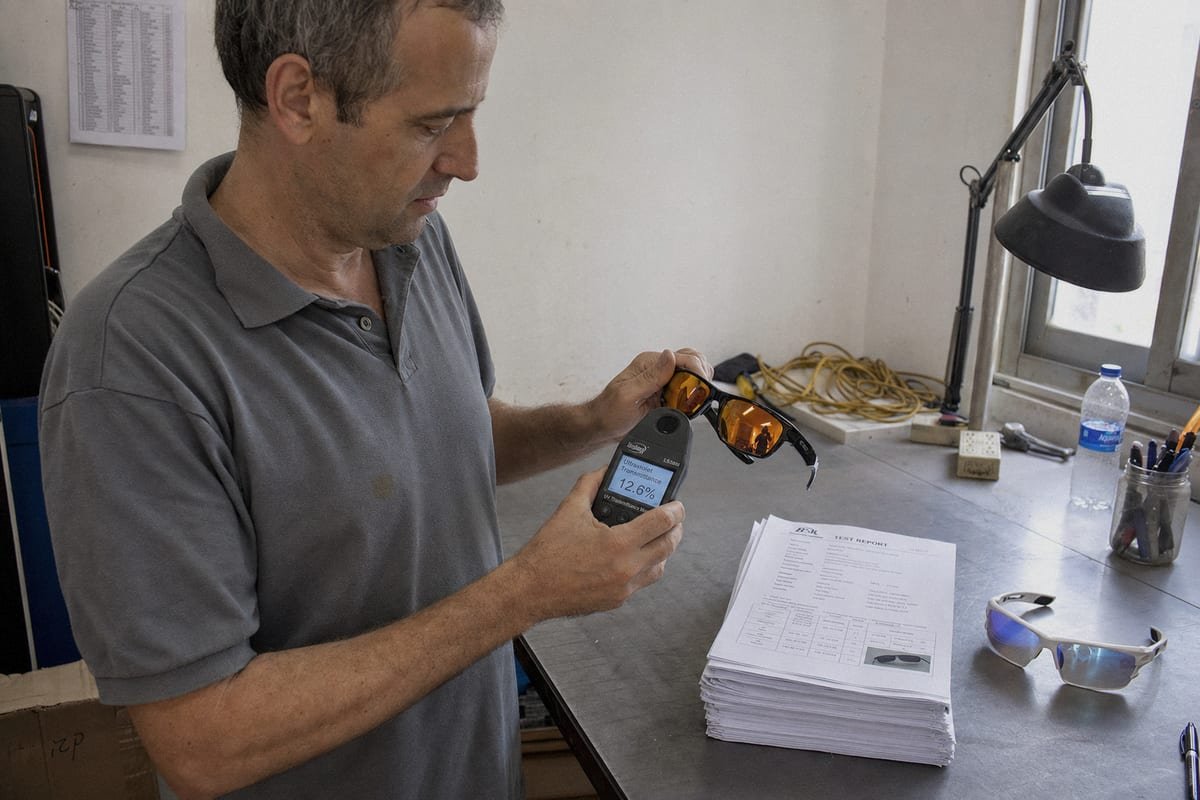
Tint darkness and UV protection are two completely different properties. A pale yellow lens can block 100% of UV rays, while a nearly black lens can let harmful radiation straight through to a dilated pupil. Because dark lenses cause pupils to open wider, a dark lens without UV filtering actually increases the UV dose reaching a child's retina. That false sense of security is the biggest hidden risk in bargain kids' sunglasses.
A Practical Pre-Order Testing Sequence
Here is the sequence we recommend to buyers before they commit to a bulk order:
- Request physical samples from the exact production lens stock, not showroom samples.
- Run a UV transmittance check. A handheld UV meter 4 costs little and instantly shows whether the lens blocks light below 400 nanometers. For bulk orders, commission a third-party lab report.
- Verify optical clarity. Repeat the straight-line optical distortion test on at least five random samples, because cheap suppliers mix good and bad lenses in a batch.
- Check light transmission levels. Both lenses in a pair should have identical darkness. Mismatched tint between left and right lenses signals poor tinting control.
- Test polarization separately if claimed. Rotate the lens ninety degrees in front of an LCD screen; a genuinely polarized lens will go dark. Remember that TAC polarized lenses reduce glare, but polarization is not the same as UV protection. Evaluate both independently.
What Home Tests Cannot Tell You
Quick tests reveal obvious defects, but they cannot measure exact UV cutoff wavelengths or verify durability of coatings after two years of use. For those answers, you need documentation, which brings us to certifications.
| Test | What It Verifies | What It Cannot Verify |
|---|---|---|
| Straight-line test | Optical distortion | UV filtering |
| LCD screen rotation | Polarization | UV filtering or impact strength |
| UV flashlight or meter | Basic UV blocking | Precise UV400 cutoff compliance |
| Informe de laboratorio de terceros | Certified UV400 protection | Batch-to-batch consistency without ongoing QC |
Which Lens Certifications and Test Reports Should I Request From My Manufacturer?
Whenever a new European buyer contacts us, their first document request is almost always the same: lens test reports. After fifteen years of exporting children's eyewear to more than twenty countries, I consider this the smartest opening question a buyer can ask.
Request a UV400 transmittance report, impact resistance test results, optical clarity documentation, and regional compliance certificates such as ANSI Z80.3 for the US, EN ISO 12312-1 with CE marking for Europe, and chemical safety reports confirming BPA-free and phthalate-free materials.
Paperwork separates real factories from resellers. A trading company can print "UV400" on any packaging. A genuine manufacturer can show you the lab report behind the claim, tell you which batch it covers, and explain how often testing is repeated. When we prepare documentation for our own UV400 and polarized lens options 5, every report links back to a traceable production lot.
The Core Document Checklist
| Documento | Lo que demuestra | Who Issues It |
|---|---|---|
| UV400 transmittance report | Lens blocks UV rays up to 400nm | Third-party lab or in-house spectrometer with lab verification |
| Impact resistance test | Lens meets impact resistance standards and shatterproof safety expectations | Accredited testing lab |
| ANSI Z80.3 certification | Compliance with US nonprescription sunglass standards | US-recognized testing body |
| EN ISO 12312-1 / CE | Compliance for the European market | EU-notified or accredited lab |
| AS/NZS 1067 report | Compliance for Australia and New Zealand | Accredited lab |
| Chemical safety report | BPA-free, phthalate-free, heavy-metal-safe materials | Third-party chemical lab |
Questions That Expose Weak Suppliers
Do not stop at collecting PDFs. Ask three follow-up questions. First, does the report match the exact lens you are ordering, or a different SKU? Second, how recent is the report, and does the supplier retest periodically? Third, can they test your specific production batch before shipment? A factory that controls its own production, like ours with around 120 workers and in-house QC, can answer all three quickly. A middleman usually goes quiet.
Chemical safety deserves special attention for kids' products. Children chew on temple tips and lens edges. Documentation confirming the frame and lens materials are free of harmful plasticizers 6 protects both the child and your brand's liability position.
Why Does Choosing a Trusted Factory Matter More Than Price When Sourcing Kids' Lenses?
The hardest lesson I have watched importers learn is this: the cheapest quote almost always hides its cost somewhere. One distributor came to us after a bargain order arrived with mismatched tints across thousands of units, right before their retail launch.
A trusted factory guarantees consistent lens quality across every batch, verifiable UV400 and safety documentation, child-safe materials, and reliable QC. Cheap suppliers cut corners on coatings, molding, and testing, exposing brands to returns, recalls, and lasting damage to customer trust.
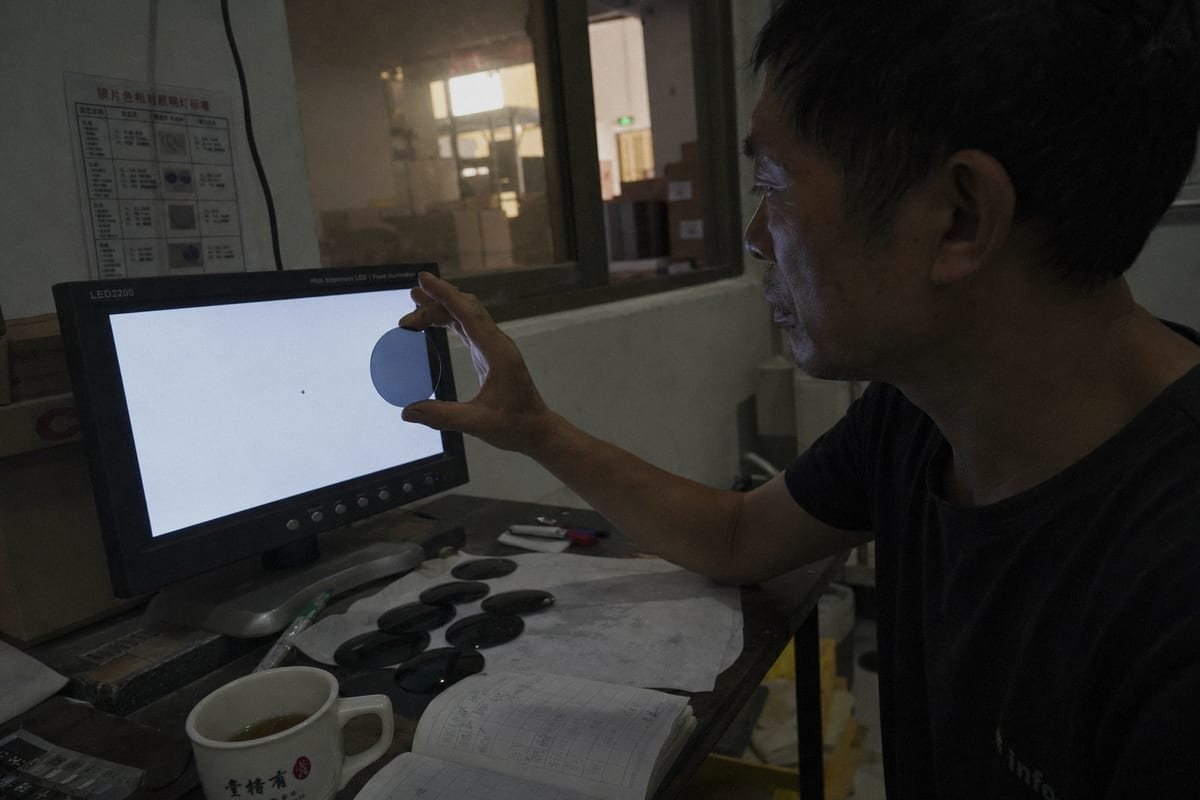
High-quality UV coatings, precision injection molding, and scratch resistant coating processes have a real cost floor. When a quote falls far below that floor, something was removed. Usually it is the hard-coat, the UV verification step, or the edge polishing. None of these omissions are visible in a product photo. All of them surface after your customers start wearing the product.
What Price-First Sourcing Actually Costs
Consider the full lifecycle of a bad lens decision. Distorted lenses trigger complaints about headaches. Peeling coatings generate one-star reviews. A failed UV claim in a regulated market can mean a recall. Each of these costs far exceeds the few cents saved per unit. For children's products, the stakes are higher still, because parents do not give a brand a second chance on safety.
What a Real Manufacturing Partner Provides
A factory partnership changes the risk equation in three ways. First, consistency: with in-house molding and a disciplined workshop, lens quality does not drift between batches. Second, low-risk market entry: our roughly 800 existing styles let new brands launch and test the market without heavy mold investment. Third, full OEM/ODM support: custom colors, logos, lens specifications, and retail-ready packaging, all backed by documented QC rather than promises.
Material expertise matters too. We build frames in flexible TR90 and TPEE 7 specifically because active children fall, sit on their glasses, and pull the temples sideways. Pairing genuinely safe, comfortable frames with certified lenses is what makes a kids' eyewear product defensible in demanding markets like Australia, Japan, and Europe. Price buys you a shipment. A trusted factory buys you a product line you can stand behind for years.
Conclusión
Cheap PC lenses hide behind cute frames and dark tints. Test for distortion, verify UV400 claims, demand certifications, and partner with a factory that documents quality — not just quotes prices.
Notas al pie
1. Background on injection molding process referenced as the quality manufacturing method. ↩︎
2. NIH MedlinePlus explains eye strain, supporting the health risk claim from lens distortion. ↩︎
3. ISO is the standards body governing optical coating and lens quality specifications discussed. ↩︎
4. EPA UV Index resource supports the article’s UV transmittance testing recommendation. ↩︎
5. Explains UV radiation science behind UV400 filtering claims mentioned in the article. ↩︎
6. EPA reference on phthalate plasticizers relevant to chemical safety claims for kids’ products. ↩︎
7. Background on thermoplastic materials used for flexible children’s eyewear frames. ↩︎
Más artículos que te podrían gustar
1 de agosto de 2026
¿Debería la fábrica encargarse del embalaje y etiquetado de las gafas de sol para niños, o utilizar un proveedor designado?
1 de agosto de 2026
Almacén propio vs. Cumplimiento directo del proveedor: ¿Qué reduce los costos de devolución para las marcas de gafas de sol para niños?

1 de agosto de 2026
Directo al almacén del puerto o staging en el extranjero: ¿Cuál ahorra más en el envío de gafas de sol para niños?
¿Buscas un socio confiable en gafas para niños?
Explore más de 800 estilos listos y soporte OEM/ODM completo adaptado a su marca.
Ponte en contacto English
  Español de México
  Deutsch
  Français
  日本語
日本語  العربية
  Português do Brasil