Cómo medir el ancho de la cara y la distancia interpupilar para el tamaño de las gafas de sol TR90 para niños?
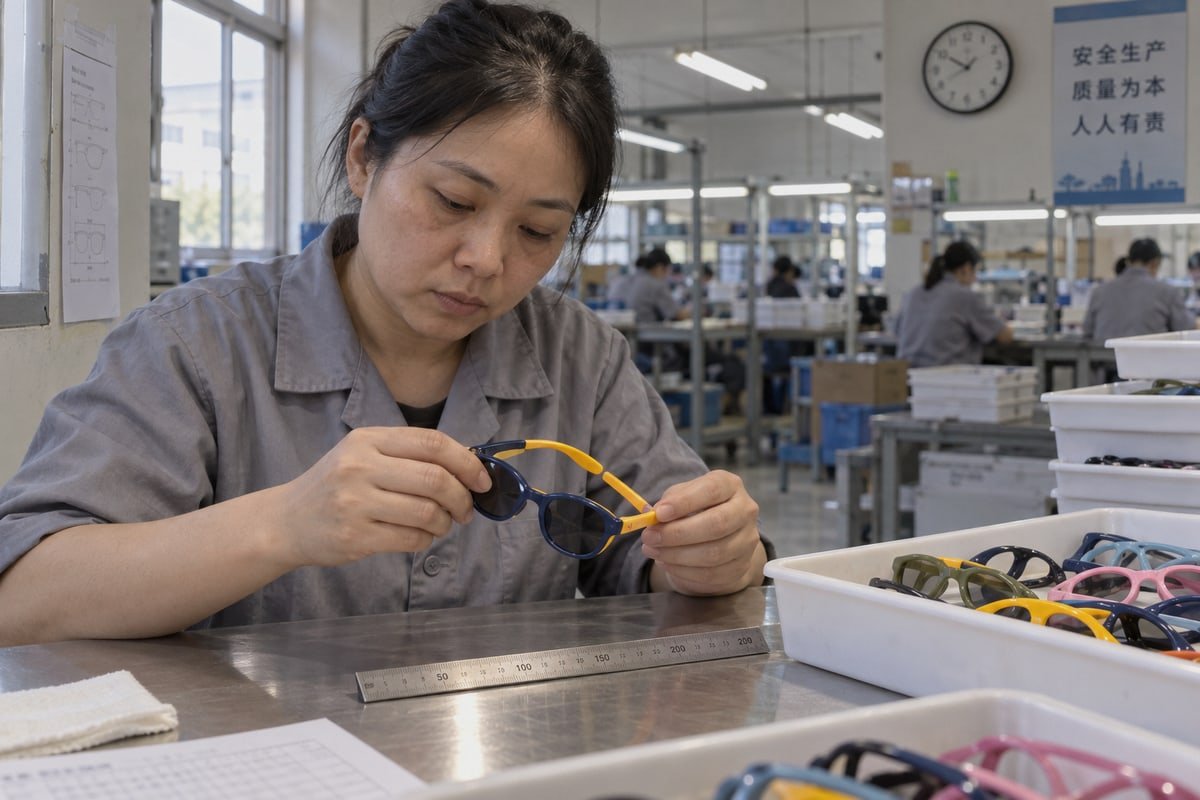
Ancho de la cara y distancia pupilar 1 para el tamaño de las gafas de sol TR90 para niños confunde a muchos compradores que visitan nuestra fábrica de Taizhou. Si se equivoca, las devoluciones se acumulan. Medir primero lo soluciona.
Para determinar el tamaño de las gafas de sol TR90 para niños, mida el ancho de la cara de sien a sien con una regla milimétrica rígida, luego mida la distancia interpupilar de centro a centro de la pupila mientras el niño mira al frente. Compare ambos números con el ancho de la lente, el ancho del puente y el ancho total de la montura, utilizando la flexibilidad del TR90 para una pequeña tolerancia.
Dos números hacen la mayor parte del trabajo. Esta guía le muestra cómo obtener ambos, cómo leer una tabla de tallas y dónde [los pedidos al por mayor](https://okayeyewear.com/how-size-kids-sunglasses-age-head-circumference-to/) suelen salir mal.
¿Cómo mido el ancho de la cara de mi hijo con precisión en casa antes de pedir gafas de sol?
Durante una ronda de control de calidad, observé a nuestro inspector revisar un modelo juvenil en una cabeza de maniquí. Pasó, pero la tabla del comprador había confundido el ancho de la lente con el ancho de la cara.
Mide el ancho de la cara de tu hijo sujetando una regla milimétrica rígida horizontalmente a través de la cara en el punto más ancho, de sien a sien, justo delante de las orejas. Mantenla ajustada sin presionar la piel, repite tres veces y anota el promedio en milímetros.
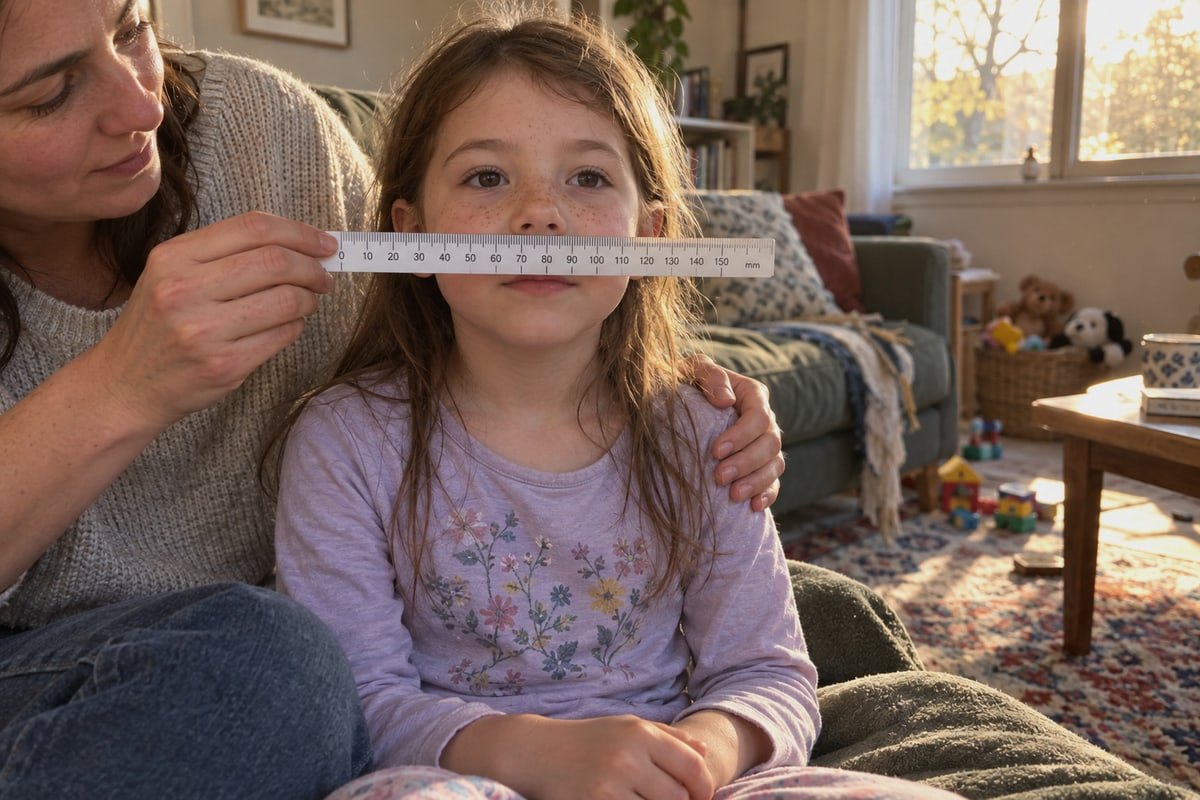
El ancho de la cara es el número que la mayoría de los padres se saltan. Miran la edad en la caja y esperan. En nuestra experiencia, esa esperanza es donde comienzan la mayoría de las quejas sobre el ajuste. Así que déjame desglosar la medición en pasos sencillos.
Qué significa realmente el ancho de la cara para las gafas de sol
El ancho de la cara es la distancia de sien a sien. Es la línea horizontal a través de la parte más ancha de la cara, aproximadamente a la altura de los ojos y justo delante de las orejas. Este número debe coincidir con el ancho total de la montura 2 de las gafas de sol. No es el ancho de la lente. Una montura con una lente de 45 mm puede tener fácilmente 120 mm de ancho una vez que se agrega el puente y las piezas finales. Esa brecha es la razón por la que tantas tablas engañan a la gente.
Un método sencillo paso a paso
- Siente al niño con buena luz, de frente a usted.
- Sostenga un regla milimétrica 3 nivel rígido.
- a través de la cara a la altura de las sienes.
- Mantenga la regla pegada a la piel. No presione.
- Lea el número donde la regla se une a la sien lejana.
Repita dos o tres veces y promedie los resultados.
Una cinta métrica de costura blanda se dobla alrededor de la cara. Esa curva agrega varios milímetros. Una regla rígida se mantiene recta, por lo que lee las dimensiones reales de la montura que el niño necesita.
| Método | Tres formas de obtener el número | Lo que necesitas | Lo mejor para |
|---|---|---|---|
| Precisión | Regla rígida en las sienes | Alta | Regla milimétrica, buena luz |
| La mayoría de los niños de 4 años en adelante | Gafas existentes que le quedan bien | Alta | Un par que ya encaja |
| Niños que ya usan gafas | Foto con una moneda para escalar | Medio | Cámara del teléfono, moneda |
Niños muy pequeños o inquietos.
El segundo método es uno que recomiendo a los compradores de marcas todo el tiempo. Si un niño ya tiene un par que le queda bien, mida esa montura de bisagra a bisagra. Ese número es su ancho total objetivo. Elimina las conjeturas.
¿Qué herramientas necesito para medir la distancia pupilar para monturas TR90 para niños?
El envoltorio alrededor de la cara agrega longitud a la curva, por lo que una cinta blanda lee varios milímetros de más; una regla milimétrica rígida mide la distancia en línea recta que abarca una montura.
Necesitas una regla milimétrica rígida o una regla de DP impresa, un espejo o un ayudante, buena iluminación y un punto de enfoque fijo al otro lado de la habitación. Las herramientas opcionales incluyen una aplicación de DP para smartphone calibrada con una tarjeta de crédito o un medidor de DP digital de un óptico.
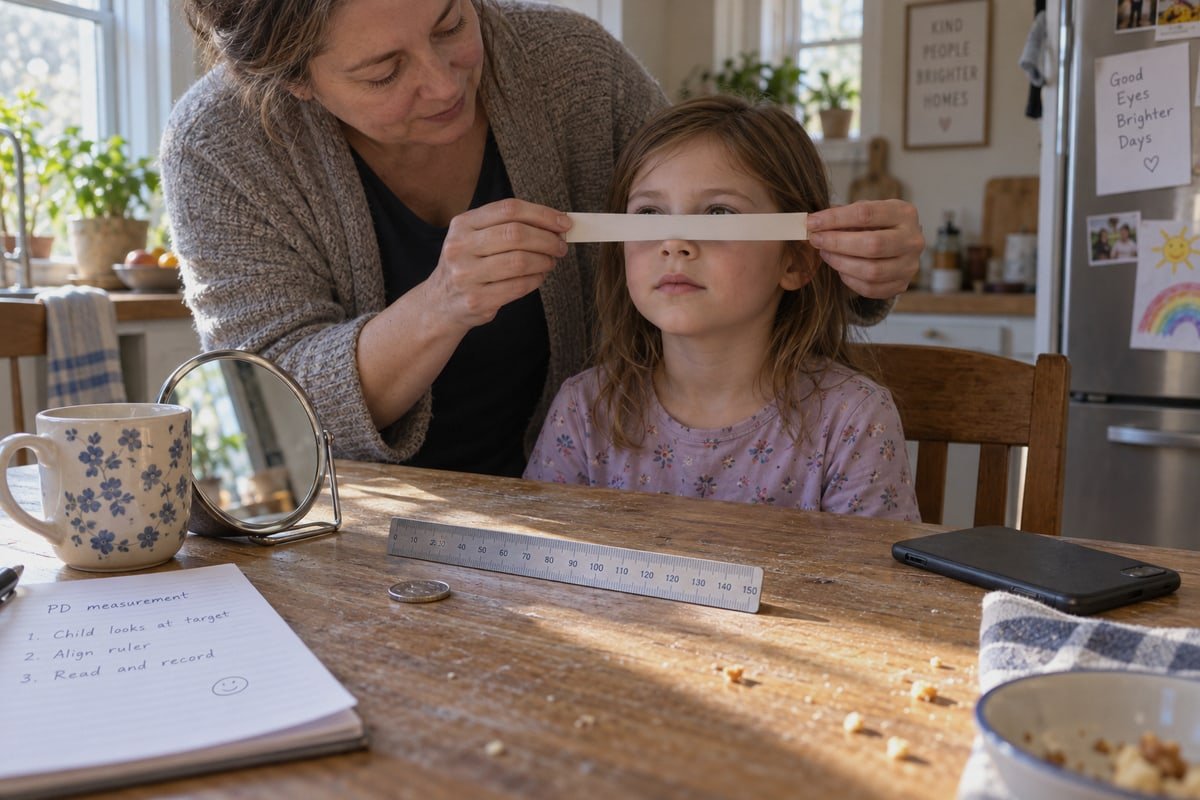
Elegir entre una regla milimétrica normal y una aplicación de teléfono es una compensación que sopeso a menudo con nuestros compradores de marcas. La regla no cuesta nada, pero un niño de cuatro años que se mueve pone a prueba la paciencia. centro óptico 4 La distancia interpupilar, o DP, es la distancia entre los centros de las dos pupilas. Siempre se escribe en milímetros. Cuando colocamos las lentes en un nuevo molde TR90, este es el número alrededor del cual diseñamos. Decide si el.
de cada lente se asienta sobre el ojo.
| Herramienta | Costo de herramienta único | Notas |
|---|---|---|
| El kit de herramientas básico | Muy bajo | Regla milimétrica rígida. |
| El estándar. Cualquier regla recta con marcas en mm funciona. | Regla de DP impresa | Gratis. |
| Mirror | Usually at home | For the self-measure method on older kids. |
| Helper | Regla de DP impresa | The most useful tool for young children. |
| Smartphone PD app | Free to low | Uses a credit card or coin for scale calibration. |
| Digital PD meter | Optician only | Very accurate, but not needed for non-prescription sunglasses. |
The helper method, step by step
I prefer this method for anyone under about eight years old.
- Have the child sit and look at a fixed point across the room. A picture on the wall works well.
- Stand in front of the child and hold the ruler flat across the bridge of the nose.
- Line up the zero mark with the center of the right pupil.
- Without moving the ruler, read the mark at the center of the left pupil.
- Repeat the reading 2 to 4 times and average them.
Children fidget. Averaging smooths out those small shifts. If the child keeps looking at you instead of the wall, ask a second adult to hold up a toy behind your shoulder.
The mirror method for older kids
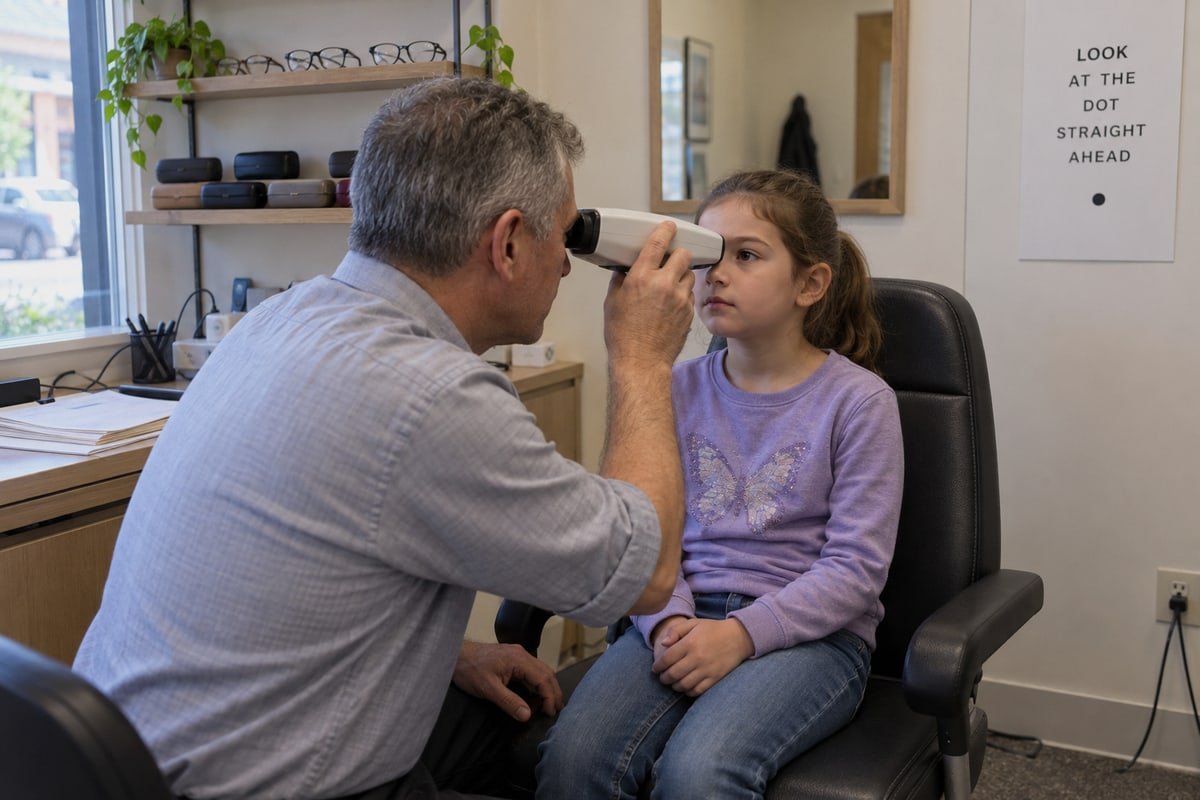
An older child can do this alone. They hold the ruler against the bridge of their nose, look into a mirror, close the right eye, and line zero up with the left pupil. Then they open the right eye, close the left, and read the mark at the right pupil. It takes practice. I still suggest a helper for a check.
What numbers to expect
Retailer guides commonly place children's PD between 43 and 58 mm. Some charts narrow that to 42 to 54 mm for younger kids. A toddler often sits in the low 40s. A ten-year-old may be near 55 mm. The exact number depends on head size, not just age.
Does PD really matter for sunglasses without prescription?
Some buyers push back here. They tell me PD only matters for optical lenses. I understand the point, but I disagree in practice. Poor optical center alignment on tinted lenses 5 means the child sees more frame edge and less lens. The sunglasses feel off, and kids take off things that feel off. Comfort and coverage matter as much as strict optics, and PD serves both.
¿Cómo hago coincidir las medidas de mi hijo con la tabla de tallas de gafas de sol TR90 correcta?
A procurement manager from Australia once emailed me a child's face width and PD and asked which of our 800 styles would fit. A size chart answered her.
Empareja las medidas leyendo el código de tamaño de la montura como ancho de lente–ancho de puente–longitud de patilla, duplicando el ancho de lente y sumando el ancho de puente para estimar el ancho total de la montura, luego eligiendo la banda de edad cuyo ancho total se encuentra a pocos milímetros del ancho de la cara y cuyos centros de lente se alinean con la PD.
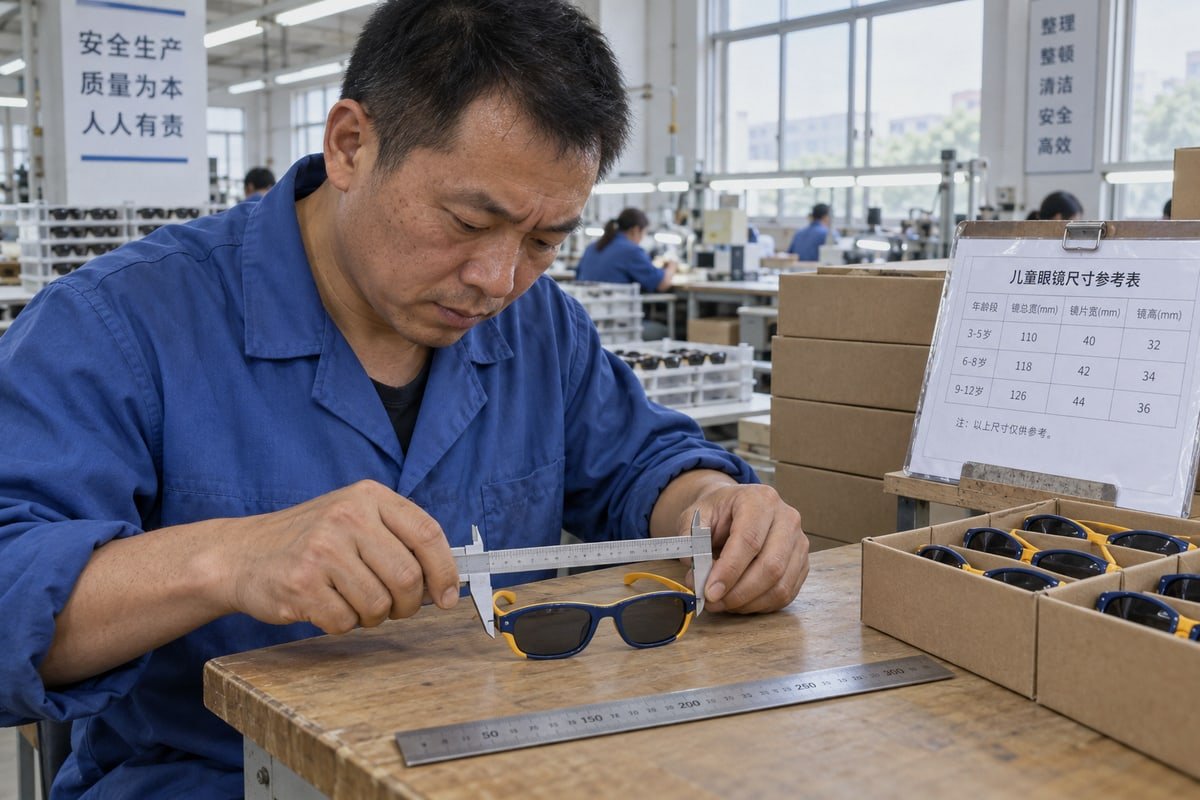
Once you have face width and pupillary distance, the chart does the rest. The trick is knowing what each number on the chart means. Here is how we explain it to new brand partners.
Decoding a size code like 49-16-130
Most kids' TR90 frames carry a three-part code. Take 49-16-130.
- 49 is the lens width in millimeters.
- 16 is the bridge width, the gap between the lenses at the nose.
- 130 is the temple length, from hinge to the tip behind the ear.
A smaller frame might read 45-16-125. Same bridge, smaller lens, shorter temple. Some listings add a fourth number for lens height, which matters for coverage on round toddler faces.
Two quick calculations
Primero, estimate frame PD. Add lens width and bridge width. For 49-16-130, that is 65 mm. Hmm, that seems large for a child, and it is. It tells you this frame suits an older youth with a PD in the mid-50s to high-50s, because a few millimeters of tolerance is normal. For 45-16-125, frame PD is 61 mm, closer to a child in the low 50s.
Second, estimate total frame width. Double the lens width, add the bridge, then add roughly 6 to 10 mm for the two end pieces. For 45-16-125, that gives about 106 to 116 mm. Compare that to the child's temple-to-temple distance.
A working kids' TR90 sizing chart
| Banda de edad | Ancho de lente | Ancho del puente | Longitud de la patilla | Rango típico de DP |
|---|---|---|---|---|
| Toddler (approx. 1–3) | 40–44 mm | 12–14 mm | 105–115 mm | 42–47 mm |
| Kids (approx. 4–7) | 44–48 mm | 14–16 mm | 115–125 mm | 46–52 mm |
| Junior (approx. 8–10) | 48–52 mm | 15–17 mm | 125–135 mm | 50–55 mm |
| Youth (approx. 11+) | 52–56 mm | 16–18 mm | 130–140 mm | 53–58 mm |
Treat the age labels as loose guides. The face width and PD columns are the ones that decide the sale. A large five-year-old may sit in the junior row. A small nine-year-old may sit in the kids row. Age is a rough proxy. Measurements are the real answer.
When the numbers fall between sizes
This happens often. My advice is simple. Choose the smaller size if the child's PD is closer to that frame's PD. Choose the larger size if the face width is more than 5 mm over the smaller frame's total width. TR90 bends outward a little at the temples. Our frames with TPEE temples flex even more. That flex gives you a few millimeters of grace, not a full size.
Bridge width deserves its own check
Bridge width often gets ignored. A bridge that is too wide lets the frame slide down the nose. The lenses then sit low, and the child looks over the top. Compare the middle number in the code to the child's nose. If an existing pair fits well at the nose, copy its bridge number.
¿Qué errores de tamaño debo evitar al pedir gafas de sol TR90 para niños al por mayor?
One lesson fifteen years of eyewear production taught our team: bulk sizing errors multiply. A single wrong chart on a container order becomes a container of returns.
Evita confundir el ancho de la lente con el ancho total de la montura, elegir la talla por edad solamente, usar una cinta métrica flexible en lugar de una regla rígida, ignorar el ancho del puente, omitir la longitud de las patillas, confiar en la flexibilidad del TR90 para corregir un mal ajuste inicial y pedir una talla para un amplio rango de edad sin pruebas de muestra.
Bulk buying changes the math. A parent who mis-measures loses one pair. A brand that mis-sizes loses a whole run. Here are the mistakes I see most, and what we do on our production line to help buyers avoid them.
The mistakes that cost the most
| Error | Why it hurts | Solucionar |
|---|---|---|
| Reading lens width as frame width | Frames arrive 20–30 mm wider than expected | Always calculate total width from the full size code |
| Sizing by age only | Same-age kids vary by 10 mm or more in face width | Build your chart around face width and PD |
| Ignoring bridge width | Frame slides down, lenses sit low | Match the middle number to nose width |
| Skipping temple length | Temples too short pinch; too long slip | Check the third number against ear-to-hinge distance |
| Relying on "flex-fit" | Flex hides a few mm, not a full size | Set a baseline fit first, then let TR90 add tolerance |
| No sample test | Errors are found after the container lands | Test samples on real children before mass production |
The flex-fit objection, answered
Buyers sometimes tell me that TR90 is flexible, so exact sizing is less important. There is some truth in that. TR90 is a flexible thermoplastic material with strong resistencia al impacto 6 and hypoallergenic properties, and it does give a wider fit window than rigid acetate. But flex is a cushion, not a cure. A frame 15 mm too wide will still slide off a small face, no matter how well it bends. Use the flex to cover growth and small variance. Do not use it to skip measuring.
The warm fit test
Here is a simple check we suggest before any brand finalizes a size range. Have a child wear the sample for five to ten minutes. TR90 softens slightly with body heat and settles onto the face. After that time, look at three things. Do the lenses sit centered over the eyes? Do the temples touch the head without leaving marks? Does the frame stay put when the child looks down? If all three pass, the size is right.
One size does not fit ages 3 to 12
A single "kids" size covering toddlers through pre-teens almost always fails at one end. Spread the range. Even two sizes, a kids and a junior, cut return rates sharply. With around 800 existing styles in our catalog, a brand can pick a toddler eyewear sizing chart, a kids band, and a youth band without paying for new molds. That keeps the first order low-risk.
A short pre-order checklist
- Confirm face width and pupillary distance ranges for each target grupo de edad.
- Decode every código de talla into lens width, bridge width, temple length, and total width.
- Request samples in each planned size, then run the warm fit test on real children.
- Ask your supplier for lens height, since round toddler faces need taller coverage.
- Confirm UV400 or polarized lens specs alongside the frame dimensions.
- Lock the size chart into the packaging artwork so retail shoppers measure before buying.
Conclusión
Guessing sizes costs brands returns and trust. Measure face width and PD, match them to real frame dimensions, and let TR90 flex handle the rest. We can help.
¿Interesado en obtener los productos mencionados en este artículo? Ver detalles y solicitar un presupuesto aquí:
Notas al pie
1. Official American Academy of Ophthalmology guide on measuring PD. ↩︎
2. Detailed explanation of eyeglass frame components and sizing dimensions. ↩︎
3. NIST official reference for SI length units including millimeters. ↩︎
4. Technical definition of the optical center within a lens system. ↩︎
5. Professional explanation of lens types and their impact on visual performance and protection. ↩︎
6. International standard for sunglasses safety and impact performance requirements. ↩︎
Más artículos que te podrían gustar

28 de septiembre de 2026
¿Pueden las gafas de sol para niños TR90 y TPEE utilizar materiales reciclados o de base biológica?

28 de septiembre de 2026
¿Son reciclables las gafas de sol para niños TR90 y TPEE? Explicación de los consejos de eliminación.

28 de septiembre de 2026
¿Cómo evitar deformaciones y arañazos al enviar gafas de sol para niños TR90 y TPEE?
¿Buscas un socio confiable en gafas para niños?
Explore más de 800 estilos listos y soporte OEM/ODM completo adaptado a su marca.
Ponte en contacto English
 Español de México
 Deutsch
 Français
 日本語
 العربية
 Português do Brasil