Was sind regionale Präferenzen, die bei der Beschaffung von Sonnenbrillen für Kinder für Europa und die USA wichtig sind?
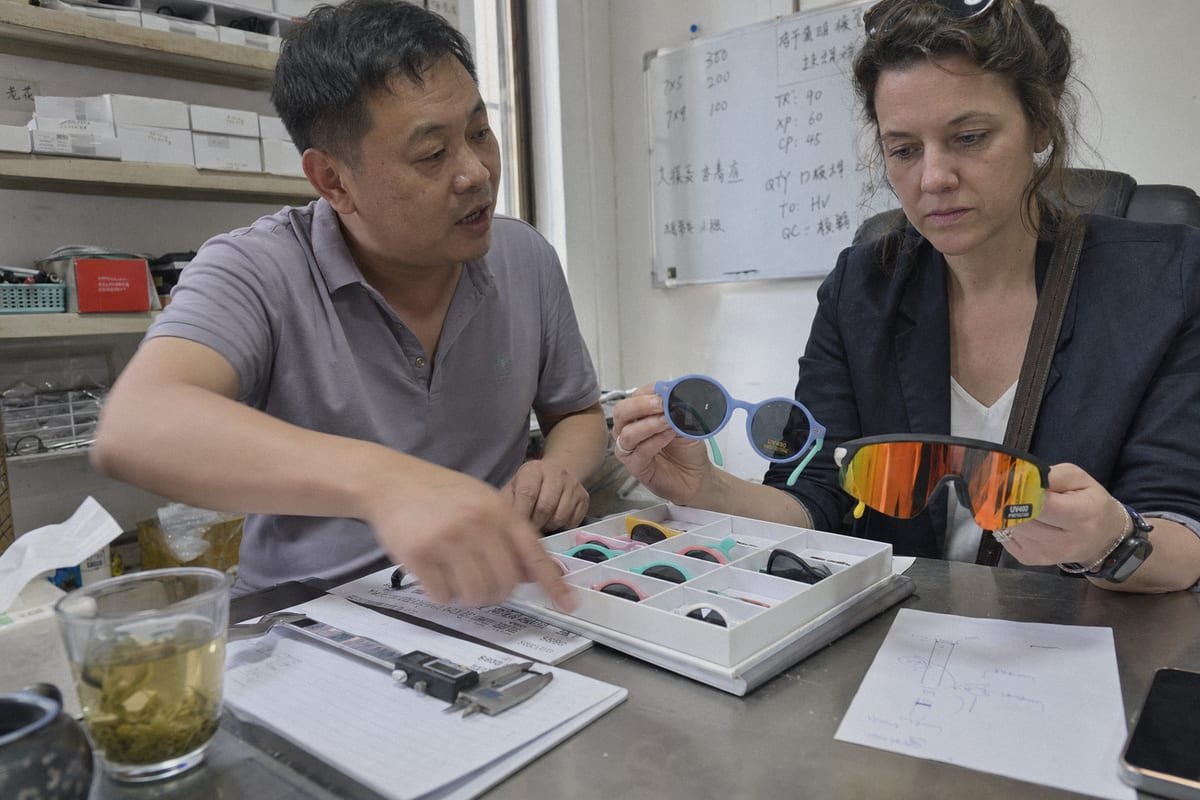
Die Beschaffung von Sonnenbrillen für Kinder für Europa und die USA scheint einfach zu sein, bis eine Bestellung abgelehnt wird. An unserer Produktionslinie in Taizhou habe ich Käufer ganze Saisons wegen einer falschen Annahme verlieren sehen.
Bei der Beschaffung von Sonnenbrillen für Kinder für Europa und die USA belohnt Europa Zertifizierung, die Einhaltung der CE-Kennzeichnung, hochwertige Materialien und das Vertrauen des Optikhandels, während die USA Markenidentität, lizenzierte Stile, polarisierte Hochleistungslinsen und breite Preisstaffeln belohnen. UV400-Schutz ist in beiden Märkten die nicht verhandelbare Basis.
Das gleiche Paar Sonnenbrillen kann in beiden Regionen erfolgreich sein – aber aus unterschiedlichen Gründen. Ich werde genau aufschlüsseln, was sich von Markt zu Markt ändert.
Wie unterscheiden sich europäische und US-amerikanische Sicherheitsstandards für Kinder-Sonnenbrillen?
Ein deutscher Käufer bat mich einmal um unsere vollständige technische Dokumentation, bevor wir überhaupt über den Preis sprachen. Ein US-Käufer bat in der gleichen Woche zuerst um Ergebnisse des Falltestes. Dieser Kontrast lehrte mich alles über diese beiden Märkte.
Europa klassifiziert Sonnenbrillen als persönliche Schutzausrüstung gemäß der Verordnung 2016/425, die eine CE-Kennzeichnung und die Konformität mit EN ISO 12312-1 erfordert. Die USA behandeln sie als medizinische Geräte der Klasse I unter Aufsicht der FDA, was die Konformität mit ANSI Z80.3 und Schlagfestigkeitsprüfungen gemäß 21 CFR 801.410 erfordert.

Die beiden Regulierungssysteme gehen von unterschiedlichen Philosophien aus. Europa behandelt eine Sonnenbrille für Kinder als Schutzausrüstung. Das bedeutet, das Produkt muss beweisen, dass es schützt, bevor es auf den Markt kommt. Die USA behandeln Sonnenbrillen als ein medizinisches Gerät mit geringem Risiko. Der Schwerpunkt liegt dort stark auf der Schlagfestigkeit der Gläser und der wahrheitsgemäßen Kennzeichnung.
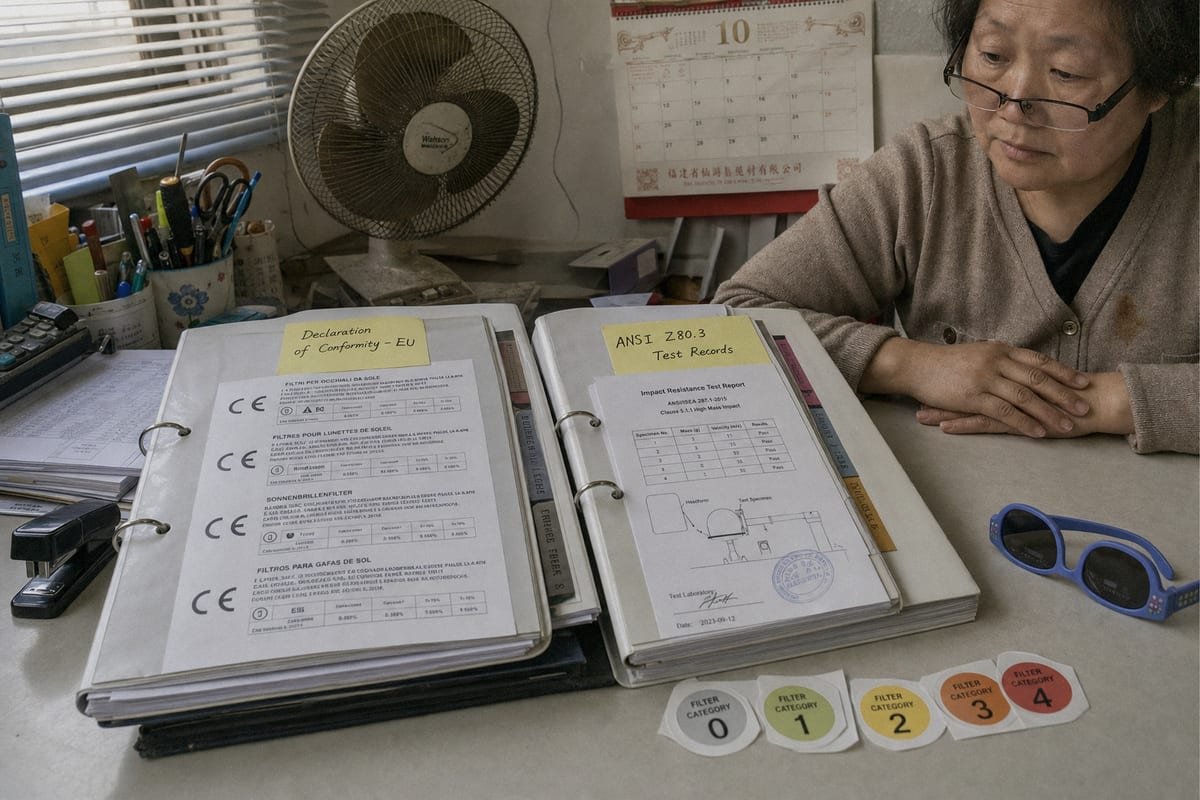
In unseren fünfzehn Jahren des Exports von Kinderbrillen war der Dokumentationsaufwand auf europäischer Seite immer höher. Europa verlangt eine Konformitätserklärung 1, eine technische Dokumentation und eine Kennzeichnung, die oft in mehreren Sprachen für den grenzüberschreitenden Einzelhandel erfolgen muss. Die USA sind ein einsprachiger Markt mit einer einfacheren Papierarbeit, aber der Fallschlagtest ist streng und nicht verhandelbar.
Wichtige Compliance-Unterschiede im Überblick
| . Schlagfestigkeitsprüfungen sind eine separate Verpflichtung von CPSIA-Prüfungen. Viele Importeure müssen sich auch bei der FDA als Erstimporteur registrieren und das Produkt als medizinische Klasse-I-Gerät auflisten, um eine Beschlagnahmung der Sendung an der Grenze zu vermeiden. | Europa | Vereinigte Staaten |
|---|---|---|
| Rechtliche Einstufung | PSA (Verordnung 2016/425) | Medizinisches Gerät der Klasse I (FDA) |
| Kernstandard | EN ISO 12312-1 2 Standard | ANSI Z80.3-Zertifizierung |
| Obligatorische Kennzeichnung | CE-Kennzeichnung | Keine Kennzeichnung, aber 21 CFR 801.410 Schlagtest |
| Glasbeschriftung | Filterkategorie 0–4 | UV-Angaben müssen belegt werden |
| Dokumentation | Konformitätserklärung, mehrsprachig | Englische Kennzeichnung, Testprotokolle |
Warum das für die Beschaffung wichtig ist
Wenn Ihre Fabrik nicht echte Testberichte gegen beide Rahmenwerke vorlegen kann, tragen Sie die Haftung. Wir halten Dokumentationen für beide Regionen bereit, da viele unserer Kunden über den Atlantik mit einer Produktlinie verkaufen. Ein praktischer Tipp: Stellen Sie sicher, dass die Glasfilterkategorien für Europa korrekt aufgedruckt sind. Einzelhandelskäufer dort prüfen dies, und fehlende Kategorieetiketten können die Zollabfertigung verzögern oder Rücksendungen von Optikketten auslösen.
Materialien sind auch für Regulierungsbehörden wichtig. Schlagfeste Materialien wie TR90 und flexible BPA-frei 3 TPEE-Rahmen reduzieren das Bruchrisiko bei aktiven Spielen, was die Compliance-Darstellungen in beiden Märkten unterstützt. Ein steifer, spröder Rahmen, der in scharfe Kanten bricht, ist überall ein Problem.
Welche Brillengestell-Stile und -Farben sprechen Käufer in Europa im Vergleich zu den USA am meisten an?
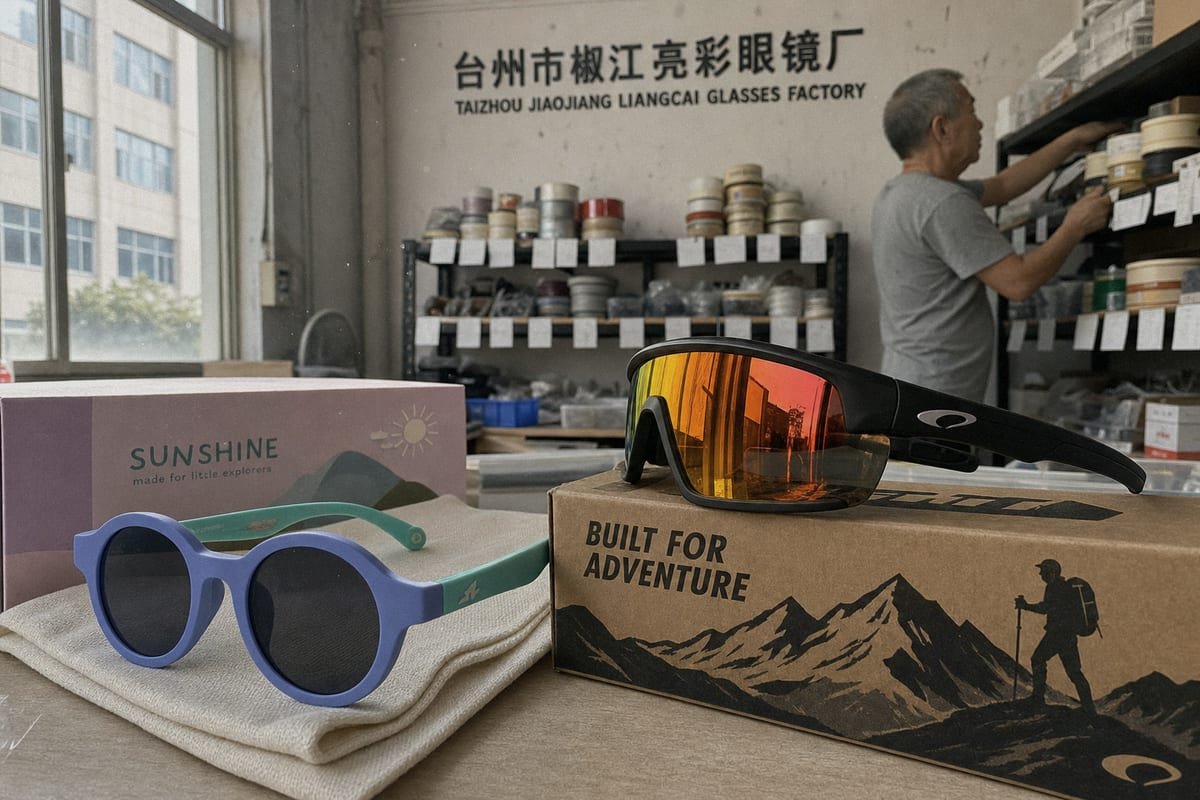
Zwei unserer meistverkauften Formen erzählen diese Geschichte perfekt. Ein weicher, pastellfarbener runder Rahmen – zartes Blau mit mintfarbenen Bügeln – wird hauptsächlich an europäische Boutiquen geliefert. Eine schwarze Sport-Wraparound-Brille mit verspiegeltem orangefarbenem Glas wird hauptsächlich an amerikanische Outdoor-Marken geliefert.
Europäische Käufer bevorzugen raffinierte, minimalistische Kinder-Sonnenbrillen in gedeckten Pastelltönen, Retro-Rundformen und Mini-Me-Erwachsenen-Silhouetten mit hochwertigen Oberflächen. US-Käufer bevorzugen kräftigere Farben, lizenzierte Charakterthemen, sportliche Wraparounds und verspiegelte Gläser, unterstützt durch breitere Passformbereiche und ein Gut-Besser-Beste-Sortiment.
Stilpräferenzen sind nicht zufällig. Sie folgen der Einzelhandelsstruktur. Europa verkauft einen großen Teil der Kinderbrillen über Optikergeschäfte und Premium-Boutiquen. Diese Kanäle belohnen poliertes Design, dezente Farbpaletten und eine Story, die auf Qualität setzt. Die USA verkaufen stark über den Massenmarkt, E-Commerce und spezialisierte Outdoor-Geschäfte. Diese Kanäle belohnen Regalwirkung, erkennbare Charaktere und aktivitätsspezifische Designs.
Stilrichtung nach Region
| Designelement | Europa | Vereinigte Staaten |
|---|---|---|
| Farbpalette | Pastelltöne, Erdtöne, gedeckte Zweifarbigkeit | Hell, kräftig, verspiegelt, hoher Kontrast |
| Silhouette | Rund, Retro, Mini-Me-Klassiker | Wraparound, Sport-Shield, übergroß |
| Charakterlizenzierung | Vorhanden, aber sekundär | Wichtiger Konversionsfaktor |
| Oberflächenpräferenz | Matt, gummiert, raffiniert | Glänzend, schillernd, auffällige Gläser |
| Fit expectations | Narrower, higher-bridge standards | Broader global-fit and alternative-fit needs |
The mini-me trend runs strong in both regions. Parents like children's versions of aviators and wayfarers that echo their own eyewear. But the execution differs. In Europe, a mini-me frame should look like a scaled-down premium adult frame. In the US, the same silhouette can carry a superhero print or a color-shift mirrored lens and sell even better.
Fit is another quiet difference. Our US clients increasingly request wider frames and adjusted bridge fits to serve diverse facial morphologies. European collections still skew toward narrower, high-bridge anatomical standards. When we develop a shared style for both markets, we often run two bridge variants from one design language. With roughly 800 existing styles in our catalog, most buyers can find both directions without investing in new molds—which lowers the risk of testing a new market.
Sustainability also shapes European style briefs. Buyers there ask about sustainable eyewear materials 4, bio-based options, and recyclability far more often than US buyers do. In the US, "Made in USA" storytelling and durability guarantees come up more frequently instead.
Priorisieren europäische und US-amerikanische Eltern unterschiedliche Brillenglasmerkmale wie UV400 oder Polarisation?
Lens specification calls are where I spend the most time with new clients. A UK importer and a Texas outdoor brand can order the same frame, yet their lens briefs read like different documents.
Beide Regionen fordern als Basis vollständigen UV400-Schutz, aber europäische Eltern konzentrieren sich auf zertifizierte Filterkategorien, optische Glaubwürdigkeit und gekennzeichnete Schutzstufen. US-Eltern erwarten häufiger polarisierte Gläser als Standard, plus aufkommende Hybridfunktionen wie Blaulichtfilterung für bildschirmintensive Lebensstile.
UV protection is the universal purchase driver. Children's eyes let more UV-Strahlung 5 reach the retina than adult eyes, and parents in both regions know this. A German consumer study found that a large majority of buyers rank UV protection as their main sunglasses purchase criterion. So UV400 protection standards must anchor every product story you build, on both sides of the Atlantic.
The divergence appears above that baseline. European buyers speak the language of certification. They want the lens filter category (0–4) printed clearly, EN ISO 12312-1 test evidence available, and claims that an optician would endorse. The trust framework is regulatory. US buyers speak the language of features and benefits. Polarized lenses for children are frequently treated as a default expectation rather than an upgrade, especially in outdoor, boating, and travel-focused assortments.
How Lens Priorities Stack Up
| Lens attribute | Europa | Vereinigte Staaten |
|---|---|---|
| UV400-Schutz | Mandatory baseline, certification-led | Mandatory baseline, benefit-led |
| Polarisierung | Valued, roughly a third of youth sales | Often expected as standard |
| Filter category labeling | Critical trust signal | Rarely requested |
| Mirrored / gradient coatings | Selective, fashion-driven | Popular for sport and style |
| Blue-light hybrid lenses | Emerging slowly | Growing fast among tech-parents |
The Hybrid Lens Question
One trend we watch closely: US "tech-parents" are asking for hybrid lenses that combine UV protection with blue-light filtering 6 for kids who move between playgrounds and tablets. This request is currently outpacing similar interest from Europe. When we quote these projects, we advise clients to keep the outdoor UV claim primary and the blue-light claim secondary, so the product stays credible under both ANSI Z80.3 certification expectations and FDA labeling rules.
My practical advice: specify polarized options for any US-focused line, and specify printed filter categories plus documentation for any European line. Doing both from the start costs little and keeps one production run viable for two markets.
Wie sollte ich Verpackung und Branding für europäische und US-amerikanische Einzelhandelsmärkte anpassen?
Early in my export career, a Dutch distributor returned a packaging proof because the compliance panel was too small and only in English. That single revision round taught our team more than any seminar could.
Für Europa muss die Verpackung mit der Konformität beginnen: CE-Kennzeichnung, Filterkategorie, mehrsprachige Kennzeichnung und Zertifizierungshinweise, idealerweise mit nachhaltigen Materialien. Für die USA sollte die Verpackung mit der Markengeschichte, Lifestyle-Bildern, Regalwirkung und Nutzenhinweisen wie Polarisations- und Haltbarkeitsgarantien beginnen.
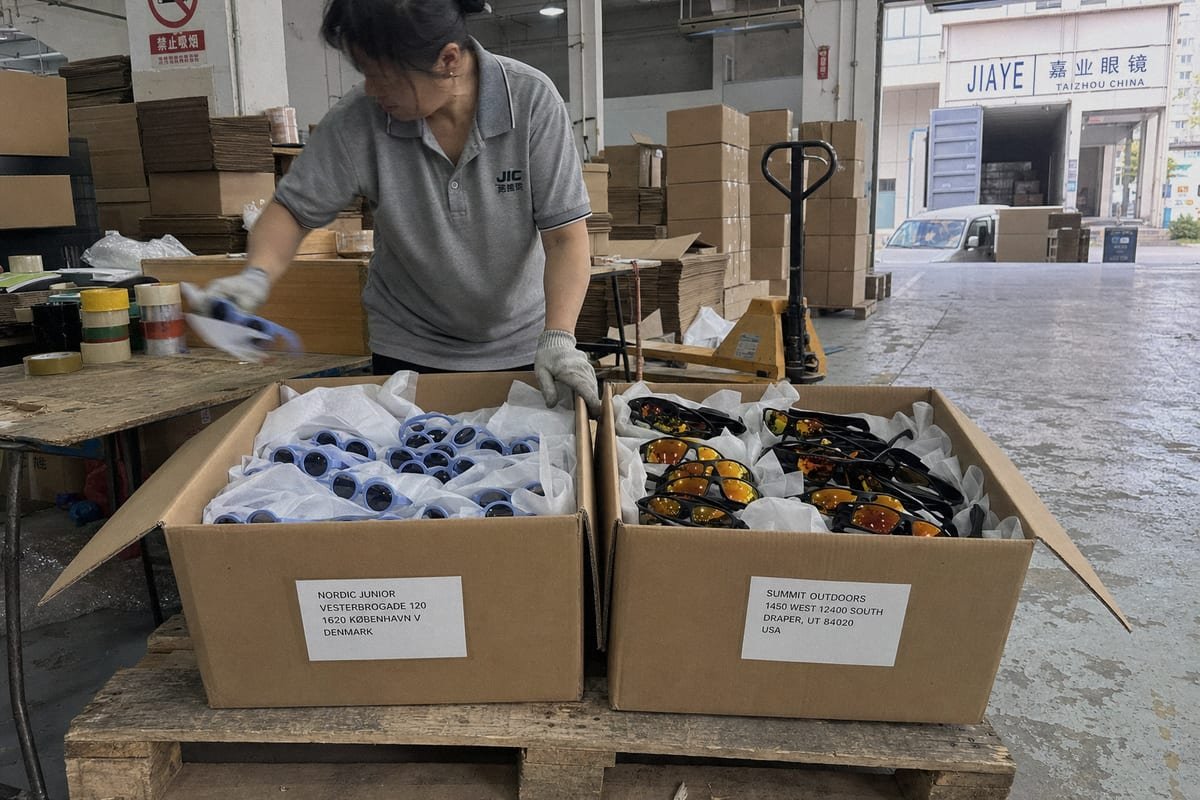
Packaging is not decoration. It is the last trust checkpoint before purchase. And the trust triggers differ sharply by region.
The European Packaging Checklist
European retail—especially optical channels—reads packaging like a document. In our OEM/ODM projects for European brands, we build packaging around these elements:
- CE mark and reference to the EN ISO 12312-1 standard, printed legibly.
- Lens filter category (0–4) stated on the box or hang tag.
- Multilingual copy covering the destination markets, since cross-border sales demand it.
- A Declaration of Conformity available to the retailer on request.
- Material story: eco-friendly, BPA-free TPEE frames and recyclable packaging respond directly to the EU's push on sustainable design.
Understated design works here. Muted colors, clean typography, and a quality narrative outperform loud graphics in most European kids eyewear channels.
The US Packaging Playbook
American shelves and product listings compete on attention. Our US clients typically request:
- Bold brand-forward graphics with lifestyle photography—beach, bike, ballpark.
- Clear benefit callouts: "100% UV400," "Polarized," "Flexible & Unbreakable."
- Peg-ready or counter-display formats for mass retail and e-commerce bundling.
- Support for service-led offers, such as lost-or-broken replacement guarantees, which favor higher-margin durable frames over budget-tier units.
- FDA approved eyewear 7 positioning through documented impact testing, referenced simply rather than technically.
For brands running wholesale private label sunglasses programs in both regions, we usually recommend one shared structural box with two printed variants. The frame inside stays identical. The trust language changes. This approach keeps minimums manageable while giving each market the signals its shoppers expect. One warning from experience: never ship the US-branded version into European distribution to save costs. Missing compliance labeling erodes retailer trust fast, and in Europe trust is the entire sale.
Schlussfolgerung
One product, two buying logics. Europe buys certified trust; the US buys brands and benefits. Source kids sunglasses with both playbooks ready, and both mature markets open up.
Fußnoten
1. Explains the EU conformity documentation required for PPE-classified sunglasses exports. ↩︎
2. Official ISO source clarifying the sunglasses safety standard referenced for European compliance. ↩︎
3. Current FDA guidance on the safety and regulatory status of Bisphenol A (BPA) in consumer products. ↩︎
4. Background on sustainable design concepts relevant to European eyewear sourcing trends. ↩︎
Weitere Artikel, die Ihnen gefallen könnten



Auf der Suche nach einem zuverlässigen Partner für Kinderbrillen?
Entdecken Sie über 800 sofort verfügbare Modelle und umfassenden OEM/ODM-Support, der auf Ihre Marke zugeschnitten ist.
Kontakt aufnehmen English
  Español de México
  Deutsch
  Français
  日本語
日本語  العربية
  Português do Brasil