Will TR90 & TPEE Kids Sunglasses Frames Yellow During Long-Term Storage?
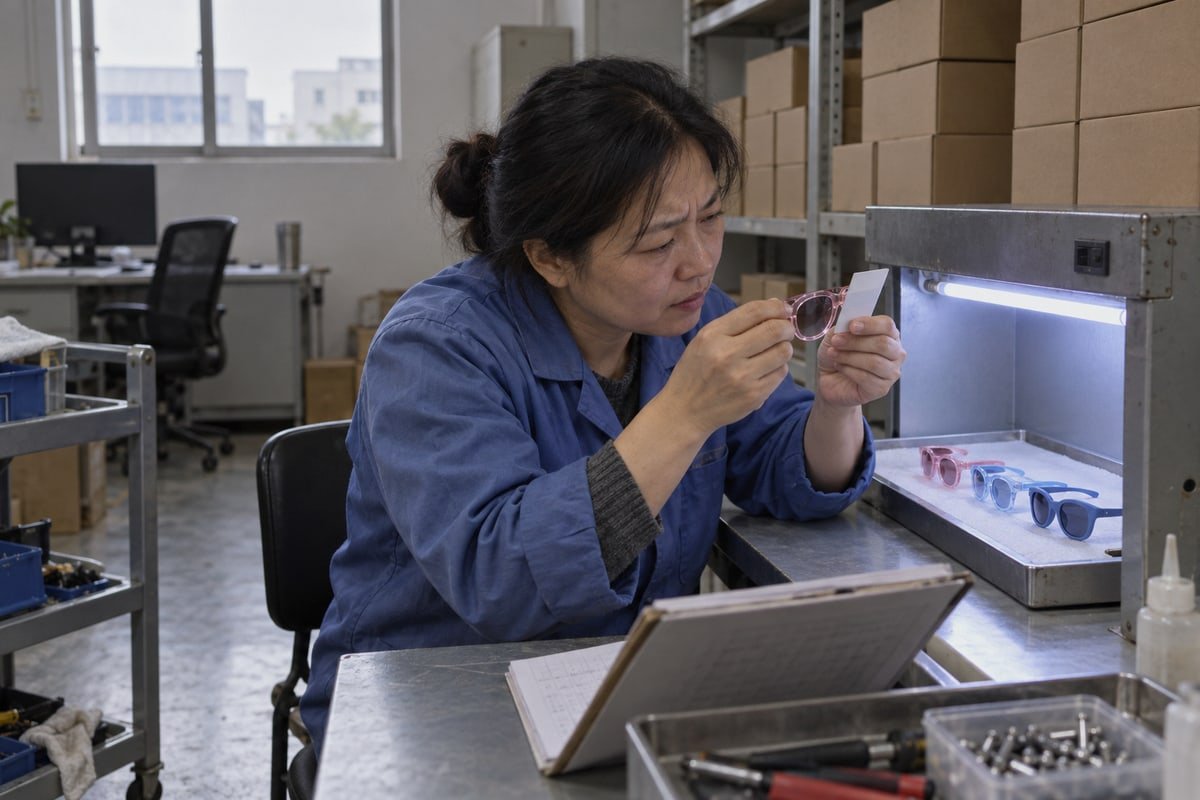
Nothing kills a launch like clear frames turning amber in the warehouse UV stabilizer packages 1. That worry reached our Taizhou line when a buyer asked about [TR90 & TPEE kids sunglasses frames](https://okayeyewear.com/tpee-vs-tr90-pc-material-best-kids-sunglasses/).
TR90 & TPEE kids sunglasses frames usually will not yellow during long-term storage if the resin is UV-stabilized and the frames are kept cool, dry, and dark. Neither material is fully yellow-proof, though. Clear colors, heat, humidity, and packaging chemicals can still cause slow discoloration over several years.
That short answer hides a lot of detail. Below I walk through how to spot risk before ordering, how to store stock, what upgrades you can ask for, and when yellowing becomes a safety issue.
How can I tell if TR90 or TPEE frames are prone to yellowing before I place a bulk order?
Every new resin batch that enters our workshop gets a simple check first: we mold a few clear test pieces and leave them under a UV lamp beside a control.
You can judge yellowing risk by asking for the resin grade and supplier name, confirming UV stabilizers are in the formulation, requesting accelerated aging test data, and inspecting clear samples for a warm tint. Also check whether the frame is translucent or opaque, since clear frames show aging first.
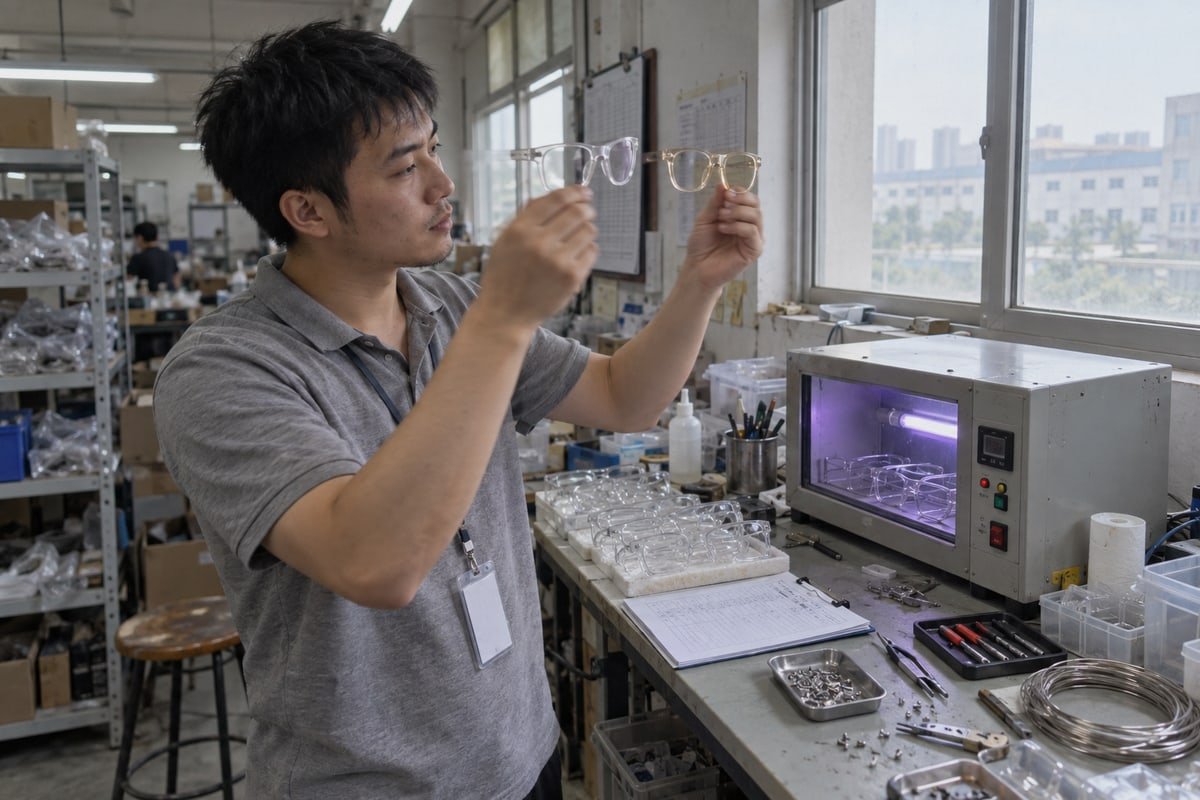
Start with the resin grade, not the marketing label
The word TR90 is used loosely in the eyewear trade. Strictly, it points to a polyamide family. The best-known branded grade is Grilamid TR-90. When a supplier can name the grade and its source 2, you know the stabilizer content is consistent from lot to lot. When the answer is just "TR90-type material," the formulation could change every order.
TPEE is a thermoplastic polyester elastomer. Its thermoplastic elastomer properties 3 are what make it so good for kids' temples. It bends, twists, and returns to shape. But public evidence on its long-term color stability is thinner than it is for TR90. So you should ask about it directly. Do not assume.
Questions to ask before a bulk order
| Frage | Good answer | Warning sign |
|---|---|---|
| Which resin grade and supplier? | A named grade such as Grilamid TR-90, plus a specified TPEE hardness | "Similar to TR90" with no source |
| Are UV stabilizers in the formulation? | Yes, documented for each color | "Not needed, the material is UV-proof" |
| Is there accelerated aging test data? | Yes, for example minimal yellowing after 1,000+ hours of UV exposure | No data, only a verbal promise |
| How does a clear sample look today? | Neutral, water-clear | Warm cast on a brand-new sample |
| What hardware is used? | Plated or stainless hinges and screws | Bare metal that can oxidize green |
One caution on the 1,000-hour figure. It is a supplier-specific claim, not a universal property of the material. Ask which resin, which color, and which test standard it refers to.
Read the sample with your own eyes
Translucent frames reveal aging first. Our gradient coral-pink style and our crystal sky-blue style show every shade shift. Our opaque slate-blue kids frame can go through the same polymer oxidation 4 and nobody would notice. That is why I always tell buyers to judge the clear colorway, not the dark one.
Time matters too. Low-quality clear frames in a high-UV setting can show yellowing in as little as 6 to 12 months. Good ones stay clear for several years. So ask for a sample that has already sat in the factory showroom for a year. It tells you more than a piece molded last week.
Finally, look closely near the hinges. A greenish or yellow stain right at the rivet is often metal oxidation, not resin aging. That is a hardware problem, and it has a different fix.
What storage conditions should I follow to keep my kids' sunglasses inventory from discoloring?
One lesson cost us a re-pack: cartons stored near a south-facing loading door came back warmer in tone than the same lot kept deep inside the racks.
Store kids' sunglasses in a cool, dry, dark space, ideally inside UV-blocking hard cases or opaque cartons. Keep them away from windows, heat sources, and damp floors. Wipe off sweat and skin oils before storage, and avoid cardboard or plastic packaging that contains BHT antioxidants.
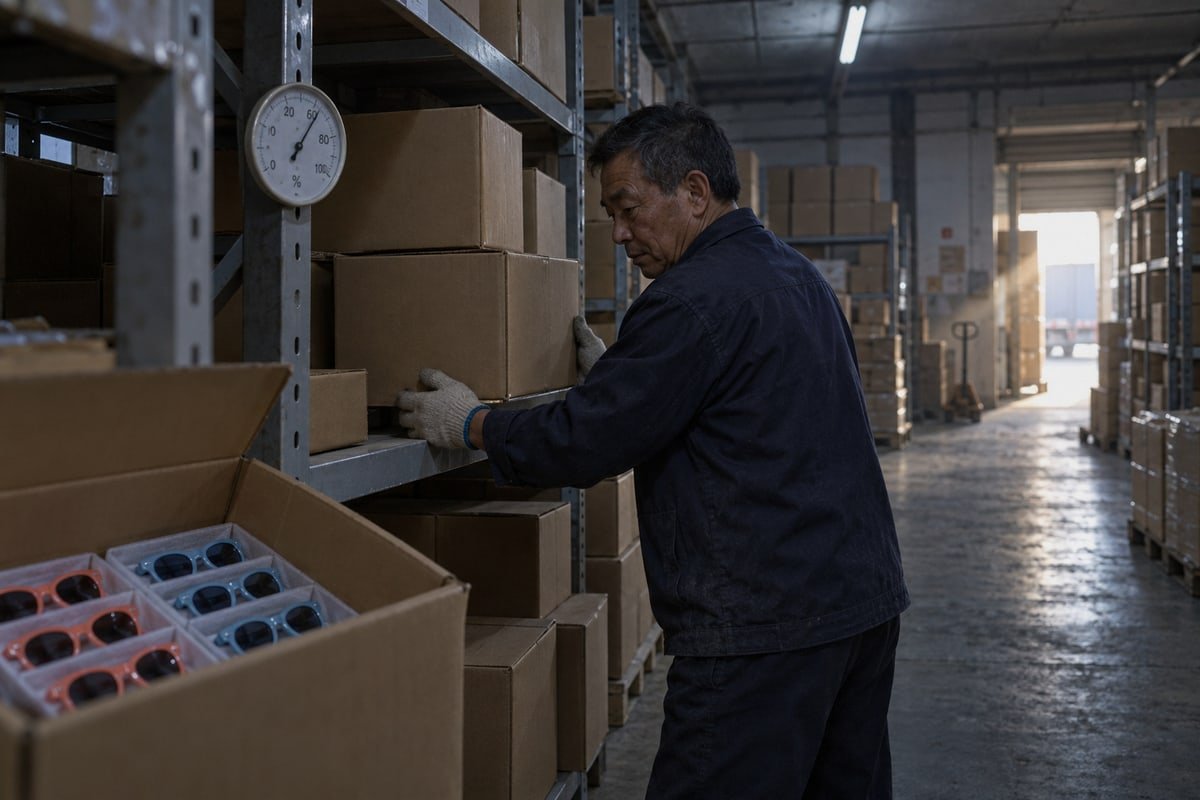
Light, heat, and moisture are three separate threats
Most people think only about sunlight. UV degradation is the main driver, yes. But yellowing does not stop when the lights go off. Thermal oxidation keeps working in total darkness, only slower. A warm, sealed stockroom can age a clear frame without a single ray of sun.
TR90 has its own quirk. It is a polyamide, and polyamides carry residual amino end-groups from the polymer chain. These oxidize slowly over time and produce what the trade calls dark yellowing. This process is independent of light. Good thermal stability 5 in the resin grade slows it down. Cool storage slows it further.
TPEE has a different weak point. It is a polyester, so its ester bonds can break down when moisture is present. This is hydrolytic yellowing. Its moisture absorption rate is what makes humidity control more important for TPEE temples than for TR90 fronts. Since many of our best-selling styles use a TR90 front with TPEE temples, we treat humidity as seriously as sunlight.
| Storage factor | What it does to the frame | Target condition |
|---|---|---|
| UV-Licht | Drives photo-oxidation of the surface | No direct or indirect sunlight; opaque cartons or cases |
| Heat | Speeds thermal oxidation and amino end-group aging | Stable room temperature; no hot cars, radiators, or sealed sunny rooms |
| Humidity | Hydrolysis of TPEE ester bonds; metal hardware oxidation | Dry room, pallets off the floor, desiccant in cartons |
| Skin residue | Sweat, sunscreen, and cosmetics trigger local reactions | Wipe every frame before packing |
| Packaging chemicals | BHT migrating from cardboard or poly bags causes phenolic yellowing | BHT-free packaging materials |
A simple pre-storage routine
- Clean each frame with a mild eyewear-safe cleaner. TR90 has decent chemical resistance, but alcohol, acetone, and thinners can still dull the surface and make aging look worse.
- Let the frame dry fully. Trapped moisture is the enemy of TPEE and of metal screws.
- Place the frame in a case or a BHT-free bag.
- Pack cartons away from exterior walls and doors that catch afternoon sun.
- Rotate stock first-in, first-out. Material shelf life is real, and the oldest cartons should ship first.
This kind of discoloration prevention costs almost nothing. It just needs to be written into the warehouse routine.
Can I request anti-yellowing material upgrades or additives when I customize my frames with a manufacturer?
Adding more UV stabilizer to a translucent coral-pink frame sounds like a free win. In practice we weigh it against clarity, cost per kilo, and color matching across batches.
Yes. Under an OEM or ODM program you can request UV stabilizer packages, higher-grade resin such as Grilamid TR-90, blue-masking optical brighteners, opaque or darker colorways, and UV-blocking packaging. Ask the factory to document the formulation and back it with accelerated aging test results.
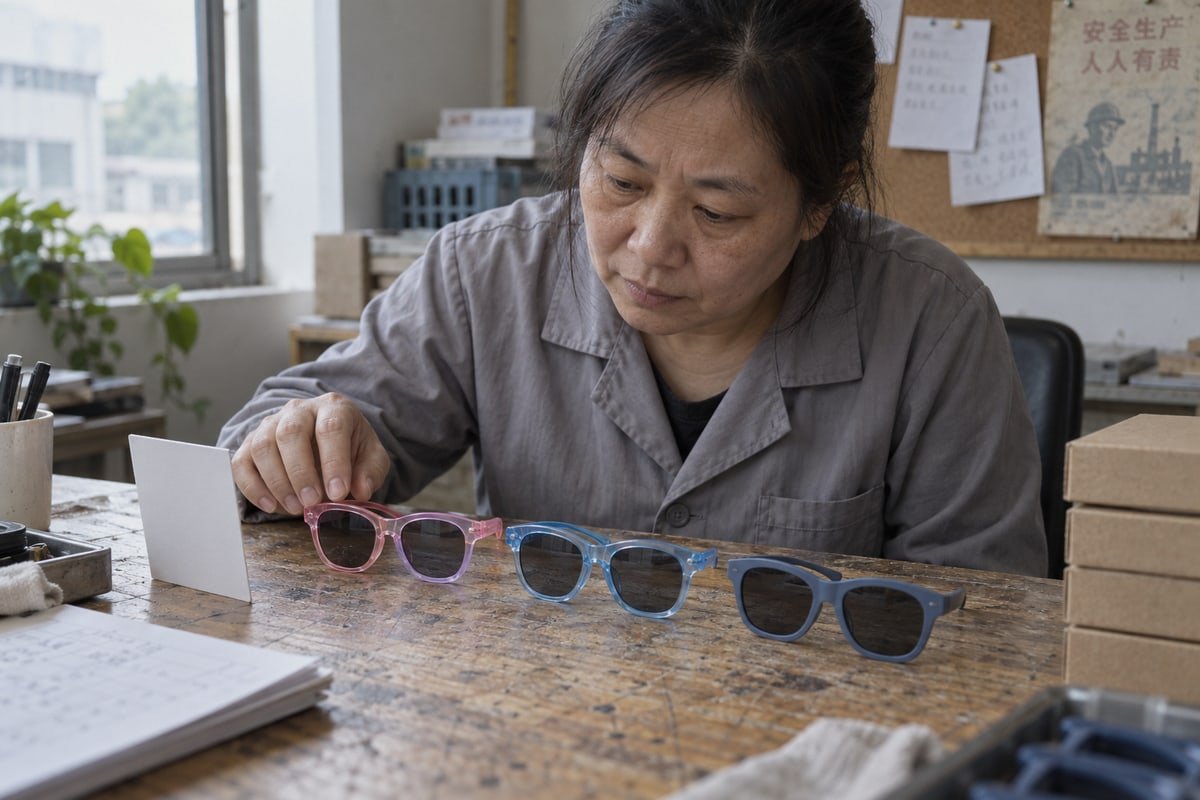
What you can change in the formulation
A serious factory can adjust the raw material, not just the color. Here is what each upgrade does and what it costs you.
| Upgrade option | Was es tut | Trade-off to consider |
|---|---|---|
| UV stabilizer package | Slows UV degradation and surface oxidation | Small cost increase per kilo; each color must be re-verified |
| Blue-masking optical brightener | Neutralizes the yellow shift through complementary color masking | Hides aging rather than stopping it; can cool the tint of pastel shades |
| Premium resin grade | More consistent stabilizer content and better thermal stability | Higher material cost and possible longer lead time on resin |
| Opaque or matte colorway | Hides any yellowing that does occur | Changes the design look; not an option for crystal styles |
| UV-blocking case and packaging | Protects during retail display and storage | Adds cost and shipping weight |
Blue-masking brighteners deserve a word of caution. High-end producers now blend them into the raw resin. They work by shifting the visible tone, not by protecting the polymer. So I treat them as a finish, not a fix. Pair them with real stabilizers.
What we do with existing molds
You do not need a new mold to get better material. Our catalog holds around 800 existing styles. A brand can pick a shape, then upgrade only the resin and the stabilizer package. That keeps mold investment at zero while you test the market.
For styles built with a TR90 front and TPEE temples, we test both parts separately. The front and the temple age by different chemistry, as I explained above. An accelerated aging test on the finished frame, in the actual production color, is the only data I trust. A test on natural clear resin does not tell you how the pink gradient will behave.
All of our materials are BPA-free eyewear materials and environmentally friendly. That does not change with the stabilizer package. Your compliance documents stay valid.
Where the honest limits are
No additive makes a clear frame permanent. A stabilized TR90 frame stored well can stay clear for many years. A poorly stored one will still age. The upgrade buys time and consistency. It does not buy immunity. Any supplier who promises otherwise is selling you a slogan.
Does yellowing affect the safety or durability of TR90 and TPEE frames, or is it just a cosmetic issue?
A procurement manager from Europe once sent us a photo of a competitor's yellowed sample and asked one question: is this still safe for a child?
Mild yellowing is mostly cosmetic, but it is also an early sign of polymer chain degradation. Over time, advanced yellowing in TR90 and TPEE frames goes along with increased brittleness and loss of flex memory. Frames that snap instead of bending pose a real safety risk for children.
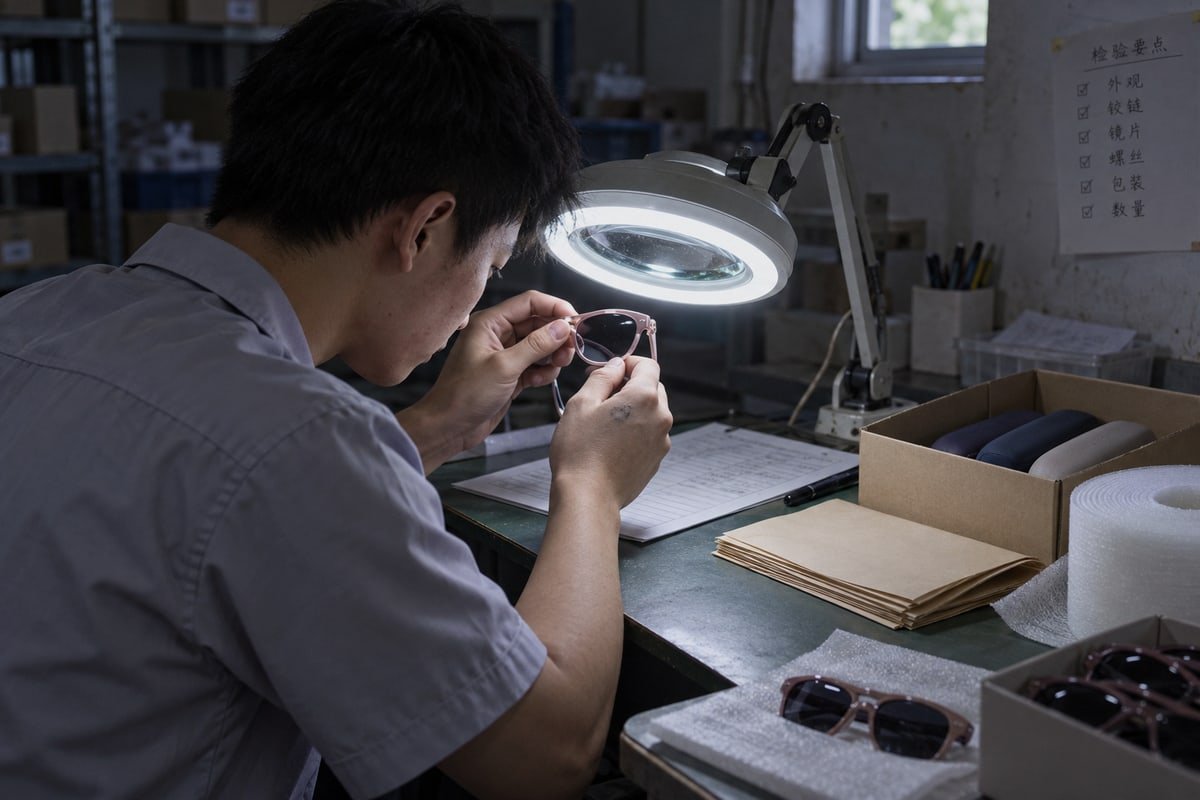
Yellowing is a signal, not just a stain
The color change and the strength change come from the same root. Polymer oxidation breaks and cross-links the long chains that give TR90 and TPEE their bend-and-return behavior. The first visible result is a yellow tint. The later result is stiffness, then cracking. So the tint is like a warning light. It tells you the chemistry has started.
For adult frames, this might be a slow, low-stakes process. For kids, it is different. A child sits on their sunglasses, twists the temples, and drops them on concrete. Flexible frame durability is the whole safety case for these materials. Once the flex memory fades, the frame stops absorbing impact and starts transferring it.
| Phase | Visible sign | What is happening inside | Empfohlene Aktion |
|---|---|---|---|
| Early | Slight warm tint on clear parts | Surface oxidation only | Still safe to sell; fix the storage conditions |
| Mittlere | Uneven yellow patches, duller gloss | Chain degradation reaching deeper | Run a flex check on samples from the lot |
| Advanced | Deep yellow, chalky feel, fine cracks at hinges | Loss of memory flexibility, brittleness | Withdraw the lot; do not ship to children |
Not every discoloration is the frame
Before you write off a lot, look at where the color sits. Greenish or brown marks concentrated at the hinge or the rivet usually mean the metal hardware has oxidized. The polymer around it may be perfectly healthy. Swapping to plated hardware and keeping stock dry solves that problem without touching the resin.
The simple flex check
We use a plain test on the workshop floor. Take an aged frame and a fresh one of the same style. Bend each temple outward and let it go. A healthy TPEE temple returns smoothly with no stress marks. A degraded one resists, whitens at the bend, or stays slightly open. This takes ten seconds and needs no lab.
Public guidance puts the working life of TPEE kids' sunglasses at roughly 2 to 5 years with regular care. Frames with good thermal stability and proper storage sit at the top of that range. Frames that spent a summer on a sunny dashboard sit at the bottom. The yellow tint tells you which end you are on.
Schlussfolgerung
Yellowed stock means lost margin, awkward returns, and a brand promise broken before the first sale. That risk grows quietly in every warm, bright, humid stockroom.
TR90 & TPEE kids sunglasses frames resist yellowing well when the resin is stabilized and stored properly. Ask for the grade, test the clear sample, and control the shelf.
Interested in sourcing the products mentioned in this article? See details and request a quote here:
Fußnoten
1. Technical resource explaining how UV stabilizer packages protect plastic materials from environmental degradation. ↩︎
2. Official manufacturer page for Grilamid TR-90, detailing the source and quality of the resin. ↩︎
3. Technical overview of TPEE (Hytrel) properties, focusing on the flexibility required for children’s eyewear. ↩︎
4. Detailed scientific resource on the chemical process of polymer oxidation and its effects on material integrity. ↩︎
5. Scientific explanation of thermal stability and its role in preventing non-photo-induced yellowing in polymers. ↩︎
Weitere Artikel, die Ihnen gefallen könnten
Auf der Suche nach einem zuverlässigen Partner für Kinderbrillen?
Entdecken Sie über 800 sofort verfügbare Modelle und umfassenden OEM/ODM-Support, der auf Ihre Marke zugeschnitten ist.
Kontakt aufnehmen English
  Español de México
  Deutsch
  Français
  日本語
日本語  العربية
  Português do Brasil