How to Check if TR90 & TPEE Kids Sunglasses Bonding Is Secure and Won’t Peel?
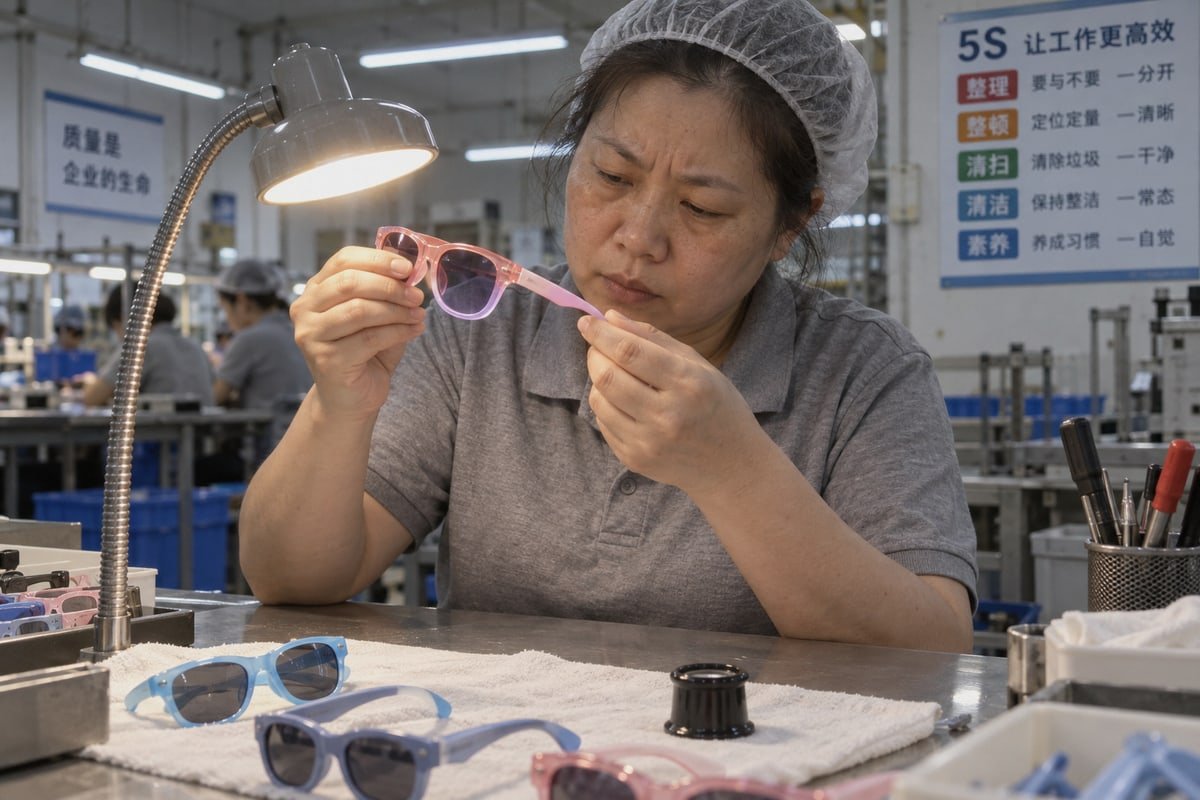
A peeling seam on TR90 & TPEE kids sunglasses bonding turns a bulk order into returns. We saw it early on our Taizhou line and changed how we build joints.
Check TR90 & TPEE kids sunglasses bonding with a light inspection for bubbles and gaps, a fingernail pick along the seam, a 180-degree twist, and a sweat or alcohol rub. Then confirm the factory uses plasma-treated substrates, double injection molding, and cross-hatch adhesion testing before you approve production.
Below, I walk through each check in the order we use it. First the quick visual and hand tests. Then the stress tests. Then the standards and the manufacturing methods 1 that make peeling unlikely in the first place.
What visual and physical checks can I do to spot weak bonding before I approve a bulk order?
Last season our QC lead pulled a sample from the line, ran her thumbnail along the temple seam, and caught a lifted edge our visual pass had missed.
Inspect the seam under a bright light for micro-bubbles, silvering, or gaps. Run a fingernail along the TR90-to-TPEE transition to feel for lift. Confirm lenses sit fully in the channel, then gently flex temples and nose pads. Reject any sample with exposed adhesive or uneven finish.
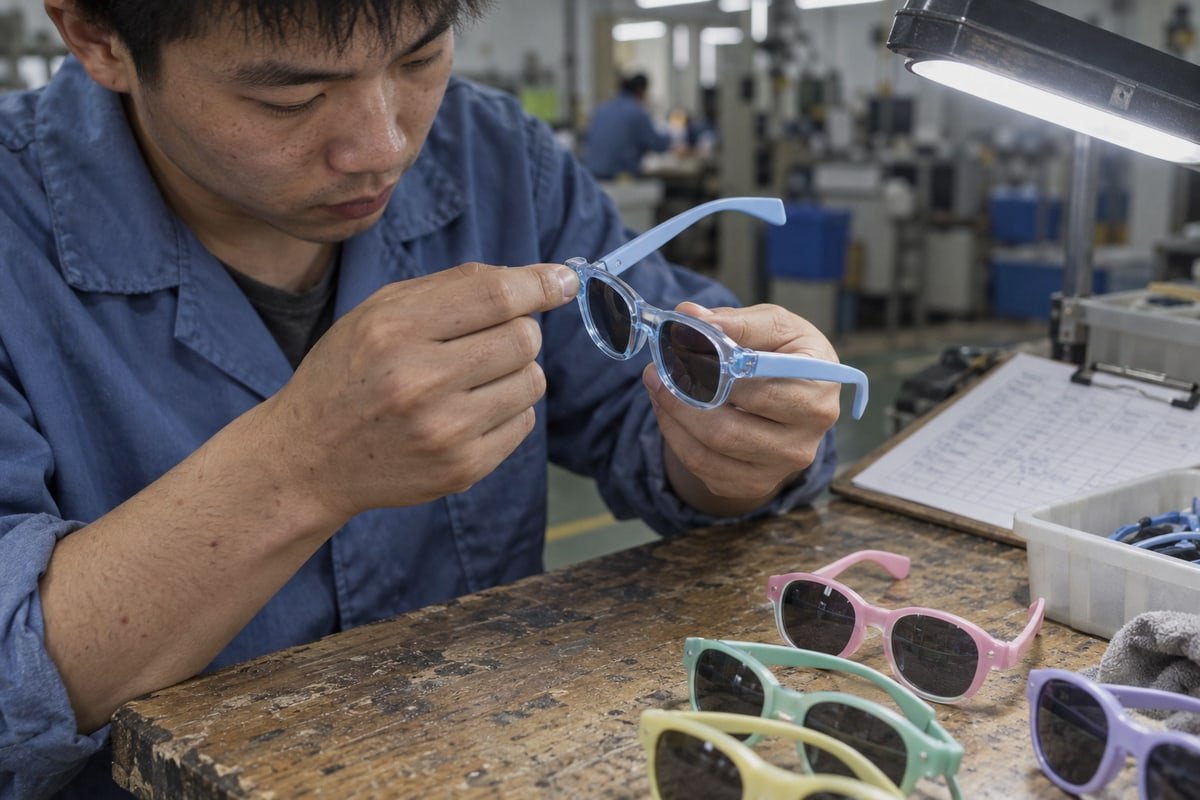
You do not need a lab for the first pass. You need a strong lamp, your hands, and about ten minutes per sample. I recommend doing this on at least three samples from the pre-production run, not just the golden sample the factory sends first.
Start with the light
Hold the frame under a high-intensity light and tilt it slowly. Translucent fronts, like the coral-to-lavender gradient and clear sky-blue styles we run, make this easy. Internal air pockets show up as tiny dots or a milky haze. A thin silver line at the interface where the soft TPEE meets the rigid TR90 is called silvering. It means the two materials did not fully fuse. Look also for uneven gaps along the seam. A good join looks like one continuous surface, even where a glossy front meets a matte temple.
Then use your hands
Next comes the fingernail pick test. Drag a nail along every transition line. Pay close attention to temple tips, nose pad edges, and any decorative overlay. If your nail catches, that is an initial lift point. It will grow with every bend. Then flex the temples outward and gently twist the front. A healthy frame springs back. A weak one whitens or opens at the bond line.
What to look for and what it means
| Sign you see | Wahrscheinliche Ursache | Entscheidung |
|---|---|---|
| Micro-bubbles inside the seam | Trapped air during overmolding process | Reject sample, ask for process review |
| Silver line at interface | Poor surface prep, no true fusion | Reject, request adhesion strength test |
| Glue squeeze-out or exposed adhesive | Glued trim instead of molded join | Reject for kids' use |
| Nail catches at temple tip | Early material delamination | Reject batch |
| Lens edge sits above channel | Loose lens retention | Return for re-seating |
| Smooth, flush seam, springs back | Sound bond | Proceed to stress tests |
One more point. Check the finish quality around the join. Misalignment, flash, or an uneven color line between front and temple usually signals a rushed mold or bad process control. Those same conditions produce weak bonds.
How do I test if TR90 and TPEE bonding will survive daily wear and tear from active kids?
A procurement manager from Australia once asked me a fair question: could our TR90 frames with TPEE temples survive a summer in a school bag? We tested it together.
Test TR90 and TPEE bonding with a repeated 180-degree torsion, a 90-degree bend that must spring back, thermal shock between heat and freezing, a 70% isopropyl alcohol rub on the seam, and accelerated UV aging. Peeling, whitening, or cracking at the bond line means the frame fails.
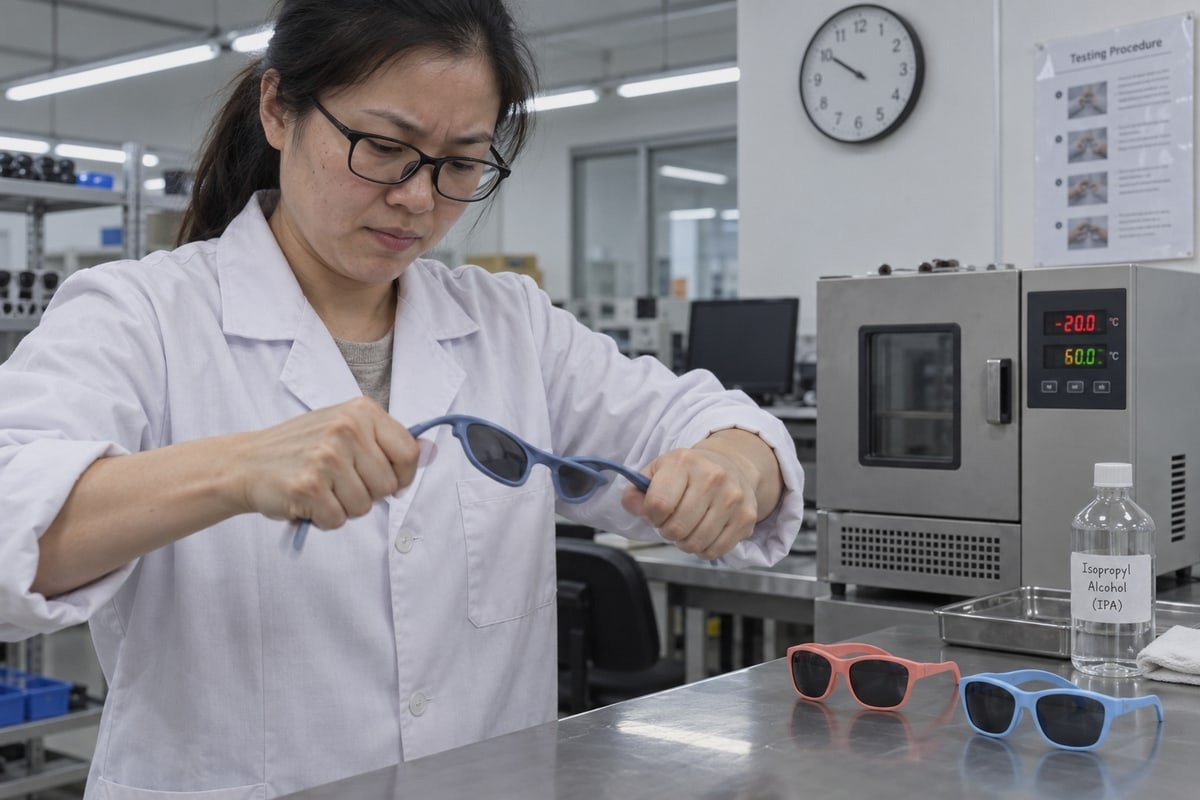
Kids do not treat sunglasses gently. They chew temple tips. They sit on frames. They leave them on a hot car dashboard, then drop them in a cold pool. Each of those events stresses the bond in a different way. So we test each stress separately, then in sequence.
The five tests we run in order
- Torsion. Hold the two temples and twist the frame to 180 degrees. Release. Repeat many times. Inspect the seam after each set. Shearing or lifting at the interface fails the sample.
- Bend. Fold one temple back to 90 degrees against the front. It must spring back with no whitening or cracking. This is a common product claim and buyers should ask for it in writing.
- Thermal shock. Cycle the frame between extreme heat and freezing. TR90 and TPEE expand at different rates. A poorly fused seam opens up when the two materials move against each other. This is where thermal stability matters most.
- Chemical rub. Wipe the seam with 70% isopropyl alcohol. Sweat, sunscreen, and cleaning wipes all attack a weak interface. The seam should show no softening or lift.
- UV aging. Put samples in an accelerated UV chamber that simulates roughly 12 months of sun. Ultraviolet light 2 degrades the chemical bridge between polymer layers and causes delayed peeling that never shows at sampling.
What passing looks like
| Zwei Methoden dominieren. Der Stahlwolltest reibt ein standardisiertes Pad unter festem Druck für eine festgelegte Anzahl von Zyklen über die Beschichtung und bewertet dann die Kratzer. Der Bayer-Abriebtest schüttelt die Linse in abrasivem Medium und vergleicht die Zunahme der Trübung mit einer unbeschichteten Referenz. Bayer liefert ein numerisches Verhältnis, das den Vergleich der Abriebfestigkeitsniveaus zwischen den Lieferanten vereinfacht. | Pass condition | Fail signal |
|---|---|---|
| 180-degree torsion, repeated | Seam flush, no shear | Lift or visible shear line |
| 90-degree bend | Full spring-back | Whitening, crack, open bond |
| Thermal shock cycles | No gap at interface | Seam opens or lifts |
| 70% IPA rub | No softening, no lift | Tacky edge, dissolved interface |
| UV aging, 168 hours | Color shift ΔE below 2, seam intact | Fading plus lifted edge |
Haltbarkeit des flexiblen Rahmens is not one property. It is the sum of these results. I tell buyers to run the sequence on three samples and keep one untested sample as a reference for comparison.
What quality control standards should I ask my manufacturer to follow for secure material bonding?
Every added test step costs us time on the line, yet skipping one costs a buyer their reputation. We weigh that trade-off on every new style.
Ask for ISO 12870 frame testing, ISO 9001 production, an ASTM D3359 cross-hatch adhesion test on bonded areas, UV colorfastness with ΔE below 2 after 168 hours, batch traceability, BPA-free material declarations, and a written defect warranty. Request test reports, not verbal assurances.
Many buyers ask about the material name first. That is the wrong starting point. A frame labeled TR90 or TPEE can still delaminate if the join was made badly. The material tells you about flexibility. The QC system tells you whether the bond will last. So I push buyers to ask for documents, not adjectives.
The standards that actually cover the bond
| Standard or check | Was es abdeckt | Why it matters for bonding |
|---|---|---|
| ISO 12870 | General requirements for spectacle frames, including durability | Confirms the whole frame survives repeated stress, not just the polymer |
| ISO 9001 | Production quality management | Shows processes are documented and repeatable across batches |
| ASTM D3359 cross-hatch adhesion test 3 | Quantifies adhesion between layers | A cut grid and tape pull shows whether any material flakes off |
| UV aging, 168 hours, ΔE below 2 | Colorfastness after sun exposure | Proves the surface and interface resist UV breakdown |
| Chargenrückverfolgbarkeit | Links each frame to material lot and mold run | Lets you isolate a bad lot instead of scrapping an order |
| Impact resistance standards | Lens and frame behavior under impact | Confirms lens retention holds under a knock |
| BPA-free eyewear materials | Material safety declaration | Required by most children's brands and parents |
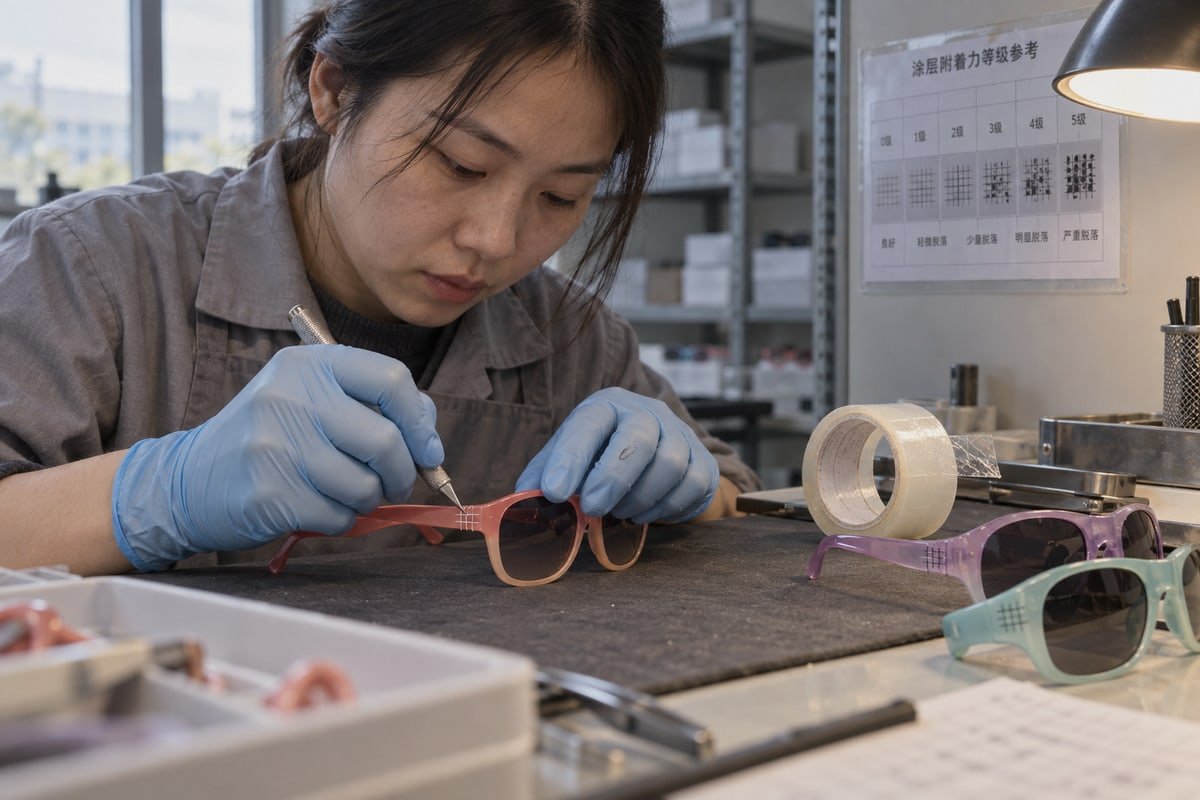
The cross-hatch adhesion test deserves a closer look. The technician scores a small grid into the bonded surface, applies tape, and pulls it off. Then they rate how much material lifted. It is simple, cheap, and hard to argue with. Ask for it on a sample area at the TR90-to-TPEE junction, not on a flat panel.
The buyer objections I hear most
Some buyers say TPEE is safest because it bends easily. Others say TR90 is better because it holds shape. Both are partly right. But neither point answers the peeling question. The failure point is the joint, not the base polymer. A real factory with 5S workshop management and consistent process records will produce a stable bond in either material. A trading company passing your order to an unknown molder will not. That is why I put QC documents ahead of material claims in every quotation we send.
Which manufacturing techniques should I look for to ensure TR90 and TPEE won't peel over time?
Our engineers learned the hard way that a rough, untreated TR90 surface never truly fuses with TPEE. Texture alone looked fine at sampling and peeled months later.
Look for double injection molding or a controlled overmolding process, plasma or corona treatment of the TR90 substrate to a surface tension above 38 mN/m, matched thermal stability between materials, and ultrasonic inspection for cold joins. Glued decorative trim and mechanical interlocking alone will not hold up.
Before comparing techniques, it helps to see how the two materials fit different children.
| Faktor | TPEE | TR90 |
|---|---|---|
| Beste Verwendung | Soft, rubber-like, highly flexible | Lightweight, sturdy, more structured |
| Typical age band | 0–5 Jahre | 6 years and up |
| Typical weight target | Very light, chew-tolerant | 12–15 g for kids' designs |
| Stärke | Bends without feeling sharp | Holds shape during sports |
| Where peeling risk sits | Any glued overlay | Front-to-temple join, decorative trim |
Notice the last row. Neither material peels on its own. The bond between them, or between the frame and any add-on part, is where trouble starts.
Joining methods, ranked by reliability
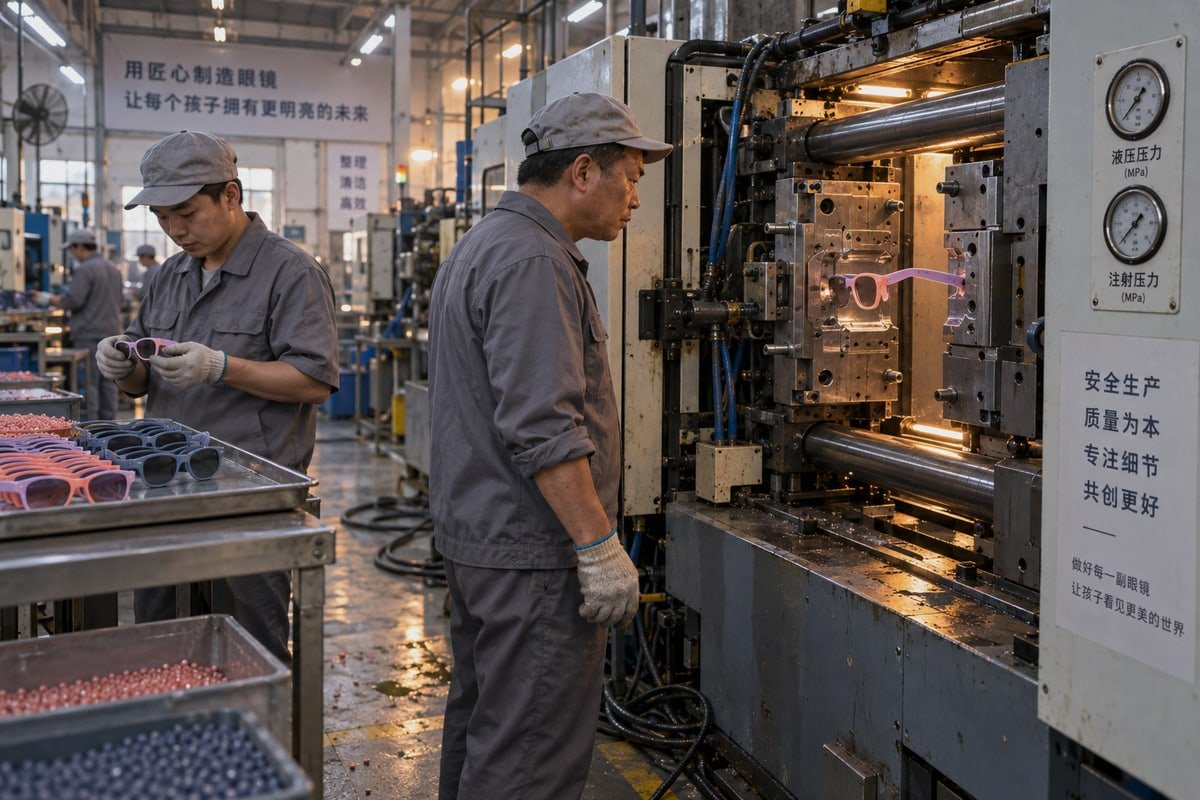
Double injection molding is the method we prefer for TR90 frames with TPEE temples. The rigid TR90 part is molded first. Then the soft TPEE is shot directly onto it inside the same tool while the surface is still receptive. This uses the thermoplastic elastomer properties 4 of TPEE to form a molecular bond, not just a mechanical grip.
A controlled overmolding process is similar but done in two tools. It works well when surface prep is right. It fails when the TR90 part cools, picks up dust, or has low surface energy before the second shot.
Glued assembly is the weakest option. Adhesive can work for adult acetate frames. On a kids' frame that gets twisted daily, it is the first thing to go.
Surface preparation is the hidden step
TR90 has a low-energy surface. TPEE will not fuse to it reliably unless that surface is activated. Ask the factory whether they measure the dyne level of the TR90 part before the second shot. The threshold to look for is above 38 mN/m. Ask whether they use atmospheric plasma 5 or corona treatment to reach it. Mechanical interlocking, like undercuts and texture, helps. But it is not enough on its own for high-flex kids' eyewear.
Catching what the eye cannot see
Even a good process can produce a cold join, where the second shot did not fully melt into the first. These are invisible from outside. Ultrasonic non-destructive testing finds internal air gaps and cold joins without cutting the frame. It is worth requesting on the first production batch of any new mold. With around 800 existing styles already in production, we run this on established tools too, because material lots change.
Schlussfolgerung
Peeling bonds kill kids' eyewear brands quietly. Check seams, stress the frame, demand test reports, and choose a partner who fuses TR90 and TPEE properly. Then approve your order.
Interested in sourcing the products mentioned in this article? See details and request a quote here:
Fußnoten
1. ISO 9001 defines the international standards for consistent manufacturing and quality control methods. ↩︎
2. NASA resource explaining the properties and degradative effects of UV radiation on materials. ↩︎
3. ASTM D3359 is the industry standard for testing the adhesion of coatings and bonded layers. ↩︎
4. Technical background on TPEE materials and their unique bonding characteristics in manufacturing. ↩︎
5. Scientific overview of plasma activation used to increase surface energy for better polymer adhesion. ↩︎
Weitere Artikel, die Ihnen gefallen könnten


Auf der Suche nach einem zuverlässigen Partner für Kinderbrillen?
Entdecken Sie über 800 sofort verfügbare Modelle und umfassenden OEM/ODM-Support, der auf Ihre Marke zugeschnitten ist.
Kontakt aufnehmen English
  Español de México
  Deutsch
  Français
  日本語
日本語  العربية
  Português do Brasil