How to Specify Frame & Lens Safety Requirements for Kids’ Sunglasses Suppliers?
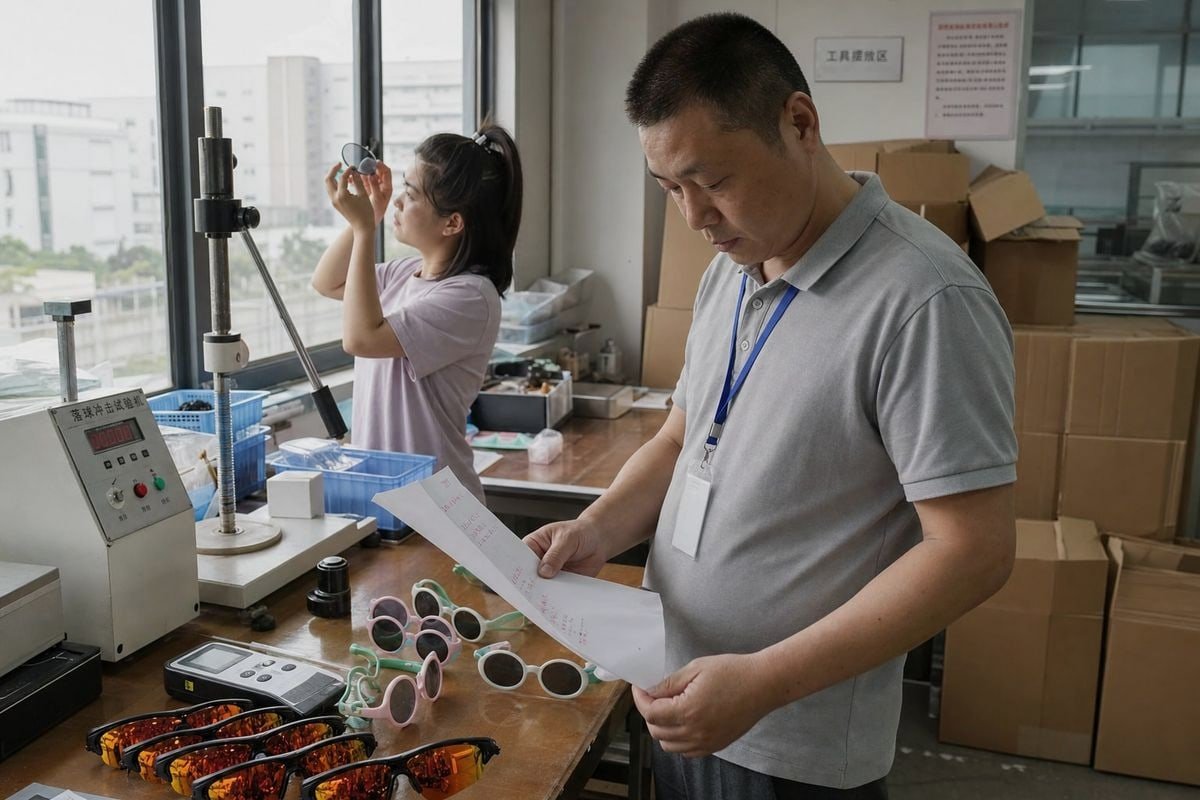
Frame and lens safety requirements for kids’ sunglasses suppliers are where most sourcing problems start. I have seen vague spec sheets on our Taizhou production line cause costly recalls.
To specify frame and lens safety requirements for kids’ sunglasses suppliers, define impact-resistant polycarbonate lenses with UV400 protection, flexible non-toxic frame materials like TPEE or TR90, compliance with FDA 21 CFR 801.410, ANSI Z80.3 or EN ISO 12312-1, plus CPSIA chemical limits and verified test reports.
That answer covers the essentials. But a real supplier spec needs measurable acceptance criteria, not just standard names. Let me break down exactly what to write, section by section.
What Safety Standards Should I Require from My Kids' Sunglasses Supplier?
A buyer from Australia once sent us a one-line spec: "must be safe for kids." Our engineering team had to send back three pages of questions before we could quote accurately.
Require FDA 21 CFR 801.410 impact resistance for the US, ANSI Z80.3 or EN ISO 12312-1 for optical and UV performance, CPSIA lead and phthalate limits for children's products, and ASTM F803 only if the product is sports eyewear. Match each standard to your destination market.
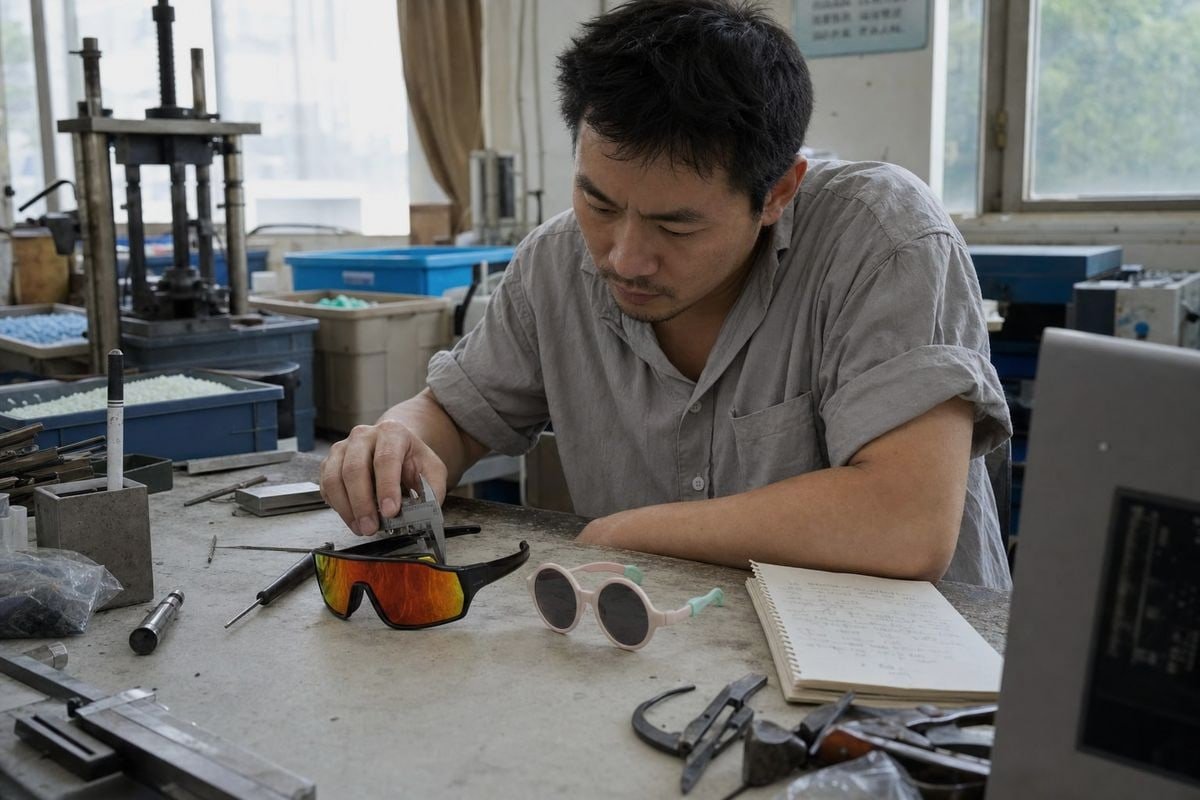
The biggest mistake I see in supplier specs is treating all standards as interchangeable. They are not. Each one covers a different risk, and each destination market has its own legal baseline. Your spec sheet should map standards to markets explicitly, so your supplier knows exactly which test reports to prepare.
Match the Standard to the Market
Here is the mapping we use when quoting for buyers in different regions:
| Markt | Schlüsselstandard | Was es abdeckt |
|---|---|---|
| Vereinigte Staaten | FDA 21 CFR 801.410 1 | Schlagfestigkeit der Gläser (Fallballtest) |
| Vereinigte Staaten | ANSI Z80.3 | UV transmittance, optical quality, flammability |
| Vereinigte Staaten | Die erste Frage ist immer die Klassifizierung. Sind Ihre Sonnenbrillen wirklich ein Kinderprodukt? Betrachten Sie die Größe, das Marketing, die Verpackung und den beabsichtigten Benutzer. Unsere kompakten runden Rahmen in Periwinkle-Blau mit mint-türkisen Bügeln sind eindeutig für kleine Gesichter konzipiert. Niemand würde argumentieren, dass es sich um Produkte für den allgemeinen Gebrauch handelt. Diese Klassifizierung löst den gesamten Satz von 2 | Lead, phthalates, tracking labels, CPC certificate |
| Europa | EN ISO 12312-1 3 | UV protection, mechanical strength, marking |
| Europa | EN 71-3 / REACH 4 | Chemical migration, restricted substances |
| Australien / Neuseeland | AS/NZS 1067 | Lens categories, UV protection, labeling |
| Sportnutzung | ASTM F803 5 | High-velocity impact protection |
Everyday Sunglasses vs. Sports Eyewear
This distinction matters more than most buyers realize. Ordinary kids' sunglasses and sports eyewear are separate product categories with very different testing severity. ASTM F803 sports products must survive high-velocity impacts that would destroy a normal fashion frame. If your product is a wraparound shield style for cycling or running, do not label it "sports protective" unless it actually passes the sports standard. Ask your supplier which category they are quoting. We always confirm this before opening a mold, because the lens thickness, frame geometry, and retention design all change.
Also remember: children's sunglasses in the US are children's products under CPSIA. That means third-party testing at a CPSC-accepted lab, a Children's Product Certificate, and permanent tracking labels. Many general eyewear suppliers do not know this. A supplier who asks you about your target market before quoting is usually a supplier worth keeping.
How Do I Specify the Right Frame Material for Safe, Comfortable Kids' Eyewear?
Fifteen years of molding children's frames taught our team one hard lesson: kids do not wear sunglasses, they stress-test them. They sit on them, chew them, and bend the temples backward.
Specify flexible, impact-tolerant polymers such as TPEE or TR90 that bend without snapping, require BPA-free and phthalate-free materials with CPSIA and EN 71-3 chemical compliance, and demand smooth finishing with no sharp edges, burrs, or small detachable parts.
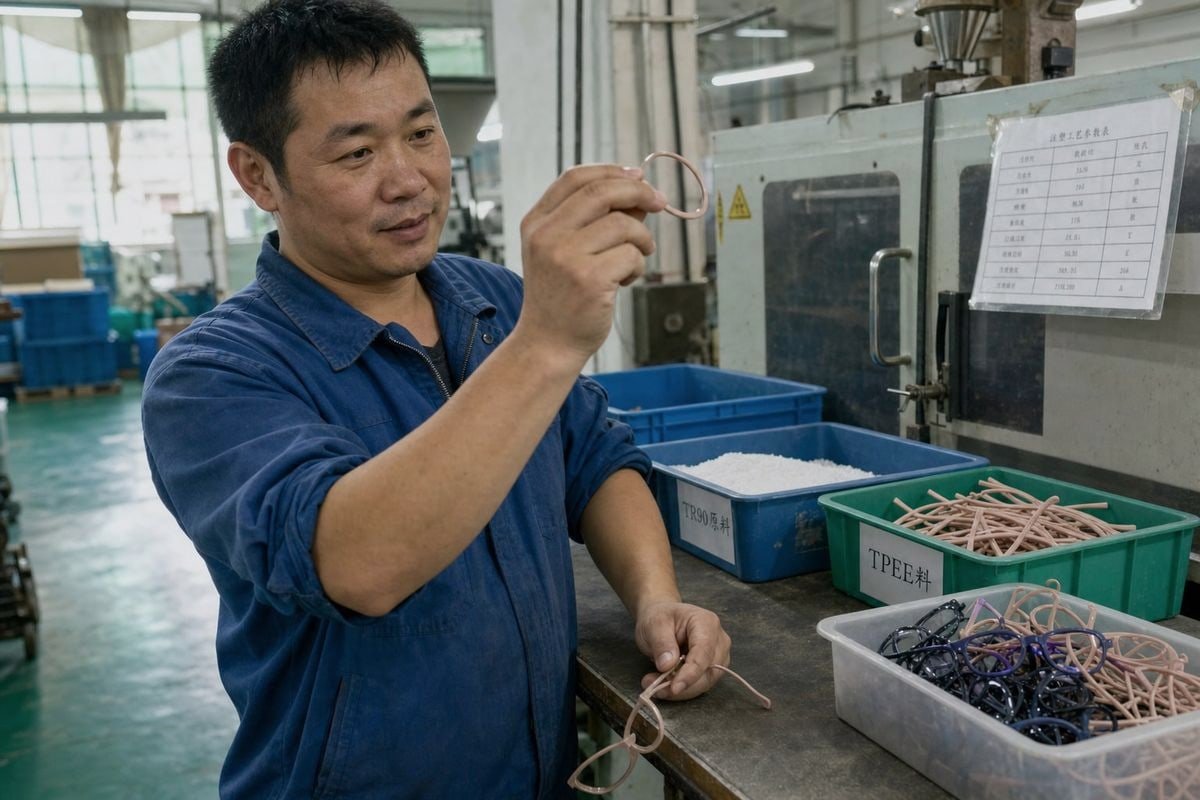
Frame safety comes down to two questions. First, what happens mechanically when a child abuses the frame? Second, what happens chemically when a child mouths or wears it against the skin all day? Your spec should address both, separately and in writing.
Mechanical Behavior: Flex, Don't Fracture
Rigid, brittle plastics are the enemy in children's eyewear. When a hard frame snaps, it creates sharp edges near a child's eyes and face. That is why we build most of our children's lines in TPEE flexible frames or TR90 6, often combining a TR90 front with TPEE temples. TPEE can twist nearly flat and return to shape. TR90 is a lightweight memory nylon that resists permanent deformation. Neither material shatters under normal child handling.
Useful spec language you can copy: "Frames shall withstand repeated flexing and twisting during normal child handling without cracking, permanent deformation, or exposure of sharp edges or burrs." Add lens retention: "Lenses shall not rotate, loosen, or detach from the frame during use or after standard handling tests."
Chemical Safety: What Touches the Skin Matters
| . Schlagfestigkeitsprüfungen sind eine separate Verpflichtung von CPSIA-Prüfungen. Viele Importeure müssen sich auch bei der FDA als Erstimporteur registrieren und das Produkt als medizinische Klasse-I-Gerät auflisten, um eine Beschlagnahmung der Sendung an der Grenze zu vermeiden. | Was zu spezifizieren ist | Warum es wichtig ist |
|---|---|---|
| Bleiinhalt | Below CPSIA limits, third-party tested | Children's product legal requirement in the US |
| Phthalate | Phthalate-free certification per CPSIA | Softeners in cheap plastics pose ingestion risk |
| BPA | BPA-free materials with documentation | Important for toddler products that get mouthed |
| Heavy metal migration | EN 71-3 testing on all frame components | Covers leaching through skin or mouth contact |
| Nickel-Freisetzung | Test any metal hinges or decorations | Some markets limit nickel in children's items |
One caution from experience: "BPA-free" is a useful purchasing term, but it is not a compliance package. Ask for the actual lab reports behind the claim. On our line, we keep material disclosure sheets for every resin batch, because buyers in Japan and Europe increasingly ask for them before placing a first order.
Fit Is a Safety Feature Too
Oversized "grow into it" frames slip, sit crooked, and leave gaps around the eyes. Specify sizing by age group, a flatter nose bridge suited to children's faces, and temple retention that keeps the frame stable during play. For babies and toddlers, sample-fit testing on representative head sizes is worth writing into the spec.
What Lens Quality and UV Protection Requirements Should I Include in My Supplier Spec Sheet?
The trade-off we discuss most often with new buyers is lens cost versus lens safety. Cheap acrylic lenses save cents per unit but fail exactly where children's eyewear cannot afford to fail.
Specify polycarbonate lenses that pass the FDA drop ball test, UV400 protection blocking all UVA and UVB rays, optical quality free of distortion per ANSI Z80.3 or EN ISO 12312-1, secure lens retention, and an explicit ban on glass lenses for children.
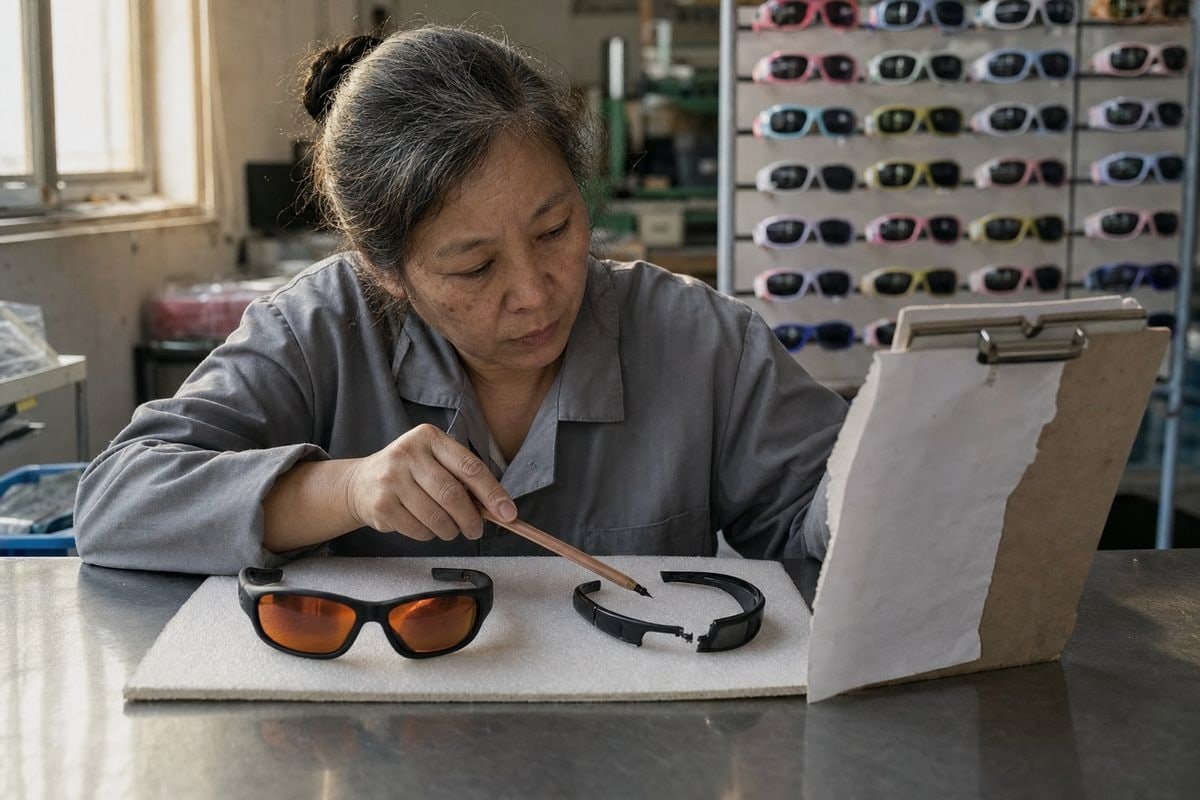
Lens requirements deserve their own section in your spec sheet, separate from the frame. Lens safety is about three things: what happens on impact, how much UV gets through, and how clearly the child sees. Weakness in any one of these makes the product unsafe or unsellable.
The Non-Negotiables, in Priority Order
- Impact resistance. Polycarbonat 7 lenses are the industry baseline for children. They are dramatically more impact-resistant than acrylic or CR-39 and far lighter than glass. Glass lenses should never be fitted to children — write that exclusion into the spec explicitly.
- Drop ball test compliance. For the US, require impact resistance testing per FDA 21 CFR 801.410. Ask your supplier whether they test every lens or use statistically valid batch sampling, and get that answer in writing.
- UV400 protection. Require lenses to block 100% of UVA und UVB 8 up to 400 nanometers. Children's eyes let more UV reach the retina than adult eyes, so this claim carries real health weight. Never accept "UV protective" without a measured transmittance report.
- Optical clarity. Poor optics cause distortion and visual fatigue. Reference the optical quality requirements in ANSI Z80.3 or EN ISO 12312-1 rather than inventing your own.
- Linsensitz. Lenses must not pop out, rotate, or loosen during use. This is a WHO/ISO-level guidance point, and it is a common failure on cheap frames.
Optional Upgrades Worth Considering
Scratch-resistant hard coatings extend product life, since kids drop glasses lens-down constantly. Polarized lens options reduce glare for beach and water use, and we supply both UV400 and polarized versions across our children's range. Mirrored gradient coatings — like the orange-to-teal shields popular in sports styles — are cosmetic; make sure the UV claim comes from the lens material and testing, not the coating's appearance. A dark lens with weak UV blocking is worse than no sunglasses at all, because it dilates the pupil while letting UV in.
How Can I Verify My Supplier Actually Meets the Safety Requirements I've Specified?
Early in our export history, a distributor told us he had been burned by a supplier who showed one golden sample, then shipped a different resin. That conversation shaped how we now document everything for buyers.
Verify compliance by requesting third-party test reports from accredited labs, a Children's Product Certificate for the US, EU Declarations of Conformity, material disclosure sheets, approved pre-production samples, and a written change-control commitment. Cross-check report dates, product photos, and lab accreditation.
A spec sheet is only as strong as your verification process. Standards named on paper mean nothing if you never see the evidence. Here is the documentation pack we recommend buyers request before wiring any deposit.
The Compliance Pack Checklist
| Dokument | Was zu überprüfen ist | Warnsignal |
|---|---|---|
| Drittanbieter-Prüfberichte | Lab accreditation, test date, exact model tested | Reports older than 2 years or for a different SKU |
| Kinderproduktzertifikat (CPC) | Cites CPSIA rules, lists CPSC-accepted lab | Supplier says a CPC is "not needed" for the US |
| Drop ball test records | Method matches 21 CFR 801.410 | Only a verbal claim of "impact resistant" |
| UV transmittance report | Measured blocking to 400 nm | UV400 printed on packaging with no data |
| Material disclosures | Resin grades for frame and lens, phthalate-free certification | Vague answers like "food-grade plastic" |
| Konformitätserklärung | References EN ISO 12312-1 for EU sales | CE mark with no supporting file |
| Sealed golden sample | Signed and retained by both parties | Supplier resists sealing a reference sample |
Verify the Process, Not Just the Paper
Documents can be recycled or borrowed. So go one level deeper. Ask how the factory controls material changes: a proper supplier commits in writing to notify you before switching any resin, coating, or component. Ask about in-line quality checks — our 5S-managed workshop logs incoming material inspection and finished-goods sampling for every order, and a serious factory should show you similar records. Video audits work well if you cannot visit. Finally, run your own spot checks: send one carton from an early shipment to an independent lab for CPSIA and UV testing. It costs a few hundred dollars and protects your brand against exactly the failure that hurts most — a false safety claim on a children's product.
Put the whole spec into your purchase order, not just an email. When requirements sit inside the contract, acceptance criteria become enforceable, and disputes get resolved by test data instead of arguments.
Schlussfolgerung
A vague spec invites unsafe kids' sunglasses. Define frame materials, lens standards, UV400 claims, and compliance documents precisely — then verify everything. Your brand's trust depends on it.
Fußnoten
1. Direct link to the official FDA Code of Federal Regulations database for impact resistance. ↩︎
2. Authoritative CPSC page describing the Consumer Product Safety Improvement Act referenced throughout. ↩︎
3. Reliable summary of international sunglasses standards to avoid common 403 errors on the ISO website. ↩︎
4. ECHA’s official explanation of REACH chemical restriction regulation mentioned in the frame safety table. ↩︎
5. Official ASTM standard page for sports eyewear impact protection referenced for sports-use sunglasses. ↩︎
6. Background on nylon-based memory polymers like TR90 used in flexible children’s eyewear frames. ↩︎
7. Background reference on polycarbonate material properties used for impact-resistant children’s lenses. ↩︎
8. WHO reference on UV radiation health effects relevant to UV400 lens protection claims. ↩︎
Weitere Artikel, die Ihnen gefallen könnten



Auf der Suche nach einem zuverlässigen Partner für Kinderbrillen?
Entdecken Sie über 800 sofort verfügbare Modelle und umfassenden OEM/ODM-Support, der auf Ihre Marke zugeschnitten ist.
Kontakt aufnehmen English
  Español de México
  Deutsch
  Français
  日本語
日本語  العربية
  Português do Brasil