Wie man quantifizierbare Abnahmekriterien für Kinderbrillen verhandelt?

Quantifizierbare Abnahmekriterien für Kinderbrillen entscheiden, ob Ihre Lieferung reibungslos durchgeht oder in Streitigkeiten stecken bleibt. An unserer Produktionslinie in Taizhou verursachen vage Spezifikationen die meisten Probleme. Unscharfe Wörter wie ’langlebig“ laden zu Streitigkeiten, Rücksendungen und schwindendem Vertrauen ein. Die Lösung ist einfach: alles messen.
Um quantifizierbare Abnahmekriterien für Kinderbrillen zu verhandeln, wandeln Sie vage Bedürfnisse in messbare Bestanden/Nicht bestanden-Prüfungen um: Maßtoleranzen von ±0,2 mm, Scharnierhaltbarkeit von 5.000 Zyklen, CPSIA-Chemikalientestberichte, AQL 2,5/4,0-Stichprobengrenzwerte und ein unterschriebenes Muster – alles schriftlich vor der Bestellung dokumentiert.
Das ist die kurze Antwort. Der Rest dieses Artikels zeigt Ihnen, wie Sie jedes Teil Schritt für Schritt aufbauen und wie Sie Ihren Brillengestelllieferanten dazu bringen, dem zuzustimmen.
Welche messbaren Spezifikationen sollte ich in meine Akzeptanzkriterien für Kinderbrillen aufnehmen?
Ein Käufer aus Australien schickte uns einmal Datenblatt ein Muster, das nur sagte: "muss Kindern im Alter von 3–6 Jahren bequem passen." Unsere Ingenieure schickten zwölf Fragen zurück, bevor wir ein Angebot abgeben konnten. Dieser Austausch lehrte beide Seiten, warum Zahlen Adjektive schlagen.
Geben Sie genaue Steg- und Bügelmaße, die Gesamtbreite des Rahmens, die Glasbreite und das Gewicht an, jeweils mit einer angegebenen Toleranz. Fügen Sie Scharnierzyklen, Flex-Erholungsgrenzen, Haftprüfungen für Beschichtungen und Oberflächenfinish-Standards hinzu. Jede Spezifikation muss mit einem Werkzeug messbar sein, nicht nach Meinung beurteilt werden.

Die Kernregel, der wir folgen: Wenn eine Anforderung nicht gemessen, inspiziert oder getestet werden kann, sollte sie kein Abnahmekriterium sein. "Sieht stabil aus" ist keine Spezifikation. "Bügelfeder kehrt nach einer 90-Grad-Außenbiegung in die ursprüngliche Form zurück" ist eine Spezifikation. Unser Team wendet diese Regel auf etwa 800 bestehende Modelle an, sodass wir gesehen haben, was passiert, wenn Spezifikationen locker sind – und wenn sie eng sind.
Abmessungen und Passform
Kindergesichter variieren je nach Altersgruppe, daher sind genaue Zahlen wichtiger als bei Erwachsenenbrillen. Fragen Sie Ihren Lieferanten, ob er nach Altersgruppen unterschiedliche Formen verwendet. In unserer Fabrik gruppieren wir Brillen grob nach Kleinkind-, Vorschul- und Schulalter-Passformen, und die Steggeometrie ändert sich für jede.
Hier ist eine praktische Startcheckliste zum Anpassen:
| Spezifikationskategorie | Was zu messen ist | Typische Anforderung |
|---|---|---|
| Rahmenbreite | Gesamtbreite vorne | Entsprechen dem genehmigten Muster ±0,2 mm |
| Stegbreite | Innenstegbreite | In mm angegeben, ±0,2 mm |
| Bügellänge | Scharnier bis Spitze | In mm angegeben, ±0,5 mm |
| Breite/Höhe der Gläser | A- und B-Messungen | ±0,2 mm |
| Gewicht | Kompletter Rahmen | In Gramm angegeben, ±5% |
| Glasausrichtung | Links/rechts Symmetrie | Keine sichtbare Schrägstellung auf flacher Oberfläche |
Leistung und Materialien
Über die Abmessungen hinaus definieren Sie das Materialverhalten. TR90 1 und TPEE sind von Natur aus flexibel, daher spezifizieren Sie die Rückstellung: Der Rahmen muss nach dem Biegen ohne Aufhellung oder Rissbildung in seine Form zurückkehren. Definieren Sie auch die Haltbarkeit von Beschichtungen und Drucken – Logodrucke sollten einem definierten Reibtest ohne Verblassen standhalten.
Behandeln Sie auch das Passverhalten am Kind. Machen Sie Komfort zu beobachtbaren Prüfungen: Augen zentriert in den Gläsern, Rahmen sitzt gerade, kein starkes Verrutschen bei einer Auf-Ab-Kopfbewegung und keine roten Druckstellen nach einem 10–15-minütigen Tragetest. Diese sind einfach, geben aber ein klares Bestanden/Nicht bestanden-Ergebnis.
Wie lege ich realistische Toleranzgrenzen fest, wenn ich mit meinem Rahmenhersteller verhandle?
Es gibt immer einen Kompromiss, den wir mit Käufern abwägen: Engere Fertigungstoleranzen bedeuten höhere Stückkosten und mehr abgelehnte Teile, während lockerere Toleranzen inkonsistente Passformen bei kleinen Gesichtern riskieren. Die richtige Antwort liegt dazwischen, und sie unterscheidet sich je nach Merkmal.
Legen Sie kritische Passformmaße wie Stegbreite und Glasbreite auf ±0,2 mm fest, sekundäre Maße wie Bügellänge auf ±0,5 mm und Gewicht auf ±5%. Bestätigen Sie, dass die Fabrik ein Muster pro SKU aufbewahrt und zustimmt, dass jede Charge vor dem Versand damit verglichen wird.
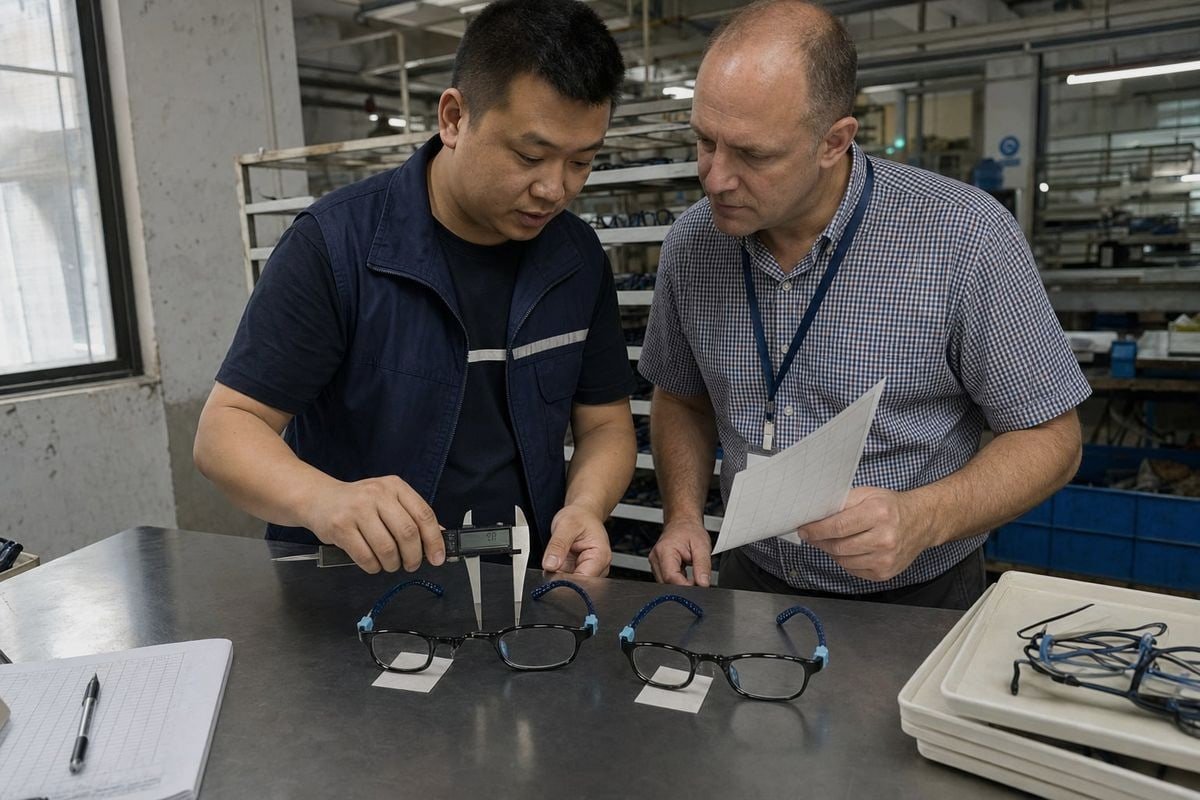
Toleranzen sind der Punkt, an dem die Verhandlung real wird. Eine zu enge Toleranz für den Prozess wird einfach ignoriert – oder in Ihren Preis eingerechnet. Eine zu lockere Toleranz lässt Rahmen durch, die einer Vierjährigen von der Nase rutschen. Die Diskussion sollte also mit einer Frage beginnen: Welche Abmessungen sind für die Passform eines Kindes tatsächlich entscheidend?
Abmessungen nach Kritikalität einstufen
Nicht jede Messung verdient die gleiche Toleranz. Wir schlagen einen dreistufigen Ansatz vor:
| Stufe | Abmessungen | Vorgeschlagene Toleranz | Warum |
|---|---|---|---|
| . Kritisch | Stegbreite, Glasbreite, Glashöhe | ±0,2 mm | Beeinflusst direkt die optische Zentrierung und die Nasenpassform |
| Wichtig | Bügellänge, Rahmenbreite, pantoskopischer Winkel | ±0,5 mm | Beeinflusst den Komfort, Anpassung bei der Abgabe |
| Cosmetic | Color match, surface gloss, print position | Against approved limit sample | Visual, judged versus master sample |
Injection-molded TR90 holds tight dimensions well once the mold is proven, so ±0.2mm on critical dimensions is realistic, not punishing. Softer TPEE temple parts move slightly more, which is why temple length gets a wider band. Dimensional stability over temperature also matters: ask how the material behaves after heat exposure during lens glazing, because a frame that distorts at the optical lab fails the customer even if it left the factory in spec.
Anchor Everything to the Master Sample
Numbers on paper are only half the deal. The other half is the signed, sealed master sample. In our workshop, each approved SKU has a retained golden sample, and batch inspection compares production directly against it — color, texture, hinge feel, and dimensions. Ask your supplier to confirm this in writing, and ask how long they retain the sample. If they cannot trace a defect back to a production line, worker, or date, tolerance talk is mostly theater.
Some buyers also ask for virtual try-on alignment. If your brand uses 3D assets, add a criterion that physical frame dimensions match your CAD or virtual try-on model within about 1% variance, so the online fit experience matches the real product.
Welche Sicherheits- und Haltbarkeitstests sollte ich vor der Genehmigung meiner Bestellung verlangen?
When we ship children's frames to Europe, Japan, and the US, the compliance file travels with the goods. One lesson from 15 years in eyewear: a supplier who promises "child-safe" but cannot produce a recent third-party report is asking you to carry their risk.
Fordern Sie ISO 12870-Strukturprüfungen, CPSIA-Berichte von Drittanbietern für Blei und Phthalate, Nickelabgabeergebnisse für Metallteile und eine Scharnierausdauer von mindestens 5.000 Öffnungs-Schließ-Zyklen an. Für Sportmodelle fügen Sie die ASTM F803-Schlagfestigkeitsprüfung hinzu. Fordern Sie Dokumente an, keine mündlichen Zusicherungen.
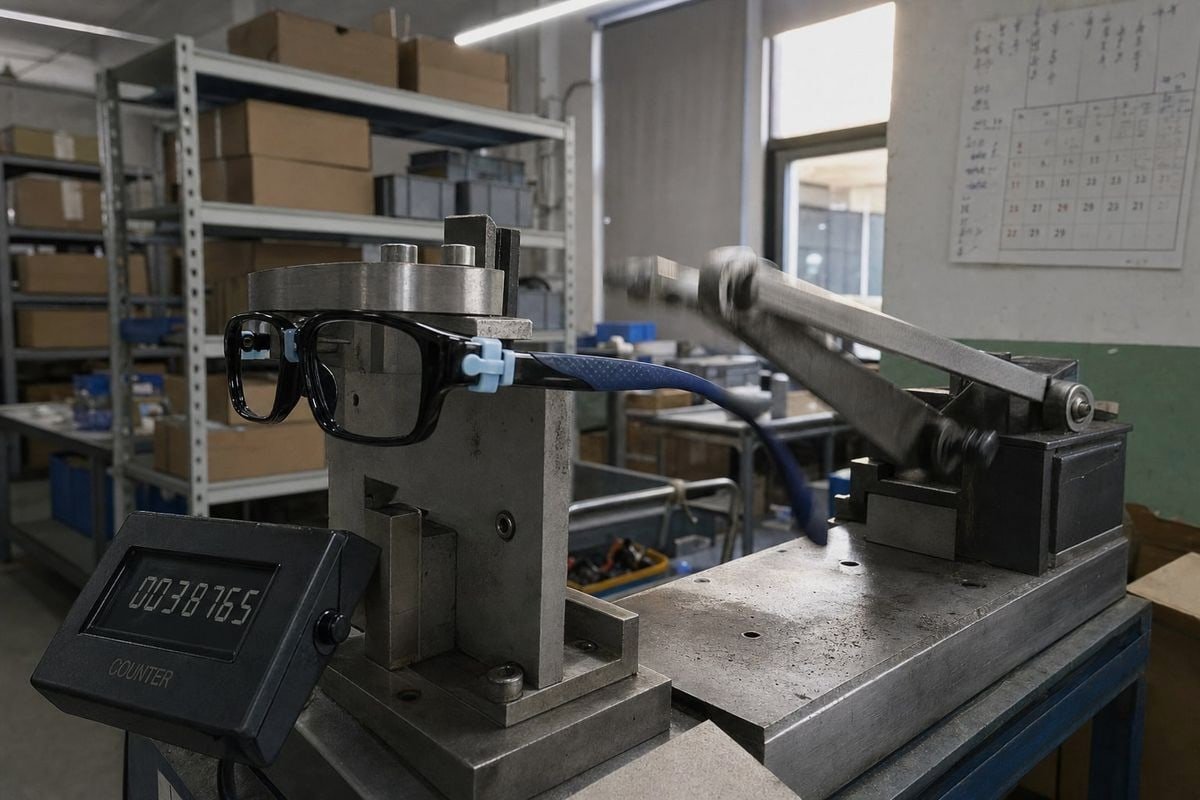
Safety proof splits into two buckets: regulatory compliance and mechanical durability. Both belong in your acceptance criteria as documentary requirements, meaning the paperwork itself is a pass/fail item. A missing certificate should block shipment just like a cracked hinge would.
The Compliance File
Ask for material certificates covering every component — frame body, nose pads, temple tips, hinges, screws, and coatings. For the US market, CPSIA-Tests 2 for lead and phthalates is the baseline. For Europe, REACH 3 applies. If your frames touch skin with metal parts, require zero nickel release, backed by hypoallergenic material certification nickel-release 4 for the contact components. Check report dates too; a test from four years ago on a different colorway tells you little. Some markets also require age-grade labeling, so confirm your factory can print and apply it correctly.
The Durability Battery
Here is the test set we recommend writing into a kids' frame contract:
| Zwei Methoden dominieren. Der Stahlwolltest reibt ein standardisiertes Pad unter festem Druck für eine festgelegte Anzahl von Zyklen über die Beschichtung und bewertet dann die Kratzer. Der Bayer-Abriebtest schüttelt die Linse in abrasivem Medium und vergleicht die Zunahme der Trübung mit einer unbeschichteten Referenz. Bayer liefert ein numerisches Verhältnis, das den Vergleich der Abriebfestigkeitsniveaus zwischen den Lieferanten vereinfacht. | Standard / Method | Minimum Requirement |
|---|---|---|
| Structural integrity | ISO 12870 5 standards | Pass bridge deformation and endurance clauses |
| Hinge fatigue | Cycle test | 5,000 open-close cycles, smooth function after |
| Schlagfestigkeit | ASTM F803 6 (sports frames) | High-velocity impact pass |
| Cold flexibility | -20°C flex test for TR90 | No cracking or whitening |
| Coating corrosion | 48-hour neutral salt spray (metal parts) | No blistering or peeling |
| Re-glazing durability | Repeated lens insertion cycles | Agreed number of cycles without rim fatigue |
Two items deserve extra attention for optical frames specifically. First, rim tension: if the rim grips the lens too hard, it can warp the lens and undermine optical performance — a real concern for myopia management 7 lenses. Agree on a rim tension limit. Second, re-glazing durability: kids' prescriptions change often, so the frame should survive several lens replacement cycles without the rim stretching or cracking. Spring hinge cycle life matters here too if your design uses spring hinges, since children pull frames off one-handed constantly.
Wie kann ich Streitigkeiten über Qualitätsstandards bei der Finalisierung meines Lieferantenvertrags vermeiden?
Early in our export work, a shipment argument taught us something valuable: the buyer and our QC team had inspected the same goods and reached opposite conclusions, because nobody had defined what counted as a "major" defect. We never made that mistake again.
Verhindern Sie Streitigkeiten, indem Sie vor der Bestellung einen AQL-Stichprobenplan, eine Liste der Fehlerklassifizierung und ein vereinbartes Inspektionsverfahren in den Vertrag aufnehmen. Definieren Sie Haupt- und Nebenfehler, Ablehnungsgründe, Abhilfemaßnahmen und Rückverfolgbarkeitsanforderungen, die alle an der unterzeichneten Musterprobe verankert sind.
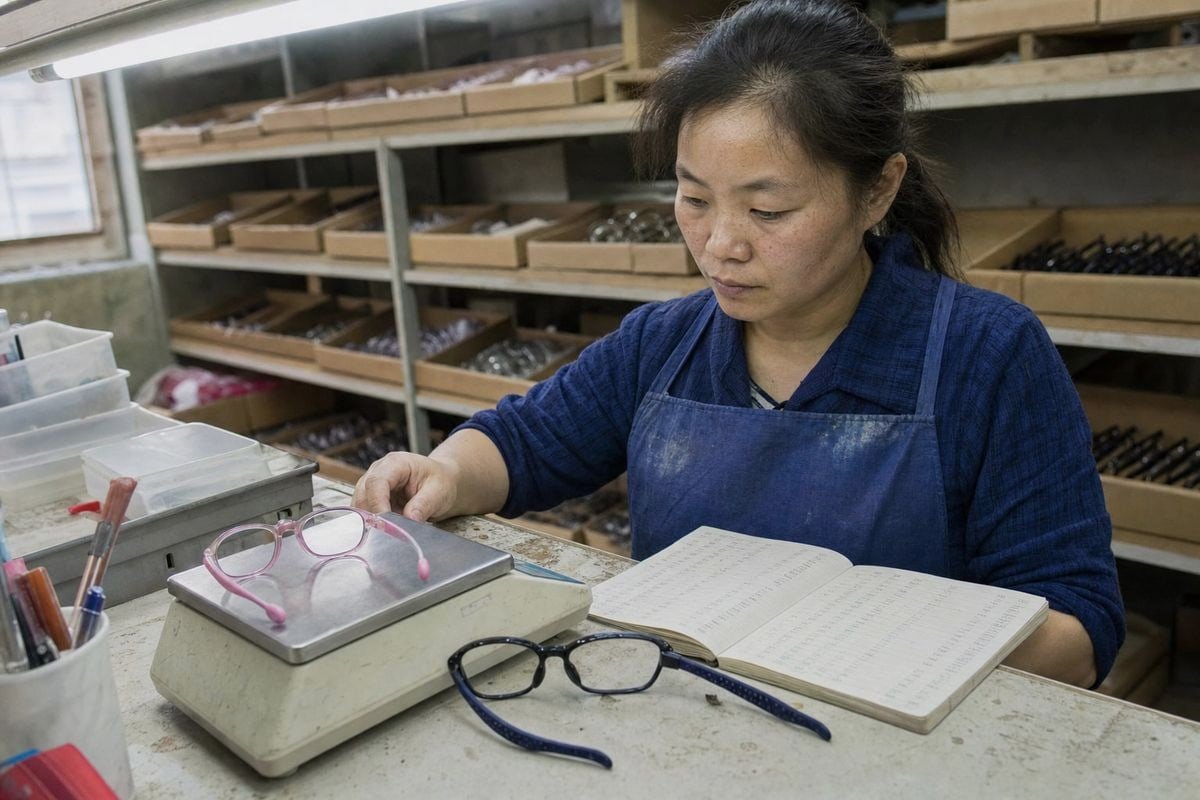
Disputes almost never come from bad faith. They come from two honest parties measuring against different mental standards. The cure is a shared, written standard that both sides sign before production starts. Here is the sequence we walk through with new B2B buyers.
A Five-Step Negotiation Script
- Agree on the sampling plan. Acceptable Quality Level 8 (AQL) sampling, General Level II with limits of 2.5 for major defects and 4.0 for minor defects, is the common baseline for eyewear. Write the exact AQL level into the contract, not just the word "inspection."
- Build the defect classification list together. A cracked hinge is critical. A misaligned temple is major. A faint print smudge inside the temple is minor. Listing 20–30 named defects with their classification removes almost all inspection arguments.
- Define the acceptance procedure. State who inspects, when, where, and against which documents: the spec sheet, the master sample, and the compliance file. Pre-shipment inspection with a clear pass/fail outcome beats after-arrival surprises.
- Set rejection and remedy terms. Spell out what happens on failure: rework, replacement, discount, or refund — and who pays for re-inspection. Ambiguity here is where relationships break.
- Require traceability. Confirm the factory can trace a defective batch by production date, line, or worker. Our 5S-managed workshop logs this by default, and it turns a defect crisis into a contained, fixable event.
Keep It Collaborative, Not Adversarial
One buyer objection we hear often: "Won't all these requirements scare off my supplier or raise my price?" In our experience, the opposite happens. Clear Quality Assurance protocols reduce the factory's uncertainty, cut rework, and let both sides quote and plan accurately. A supplier who resists written acceptance criteria is telling you something. A good factory welcomes them, because the criteria protect the factory too — an agreed AQL result is the factory's proof of performance. Start with a trial order, verify both the product and the documentation, and scale from there.
Schlussfolgerung
Vague specs create disputes; measurable ones prevent them. Define dimensions, tolerances, tests, documents, and AQL limits in writing before your order — and choose a factory that welcomes that discipline.
Fußnoten
1. Background reference on thermoplastic materials like TR90 used in flexible frame construction. ↩︎
2. Official source explaining CPSIA lead and phthalate testing requirements referenced in article. ↩︎
3. European Commission’s official overview of REACH chemical safety regulations. ↩︎
4. Government reference explaining nickel exposure relevant to hypoallergenic metal component requirements. ↩︎
5. Official ISO standard page for spectacle frame requirements and test methods cited in article. ↩︎
6. Official ASTM standard for eye protectors for selected sports referenced for impact resistance testing. ↩︎
7. National Eye Institute’s authoritative guide on myopia causes and management. ↩︎
8. Background concept explaining AQL sampling standard used throughout the acceptance criteria negotiation. ↩︎
Weitere Artikel, die Ihnen gefallen könnten

Auf der Suche nach einem zuverlässigen Partner für Kinderbrillen?
Entdecken Sie über 800 sofort verfügbare Modelle und umfassenden OEM/ODM-Support, der auf Ihre Marke zugeschnitten ist.
Kontakt aufnehmen English
  Español de México
  Deutsch
  Français
  日本語
日本語  العربية
  Português do Brasil