How to Negotiate Quantifiable Acceptance Criteria for Kids’ Optical Frames?

Quantifiable acceptance criteria for kids’ optical frames decide whether your shipment sails through or stalls in disputes. On our Taizhou production line, vague specs cause most problems. Fuzzy words like “durable” invite arguments, returns, and eroded trust. The fix is simple: measure everything.
To negotiate quantifiable acceptance criteria for kids’ optical frames, convert vague needs into measurable pass/fail checks: dimensional tolerances of ±0.2mm, hinge endurance of 5,000 cycles, CPSIA chemical test reports, AQL 2.5/4.0 sampling limits, and a signed master sample — all documented in writing before the purchase order.
That is the short answer. The rest of this article shows you how to build each piece, step by step, and how to get your frame supplier to agree to it.
What Measurable Specs Should I Include in My Acceptance Criteria for Kids' Optical Frames?
A buyer from Australia once sent us a spec sheet that said only "must fit kids aged 3–6 comfortably." Our engineers sent back twelve questions before we could quote. That exchange taught both sides why numbers beat adjectives.
Include exact bridge and temple dimensions, overall frame width, lens width, and weight, each with a stated tolerance. Add hinge cycle counts, flex recovery limits, coating adhesion checks, and surface finish standards. Every spec must be measurable with a tool, not judged by opinion.
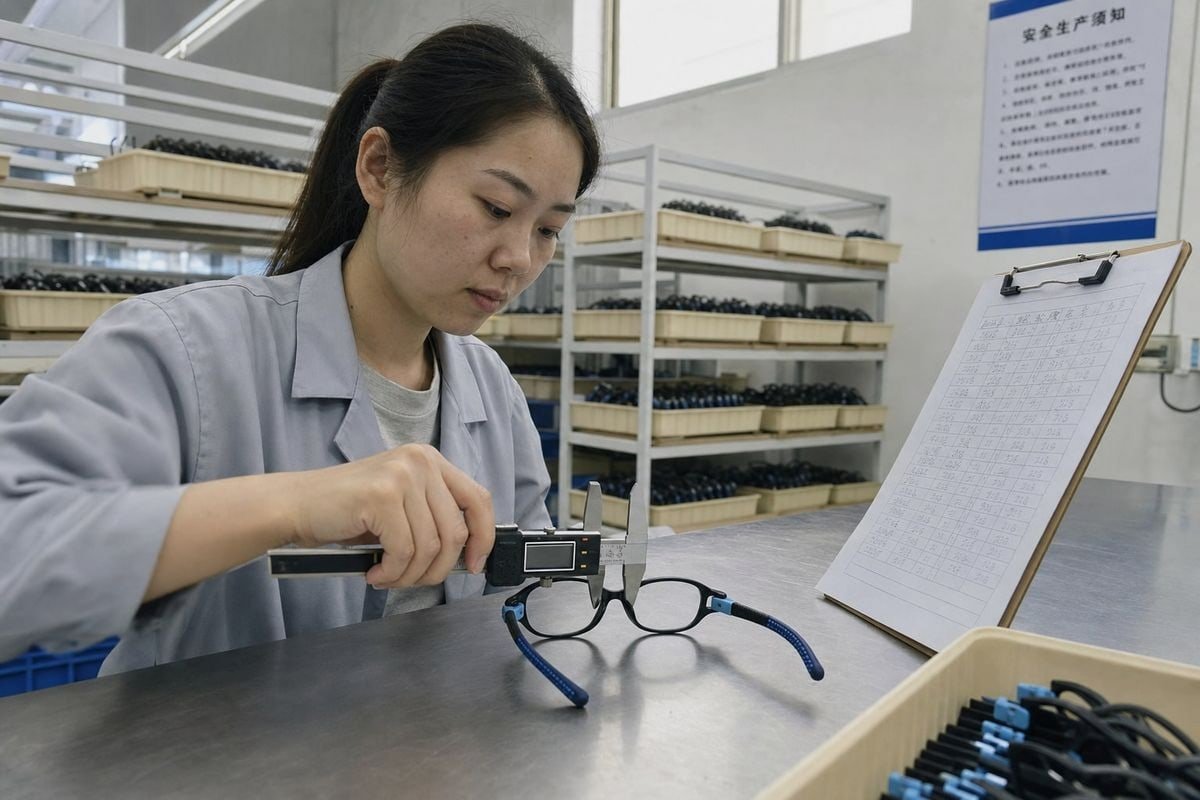
The core rule we follow: if a requirement cannot be measured, inspected, or tested, it should not be an acceptance criterion. "Looks sturdy" is not a spec. "Temple returns to original shape after a 90-degree outward flex" is a spec. Our team applies this rule to roughly 800 existing styles, so we have seen what happens when specs are loose — and when they are tight.
Dimensions and Fit
Children's faces vary by age group, so exact numbers matter more than for adult frames. Ask your supplier whether they use different molds by age band. At our factory, we group frames roughly by toddler, preschool, and school-age fits, and the bridge geometry changes for each.
Here is a practical starting checklist you can adapt:
| Spec Category | What to Measure | Typical Requirement |
|---|---|---|
| Largura da armação | Total front width | Match approved sample ±0.2mm |
| Largura da ponte | Inner nose bridge span | Stated in mm, ±0.2mm |
| Comprimento da haste | Hinge to tip | Stated in mm, ±0.5mm |
| Lens width/height | A and B measurements | ±0.2mm |
| Peso | Complete frame | Stated in grams, ±5% |
| Lens alignment | Left/right symmetry | No visible skew on flat surface |
Performance and Materials
Beyond dimensions, define material behavior. TR90 1 and TPEE are flexible by design, so specify recovery: the frame must return to shape after bending without whitening or cracking. Define coating and print durability too — logo prints should survive a defined rub test without fading.
Also cover fit behavior on the child. Turn comfort into observable checks: eyes centered in lenses, frame sits level, no dramatic sliding during a down-up head movement, and no red pressure marks after a 10–15 minute wear test. These are simple, but they give a clear pass/fail result.
How Do I Set Realistic Tolerance Levels When Negotiating with My Frame Manufacturer?
There is always a trade-off we weigh with buyers: tighter manufacturing tolerances mean higher unit cost and more rejected parts, while looser tolerances risk inconsistent fit on small faces. The right answer sits between those two, and it differs by feature.
Set critical-fit dimensions like bridge width and lens width at ±0.2mm, secondary dimensions like temple length at ±0.5mm, and weight at ±5%. Confirm the factory keeps a master sample per SKU and agrees that every batch is measured against it before shipment.
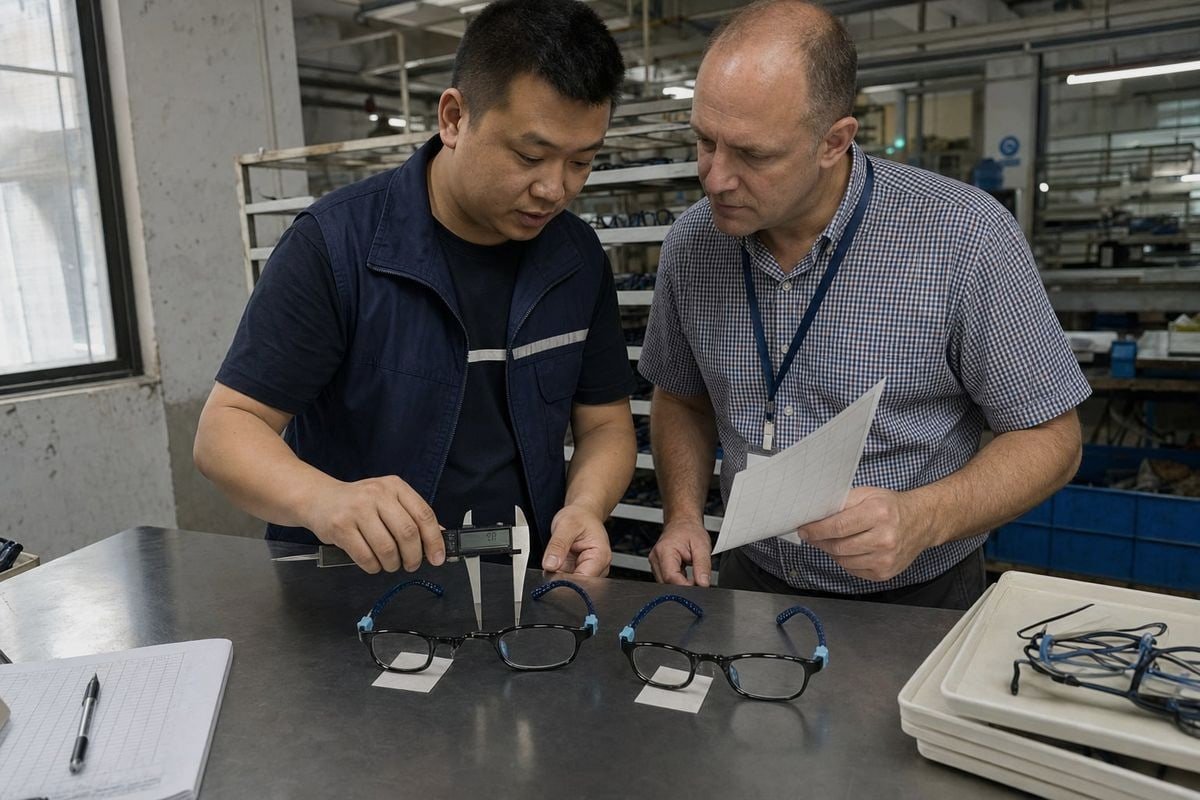
Tolerances are where negotiation gets real. A tolerance that is too tight for the process will just get ignored — or padded into your price. A tolerance that is too loose will pass frames that slide down a four-year-old's nose. So the discussion should start with one question: which dimensions are actually critical for a child's fit?
Rank Dimensions by Criticality
Not every measurement deserves the same tolerance. We suggest a three-tier approach:
| Camada | Dimensões | Suggested Tolerance | Por quê |
|---|---|---|---|
| Crítico | Bridge width, lens width, lens height | ±0.2mm | Directly affects optical centering and nose fit |
| Important | Temple length, frame width, pantoscopic tilt | ±0.5mm | Affects comfort, adjustable at dispensing |
| Cosmético | Color match, surface gloss, print position | Against approved limit sample | Visual, judged versus master sample |
Injection-molded TR90 holds tight dimensions well once the mold is proven, so ±0.2mm on critical dimensions is realistic, not punishing. Softer TPEE temple parts move slightly more, which is why temple length gets a wider band. Dimensional stability over temperature also matters: ask how the material behaves after heat exposure during lens glazing, because a frame that distorts at the optical lab fails the customer even if it left the factory in spec.
Anchor Everything to the Master Sample
Numbers on paper are only half the deal. The other half is the signed, sealed master sample. In our workshop, each approved SKU has a retained golden sample, and batch inspection compares production directly against it — color, texture, hinge feel, and dimensions. Ask your supplier to confirm this in writing, and ask how long they retain the sample. If they cannot trace a defect back to a production line, worker, or date, tolerance talk is mostly theater.
Some buyers also ask for virtual try-on alignment. If your brand uses 3D assets, add a criterion that physical frame dimensions match your CAD or virtual try-on model within about 1% variance, so the online fit experience matches the real product.
Which Safety and Durability Tests Should I Require Before Approving My Order?
When we ship children's frames to Europe, Japan, and the US, the compliance file travels with the goods. One lesson from 15 years in eyewear: a supplier who promises "child-safe" but cannot produce a recent third-party report is asking you to carry their risk.
Require ISO 12870 structural testing, third-party CPSIA reports for lead and phthalates, nickel-release results for metal parts, and hinge endurance of at least 5,000 open-close cycles. For sports styles, add ASTM F803 impact resistance testing. Demand documents, not verbal assurances.
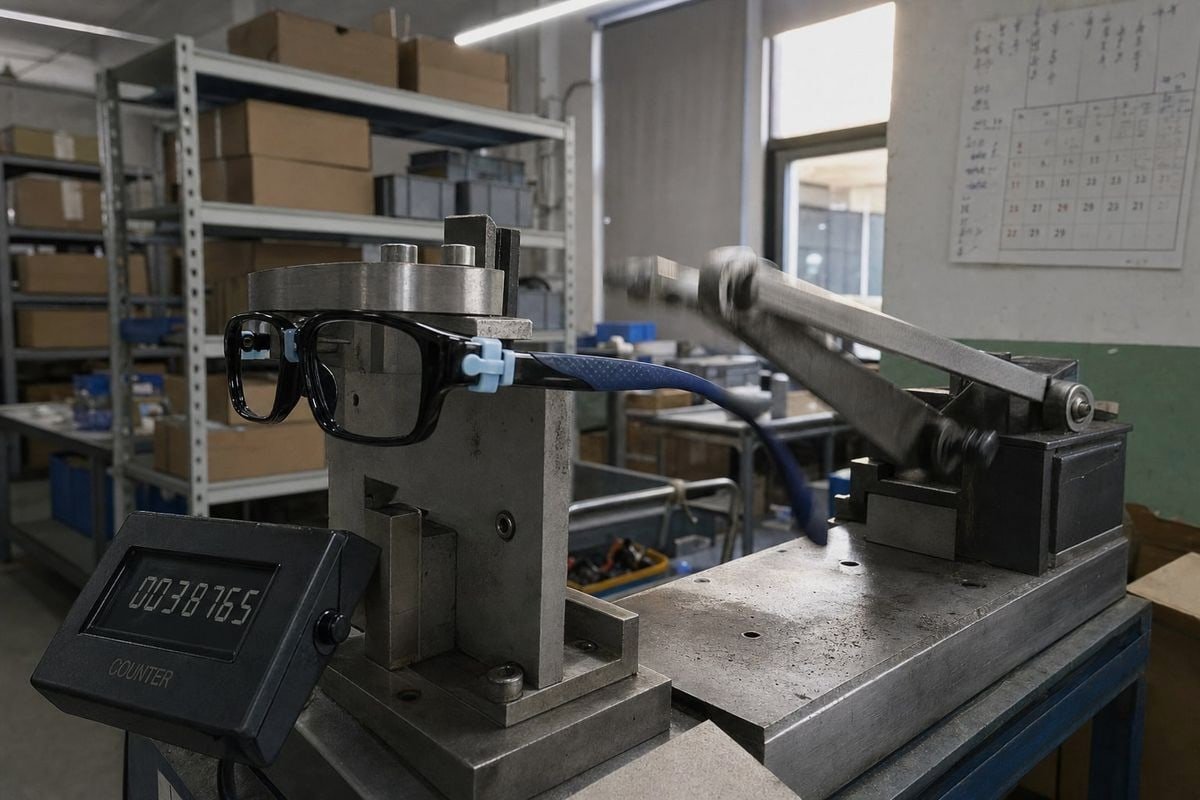
Safety proof splits into two buckets: regulatory compliance and mechanical durability. Both belong in your acceptance criteria as documentary requirements, meaning the paperwork itself is a pass/fail item. A missing certificate should block shipment just like a cracked hinge would.
The Compliance File
Ask for material certificates covering every component — frame body, nose pads, temple tips, hinges, screws, and coatings. For the US market, testes CPSIA 2 for lead and phthalates is the baseline. For Europe, REACH 3 applies. If your frames touch skin with metal parts, require zero nickel release, backed by hypoallergenic material certification nickel-release 4 for the contact components. Check report dates too; a test from four years ago on a different colorway tells you little. Some markets also require age-grade labeling, so confirm your factory can print and apply it correctly.
The Durability Battery
Here is the test set we recommend writing into a kids' frame contract:
| Teste | Standard / Method | Minimum Requirement |
|---|---|---|
| Structural integrity | ISO 12870 5 standards | Pass bridge deformation and endurance clauses |
| Hinge fatigue | Cycle test | 5,000 open-close cycles, smooth function after |
| Resistência ao impacto | ASTM F803 6 (sports frames) | High-velocity impact pass |
| Cold flexibility | -20°C flex test for TR90 | No cracking or whitening |
| Coating corrosion | 48-hour neutral salt spray (metal parts) | No blistering or peeling |
| Re-glazing durability | Repeated lens insertion cycles | Agreed number of cycles without rim fatigue |
Two items deserve extra attention for optical frames specifically. First, rim tension: if the rim grips the lens too hard, it can warp the lens and undermine optical performance — a real concern for controle de miopia 7 lenses. Agree on a rim tension limit. Second, re-glazing durability: kids' prescriptions change often, so the frame should survive several lens replacement cycles without the rim stretching or cracking. Spring hinge cycle life matters here too if your design uses spring hinges, since children pull frames off one-handed constantly.
How Can I Avoid Disputes Over Quality Standards When Finalizing My Supplier Contract?
Early in our export work, a shipment argument taught us something valuable: the buyer and our QC team had inspected the same goods and reached opposite conclusions, because nobody had defined what counted as a "major" defect. We never made that mistake again.
Prevent disputes by writing an AQL sampling plan, a defect classification list, and an agreed inspection procedure into the contract before the purchase order. Define major and minor defects, rejection triggers, remedy steps, and traceability requirements, all anchored to the signed master sample.
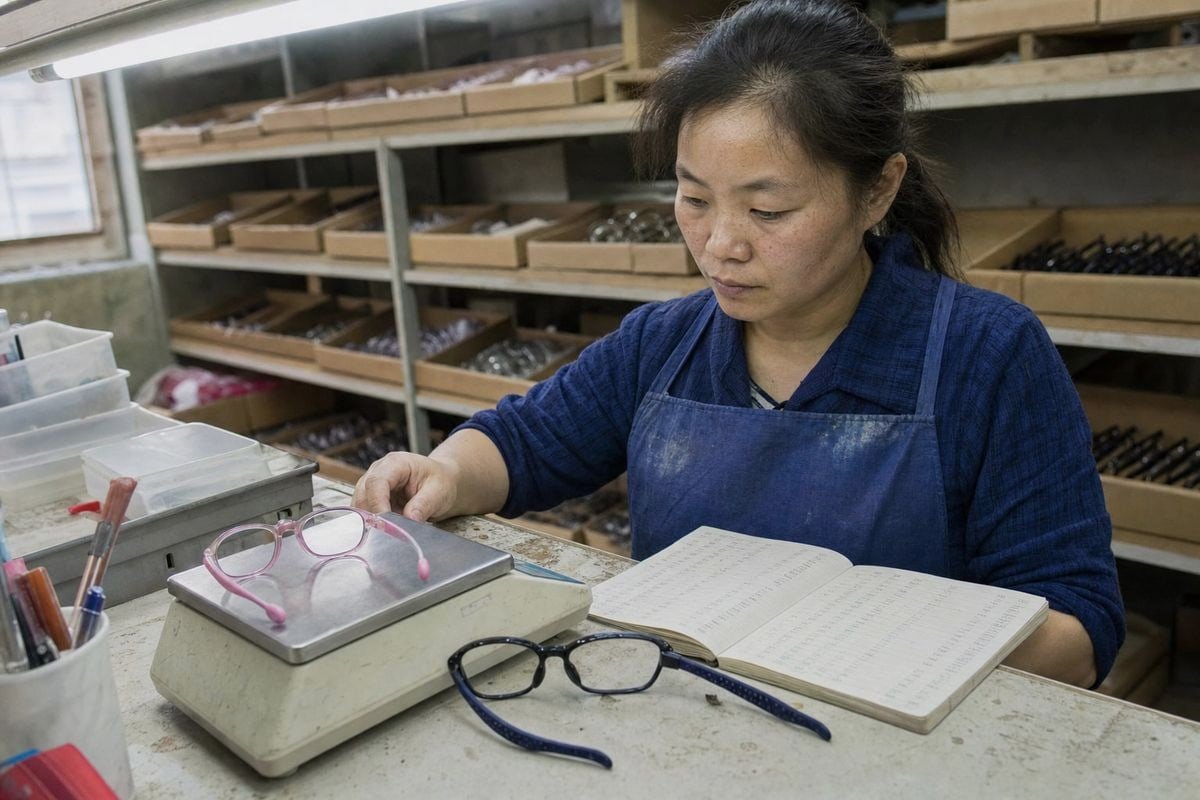
Disputes almost never come from bad faith. They come from two honest parties measuring against different mental standards. The cure is a shared, written standard that both sides sign before production starts. Here is the sequence we walk through with new B2B buyers.
A Five-Step Negotiation Script
- Agree on the sampling plan. Acceptable Quality Level 8 (AQL) sampling, General Level II with limits of 2.5 for major defects and 4.0 for minor defects, is the common baseline for eyewear. Write the exact AQL level into the contract, not just the word "inspection."
- Build the defect classification list together. A cracked hinge is critical. A misaligned temple is major. A faint print smudge inside the temple is minor. Listing 20–30 named defects with their classification removes almost all inspection arguments.
- Define the acceptance procedure. State who inspects, when, where, and against which documents: the spec sheet, the master sample, and the compliance file. Pre-shipment inspection with a clear pass/fail outcome beats after-arrival surprises.
- Set rejection and remedy terms. Spell out what happens on failure: rework, replacement, discount, or refund — and who pays for re-inspection. Ambiguity here is where relationships break.
- Require traceability. Confirm the factory can trace a defective batch by production date, line, or worker. Our 5S-managed workshop logs this by default, and it turns a defect crisis into a contained, fixable event.
Keep It Collaborative, Not Adversarial
One buyer objection we hear often: "Won't all these requirements scare off my supplier or raise my price?" In our experience, the opposite happens. Clear Quality Assurance protocols reduce the factory's uncertainty, cut rework, and let both sides quote and plan accurately. A supplier who resists written acceptance criteria is telling you something. A good factory welcomes them, because the criteria protect the factory too — an agreed AQL result is the factory's proof of performance. Start with a trial order, verify both the product and the documentation, and scale from there.
Conclusão
Vague specs create disputes; measurable ones prevent them. Define dimensions, tolerances, tests, documents, and AQL limits in writing before your order — and choose a factory that welcomes that discipline.
Notas de rodapé
1. Background reference on thermoplastic materials like TR90 used in flexible frame construction. ↩︎
2. Official source explaining CPSIA lead and phthalate testing requirements referenced in article. ↩︎
3. European Commission’s official overview of REACH chemical safety regulations. ↩︎
4. Government reference explaining nickel exposure relevant to hypoallergenic metal component requirements. ↩︎
5. Official ISO standard page for spectacle frame requirements and test methods cited in article. ↩︎
6. Official ASTM standard for eye protectors for selected sports referenced for impact resistance testing. ↩︎
7. National Eye Institute’s authoritative guide on myopia causes and management. ↩︎
8. Background concept explaining AQL sampling standard used throughout the acceptance criteria negotiation. ↩︎
Mais Artigos que Você Pode Gostar


Procurando um Parceiro Confiável em Óculos Infantis?
Explore mais de 800 estilos prontos e suporte completo OEM/ODM adaptado à sua marca.
Entre em Contato English
  Español de México
  Deutsch
  Français
  日本語
日本語  العربية
  Português do Brasil