B2B Platforms vs Trade Shows: Which Screens Kids’ Sunglasses Suppliers Better?
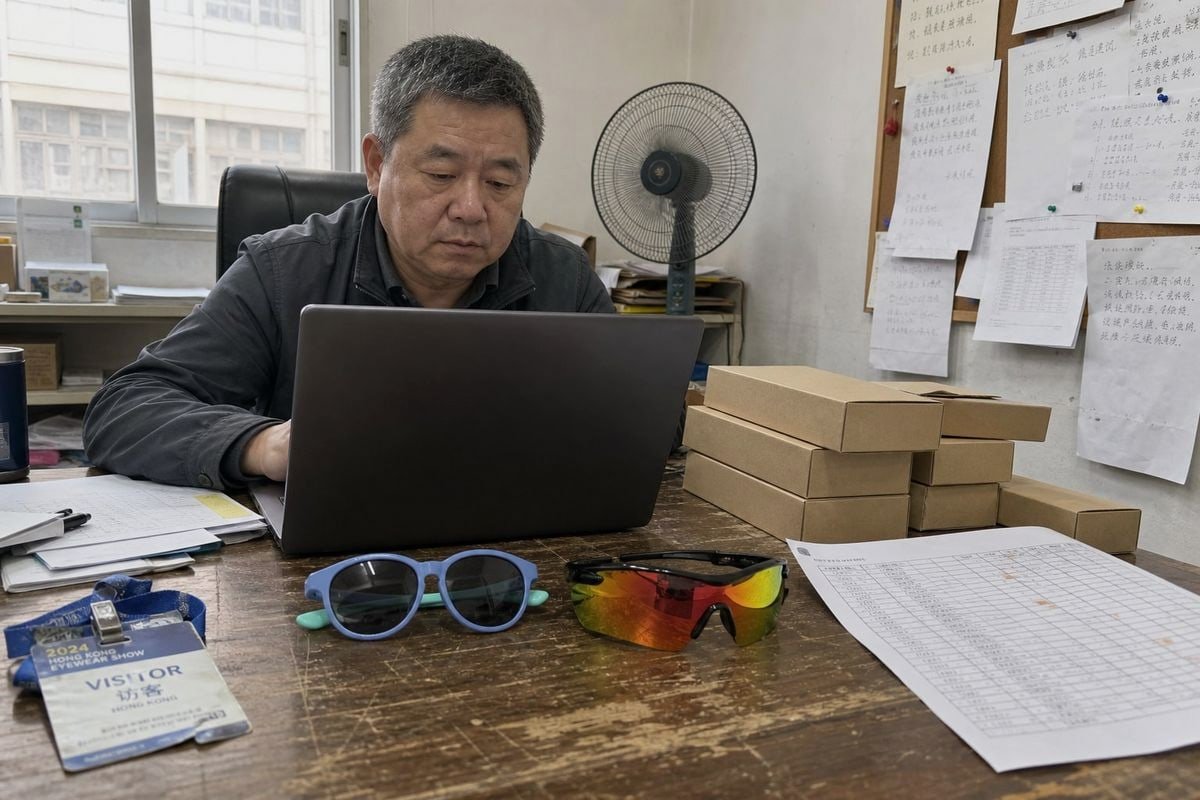
Choosing between B2B platforms 1 and trade shows to screen kids’ sunglasses suppliers is a real headache — our Taizhou factory meets buyers burned by both channels every season.
B2B platforms screen kids’ sunglasses suppliers faster and cheaper, offering global reach and side-by-side comparison, while trade shows screen more deeply through hands-on product inspection and face-to-face trust-building. The strongest wholesale sourcing strategy combines both: shortlist online, then verify in person.
Neither channel is a complete answer on its own. Below, I break down how each one works, where each one fails, and how to combine them for children’s eyewear sourcing.
How can I verify a kids' sunglasses supplier's safety certifications before committing to either channel?
A buyer from Australia once asked us for our UV400 protection 2 testing reports before she would even schedule a video call. That request was smart — and it should be your standard, too.
Verify safety certifications by requesting original test reports from accredited labs, confirming report numbers directly with the issuing laboratory, checking CPSIA compliance standards for the US or EN standards for Europe, and reviewing factory audit reports — regardless of whether you found the supplier online or at a show.
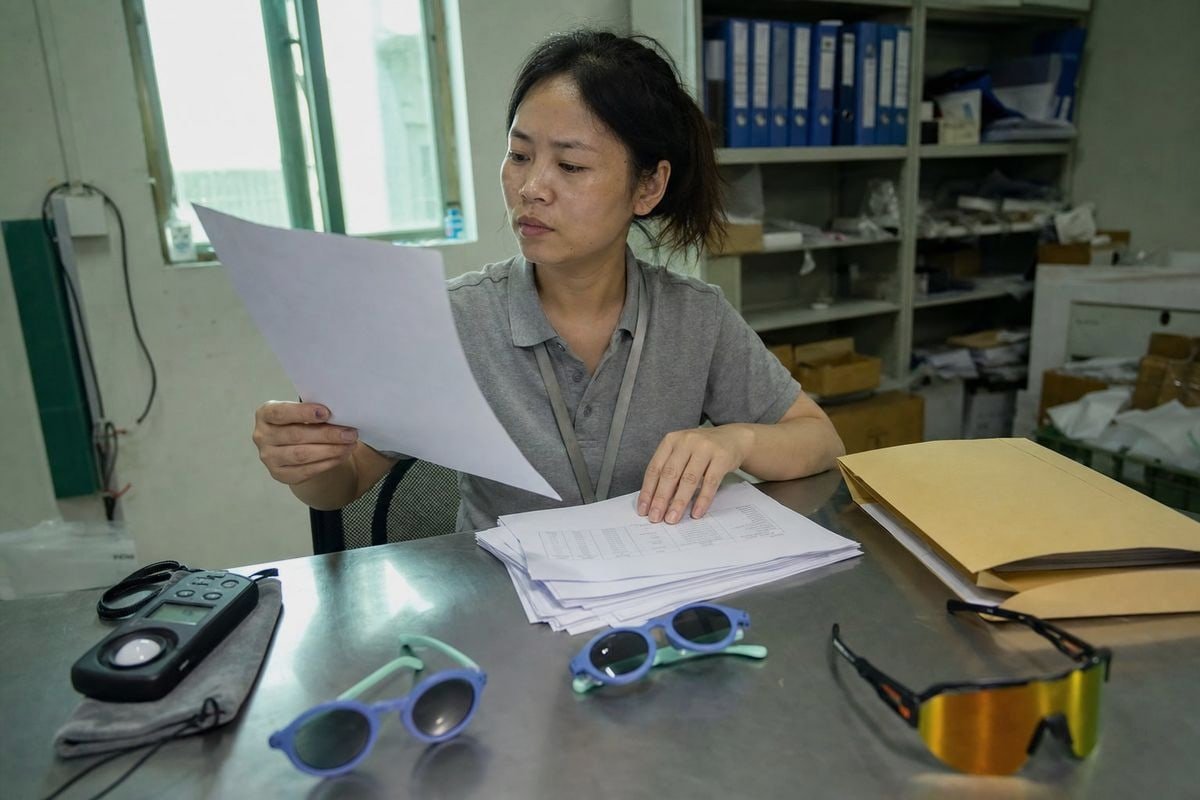
Certification verification is channel-neutral. Whether you meet a supplier on Alibaba or at a Hong Kong optical fair, the documents you need are the same. What changes is how easy it is to check them.
The documents that actually matter for children's eyewear
Kids' sunglasses are regulated as children's products 3 in most major markets. That means general eyewear paperwork is not enough. In our experience exporting to 20+ countries, serious buyers ask for a specific stack of documents. Here is what we prepare for our TR90 and TPEE frames, and what you should request from any supplier:
| Document | What it proves | How to verify it |
|---|---|---|
| UV400 lens test report | Lenses block UV to 400nm as claimed | Call or email the lab with the report number |
| CPSIA test report (US) | Lead, phthalates, and small-parts safety for children | Confirm the lab is CPSC-accepted |
| EN ISO 12312-1 report (EU) | Sunglasses meet EU optical and impact requirements | Check the notified body's database |
| Factory audit report (BSCI, ISO, or client audit) | The factory exists and runs real quality systems | Ask for the full report, not a summary page |
| Material declarations | Frames are BPA-free and use safe plastics | Cross-check against the material test data |
Where each channel helps — and where it doesn't
B2B platforms make document collection easier. Good platforms host verified certificates and factory audit reports in one digital trail. Some run trade assurance programs that tie payment protection to documented claims. That structure supports long-term compliance management.
But here is the catch. A PDF on a profile page is a claim, not proof. Reports can be expired, borrowed from another factory, or issued for a different product. At a trade show, you can hold the certified sample, ask which lens supplier produced it, and watch how confidently the staff answers. Fumbling on basic UV400 questions at a booth tells you more than a polished online profile ever will.
Our advice is simple. Collect documents through the platform, then pressure-test the knowledge behind them in person or on a live video call. Product safety certifications only protect you when the people behind them understand them.
Should I meet suppliers in person at trade shows or is a virtual B2B platform review enough for vetting quality?
There is a trade-off we discuss with buyers all the time: a video call saves you a flight, but it cannot let you bend a temple arm between your fingers.
A virtual B2B platform review is enough for initial vetting — checking catalogs, certifications, and communication quality. But for kids' sunglasses, where flexibility, fit, and finish decide safety, in-person inspection at a trade show or via physical samples remains essential before large orders.
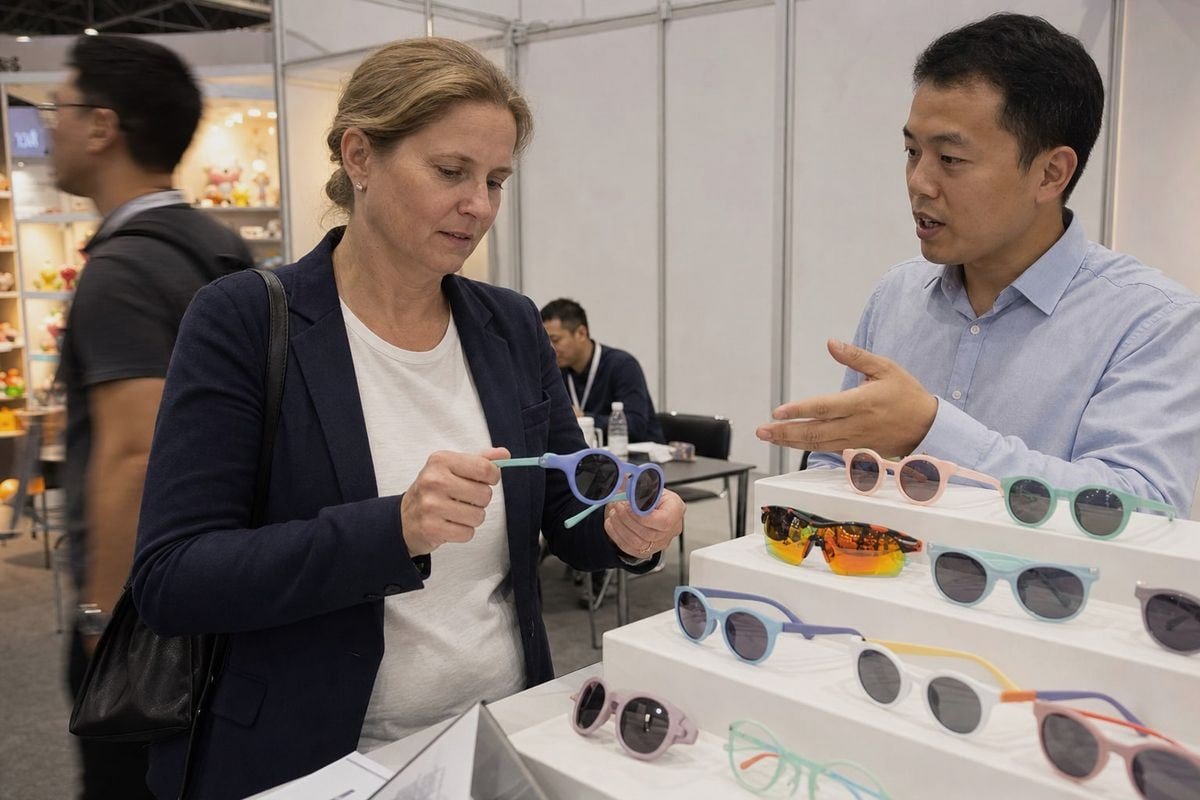
Kids' eyewear is a tactile product. Our TPEE temples 4 are designed to twist and flex without snapping, because active children fall, sit on their sunglasses, and pull them off by one arm. No product photo — not even a good one — communicates that flex behavior. This is why the "virtual is enough" argument breaks down faster in children's eyewear than in many other categories.
What only hands-on inspection reveals
At a trade show, buyers at our booth do the same three things within the first minute. They twist the temples. They press the nose bridge. They run a thumb along the lens edge. Those instinctive tests check for:
- Frame flexibility — does the material bend and recover, or does it feel brittle?
- Construction precision — are hinges tight, screws flush, and lens edges smooth with no sharp burrs?
- Finish quality — is the coating even, or does the mirror lens show orange-peel texture?
- Fit ergonomics — does the small-size bridge actually sit on a child's low nose bridge?
- Weight — does it feel light enough for all-day wear on a toddler?
Photos on a platform compress all of this into pixels. Even our sport-style wraparound shields with gradient mirror lenses look nearly identical in photos to versions with far weaker coatings. The difference only shows up in your hands — or six months later, in customer returns.
The realistic middle path
You do not always need a plane ticket. A structured virtual review plus paid physical samples covers most of the gap. Ask for a live factory video walk, watch the injection molding 5 and assembly lines, then order samples of your exact shortlisted styles. We ship samples within days precisely because we know buyers cannot judge flexible materials remotely. Treat the trade show as the deep-relationship step, not the only path to touching the product. Manufacturing capabilities 6 become obvious once you combine a live tour, real samples, and sharp questions.
A lesson we learned from the buyer's side of the table: one of our distributors once shortlisted three "gold-rated" suppliers online, and later discovered two of them were trading companies reselling from the same small workshop.
Platform ratings hide several risks: trading companies posing as factories, ratings built on unrelated product lines, borrowed certificates, no visibility into batch consistency, and zero insight into child-specific expertise. Ratings measure transaction volume and responsiveness — not real manufacturing capabilities or supply chain transparency.
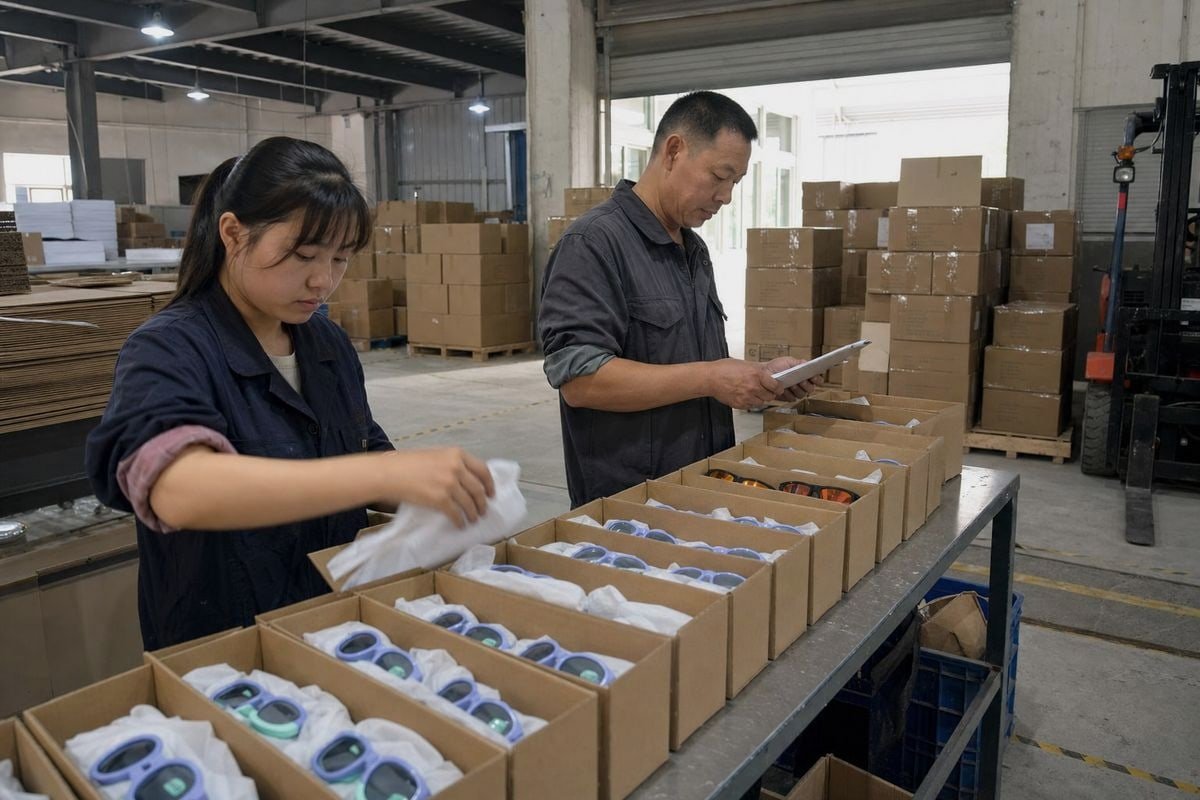
Ratings are useful signals. But they answer the wrong question. They tell you a supplier processes orders smoothly. They do not tell you whether that supplier can hold consistent lens tint across 10,000 units of a kids' frame, or whether their TR90 is virgin material or recycled scrap.
The risks ratings cannot capture
| Hidden risk | Why ratings miss it | How to expose it |
|---|---|---|
| Trading company disguised as a factory | Platforms verify a business license, not production lines | Ask spontaneous, process-level technical questions; request a live workshop tour |
| Ratings from unrelated products | A 4.9-star score may come from selling phone cases | Filter reviews for eyewear-specific transactions |
| Batch-to-batch inconsistency | Reviews reflect first orders, not the fifth reorder | Ask for a QC plan and tolerance specs; commission on-site quality inspection |
| Borrowed or expired certificates | Documents are uploaded, not continuously audited | Verify report numbers with the lab directly |
| No child-safety expertise | Ratings do not test knowledge of CPSIA or EN standards | Quiz the supplier on children's product regulations for your market |
Why unmasking traders matters for kids' products
Trading companies are not always bad. But in children's eyewear, an extra layer between you and the factory weakens supply chain transparency 8 exactly where you need it most. When a lens coating question or a recall inquiry comes up, a trader relays your question and relays back an answer — often diluted, often delayed. At our 5S-managed workshop, buyers ask about mold cavities, cycle times, and TPEE hardness grades, and our engineers answer on the spot. A trader cannot fake that in a spontaneous conversation. This is precisely where trade shows outperform platform ratings: unscripted, technical, face-to-face questions expose who actually runs the machines. Third-party factory audit reports and an independent on-site quality inspection before shipment close the remaining gap.
How do I compare the cost and time investment of attending trade shows versus sourcing through B2B platforms?
When we exhibit at optical fairs, we watch buyers who flew twelve hours to see products they could have shortlisted from their desks — and buyers who saved that flight but wasted three months on the wrong online supplier.
B2B platforms cost little beyond time: hours of searching, sample fees, and follow-up emails. Trade shows demand flights, hotels, badges, and several working days, often totaling thousands of dollars per trip. Platforms win on cost-per-supplier-discovered; shows win on decisions-per-hour once you have a shortlist.
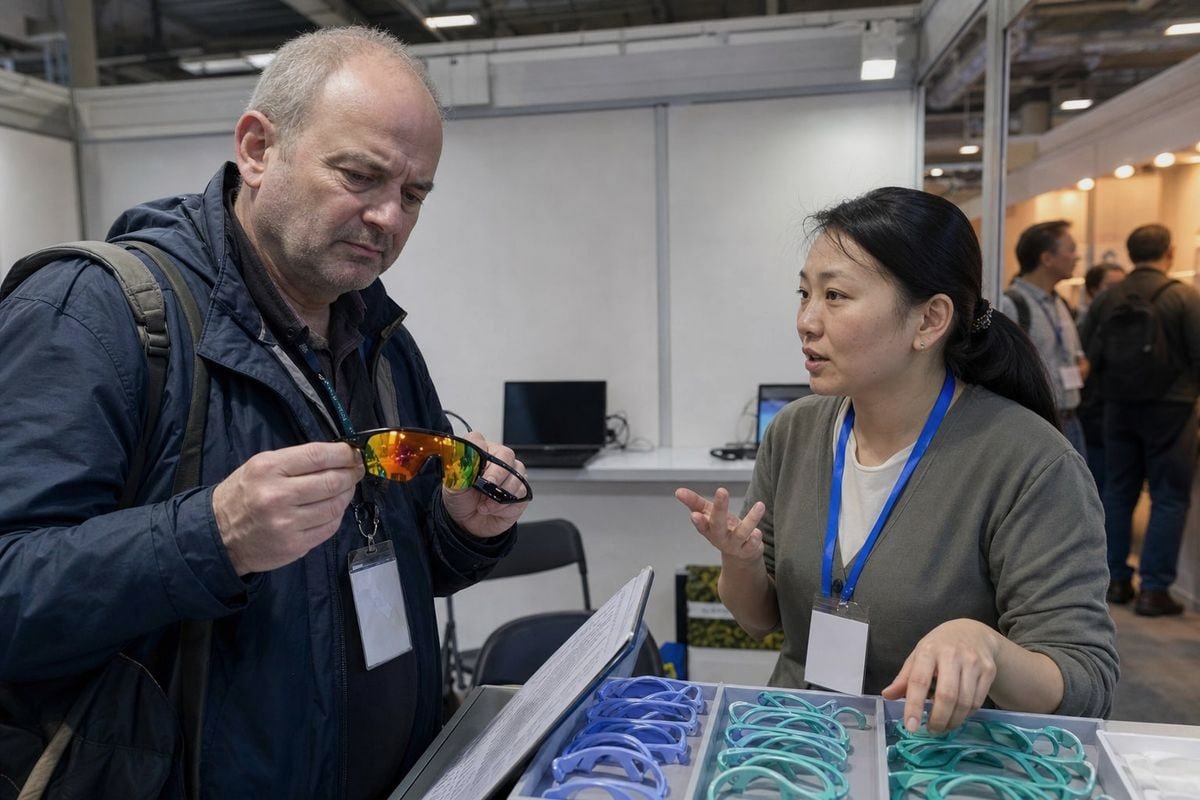
The honest comparison is not "cheap versus expensive." It is cost per useful outcome. Here is how the two channels stack up for a typical kids' eyewear buyer:
| Criterion | B2B Platforms | Trade Shows |
|---|---|---|
| Direct cost | Low — mostly sample and courier fees | High — travel, accommodation, badge, staff time |
| Time to build a longlist | Fast — dozens of suppliers in a day | Slow — limited to exhibitors present |
| Time to a confident decision | Slow — weeks of samples and calls | Fast — many face-to-face evaluations in 2–3 days |
| Availability | 24/7, year-round | Fixed dates, fixed cities |
| Negotiation leverage | Moderate, asynchronous | Strong — show-only MOQ and pricing terms |
| Best use | Initial screening and continuous monitoring | Final vetting, negotiation, relationship-building |
A workflow that spends money where it counts
Based on how our most successful long-term partners source, I recommend a four-step sequence:
- Screen online first. Use precise filters — "children's eyewear," "TR90 kids optical frames," "UV400," "OEM/ODM" — to build a longlist of 15–20 candidates. Cost: your time.
- Cut to a shortlist with documents and samples. Request test reports, audit reports, and paid samples from the top five. Cost: modest sample fees.
- Validate the finalists in person. Visit one targeted trade show or the factories themselves. Now every travel dollar works on pre-qualified suppliers instead of random booths. Negotiate MOQs and customization face-to-face.
- Follow up within 48 hours. Confirm specs, pricing, and timelines in writing while the conversation is fresh.
This hybrid approach reflects where sourcing is heading. Digital screening is becoming continuous, while trade shows shift from first-contact tools to validation and relationship-deepening tools. For startups testing the market — for example, choosing from our roughly 800 existing styles to launch without mold investment — the platform-first path keeps risk and cost low. For established brands planning custom OEM programs with branded packaging, the in-person step earns back its cost many times over in negotiated terms and avoided mistakes.
Conclusion
Screening kids' sunglasses suppliers has two stages: finding and verifying. B2B platforms find candidates faster; trade shows verify them deeper. Combine both — shortlist online, validate hands-on, follow up fast.
Footnotes
1. Defines the nature of B2B commerce and the role of digital platforms in global trade. ↩︎
2. Wikipedia provides a technical overview of UV protection standards for eyewear, including UV400. ↩︎
3. Authoritative Wikipedia entry defining safety standards for children’s products under US law. ↩︎
4. Wikipedia entry for thermoplastic elastomers, the class of materials including TPEE used for flexible children’s frames. ↩︎
5. Comprehensive Wikipedia guide explaining the technical process of plastic injection molding. ↩︎
6. Official NIST resource detailing industrial manufacturing standards and technological capabilities. ↩︎
7. Official US government resource explaining the role and benefits of trade shows for international business. ↩︎
8. Harvard Business Review article discussing the importance of transparency in modern manufacturing supply chains. ↩︎
More Articles You Might Like
August 1, 2026
Should Factory Handle Kids Sunglasses Packaging & Labeling, or Use a Designated Supplier?
August 1, 2026
Own Warehouse vs Supplier Direct Fulfillment: Which Cuts Return Costs for Kids Sunglasses Brands?

August 1, 2026
Direct-to-Port Warehouse or Overseas Staging: Which Saves More on Kids Sunglasses Shipping?
Looking for a Reliable Kids Eyewear Partner?
Explore 800+ ready styles and full OEM/ODM support tailored to your brand.
Get in Touch English
  Español de México
  Deutsch
  Français
  日本語
日本語  العربية
  Português do Brasil