What Are the Quality Differences Between Kids’ Sunglasses at Different Price Points?
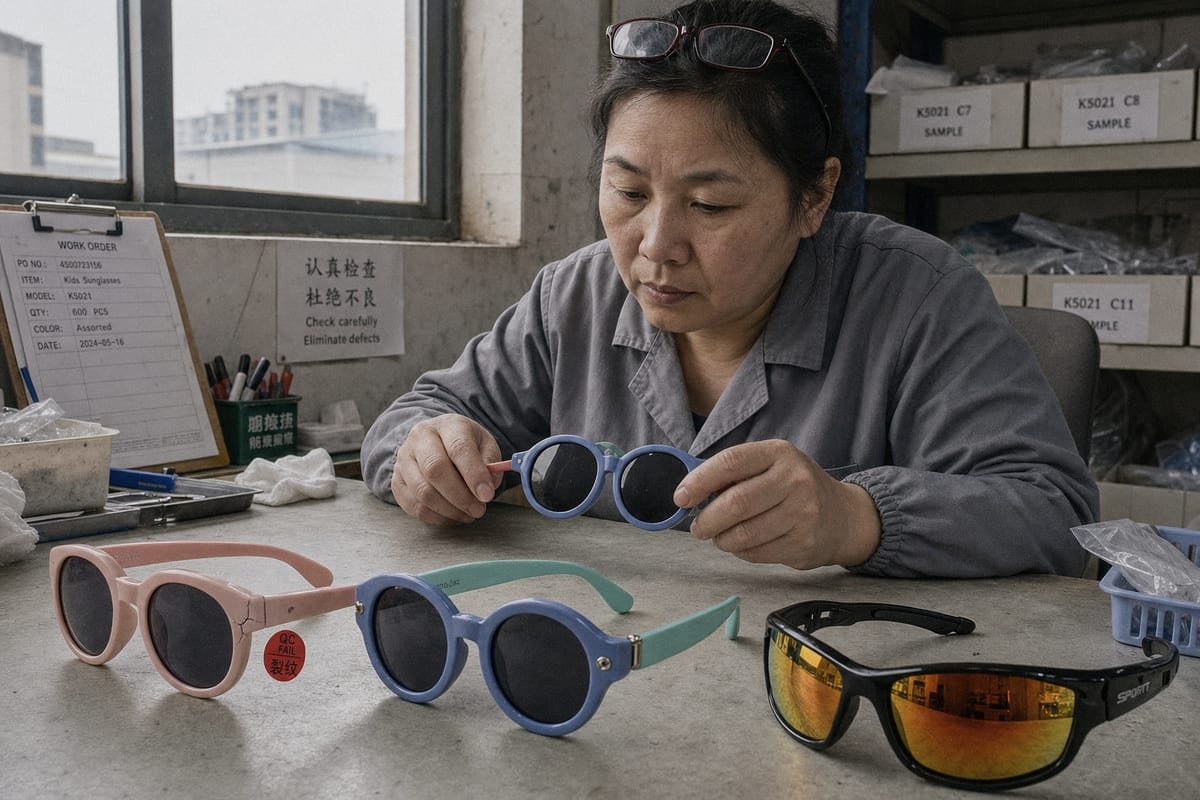
Buyers ask me about the quality differences between kids’ sunglasses at different price points almost every week, usually after a cheap shipment cracked, faded, or failed a safety audit.
The quality differences between kids’ sunglasses at different price points lie mainly in frame materials, impact resistance, lens clarity, fit, and quality control — not UV protection alone. Budget pairs can offer UV400 protection, but mid-range and premium tiers deliver better durability, comfort, and consistency.
Price alone tells you very little. What matters is knowing exactly which features improve as price rises, and which claims are just marketing. Let me break it down tier by tier.
How Do Materials Like TPEE and TR90 Affect Durability at Different Price Levels?
On our production line in Taizhou, we bend every TPEE temple sample past ninety degrees before approving a batch. Cheap injected plastic snaps at that point. Ours springs back.
TPEE and TR90 directly determine durability across price tiers. Budget sunglasses use rigid injected plastics that snap under stress, while mid-range and premium kids' frames use TPEE flexible frames and TR90 fronts that bend, twist, and recover without breaking or pinching a child's face.
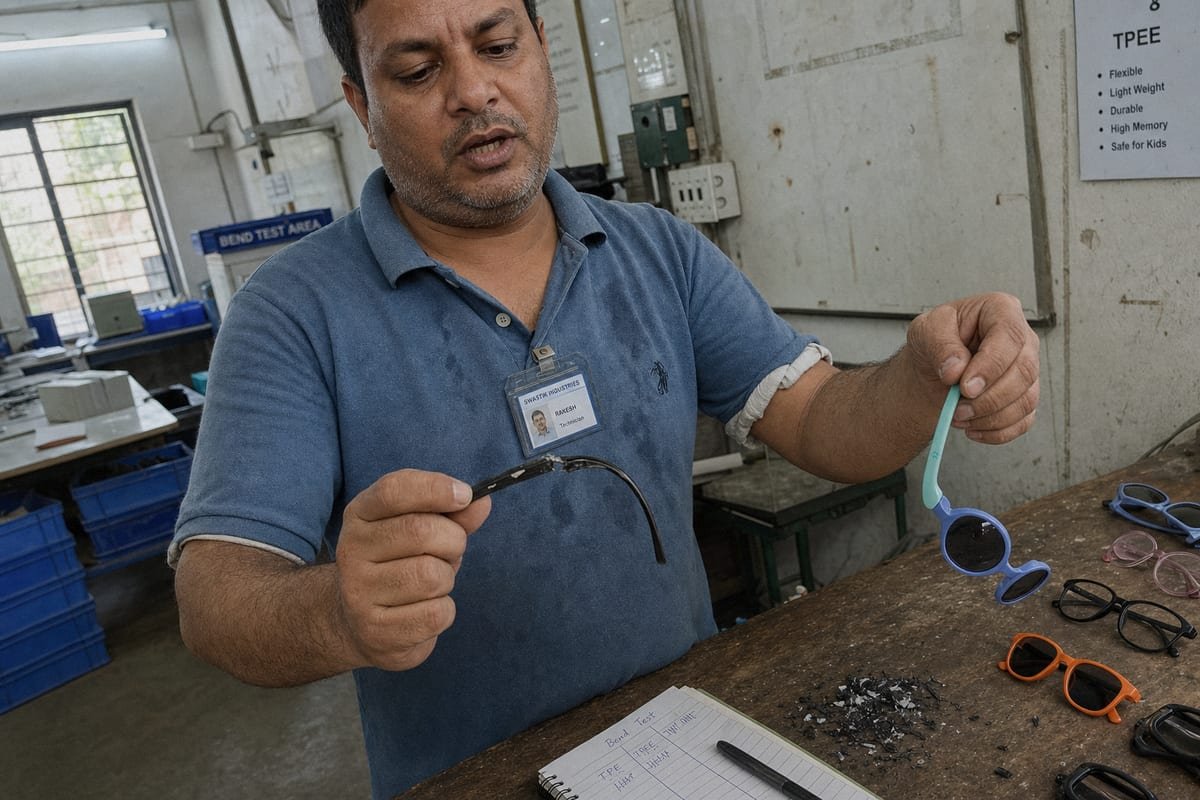
Material choice is the single biggest cost driver inside a kids' frame. It is also where budget suppliers cut corners first, because parents cannot see the polymer grade at a glance. But children find the weakness within days. They sit on their sunglasses. They pull them off with one hand. They stuff them into backpacks without a case.
What Each Material Actually Does
TR90 1 is a thermoplastic memory polymer. It is lightweight, resists impact, and returns to shape after twisting. TPEE goes further. It is a flexible elastomer we use for temples and full baby frames because it bends almost flat without stress marks. Both materials are also available as BPA-free plastic 2 grades, which matters for products that end up in toddlers' mouths.
Here is how materials typically map to price tiers:
| Price Tier | Typical Frame Material | المرونة | Real-World Lifespan |
|---|---|---|---|
| Budget ($10–20) | Rigid injected PC or acrylic | Low — snaps under torsion | Weeks to a few months |
| Mid-range ($30–50) | TR90 front, often TPEE flexible frames or temples | High — recovers from bending | One to two seasons |
| Premium ($50–80+) | TR90/TPEE combinations, silicone, spring hinges | Very high — survives sitting, twisting | Multiple years |
Why Hinges Matter as Much as Frames
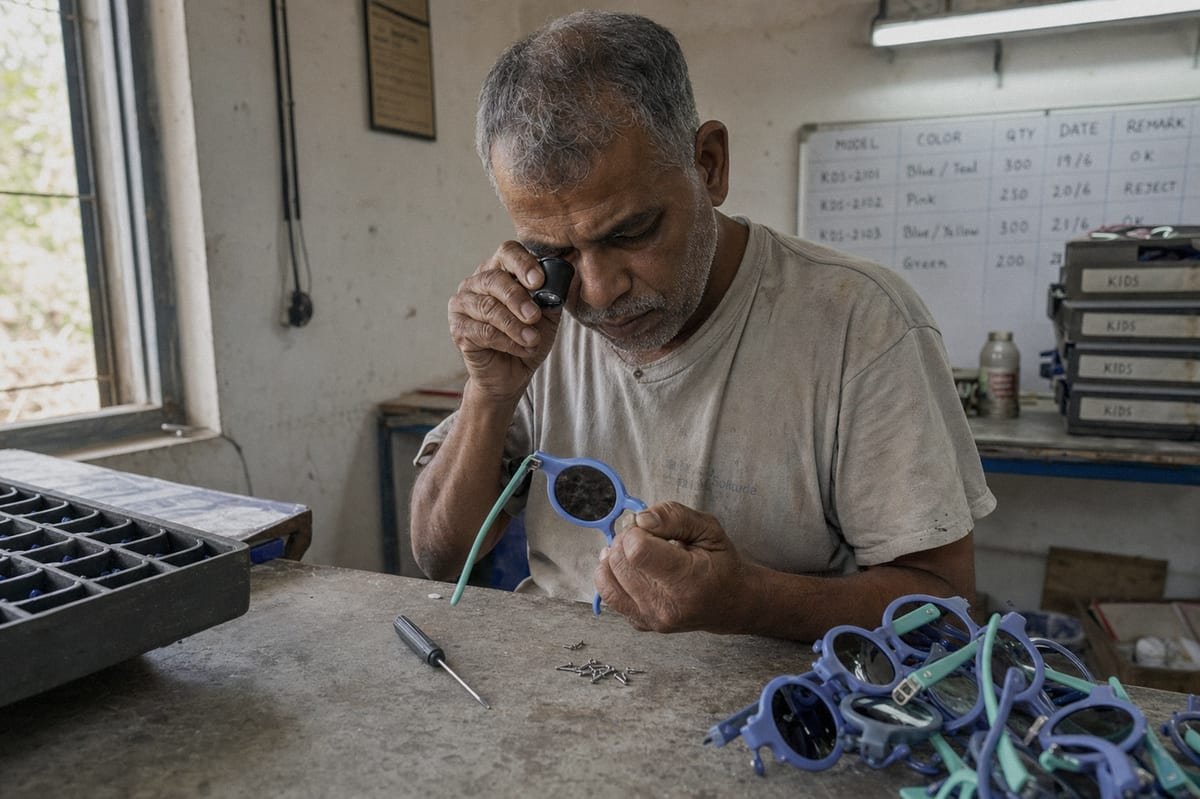
A flexible frame with a brittle hinge still fails. Mid-range and premium designs often add spring hinges or reinforced barrel hinges. In our experience developing round two-tone frames — like our periwinkle-and-mint kids' style with a rubberized matte finish — the hinge screw and barrel tolerance decide whether the frame survives year two. Budget factories rarely control that tolerance batch to batch.
What Safety and Lens Standards Should I Expect When Comparing Price Tiers?
A procurement manager from Australia once sent us a competitor's budget sample for review. The lens claimed حماية UV400 3. Our light meter showed uneven filtration across the lens surface.
At every price tier, demand verified UV400 protection and impact-resistant polycarbonate lenses as the baseline. Mid-range tiers add polarized lenses, Category 3 sun filters, and scratch-resistant coating. Premium tiers add optical-grade clarity, material safety certifications, and consistent batch testing.
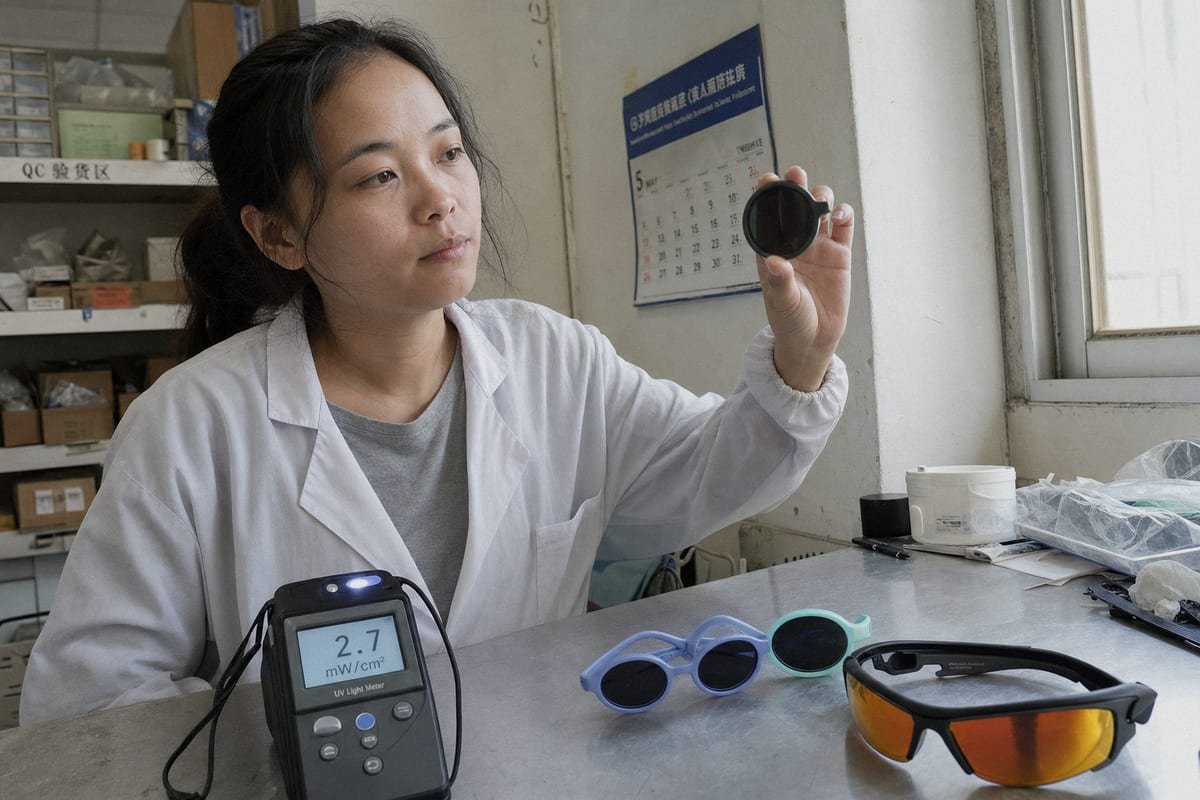
Here is the uncomfortable truth about the lowest tier. A dark lens without genuine UV filtration is worse than no sunglasses at all. The tint makes the pupil dilate, so more unfiltered radiation reaches the retina. That is why lens specification — not price — is the non-negotiable starting point.
The Standards Checklist by Tier
Use this checklist when comparing supplier quotations:
| Standard or Feature | ميزانية | Mid-Range | ممتاز |
|---|---|---|---|
| حماية من الأشعة فوق البنفسجية 400 / 100٪ UVA-UVB | Claimed, inconsistently verified | Verified per batch | Verified, documented |
| البولي كربونات 4 material lenses | Sometimes acrylic instead | معيار | Standard, optical grade |
| Impact resistance standards 5 | Rarely tested | Tested | Tested and certified |
| Category 3 sun filters | Hit or miss | شائع | معيار |
| عدسات مستقطبة | نادر | Optional upgrade | شائع |
| Scratch-resistant coating | Absent | Basic hard coat | Multi-layer coating |
| Phthalate/lead/BPA screening | Unregulated risk | Usually compliant | Documented compliance |
Optical Clarity Is the Hidden Gap
Cheap tinted lenses are mass-stamped, and they carry visible waves. That optical distortion strains young eyes during long wear. Better lenses are molded and finished to tighter tolerances, giving true visual clarity. When we develop sport shield styles — like our wraparound single-lens designs with mirrored orange-to-gold coatings — we check distortion on every lens curve, because a curved shield magnifies any molding flaw. Some premium lines now also add HEV blue-light filtration 6, though for outdoor use, UV400 and a good Category 3 tint remain the core protection.
Am I Paying for Comfort and Fit, or Just a Brand Name?
The hardest trade-off we weigh during development is bridge geometry versus mold cost. A child's nasal bridge is flatter than an adult's, and getting that curve right is expensive to engineer but invisible on a spec sheet.
In budget and mid-range tiers, extra spend buys real comfort: child-specific bridge geometry, lightweight flexible materials, rubberized grips, and wrap-around design coverage. Above roughly $60–80, a growing share of the price reflects brand prestige rather than measurable fit improvements.
Comfort is not a luxury feature in kids' eyewear. It is a safety feature. A child who finds sunglasses heavy, pinchy, or sliding will simply take them off. Then the UV rating on the box protects nobody.
Fit Features That Are Worth Paying For
These improvements deliver measurable, real-world value:
- Child-specific bridge design. Downscaled adult frames slide off flatter developing noses. Purpose-built kids' frames sit securely.
- Lightweight flexible polymers. TR90 fronts and TPEE temples reduce pressure behind the ears during long wear.
- Wrap-around design. Close-fitting curved fronts block side light and stay put during running and cycling.
- Rubberized temple tips. Small grips, like the ones on our sport shield styles, stop bouncing during activity.
- Correct sizing by age. Toddler, preschool, and school-age heads need different lens widths and temple lengths.
Where Brand Premium Takes Over
Above the premium threshold, you often pay for a fashion logo, designer styling, and retail positioning. Those things matter for sell-through, and style genuinely increases wear time — kids wear frames they love. But the polymer inside a $70 licensed frame is frequently the same TR90 found in a well-made $35 pair. When our clients build their own brands using our library of roughly 800 existing styles, they capture that fit-and-comfort value without paying a licensing markup, and without heavy mold investment.
How Can I Tell if a Lower-Cost Supplier Still Delivers Consistent Quality Control?
Fifteen years of eyewear production has taught our team one lesson above all: any factory can make one good sample. Consistency across ten thousand pieces is the real test.
Judge a supplier by process, not price. Ask for batch-level UV and impact test records, material certificates for BPA-free plastic, tolerance checks on hinges and screws, organized workshop management, and pre-shipment inspection reports. Consistent documentation signals consistent quality control.
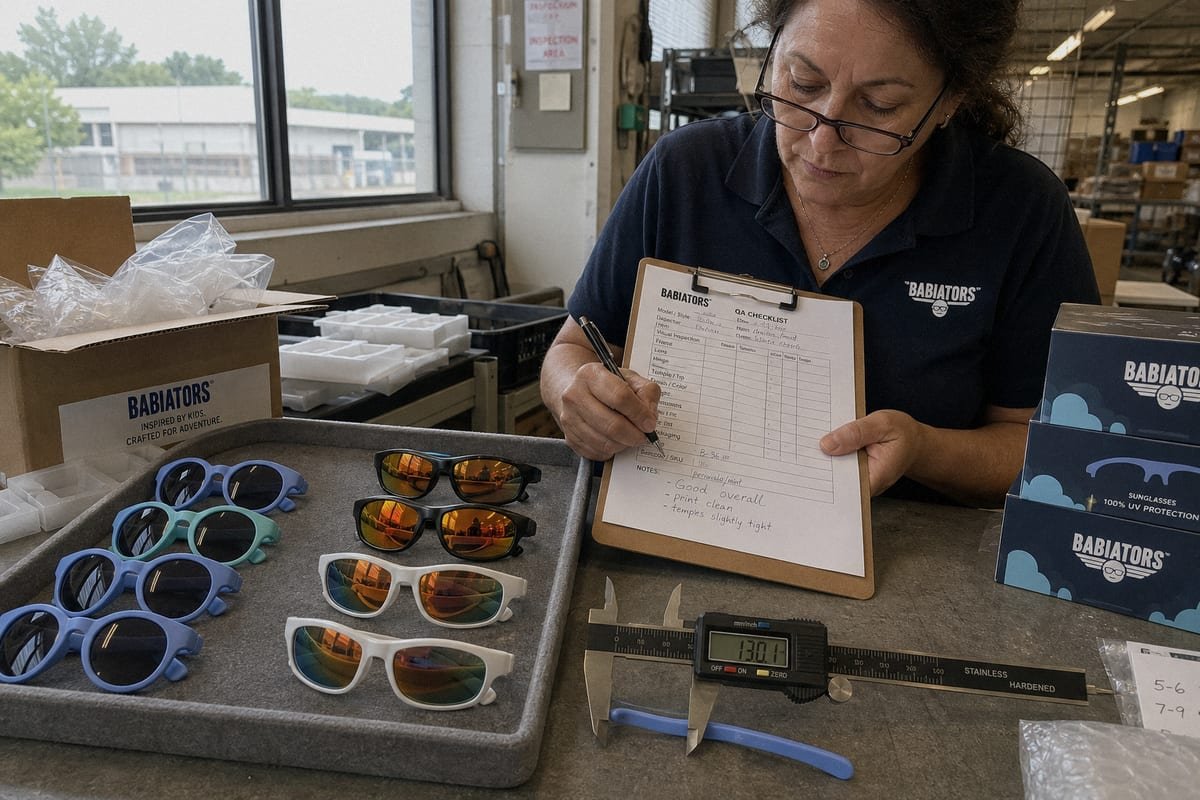
Price and quality control are related, but not locked together. A lower-cost supplier with disciplined processes can outperform a pricier trader who never sees the production floor. The problem for buyers is that QC discipline is invisible in a quotation. You have to look for its fingerprints.
A Practical Supplier Audit Checklist
Here is how we suggest buyers separate disciplined factories from lucky ones:
| QC Signal | What to Ask For | علامة حمراء |
|---|---|---|
| Lens verification | Batch UV400 test records | "All lenses are UV400" with no data |
| Impact testing | Drop-ball or equivalent test results | No defined impact resistance standards |
| سلامة المواد | Certificates for lens and frame polymers | Vague "food-grade plastic" claims |
| Workshop discipline | Factory photos, 5S or similar system | Refusal to share floor images or video |
| Consistency | Golden sample plus tolerance limits | Every reorder looks slightly different |
| Coating durability | Scratch-resistant coating adhesion tests | Coatings that rub off during transit |
Small Details Reveal Big Habits
Check the boring parts of a sample. Are hinge screws seated flush? Is the lens edge polished, or rough? Does the temple color match the front batch to batch? In our 5S-managed workshop, we track these details because a loose screw in a toddler frame is a safety issue, not a cosmetic one. Also verify OEM readiness: consistent logo printing, clean packaging, and retail-ready presentation show that a factory controls its full process, not just molding. A supplier who documents everything usually manufactures everything carefully too.
الخلاصة
Here is the risk: assuming price equals safety leads brands to either overpay for logos or under-buy on durability. Both mistakes cost you customers when frames snap or slip off.
The real quality differences between kids' sunglasses at different price points come down to materials, lens standards, fit, and QC consistency. UV400 protection is the baseline at every tier. What improves with smart spending — not just higher spending — is TPEE and TR90 flexibility, genuine polycarbonate material lenses, child-specific fit, and documented quality control. In my experience supplying children's brands across more than twenty countries, the winning formula is verified protection, a secure comfortable fit, and durability that survives real childhood. Choose a partner who can prove all three, and price becomes a strategy rather than a gamble.
ملاحظات ختامية
1. Background on thermoplastic memory polymers used in mid-range and premium frames. ↩︎
2. FDA guidance on BPA safety relevant to material certificates for children’s products. ↩︎
3. Background on UV protection standards and sunglasses lens technology for readers. ↩︎
4. Explains the impact-resistant plastic material referenced as a lens standard baseline. ↩︎
5. ISO standards body relevant to impact resistance and safety testing referenced in the checklist. ↩︎
6. NIH resource on eye health relevant to blue-light and UV filtration claims. ↩︎
7. WHO fact sheet explaining UV radiation risks supporting the article’s safety claims. ↩︎
مقالات أخرى قد تعجبك
August 1, 2026
هل يجب على المصنع التعامل مع تغليف ووضع ملصقات نظارات الأطفال الشمسية، أم استخدام مورد مخصص؟
August 1, 2026
مستودع خاص مقابل الوفاء المباشر من المورد: أيهما يقلل تكاليف الإرجاع لعلامات نظارات الأطفال الشمسية؟
August 1, 2026
مباشر إلى ميناء المستودع أو التخزين الخارجي: أيهما يوفر أكثر على شحن نظارات الأطفال الشمسية؟
هل تبحث عن شريك موثوق به للنظارات للأطفال؟
استكشف أكثر من 800 نمط جاهز ودعم OEM/ODM كامل مصمم خصيصًا لعلامتك التجارية.
اتصل بنا English
  Español de México
  Deutsch
  Français
  日本語
日本語  العربية
  Português do Brasil