How Do TR90-TPEE Kids Optical Frames Compare to Silicone and Acetate Frames?
A snapped bridge, a crying child, a refund request. Our factory hears that chain weekly. Choosing TR90-TPEE kids إطارات بصرية 1 over acetate can break it before it starts.
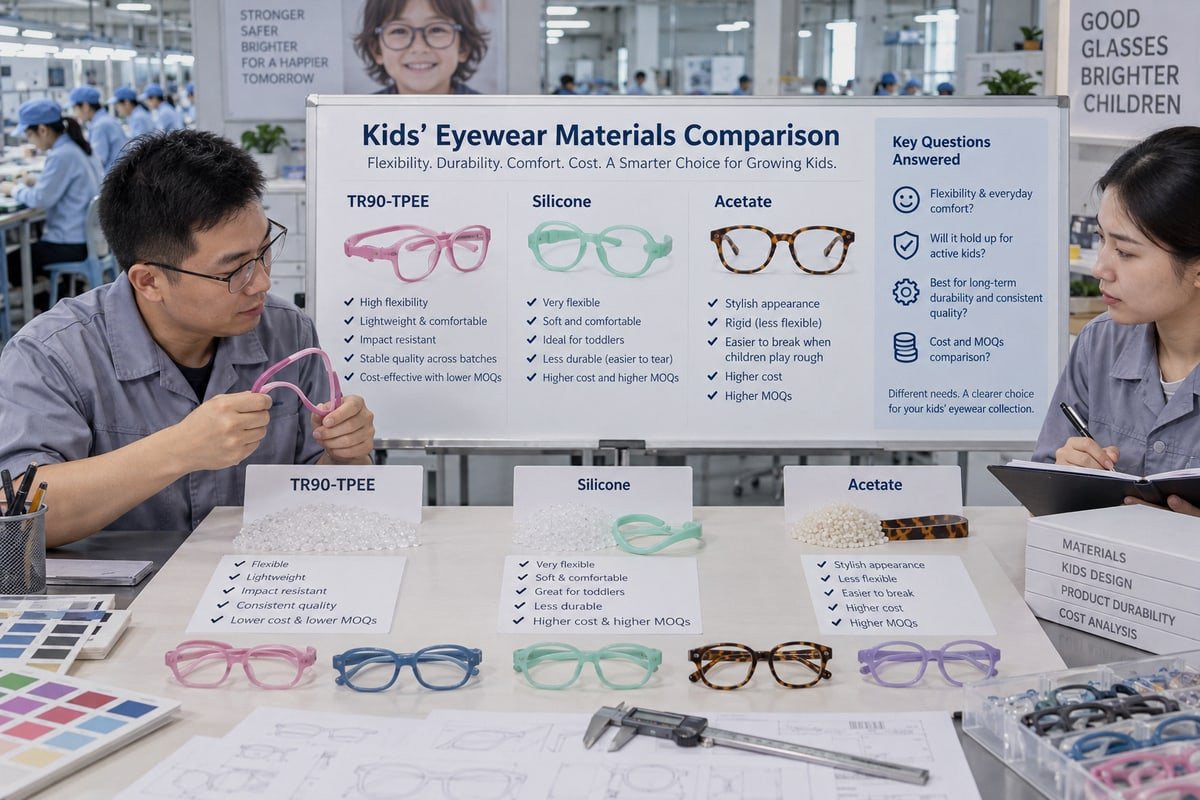
TR90-TPEE kids optical frames are lighter, more flexible, and more impact resistant than acetate, and more shape-stable than silicone. TR90 fronts weigh roughly 15–20 g versus 25–35 g for acetate, while TPEE temples add soft, rubber-like comfort. Acetate wins on color depth; silicone wins on softness only.
That is the short version. The long version matters more when you are building a line, not buying one pair. Below, I walk through the four questions buyers ask us most. Each one compares the three materials on a specific point: comfort, rough play, batch consistency, and sourcing cost.
How does TR90-TPEE compare to silicone frames when it comes to flexibility and everyday comfort for my kids' collection?
A buyer from Australia asked us last year to quote silicone frames. When we opened her reference photos, every single one was TPEE.
TR90-TPEE frames match silicone on softness at the contact points but hold their shape better. TPEE temples flex like rubber against the ear, the TR90 front keeps lenses aligned, and the finished frame weighs 15–20 g. Silicone is softer but sags, so it suits infants more than school-age kids.
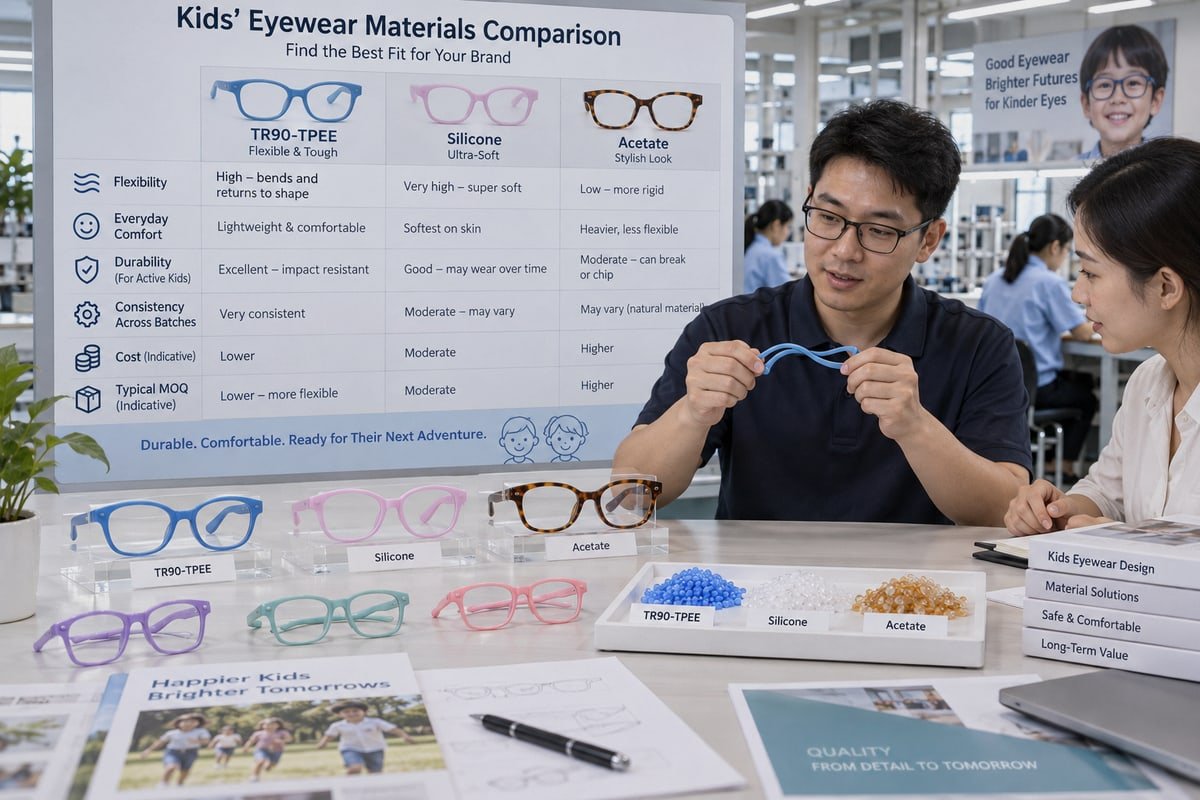
That buyer's confusion is common, and it is worth clearing up first. In the kids' eyewear market, the word "silicone" is often used loosely. Many sellers mean any soft, rubbery, bendable frame. The technically correct comparison for optical frames is TR90 versus TPEE versus acetate. True silicone is a different chemistry, and it behaves differently.
A quick side-by-side on flexibility and comfort
| الميزة | إطار أمامي TR90 + معابد TPEE | True silicone frame | Acetate (for reference) |
|---|---|---|---|
| Finished weight | About 15–20 g | Light, but varies with thickness | About 25–35 g |
| Temple softness | Rubber-like, springy | Very soft, low spring-back | Rigid, hand-adjusted |
| Shape stability | High (TR90 front) | منخفض إلى متوسط | مرتفع |
| تثبيت العدسة | Reliable groove | Can loosen over time | Reliable groove |
| نطاق العمر النموذجي | 6–12+ (TR90), 0–5 (TPEE-heavy) | 0–3 | 8+ and teens |
| الأجزاء المعدنية | Optional; screwless hinge design available | عادة لا شيء | Screws and hinges |
Where silicone genuinely belongs
Silicone deserves credit for what it does well. It is one of the most hypoallergenic materials in eyewear. It has no screws, no metal, and no hard edges. That is why it is the go-to for infants and toddlers with underdeveloped nasal bridges. Silicone frames often use an integrated bridge and a wrap-around temple or head strap, because the material alone cannot grip the face.
But that same softness is the limit. A silicone front does not hold a prescription lens as tightly as a TR90 front. It can droop in warm weather. It also feels less like "real eyewear," which older children notice quickly.
How TR90 memory plastic properties change the feel
TR90 هو Swiss-developed thermoplastic 2 with memory plastic properties. It bends past 90 degrees and returns to its original shape. Industry testing puts it at 5,000+ flex cycles and heat resistance around 120°C. On our production line we use it for the front, where lens alignment matters most.
TPEE goes on the temples. It is even softer than TR90, with a rubber-like hand feel. Look at the translucent purple-gradient style in our catalog: the crystal-clear front is TR90, the temples are TPEE, and the tips end in looped ear hooks. Small perforated dots along the temple arms add extra flex without adding weight. The light-blue version uses matte opaque TPEE temples with rubberized tips. Both give the child flexibility and comfort at the ear and nose, plus a front that stays square.
Skin-friendly details that matter for all-day wear
Comfort is not only softness. It is also what the material does over eight hours on a child's face. Our TR90-TPEE blends 3 are formulated to be food-grade and BPA-free, because small children chew on temple tips. The material resists skin oils and sweat, so the surface stays smooth instead of turning tacky. These skin-friendly components are a big reason parents keep the glasses on the child, and a big reason optical shops re-order.
Will TR90-TPEE frames hold up better than acetate frames for active children who play rough?
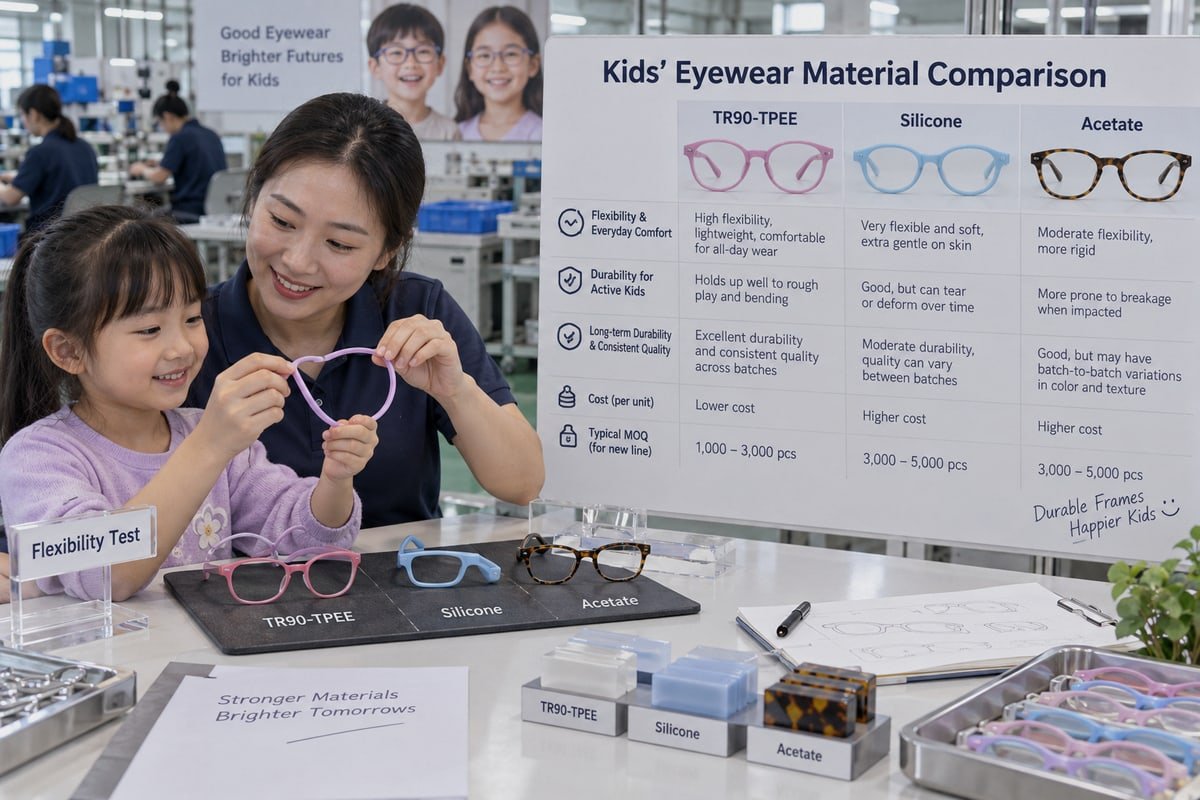
On our flex-test bench, we twist each sample TR90 temple past 90 degrees and watch it spring back. Acetate does not survive that test.
Yes. TR90-TPEE frames hold up better than acetate for active children because TR90 bends past 90° and returns to shape, survives 5,000+ flex cycles, and resists heat to about 120°C. Acetate is heavier, more brittle, snaps in cold weather, and can leave sharp edges when it breaks.
Let me be fair to acetate first. It is a beautiful material. It has deep, layered color and a polished, premium look that TR90 cannot fully copy. Many fashion-forward kids' brands choose it for that reason. The question is not whether acetate is bad. The question is what happens when a seven-year-old sits on it.
Six ways children break glasses
Rough play is not one event. It is a list of repeated small abuses. Here is how each material handles them.
- السقوط على الخرسانة. TR90 absorbs the impact and flexes. Acetate can crack at the bridge or lens rim.
- لف المعابد. TR90 and TPEE return to shape. Acetate holds a permanent bend or snaps at the hinge.
- Tugging by a sibling. TPEE temples stretch and recover. Acetate temples transfer the force to the screw and hinge.
- Chewing the tips. Food-grade, BPA-free TPEE handles this. Acetate can chip.
- Cold weather. TPEE keeps its flexibility and مقاومة الصدمات 4 in sub-zero temperatures. Acetate becomes brittle and snaps more easily.
- Sweat, sunscreen, and sun. TR90 and TPEE resist skin oils and UV. Acetate contains plasticizers that migrate out over time, causing the "whitening" you see on old frames.
Frame durability in numbers
| خاصية | TR90-TPEE | أسيتات |
|---|---|---|
| استعادة الانحناء | Past 90°, returns to shape | Limited; permanent set or fracture |
| Flex cycle testing | 5,000+ cycles reported | Not designed for repeated flexing |
| مقاومة الحرارة | About 120°C | Softens and deforms at lower heat |
| Cold performance | Stays flexible below zero | Brittle, prone to snapping |
| Aging | Resists oils, sweat, UV | Whitening and plasticizer loss |
| ينحني، لا ينكسر تقريبًا | Bends or tears, no sharp shards | Can fracture into sharp edges |
The premium objection, and why it does not hold
The objection I hear from brand owners is simple: acetate feels more premium, so it must be built better. The قوة الشد 5 of acetate is real, but strength is not the same as toughness. A material can be strong and still brittle. Our engineers found this out early. Weight and stiffness feel like quality in the hand, but on a playground they become liabilities. A heavier frame swings harder when it falls and pushes harder on the nose. That extra weight also causes the "nose-slide" effect, which is worse with thick myopia-control lenses. The lower density of TR90-TPEE lets us mold a thicker, more robust rim to hold those heavy lenses without the frame sliding down.
Safety when a frame does fail
Every frame will eventually meet a force it cannot handle. What matters then is the failure mode. Acetate can crack into sharp edges near the eye. TR90 and TPEE bend, tear, or separate cleanly. On our toddler styles we go one step further with a screwless hinge design, so there is no metal part to press into the face on impact. This is also what most eyewear safety standards for children push toward: fewer rigid parts, no sharp fragments, and predictable behavior under load.
Which material should I choose if my brand's priority is long-term durability and consistent quality across production batches?
Every new style forces a trade-off I weigh carefully: softer material feels nicer in hand, but too soft and the lens groove loses its grip.
Choose TR90 for the front and TPEE for the temples. Both are injection-molded thermoplastics, so color, wall thickness, and hinge fit stay consistent from batch to batch. Acetate is cut and polished by hand, which adds variation and whitening over time; pure silicone can sag and lose lens retention.
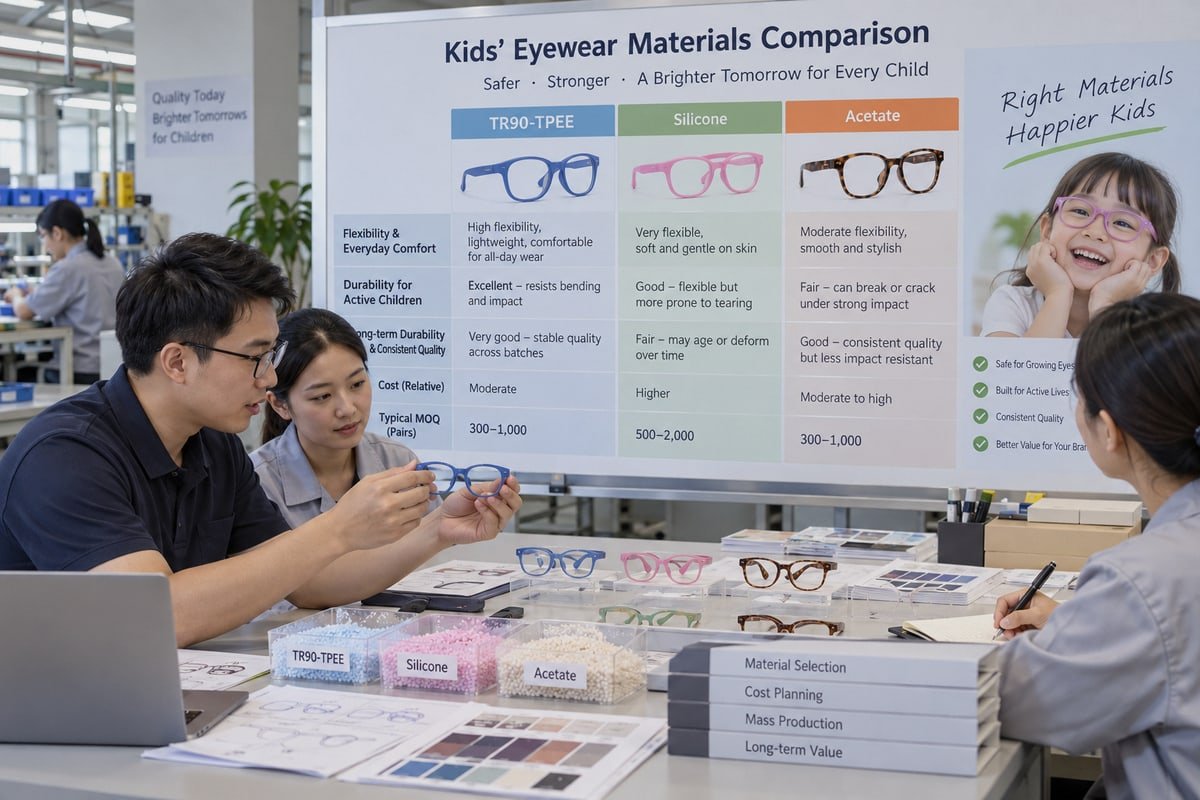
Batch consistency is a process question before it is a material question. But the material decides how easy the process is to control. That is why I push most brand buyers toward the hybrid TR90-TPEE build when they tell me consistency is the priority.
Why injection molding makes consistency easier
TR90 and TPEE are both molded. The mold sets the geometry. The resin lot sets the color. The machine parameters set the density and surface. Once those three are locked, frame 1 and frame 5,000 come out the same. Acetate works differently. Sheets are cut, tumbled, and polished by hand. Skilled workers do great work, but every hand step is a small chance for variation in thickness, gloss, and temple angle.
How we keep TR90-TPEE kids optical frames the same every run
Here is the sequence our 5S-managed workshop follows on a repeat order. I share it because buyers often assume "molded" means "no QC needed." It does not.
- Incoming resin check. We confirm the TR90 and TPEE lot numbers and color masterbatch against the approved sample.
- Mold inspection. Vent, gate, and cavity surfaces are cleaned and checked before the first shot.
- الموافقة على المقالة الأولى. The first frames off the machine are compared to the golden sample for color, dimensions, and surface.
- Flex and recovery check. Temples are bent past 90 degrees and must return without whitening or set.
- Lens retention check. Demo lenses are pressed and removed to confirm the groove holds and the front stays square.
- Hinge and tip check. Adjustable temple tips and hinges are cycled to confirm smooth movement and no play.
- Final visual and packing. Logos, colors, and packaging are matched to the buyer's spec before boxing.
The counterargument: is more flexible always better?
No, and this is the trade-off I mentioned above. A frame can be too soft. When the front flexes too much, the lens can pop, the pupil center shifts, and the prescription no longer sits where the optician set it. That is a real problem for kids in myopia-control lenses. It is why we do not mold the front from TPEE for school-age styles. TR90 gives the front structure. TPEE gives the temples give. That split is the whole point of the hybrid design.
Long-term durability by material
| العامل | TR90-TPEE | أسيتات | سيليكون |
|---|---|---|---|
| Batch color control | Masterbatch, repeatable | Sheet variation possible | Repeatable but limited palette |
| Dimensional control | Mold-locked | Hand finishing | Mold-locked, but soft |
| Aging over 2–3 years | Resists oils, sweat, UV | Whitening, plasticizer migration | Can yellow, attracts dust |
| Prescription alignment | مستقر | مستقر | ضعيف |
| قابلية إعادة التدوير | 100% recyclable thermoplastic | Often non-biodegradable plasticizers | Difficult to reprocess |
That last row matters more each year. Brands in Europe and Japan increasingly ask about الاقتصاد الدائري 6 fit. TR90 and TPEE are recyclable thermoplastics. Silicone is hard to reprocess. Acetate often carries plasticizers that complicate recycling. If your brand story includes environmentally friendly materials, the hybrid build supports it honestly.
How do the costs and MOQs of TR90-TPEE compare to silicone and acetate when I'm sourcing for a new kids' eyewear line?
Fifteen years of quoting kids' eyewear taught me one lesson: the mold, not the resin, decides whether a new line is affordable.
TR90-TPEE frames usually cost less per unit than acetate and carry lower MOQs, because they are injection-molded rather than hand-finished. Acetate needs more labor and sits at premium price points. Silicone tooling is similar to TPEE. Choosing from existing molds cuts MOQ and removes upfront tooling cost.
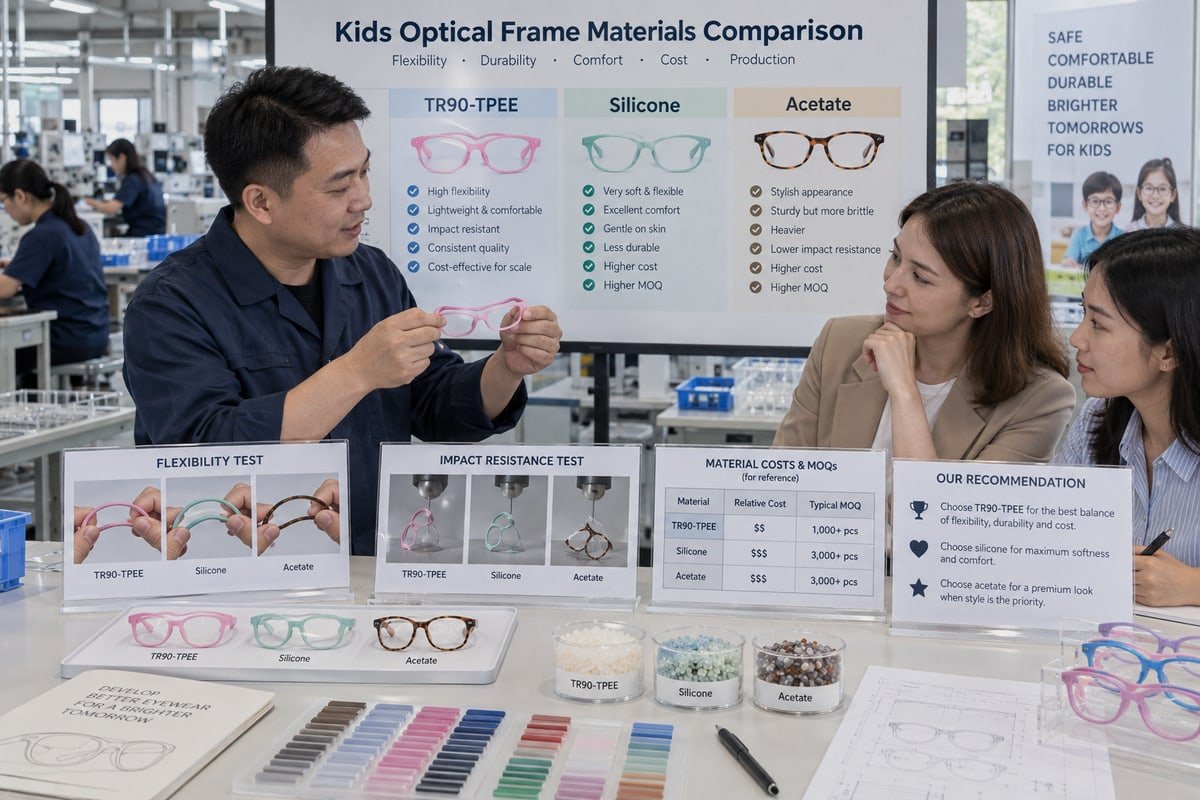
When a new brand founder sends me a budget, I usually split it into three buckets before we talk price per pair. The buckets are tooling, unit cost, and everything after the frame ships. Material changes all three, but not in the way most people expect.
Cost structure by material
| محرك التكلفة | TR90-TPEE | أسيتات | سيليكون |
|---|---|---|---|
| الأدوات | Steel mold per front and temple; shared across colors | Little tooling, but cutting patterns and hand labor | Mold per style, similar to TPEE |
| عمالة الوحدة | Low; molded, trimmed, assembled | High; cut, tumble, polish, fit | منخفض إلى متوسط |
| تغييرات اللون | Easy via masterbatch | Requires new sheet stock | Easy via pigment |
| Typical positioning | Value-durable, sport, everyday school | Premium fashion | Infant and toddler niche |
| MOQ driver | استهلاك القالب | Labor scheduling and sheet minimums | استهلاك القالب |
| Returns and breakage | منخفض | Higher on active kids | Low, but limited to young ages |
The mold question, and how to skip it
A new TR90-TPEE style needs a mold for the front and a mold for the temples. That is a real upfront cost, and it is what pushes MOQs up when everything is custom. The way around it is to start from existing tooling. Our catalog holds roughly 800 existing styles across TPEE and TR90. A brand can pick a front, pick a temple, and change the color, logo, lens, and packaging without paying for new steel. That lets an importer or a baby-product brand test a market with a smaller first order and lower risk. The two styles I described earlier, the clear front with purple-gradient temples and the light-blue front with matte-blue temples, are both existing molds. Different colorways, same tooling.
What custom OEM/ODM work actually adds
Customization does not have to mean a new mold. In our experience with brands across 20+ countries, the changes that build a brand are mostly surface-level from a tooling point of view:
- Custom colors through masterbatch, including translucent and gradient effects.
- موضع الشعار by pad print, laser, or molded inset on the temple.
- أشكال يومية كلاسيكية such as UV400 or polarized for the sun range, or demo lenses for optical fronts.
- التعبئة والتغليف والملحقات like cases, cloths, straps, and retail-ready hang cards.
Each of these adds a modest cost per unit. None of them force you into a large MOQ the way a new mold does.
The cost acetate hides
Acetate quotes look higher on paper and often are. But the bigger gap shows up after delivery. An active-kid line in acetate sees more breakage, more warranty claims, and more one-star reviews from parents. A TR90-TPEE line with lightweight construction, adjustable temple tips, and food-grade materials sees fewer of all three. When I help a buyer build a landed-cost sheet, I tell them to add a line for expected returns. That line usually flips the decision.
A simple age guide for planning a line
| الفئة العمرية | 0 إلى 3 سنوات | لماذا |
|---|---|---|
| 0–3 | TPEE-heavy, screwless, integrated bridge or strap | Softest, no metal, safest failure mode |
| 3–5 | TPEE frame or TR90 front with TPEE temples | Balance of softness and shape |
| 6–12 | واجهة TR90 مع أذرع TPEE | Holds prescription, survives school and sport |
| 12+ style-first | Acetate or TR90 in fashion colorways | Premium look matters more, play is gentler |
الخلاصة
Broken frames cost brands trust. TR90-TPEE kids optical frames give the durability, comfort, and batch consistency active children need. Acetate suits fashion. Silicone suits infants.
هل أنت مهتم بتوريد المنتجات المذكورة في هذه المقالة؟ انظر التفاصيل واطلب عرض أسعار هنا:
ملاحظات ختامية
1. WHO resource on visual impairment, relevant to the use of specialized corrective lenses. ↩︎
2. Official manufacturer site for the TR90 material (Grilamid TR), detailing its properties. ↩︎
3. FDA overview of BPA safety and regulations in consumer products. ↩︎
4. DuPont’s official page for Hytrel, the primary commercial TPEE used in flexible applications. ↩︎
5. Comprehensive overview of cellulose acetate’s chemical properties and its history in eyewear. ↩︎
6. Official European Commission page explaining circular economy principles and sustainability. ↩︎
مقالات أخرى قد تعجبك


هل تبحث عن شريك موثوق به للنظارات للأطفال؟
استكشف أكثر من 800 نمط جاهز ودعم OEM/ODM كامل مصمم خصيصًا لعلامتك التجارية.
اتصل بنا English
 Español de México
 Deutsch
 Français
 日本語
 العربية
 Português do Brasil