TR90-TPEEキッズ光学フレームとシリコンおよびアセテートフレームの比較
壊れたブリッジ、泣いている子供、返金リクエスト。当社の工場では、毎週そのような連鎖を聞いています。TR90-TPEEキッズを選択する 光学フレーム 1 アセテートよりも、始まる前に壊してしまう可能性があります。.
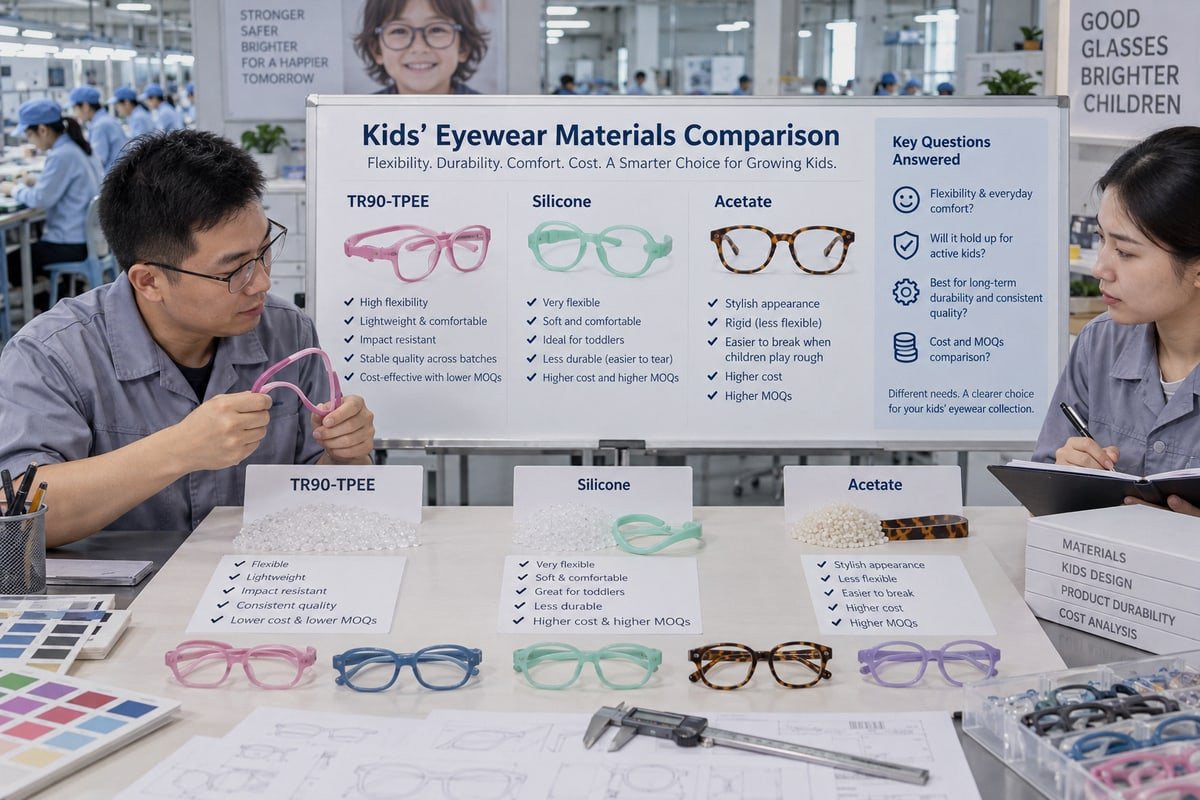
TR90-TPEEキッズ用光学フレームは、アセテートよりも軽量で柔軟性があり、耐衝撃性に優れ、シリコンよりも形状安定性に優れています。TR90のフロントの重さは約15〜20gですが、アセテートは25〜35gです。一方、TPEEのテンプルは柔らかくゴムのような快適さを加えます。アセテートは色の深みで、シリコンは柔らかさのみで優れています。.
それが短いバージョンです。長いバージョンは、購入するのではなく、ラインを構築する際に、より重要になります。以下では、バイヤーが最もよく尋ねる4つの質問について説明します。それぞれが、快適さ、激しい遊び、バッチの一貫性、調達コストという特定の点で3つの素材を比較します。.
TR90-TPEEは、柔軟性と日常的な快適さにおいて、シリコンフレームと比較して、子供たちのコレクションにどのように適合しますか?
昨年、オーストラリアのバイヤーからシリコンフレームの見積もりを依頼されました。参照写真を開いたところ、すべてTPEEでした。.
TR90-TPEEフレームは、接触部分の柔らかさでシリコンに匹敵しますが、形状はより保持します。TPEEのテンプルは耳に対してゴムのように柔軟に曲がり、TR90のフロントはレンズを整列させ、完成したフレームの重量は15〜20gです。シリコンはより柔らかいですが、たるむため、就学前の子供よりも乳児に適しています。.
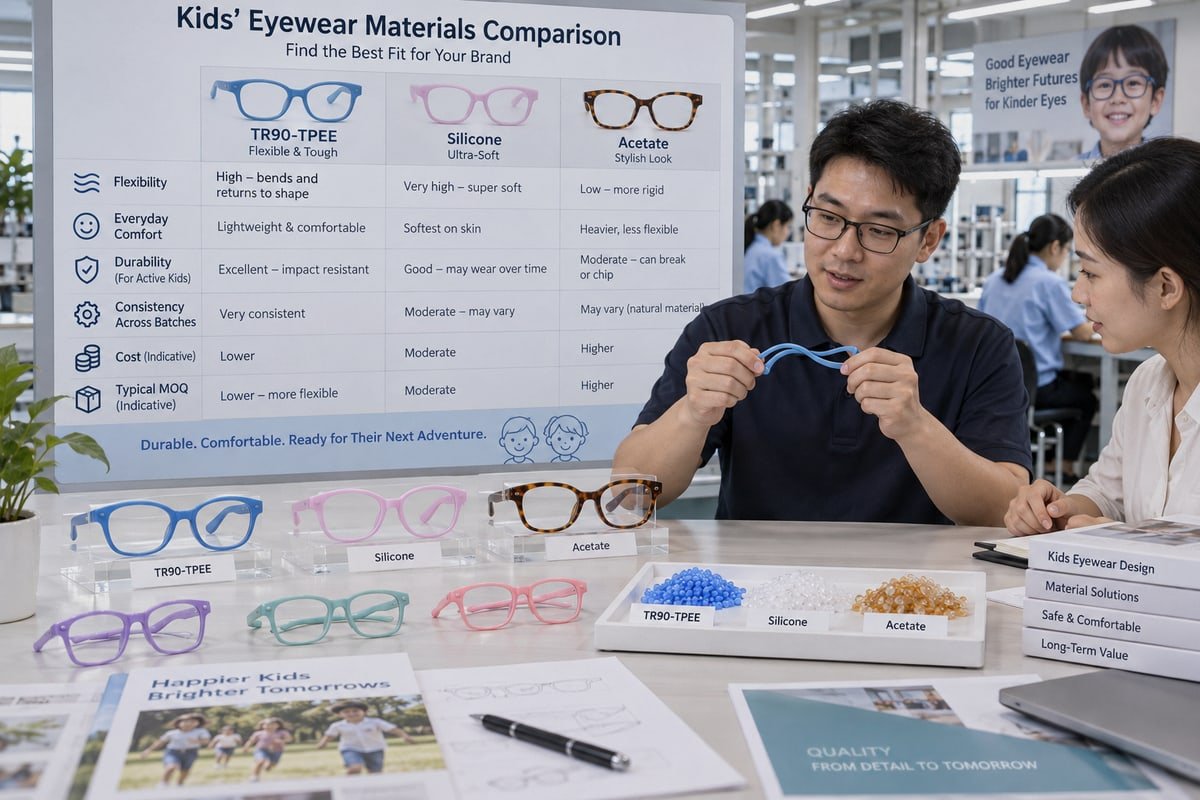
そのバイヤーの混乱は一般的であり、最初に明確にする価値があります。子供用アイウェア市場では、「シリコン」という言葉がしばしば緩やかに使用されます。多くの販売者は、柔らかく、ゴムのような、曲げやすいフレームを意味します。光学フレームの技術的に正しい比較は TR90対TPEE対アセテート. です。真のシリコンは異なる化学構造であり、異なる挙動をします。.
柔軟性と快適さの簡単な比較
| 特徴 | TR90フロント + TPEEテンプル | 真のシリコンフレーム | アセテート(参考) |
|---|---|---|---|
| 完成重量 | 約15〜20g | 軽量ですが、厚さによって異なります | 約25〜35g |
| テンプルの柔らかさ | ゴムのような、弾力がある | 非常に柔らかく、反発力が低い | 硬く、手で調整可能 |
| 形状安定性 | 高い(TR90フロント) | 低〜中程度 | 高い |
| 何も外れない(EN 71-1ロジック) | 信頼性の高い溝 | 時間とともに緩む可能性がある | 信頼性の高い溝 |
| 対象年齢層 | 6–12+ (TR90), 0–5 (TPEE-heavy) | 0–3 | 8歳以上およびティーンエイジャー |
| 金属部品 | オプション; ネジなしヒンジデザインあり | 通常なし | ネジとヒンジ |
シリコンが真価を発揮する場所
シリコンは、得意なことに対して評価されるべきです。アイウェアの中で最も低アレルギー性の素材の1つです。ネジ、金属、硬いエッジがありません。そのため、鼻梁が未発達の乳幼児に最適です。シリコンフレームは、一体型のブリッジとラップアラウンドテンプルまたはヘッドストラップを使用することがよくありますが、素材だけでは顔にフィットしません。.
しかし、その柔らかさが限界でもあります。シリコンフロントは、TR90フロントほど処方レンズをしっかりと保持しません。暖かい季節には垂れ下がる可能性があります。また、「本物のアイウェア」のように感じられないため、年長の子供たちはすぐに気づきます。.
TR90形状記憶樹脂の特性が感触を変える方法
TR90は スイス開発の熱可塑性プラスチック 2 形状記憶樹脂の特性を備えています。90度以上に曲がっても元の形状に戻ります。業界テストでは5,000回以上の 屈曲サイクル に耐え、耐熱性は約120℃です。当社の生産ラインでは、レンズの配置が最も重要なフロントに使用しています。.
TPEEはテンプルに使用されます。TR90よりもさらに柔らかく、ゴムのような手触りです。カタログの半透明のパープルグラデーションスタイルをご覧ください。クリスタルクリアなフロントはTR90、テンプルはTPEE、チップはループ状のイヤーフックで終わっています。テンプルアームに沿った小さな穴あきドットは、重量を増やさずに柔軟性を追加します。ライトブルーバージョンは、マットな不透明なTPEEテンプルとゴム引きのチップを使用しています。どちらも、耳と鼻の柔軟性と快適さに加え、顔がまっすぐなフロントを提供します。.
一日中着用するために重要な肌に優しいディテール
快適さとは、柔らかさだけではありません。8時間子供の顔にかかっている素材がどうなるかでもあります。当社の TR90-TPEEブレンド 3 は、小さな子供がテンプルの先端を噛むことがあるため、食品グレードでBPAフリーになるように配合されています。素材は肌の油分や汗に強く、表面はべたつかずに滑らかなままです。これらの肌に優しいコンポーネントは、親がメガネを子供にかけさせ続ける大きな理由であり、光学店が再注文する大きな理由です。.
TR90-TPEEフレームは、激しく遊ぶ活発な子供たちにとって、アセテートフレームよりも丈夫でしょうか?
当社のフレックステストベンチでは、各TR90テンプルのサンプルを90度以上にひねり、元に戻るのを確認します。アセテートはそのテストに耐えられません。.
はい。TR90-TPEEフレームは、活発な子供たちにとってアセテートよりも耐久性があります。なぜなら、TR90は90度以上に曲がっても元の形状に戻り、5,000回以上の屈曲サイクルに耐え、約120℃の熱にも耐えるからです。アセテートは重く、もろく、寒い時期には折れやすく、破損した際には鋭利なエッジが残ることがあります。.
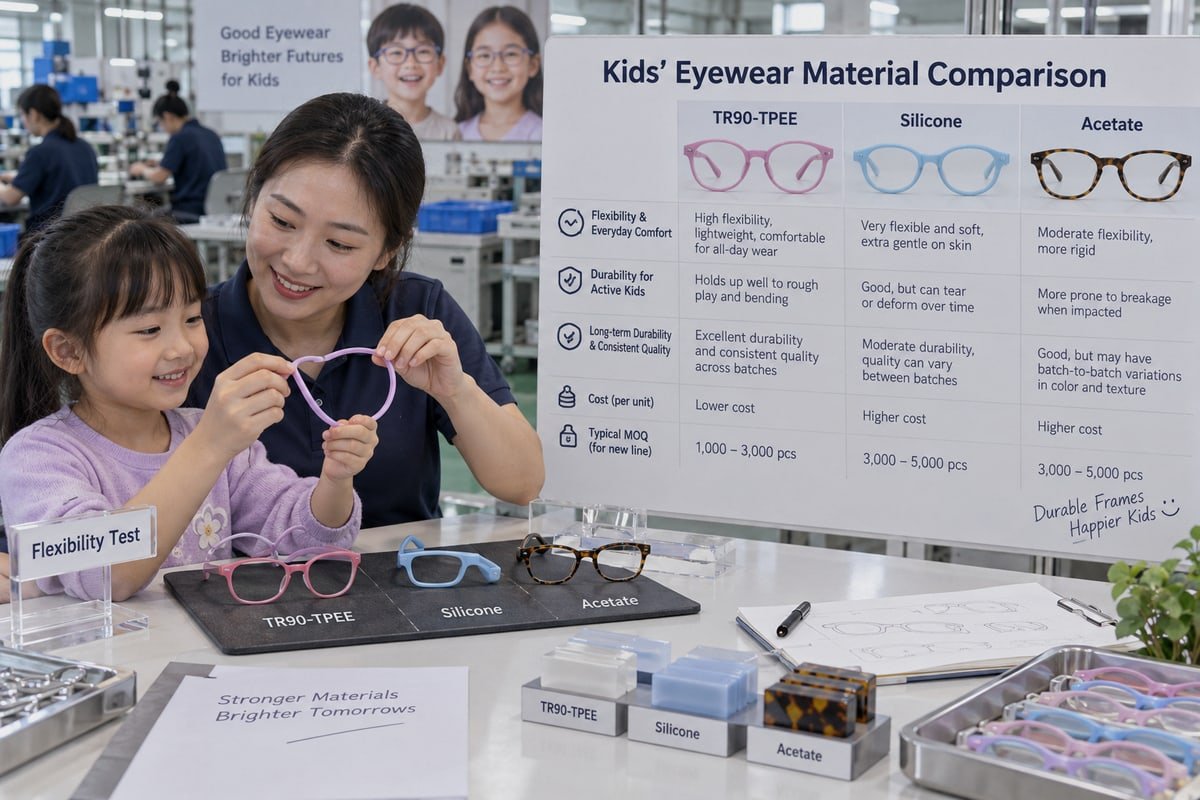
まずアセテートに公平にしましょう。美しい素材です。TR90では完全にコピーできない、深みのある層状の色と、磨かれた高級感があります。多くのファッションフォワードな子供向けブランドは、その理由でそれを選びます。問題はアセテートが悪いかどうかではありません。問題は、7歳の子供がそれに座ったときに何が起こるかです。.
子供がメガネを壊す6つの方法
Rough play is not one event. It is a list of repeated small abuses. Here is how each material handles them.
- コンクリートへの落下。. TR90 absorbs the impact and flexes. Acetate can crack at the bridge or lens rim.
- テンプルのねじれ。. TR90 and TPEE return to shape. Acetate holds a permanent bend or snaps at the hinge.
- Tugging by a sibling. TPEE temples stretch and recover. Acetate temples transfer the force to the screw and hinge.
- Chewing the tips. Food-grade, BPA-free TPEE handles this. Acetate can chip.
- Cold weather. TPEE keeps its flexibility and 耐衝撃性 4 in sub-zero temperatures. Acetate becomes brittle and snaps more easily.
- Sweat, sunscreen, and sun. TR90 and TPEE resist skin oils and UV. Acetate contains plasticizers that migrate out over time, causing the "whitening" you see on old frames.
Frame durability in numbers
| プロパティ | TR90-TPEE | アセテート |
|---|---|---|
| 非常に柔らかく、ゴム状 | Past 90°, returns to shape | Limited; permanent set or fracture |
| Flex cycle testing | 5,000+ cycles reported | Not designed for repeated flexing |
| 耐熱性 | About 120°C | Softens and deforms at lower heat |
| Cold performance | Stays flexible below zero | Brittle, prone to snapping |
| Aging | Resists oils, sweat, UV | Whitening and plasticizer loss |
| 破損時の挙動 | Bends or tears, no sharp shards | Can fracture into sharp edges |
The premium objection, and why it does not hold
The objection I hear from brand owners is simple: acetate feels more premium, so it must be built better. The 引張強度 5 of acetate is real, but strength is not the same as toughness. A material can be strong and still brittle. Our engineers found this out early. Weight and stiffness feel like quality in the hand, but on a playground they become liabilities. A heavier frame swings harder when it falls and pushes harder on the nose. That extra weight also causes the "nose-slide" effect, which is worse with thick myopia-control lenses. The lower density of TR90-TPEE lets us mold a thicker, more robust rim to hold those heavy lenses without the frame sliding down.
Safety when a frame does fail
Every frame will eventually meet a force it cannot handle. What matters then is the failure mode. Acetate can crack into sharp edges near the eye. TR90 and TPEE bend, tear, or separate cleanly. On our toddler styles we go one step further with a screwless hinge design, so there is no metal part to press into the face on impact. This is also what most eyewear safety standards for children push toward: fewer rigid parts, no sharp fragments, and predictable behavior under load.
ブランドの最優先事項が長期的な耐久性と、製造ロット全体での一貫した品質である場合、どの素材を選ぶべきでしょうか?
Every new style forces a trade-off I weigh carefully: softer material feels nicer in hand, but too soft and the lens groove loses its grip.
TR90をフロントに、TPEEをテンプルに選びましょう。どちらも射出成形された熱可塑性プラスチックなので、色、壁の厚さ、ヒンジのフィット感はロットごとに一貫しています。アセテートは手作業でカット・研磨されるため、時間とともにばらつきや白化が生じます。純粋なシリコンはたるみ、レンズ保持力を失う可能性があります。.
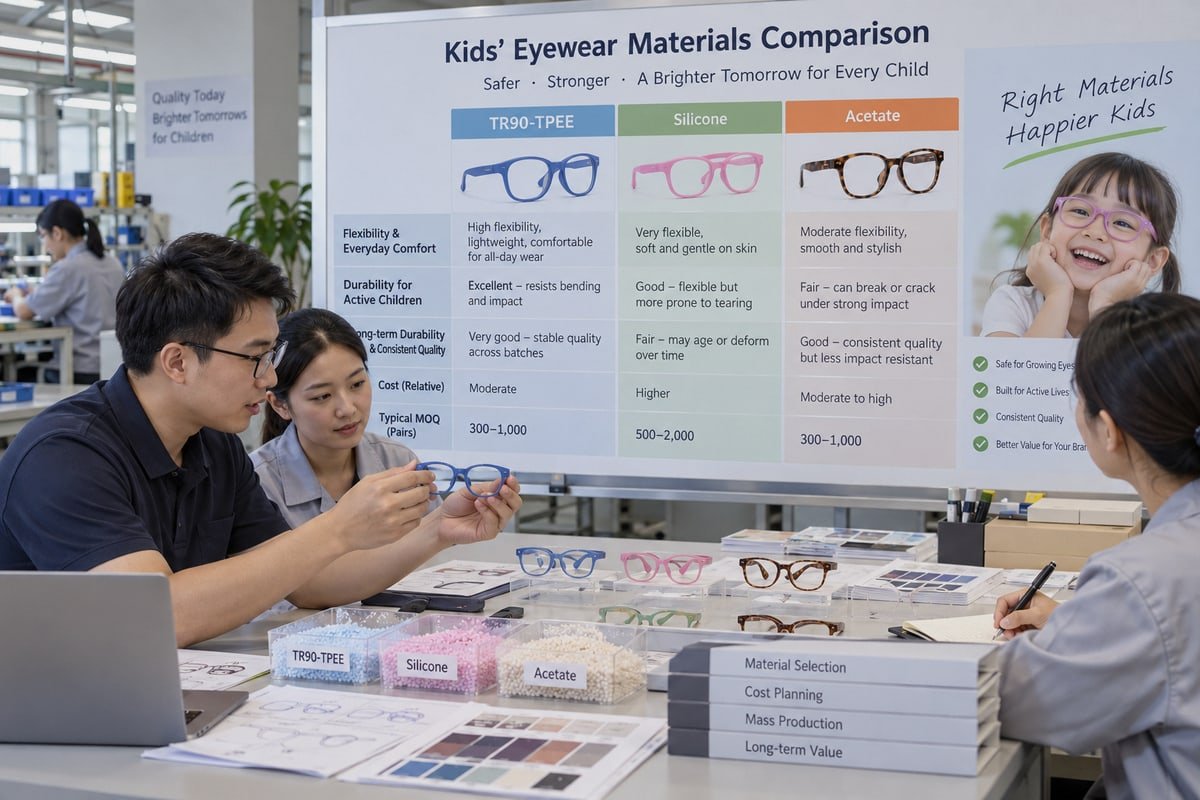
Batch consistency is a process question before it is a material question. But the material decides how easy the process is to control. That is why I push most brand buyers toward the hybrid TR90-TPEE build when they tell me consistency is the priority.
Why injection molding makes consistency easier
TR90 and TPEE are both molded. The mold sets the geometry. The resin lot sets the color. The machine parameters set the density and surface. Once those three are locked, frame 1 and frame 5,000 come out the same. Acetate works differently. Sheets are cut, tumbled, and polished by hand. Skilled workers do great work, but every hand step is a small chance for variation in thickness, gloss, and temple angle.
How we keep TR90-TPEE kids optical frames the same every run
Here is the sequence our 5S-managed workshop follows on a repeat order. I share it because buyers often assume "molded" means "no QC needed." It does not.
- Incoming resin check. We confirm the TR90 and TPEE lot numbers and color masterbatch against the approved sample.
- Mold inspection. Vent, gate, and cavity surfaces are cleaned and checked before the first shot.
- 初回承認。. The first frames off the machine are compared to the golden sample for color, dimensions, and surface.
- Flex and recovery check. Temples are bent past 90 degrees and must return without whitening or set.
- Lens retention check. Demo lenses are pressed and removed to confirm the groove holds and the front stays square.
- Hinge and tip check. Adjustable temple tips and hinges are cycled to confirm smooth movement and no play.
- Final visual and packing. Logos, colors, and packaging are matched to the buyer's spec before boxing.
The counterargument: is more flexible always better?
No, and this is the trade-off I mentioned above. A frame can be too soft. When the front flexes too much, the lens can pop, the pupil center shifts, and the prescription no longer sits where the optician set it. That is a real problem for kids in myopia-control lenses. It is why we do not mold the front from TPEE for school-age styles. TR90 gives the front structure. TPEE gives the temples give. That split is the whole point of the hybrid design.
Long-term durability by material
| 要因 | TR90-TPEE | アセテート | シリコーン |
|---|---|---|---|
| Batch color control | Masterbatch, repeatable | Sheet variation possible | Repeatable but limited palette |
| Dimensional control | Mold-locked | Hand finishing | Mold-locked, but soft |
| Aging over 2–3 years | Resists oils, sweat, UV | Whitening, plasticizer migration | Can yellow, attracts dust |
| Prescription alignment | 安定 | 安定 | 弱い |
| リサイクル性 | 100% recyclable thermoplastic | Often non-biodegradable plasticizers | Difficult to reprocess |
That last row matters more each year. Brands in Europe and Japan increasingly ask about サーキュラーエコノミー 6 fit. TR90 and TPEE are recyclable thermoplastics. Silicone is hard to reprocess. Acetate often carries plasticizers that complicate recycling. If your brand story includes environmentally friendly materials, the hybrid build supports it honestly.
TR90-TPEEのコストとMOQは、新しい子供用アイウェアラインを調達する際に、シリコンやアセテートと比較してどうですか?
Fifteen years of quoting kids' eyewear taught me one lesson: the mold, not the resin, decides whether a new line is affordable.
TR90-TPEEフレームは、通常、アセテートよりも単価が安く、MOQも低くなります。これは、手作業で仕上げるのではなく、射出成形されるためです。アセテートはより多くの労働力を必要とし、プレミアム価格帯に位置します。シリコン製ツールはTPEEに似ています。既存の金型から選択すると、MOQが削減され、初期の金型費用が不要になります。.
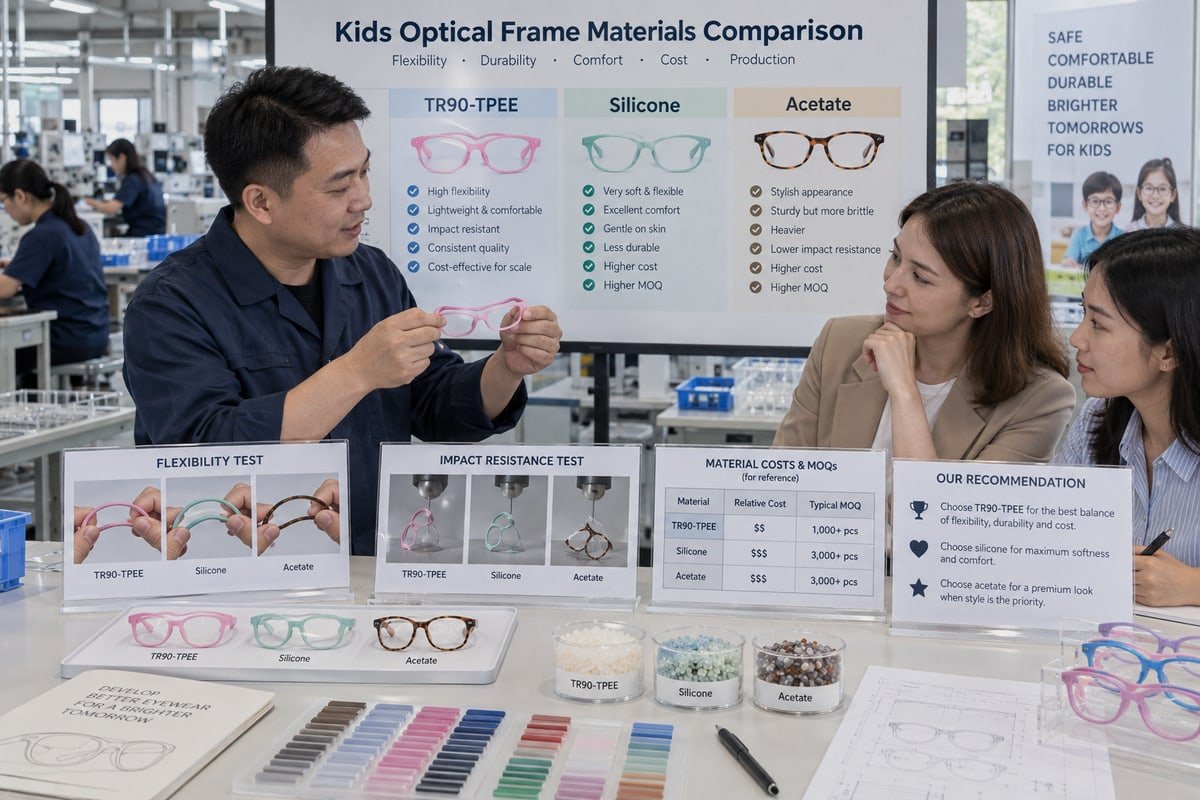
When a new brand founder sends me a budget, I usually split it into three buckets before we talk price per pair. The buckets are tooling, unit cost, and everything after the frame ships. Material changes all three, but not in the way most people expect.
Cost structure by material
| コストドライバー | TR90-TPEE | アセテート | シリコーン |
|---|---|---|---|
| 工具 | Steel mold per front and temple; shared across colors | Little tooling, but cutting patterns and hand labor | Mold per style, similar to TPEE |
| 単体労働力 | Low; molded, trimmed, assembled | High; cut, tumble, polish, fit | 低〜中程度 |
| 色の変更 | Easy via masterbatch | Requires new sheet stock | Easy via pigment |
| Typical positioning | Value-durable, sport, everyday school | Premium fashion | Infant and toddler niche |
| MOQ driver | 金型減価償却 | Labor scheduling and sheet minimums | 金型減価償却 |
| Returns and breakage | 低 | Higher on active kids | Low, but limited to young ages |
The mold question, and how to skip it
A new TR90-TPEE style needs a mold for the front and a mold for the temples. That is a real upfront cost, and it is what pushes MOQs up when everything is custom. The way around it is to start from existing tooling. Our catalog holds roughly 800 existing styles across TPEE and TR90. A brand can pick a front, pick a temple, and change the color, logo, lens, and packaging without paying for new steel. That lets an importer or a baby-product brand test a market with a smaller first order and lower risk. The two styles I described earlier, the clear front with purple-gradient temples and the light-blue front with matte-blue temples, are both existing molds. Different colorways, same tooling.
What custom OEM/ODM work actually adds
Customization does not have to mean a new mold. In our experience with brands across 20+ countries, the changes that build a brand are mostly surface-level from a tooling point of view:
- Custom colors through masterbatch, including translucent and gradient effects.
- Logo placement by pad print, laser, or molded inset on the temple.
- レンズオプション such as UV400 or polarized for the sun range, or demo lenses for optical fronts.
- パッケージングとアクセサリー like cases, cloths, straps, and retail-ready hang cards.
Each of these adds a modest cost per unit. None of them force you into a large MOQ the way a new mold does.
The cost acetate hides
Acetate quotes look higher on paper and often are. But the bigger gap shows up after delivery. An active-kid line in acetate sees more breakage, more warranty claims, and more one-star reviews from parents. A TR90-TPEE line with lightweight construction, adjustable temple tips, and food-grade materials sees fewer of all three. When I help a buyer build a landed-cost sheet, I tell them to add a line for expected returns. That line usually flips the decision.
A simple age guide for planning a line
| 年齢帯 | Recommended build | 理由 |
|---|---|---|
| 0–3 | TPEE-heavy, screwless, integrated bridge or strap | Softest, no metal, safest failure mode |
| 3–5 | TPEE frame or TR90 front with TPEE temples | Balance of softness and shape |
| 6–12 | TR90フロントとTPEEテンプルを組み合わせています | Holds prescription, survives school and sport |
| 12+ style-first | Acetate or TR90 in fashion colorways | Premium look matters more, play is gentler |
結論
Broken frames cost brands trust. TR90-TPEE kids optical frames give the durability, comfort, and batch consistency active children need. Acetate suits fashion. Silicone suits infants.
この記事で言及されている製品の調達に興味がありますか?詳細を表示し、ここから見積もりをリクエストしてください。
脚注
1. WHO resource on visual impairment, relevant to the use of specialized corrective lenses. ↩︎
2. Official manufacturer site for the TR90 material (Grilamid TR), detailing its properties. ↩︎
3. FDA overview of BPA safety and regulations in consumer products. ↩︎
4. DuPont’s official page for Hytrel, the primary commercial TPEE used in flexible applications. ↩︎
5. Comprehensive overview of cellulose acetate’s chemical properties and its history in eyewear. ↩︎
6. Official European Commission page explaining circular economy principles and sustainability. ↩︎

 English
 Español de México
 Deutsch
 Français
 日本語
 العربية
 Português do Brasil