How to Choose TR90 Kids Optical Frames by Face Shape and Nose Bridge?
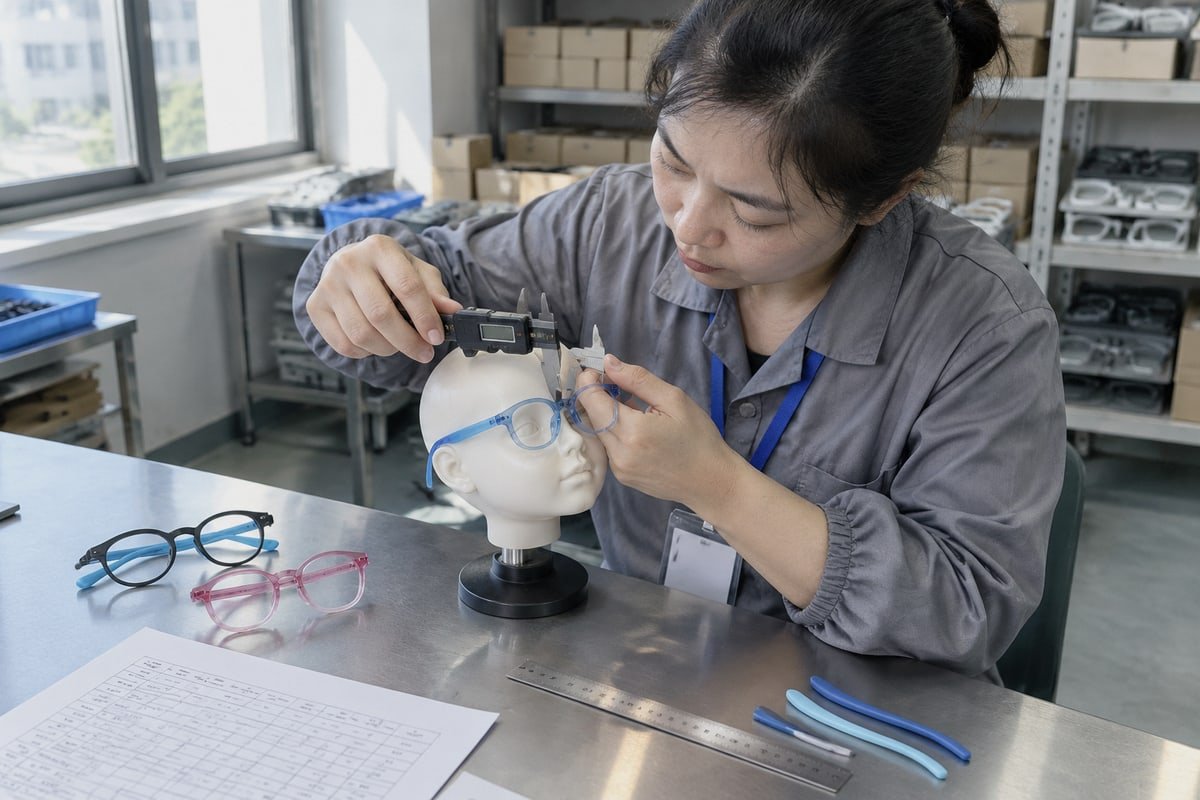
Buyers keep telling our Taizhou factory the same story: cute TR90 kids optical frames that slide or pinch, so children stop wearing them. Fit, not style, fixes that.
Choose TR90 kids optical frames by first matching frame shape to face shape, rectangular for round faces and round or oval for square faces, then confirm the nose bridge sits flush with no gaps. For school-age children, check 14–18 mm bridge width, 44–50 mm lens width, and 120–130 mm temples.
This guide breaks the decision into four steps. First, we match frame shape to face shape. Second, we check the nose bridge. Third, we test whether the TR90 is genuinely flexible and safe. Finally, we explain how OEM/ODM customization solves fit problems that off-the-shelf frames cannot.
How do I match TR90 frame shapes to my child's face shape for the best fit?
A brand founder in Australia once asked us for "the cutest frame" for her new range. We asked for her fit data first. That conversation changed how she briefs us.
Match TR90 frame shapes by contrast: rectangular or square frames for round faces, round or oval frames for square faces, oval or aviator shapes for heart-shaped faces, cat-eye or horn styles for diamond faces, and almost any shape for oval faces. Then let bridge fit make the final call.
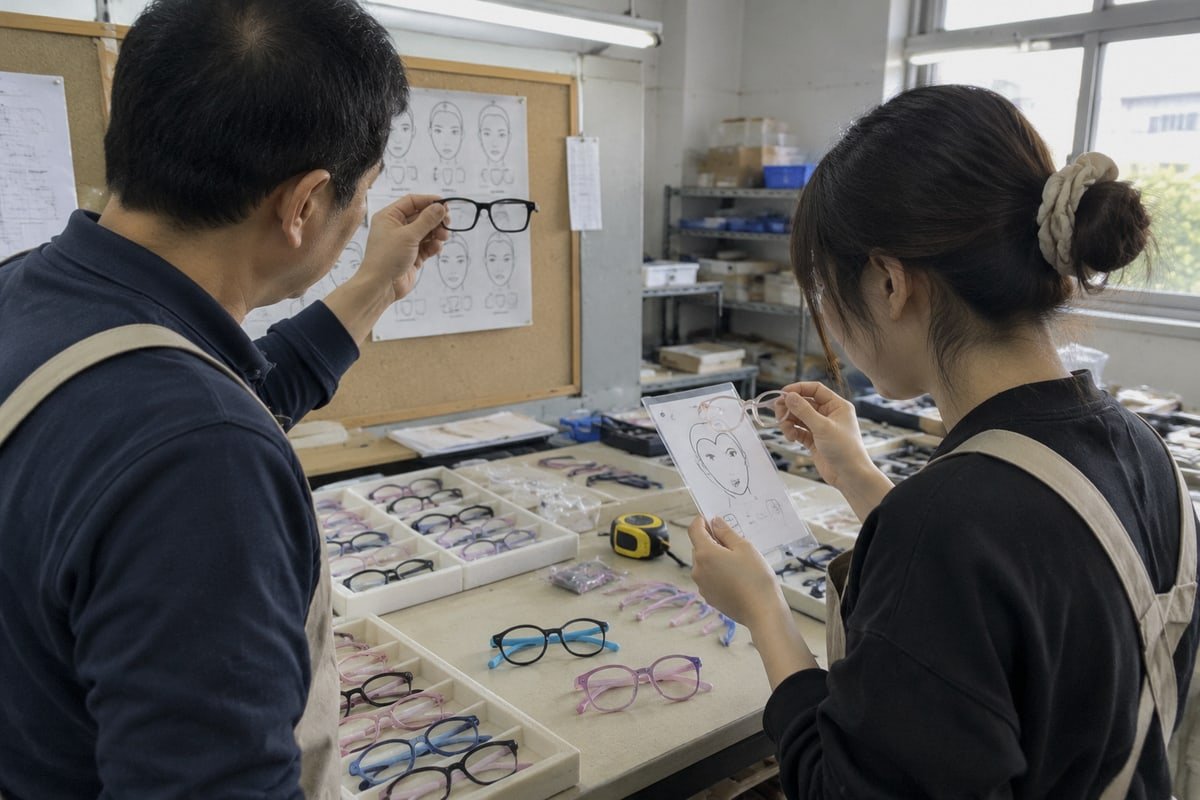
Face shape is the style guide. It narrows the options quickly. But it should never be the last word on children's eyewear. We treat it as a filter, and we treat the bridge as the gatekeeper.
How to identify a child's face shape
Parents do not need a ruler for this step. Look at the child from the front and ask three simple questions. Is the face about as wide as it is long? That usually means round or square. Is the forehead wider than the jaw? That points to heart-shaped. Is the face longer than it is wide, with soft curves? That is oval. Are the cheekbones the widest point, with a narrow forehead and chin? That is diamond. Square faces have a strong, flat jawline. Round faces have soft, full cheeks.
Face-shape-to-frame-shape guide
| شكل وجه الطفل | Recommended TR90 frame shape | لماذا يعمل | Fit caution |
|---|---|---|---|
| مستدير | Rectangular or square | Adds structure and balance | Do not go too wide; kids' frames should sit only slightly wider than the face |
| مربع | دائري أو بيضاوي | Softens angles | Keep the bridge narrow so the frame does not drop |
| بيضاوي | Most shapes | Balanced proportions already | Let comfort and bridge fit drive the choice |
| شكل قلب | Oval or aviator | Balances a narrower chin | Watch temple pressure at the wider forehead |
| Diamond | Cat-eye or horn-style | Highlights the eyes, softens cheekbone width | Check that the upper rim does not touch the brow |
Two of our own styles show how this works in practice. Our matte black round frame with sky-blue temples and a keyhole bridge suits square and angular faces well. Our translucent pink-gradient rounded-square frame gives a round face a bit more structure without hard corners.
Where the eyes should sit
Here is a rule that many retail face-shape guides skip. The child's eyes should sit horizontally centered in each lens. This keeps the optical center aligned with the child's المسافة بين الحدقتين 1 and gives the widest field of clear vision. A frame that looks stylish but pushes the pupils toward the inner edge of the lens is the wrong frame, no matter what the face-shape chart says.
Color matters more than you think
Wear compliance is a real problem in pediatric eyewear. A child who dislikes the frame will not wear it. We have seen brands lift daily wear simply by offering transparency levels and hues that flatter the child's skin undertone. Soft pastels, crystal fades, and two-tone contrasts give children a sense of choice. That confidence keeps the glasses on the face.
Some buyers push back here. They say face-shape rules are adult aesthetics, not pediatric fit guidance. They are partly right. That is exactly why we use face shape only to shortlist styles. The final choice always goes to the bridge and the width measurements, which we cover next.
What should I look for in a nose bridge design to keep kids' optical frames comfortable and secure?
On our fitting bench, we press a finished frame onto a child-size head form and look for daylight under the bridge. Any gap means the frame will slide.
Look for a nose bridge that sits flush against the skin with no gaps, typically a narrower saddle or keyhole bridge for children's flatter noses. Check bridge width in millimetres, not age, and add rubberized contact points, adjustable silicone nose pads, or a strap for toddlers and low bridge fits.
The bridge is the part of the frame that rests on the nose. It controls whether the frame sits high enough and level enough. In children, it matters more than in adults, because many kids have underdeveloped or flatter nose bridges. Toddlers especially have very little bone structure to hold a frame in place.
Read the numbers, not the age label
Age ranges on a product listing are only a starting point. Actual measurements decide the fit. This is the pediatric eyewear sizing checklist we send to buyers who sell online with no in-store fitting.
| قياس | Typical school-age range | How to check it | Growth allowance |
|---|---|---|---|
| عرض العدسة | 44–50 mm | Eyes centered in each lens | None; replace when eyes move off-center |
| عرض جسر الأنف | 14–18 ملم | Flush contact, no gap, no pinch marks | None; the bridge must fit today |
| طول الذراع الجانبي | 120-130 مم | Curves over the ear without pushing forward | 5–10 mm |
| عرض الإطار الإجمالي | Slightly wider than the face | No cheek contact, no overhang | 5–8 mm buffer |
Notice that the bridge gets no growth allowance. A frame can have room to grow in the temples. It cannot have room to grow at the nose. A bridge that is 3 mm too wide today will slide today.
Too wide, too narrow, and what each one looks like
| عرض | السبب المحتمل | Practical fix |
|---|---|---|
| Frame slides down during reading or play | Bridge too wide, or flat nose with no grip | Smaller bridge, saddle design, rubberized contact points, or adjustable silicone nose pads |
| Red marks on the sides of the nose | Bridge too narrow, or weight concentrated at one point | Wider bridge or a design that spreads load across the whole bridge surface |
| يجلس الإطار بشكل غير مستقيم | Uneven bridge flare or one temple bent | Check bridge symmetry and temple alignment |
| Child keeps pushing the glasses up | Combination of wide bridge and long temples | Correct both; the bridge alone rarely solves it |
Bridge flare and weight distribution
A newer trend we follow closely is AI-powered 3D facial scanning through mobile apps. These tools measure the bridge flare angle of the child's nose. The goal is to spread the light TR90 frame weight evenly across the bridge rather than at a single pressure point. Even without an app, parents can do a simple version at home: look at the frame from below and check that the bridge touches the nose along its whole curve, not just at the top.
Toddler versus school-age fit
For toddlers, we build differently. Facial features are smaller and the nose bridge is still developing. We recommend the smallest correct frame size, plus retention support such as cable temples or a strap harness. For school-age children, a well-cut saddle bridge with خطافات الأذن المضادة للانزلاق is usually enough.
One objection we hear often: "TR90 is flexible, so it forgives a bad bridge." It does not. Flexibility protects the frame from breaking. It does nothing to stop a wide bridge from sliding down a flat nose. Fit accuracy always beats material when the dimensions are wrong.
How can I tell if TR90 frames are truly flexible and safe enough for my child's daily wear?
Softer flex or firmer hold? Our engineers weigh that trade-off on every new TR90 kids optical frame, because a frame that bends too easily loses its optical alignment.
Genuine TR90 frames are lightweight thermoplastic nylon that bend, twist, and spring back to shape without whitening or cracking. To confirm safety, flex the temples outward, twist the front gently, check for smooth rounded edges and hypoallergenic material, and look for spring hinges and soft temple tips.
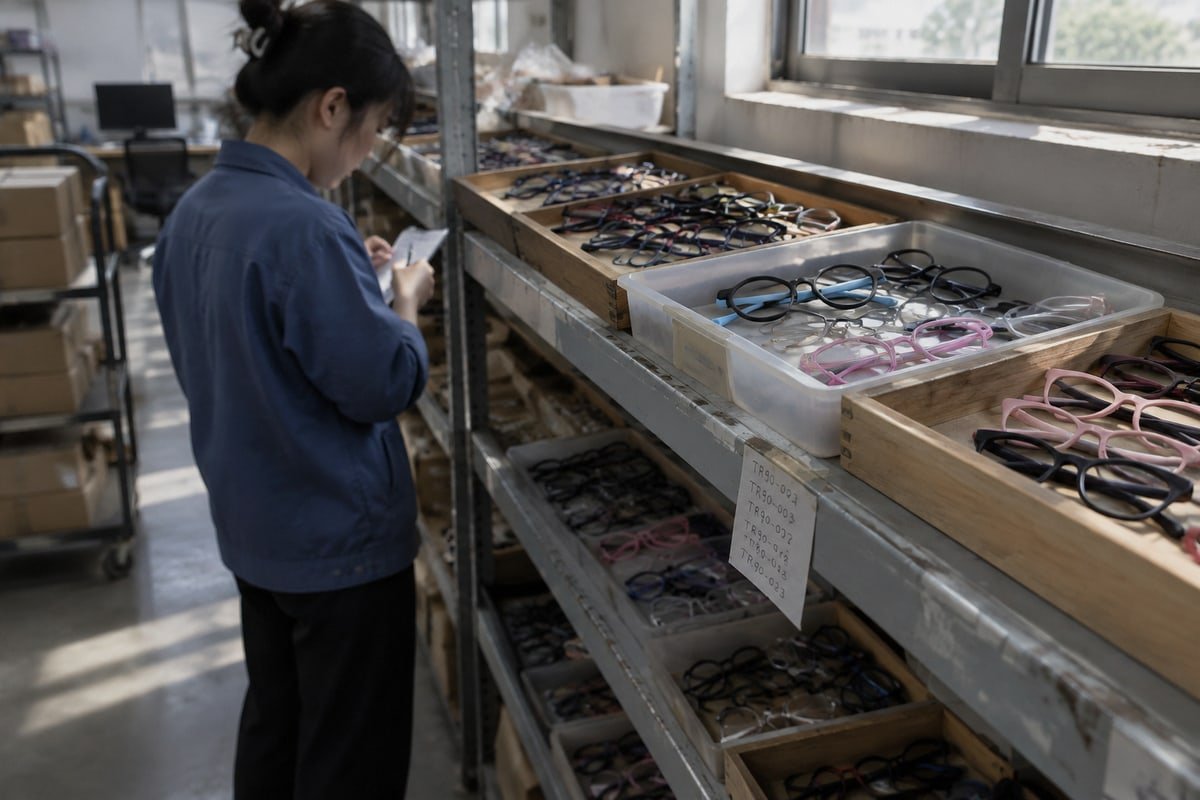
TR90 has a reputation as a near-universal answer for children's eyewear. It earned that reputation for good reasons. It is a lightweight thermoplastic with real "memory," meaning it returns to its original shape after being bent or twisted during play. It has strong مقاومة الصدمات 2 compared to rigid plastics and many metal frames. It is also a مادة مضادة للحساسية 3, which reduces skin irritation behind the ears and on the nose. But not every frame sold as TR90 behaves like TR90. Here is how we check, and how a parent or buyer can too.
A five-step hands-on test
- Flex the temples outward. Open both flexible temple arms well past their normal position. They should return without staying splayed. Stiff resistance or a creaking sound is a warning sign.
- Twist the front gently. Hold each end of the front rim and twist in opposite directions. Genuine TR90 flexes and recovers. Cheaper blends show white stress lines at the corners.
- Check the weight. A children's TR90 frame should feel almost weightless in the hand. Excess weight means excess pressure on the nasal bone.
- Run a finger over every edge. Nose bridge, rim edges, temple tips, and hinge areas should be smooth and rounded. No sharp mold lines.
- Inspect the hinges and tips. Spring hinges add give when a child pulls the frame off with one hand. Soft rubberized temple tips and anti-slip ear hooks add grip without pressure.
The trade-off nobody mentions
Here is where critical thinking helps. Maximum softness is not the goal. A frame that flexes too freely lets the lenses drift out of alignment with the child's pupillary distance. That hurts vision quality 4, especially for stronger prescriptions. On our production line we balance a resilient TR90 front, which holds the lens position, with softer TPEE temples, which absorb the pulling and twisting. This TR90-front-with-TPEE-temple combination is one of the reasons we commit to flexible-material expertise rather than generic plastic.
توافق العدسة الطبية
Parents sometimes assume flexible frames cannot hold prescription lenses securely. In practice, TR90 has good prescription lens compatibility. The lens groove holds its shape, so an optician can glaze standard single-vision lenses 5 without difficulty. What matters is that the frame is not over-flexible at the rim, which brings us back to the trade-off above.
Comfort features for active kids
Children run hotter and move more than adults. We see growing demand for micro-ventilation channels near the bridge and hinges. These small channels move air across the lens and reduce fogging during sport or when moving from cold air into a warm classroom. Combine them with soft temple tips and a well-fitted bridge, and the frame stays put through a full school day.
Why should I work with an OEM/ODM manufacturer to customize TR90 optical frames for different face shapes?
Fifteen years of building kids' eyewear taught us one thing: a single frame size never fits a whole market. Face shapes and bridges differ by region.
Working with an OEM/ODM manufacturer lets you adapt bridge width, lens size, temple length, and frame shape to your customers' actual faces instead of accepting one generic fit. You can start from existing styles, avoid heavy mold investment, and add custom colors, logos, lenses, and packaging.
A kids' eyewear brand in Japan, Europe, and Australia serves children with very different facial proportions. A bridge that works for one market may sit too high or slide in another. Off-the-shelf frames cannot solve this. Customization can. Here is how we approach it with the brands we supply across more than 20 countries.
Start from a real style library, not a blank mold
Most new brands cannot justify the cost of tooling a new mold for every face shape. That is why we keep roughly 800 أنماط موجودة 6 that buyers can select from. A buyer can pick a rounded-square front for one age group and a rectangular front for another, test the market, and only then invest in a fully original design. This lowers launch risk while still allowing fit variation across the range.
What can be customized for fit
| عنصر الإطار | خيارات التخصيص | Fit benefit |
|---|---|---|
| جسر الأنف | Saddle, keyhole, or low bridge fit; rubberized contact points; adjustable silicone nose pads | Solves sliding on flatter noses and pressure on narrower noses |
| عرض جسر الأنف | Multiple width options within the same front design | Same style serves different face shapes and regions |
| طول الذراع الجانبي | Interchangeable temple pieces of varying lengths | Growth-adaptive systems; replace temples, not the whole front rim |
| مادة الذراع | TR90 or softer TPEE flexible temple arms with anti-slip ear hooks | Better retention for active or younger children |
| Lens size and shape | Adjusted to age group while keeping eyes centered | Correct optical center and widest field of vision |
| نوع العدسة | Optical clear, anti-blue-light, UV400, or polarized | Matches the product's use case |
| Colors and finishes | Matte, gloss, translucent gradients, two-tone | Improves wear compliance across skin undertones |
| Branding and packaging | Logo placement, cases, cloths, retail-ready boxes | Consistent, professional shelf presentation |
Why a factory partner beats a trading company here
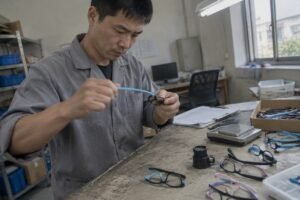
Fit customization only works when the people who mold the frame talk directly with the people who design it. In our 5S-managed workshop in Taizhou, around 120 workers handle molding, assembly, and quality checks under one roof. When a buyer reports that a bridge feels loose on their test group, we can adjust the bridge geometry and send revised samples without a middle layer slowing things down.
Growth-adaptive and modular thinking
One development we find promising is the modular TR90 system with interchangeable temples. Children grow fast. A modular design lets a parent or retailer swap in longer temples as the head grows, keeping the same front rim and lenses. For a brand, this extends product life and builds customer loyalty. We encourage buyers to consider this for school-age lines especially.
The objection we hear most is simple: "Can't we just buy a stock frame and put our logo on it?" You can. But that stock frame was designed for an average face that may not exist in your market. Custom bridge and temple options, built on flexible TR90 and TPEE, are what turn a cute frame into one a child actually keeps wearing. That is the difference between a supplier and a long-term manufacturing partner.
الخلاصة
Sliding, pinching frames end up in a drawer. Match shape to face, let the bridge decide fit, verify TR90 flex, and partner with a factory that builds both.
هل أنت مهتم بتوريد المنتجات المذكورة في هذه المقالة؟ انظر التفاصيل واطلب عرض أسعار هنا:
ملاحظات ختامية
1. Authoritative source for eye health and the importance of correct optical alignment in children. ↩︎
2. ISO 12870 specifies requirements for spectacle frames, including impact resistance and durability. ↩︎
3. The FDA provides standards for the biocompatibility of materials used in medical devices like eyewear. ↩︎
4. The WHO provides global guidance on maintaining vision quality and preventing refractive errors. ↩︎
5. The National Eye Institute offers clinical information on corrective lenses and pediatric vision care. ↩︎
6. The WTO oversees international trade standards for manufactured goods and consumer products. ↩︎
مقالات أخرى قد تعجبك

هل تبحث عن شريك موثوق به للنظارات للأطفال؟
استكشف أكثر من 800 نمط جاهز ودعم OEM/ODM كامل مصمم خصيصًا لعلامتك التجارية.
اتصل بنا English
 Español de México
 Deutsch
 Français
 日本語
 العربية
 Português do Brasil