How Do TR90 & TPEE Kids Optical Frames Achieve Bendable Rebound Without Deforming?
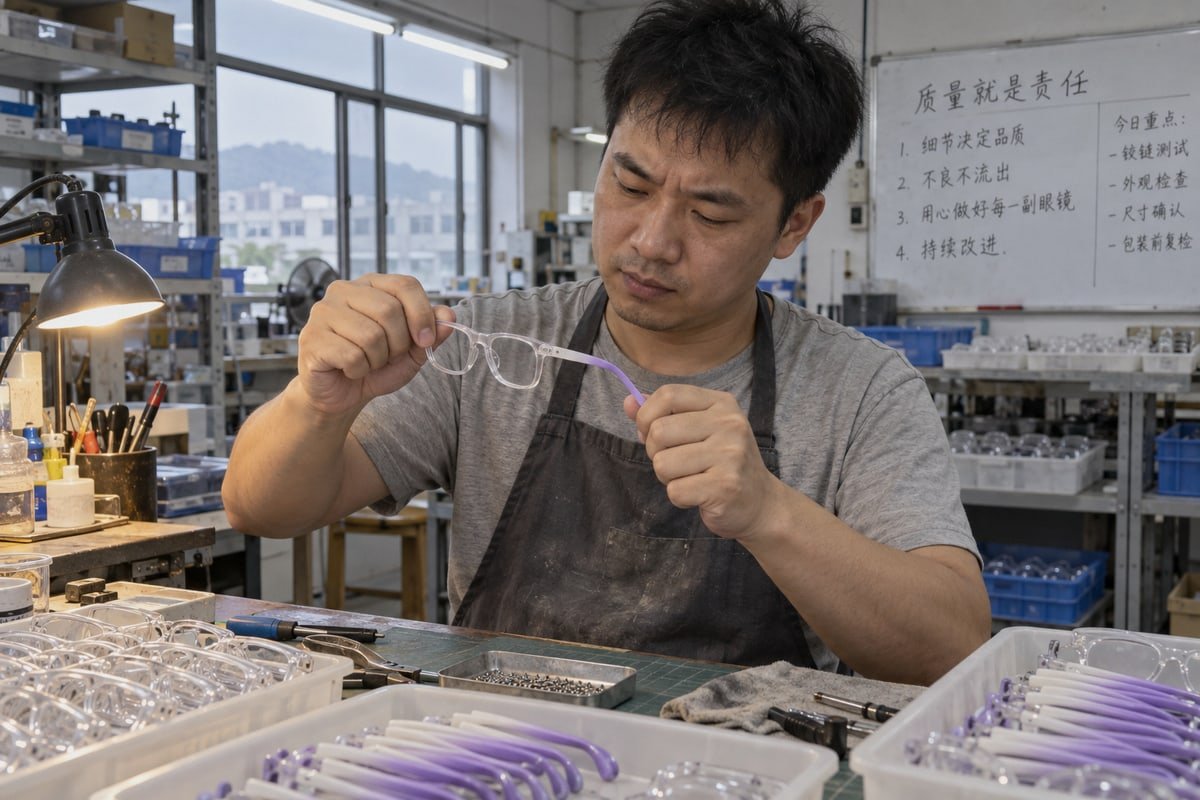
Kids sit on glasses. Rigid frames snap. TR90 & TPEE kids optical frames bend and spring back, which is why our Taizhou production line switched to these materials years ago.
TR90 & TPEE kids optical frames achieve bendable rebound through elastic deformation. TR90’s nylon chains act as a shape memory polymer, while TPEE’s hard crystalline segments pull its soft segments back into place. Both stay within their recoverable range during normal bending, so the frame returns to its molded shape.
That is the short answer. The longer answer matters if you are choosing a frame material for a children’s brand. Below, I explain the chemistry in plain terms, list the tests you should request, show how customization affects rebound, and cover why flexibility equals comfort and safety for active kids.
How does the molecular structure of TR90 and TPEE allow my frames to bend without snapping?
One bend check on our workshop floor still sticks with me. A tester folded a TR90 temple nearly in half, let go, and it sat straight again.
TR90 is a nylon 12 polyamide whose long molecular chains slide past each other and re-tangle under load instead of breaking. TPEE alternates hard crystalline segments with soft amorphous ones; the hard segments act as physical cross-links that pull the soft segments back. Both bend elastically, not permanently.
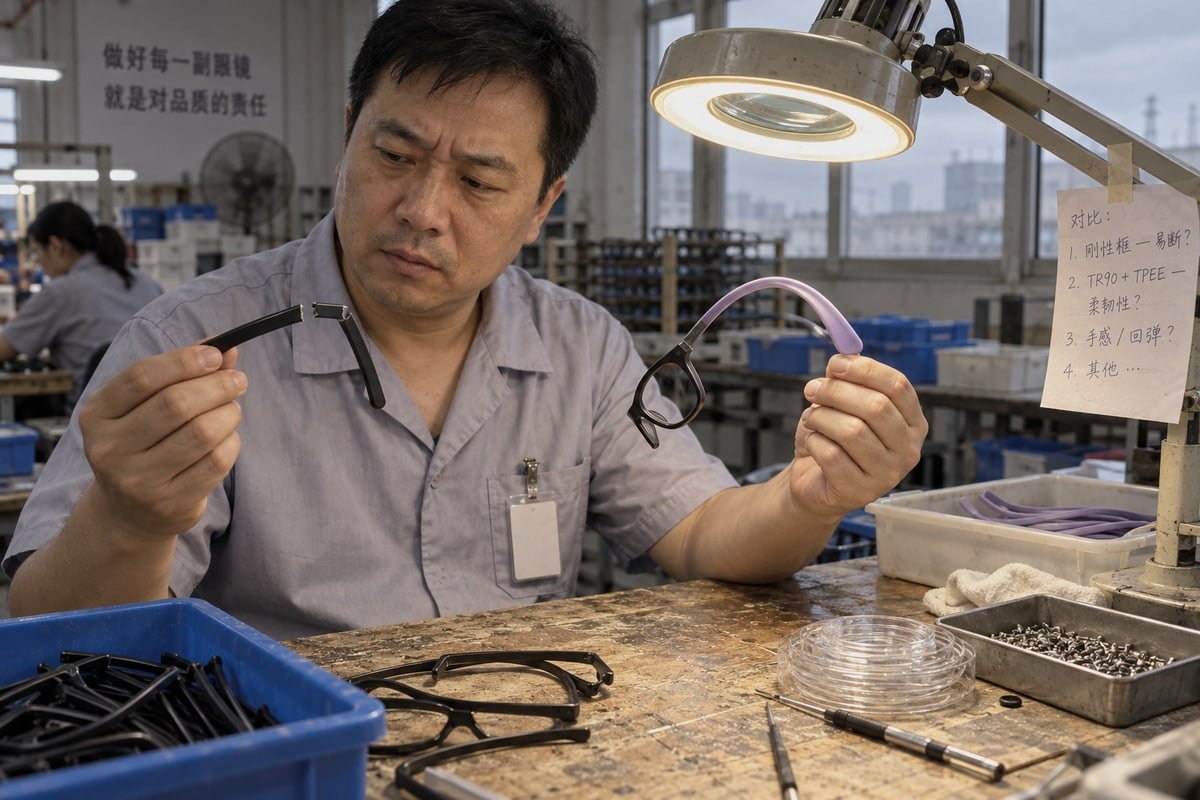
Why ordinary plastic frames fail
Standard rigid plastics have short or stiff chains. When you bend them, the chains get pulled apart. Past a small limit, they cannot recover. The frame either holds a permanent bend or cracks. Children push frames past that limit almost daily. So the material has to be built for elastic deformation from the start.
TR90: a shape memory polymer
TR90 is a Swiss-engineered بوليمر حراري بولي أميد 1 based on nylon 12. Its long-chain molecules slide and re-tangle under stress without breaking. This is why the industry calls it "memory plastic." During injection molding manufacturing 2, the polymer is set into its lowest energy state. Every later bend moves it away from that state. Once the force is released, the material is thermodynamically driven back to the zero-stress shape. That is the rebound you see. Newer bio-based grades, made from castor bean oil (PA11/PA12), keep the same long-chain carbon structure and are reported to show even better elastic recovery over the frame's life.
TPEE: rubber-like rebound with plastic-like strength
TPEE هو مطاط بوليمر بوليستر حراري. إن خصائصه المطاطية الحرارية 3 come from a two-phase structure. Hard crystalline polyester segments give قوة الشد 4 and stress-crack resistance. Soft amorphous segments give stretch. When a child pulls a temple outward, the soft segments extend and the hard segments hold their position. When the pull stops, the hard segments drag the soft segments home. In our factory, we usually pair a TR90 front with TPEE temples, so the front keeps the lenses aligned and the temples take the abuse.
TR90 مقابل TPEE في لمحة
| خاصية | TR90 (nylon 12 polyamide) | TPEE (مطاط بوليستر) |
|---|---|---|
| صلب ولكنه مرن، تأثير الذاكرة | ثابت ولكنه مرن | ناعم، مطاطي |
| Rebound source | Long-chain shape memory | Hard/soft segment architecture |
| Reported density | About 1.00–1.14 g/cm³ | Low, comparable lightweight range |
| Typical role in kids' frames | Fronts, full frames | Temples, ear hooks, soft tips |
| Cold-weather impact | No-break behavior reported in low-temperature Charpy tests | Retains elasticity, resists cracking |
| Weight advantage | Cited as 40–60% lighter than some acetate or metal frames | Similar lightweight benefit |
A full TR90 optical frame often weighs about 18–22 grams. That low mass reduces the pull on the nose bridge, which is what causes the slow "sagging" deformation in heavier acetate frames.
What testing standards should I request to confirm my kids' frames won't deform after repeated flexing?
A procurement manager from Australia once asked us a blunt question: which test proves the temples will still spring back after a year? Fair question.
Request ISO 12870 frame tests for bridge deformation, temple endurance flexing, and lens retention, plus ISO 180 Izod impact data on the raw material. Add heat-deflection results, low-temperature Charpy impact, and child-safety chemical reports such as BPA-free and phthalate-free certificates for the finished frame.
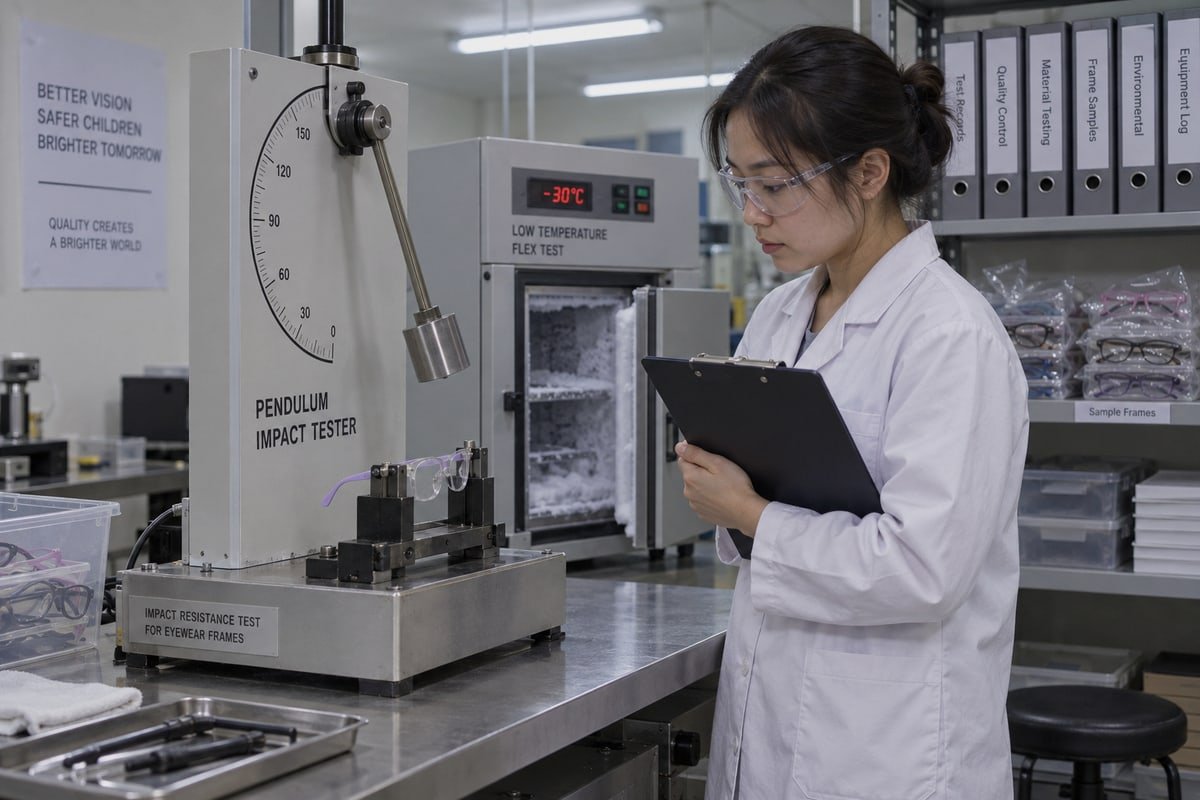
Separate material data from finished-frame data
Buyers often receive a polymer data sheet and treat it as proof for the frame. It is not. Raw TR90 pellets may pass ISO 180 Izod impact resistance 5 standards with excellent numbers. But a thin bridge, a sharp hinge corner, or a poorly filled mold can still fail. So I recommend asking for both layers of evidence.
| منطقة الاختبار | ماذا يتحقق منه | لماذا هو مهم للأطفال |
|---|---|---|
| Endurance flexing (temple) | Repeated open-close cycles without permanent set | Simulates thousands of daily on-off motions |
| تشوه الجسر | Front keeps shape under sustained load | Prevents lens misalignment and a sliding fit |
| Izod / Charpy impact | Energy absorbed on impact, including at low temperature | Drops, "sat-on" incidents, winter playgrounds |
| Heat deflection | Shape retention at elevated temperature | Sun-exposed cars, hot classrooms |
| مقاومة كيميائية | Exposure to sweat, skin oils, sunscreen | Keeps polymer chains from going brittle over time |
| السلامة الكيميائية | BPA-free frames, phthalate-free, heavy-metal limits | Required by most children's product regulators |
A simple request process
- Ask for the raw-material certificate showing the exact TR90 or TPEE grade.
- Ask for finished-frame test reports on the specific style, not a similar one.
- Confirm the hinge design. Spring hinges or screwless hinge technology reduce stress concentration where temples meet the front.
- Ask how heat figures were measured. Some supplier sheets quote short-burst temperatures that look inflated; a heat-deflection temperature with a stated method is more useful.
- Order pre-production samples and run your own bend and drop checks.
Handling the "bendable is not indestructible" objection
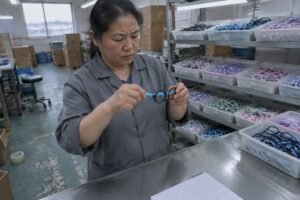
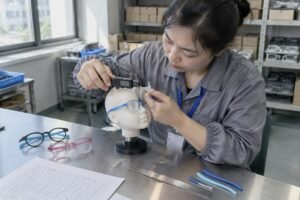
Some buyers worry that flexible marketing hides real limits. That concern is valid. TR90 and TPEE have a finite elastic limit, and repeated stress at one point can fatigue any polymer. The answer is design plus verification. In our 5S-managed workshop, every batch goes through bend, twist, and drop checks before packing. Test reports tell you the material can rebound. Process control tells you every frame in the carton actually does.
Can I customize colors and logos on TR90 & TPEE frames without compromising their bendable rebound?
Every color request comes with a trade-off we weigh carefully: pigment load and surface decoration versus the elastic recovery the base polymer was chosen for.
Yes. Colors are mixed into TR90 and TPEE pellets before injection molding, so the pigment becomes part of the polymer and does not add a brittle layer. Logos are molded, laser-marked, or pad-printed on low-flex zones like temple tips, leaving the bending sections untouched.
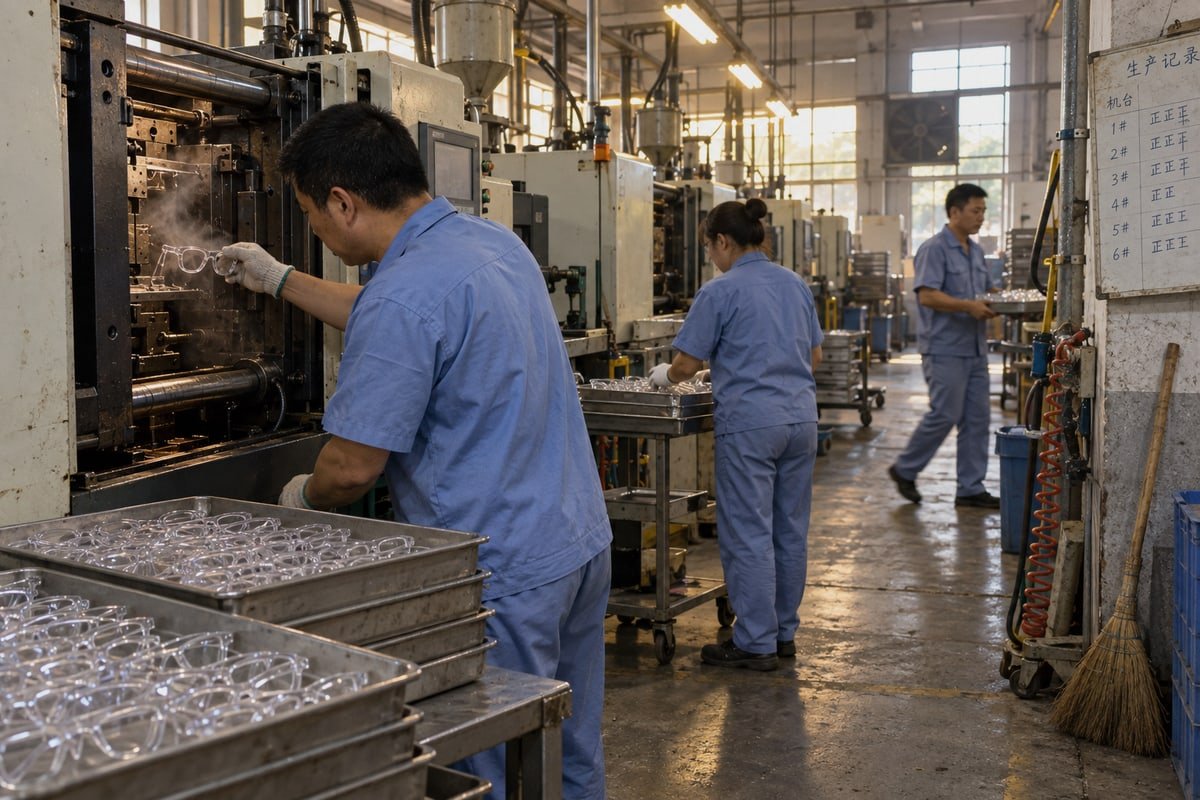
How color is built in, not painted on
Most rebound problems with customized frames come from surface coatings. A thick paint layer cracks when the polymer underneath stretches. That is why we use masterbatch coloring. The pigment is compounded into the pellets, then injection molded as one homogeneous part. A translucent crystal-clear TR90 front with gradient purple-to-lavender TPEE temples, for example, gets its fade from the co-molding sequence, not from spraying. The color goes as deep as the material itself.
Customization options and their effect on rebound
| خيار | الطريقة | Effect on flexibility |
|---|---|---|
| Solid or translucent color | Masterbatch in pellets | لا شيء |
| Gradient temples | Two-shot or sequential molding | None when TPEE grades match |
| Matte vs glossy finish | Mold texture | لا شيء |
| Molded logo | Engraved in mold cavity | None; recommended on temple |
| Laser-marked logo | Surface etch | Negligible at temple tips |
| Pad-printed logo | Ink on surface | Keep off the flex zone near the hinge |
| Perforated dot pattern on temples | Molded holes | Adds flexibility; reduces weight |
Working with existing styles to lower risk
New brands rarely need a new mold. Our catalog of roughly 800 existing styles lets a buyer pick a shape, such as a light-blue translucent rectangular front with matte opaque blue TPEE temples and rubberized tips, then apply their own colors, logo, lens spec, and packaging. Full OEM/ODM support covers UV400 or polarized lenses, cases, cloths, and retail-ready branded presentation. Testing the market this way avoids heavy tooling investment.
The adjustability objection
Opticians sometimes point out that TR90 is hard to heat-adjust after molding because its memory fights reshaping. This is true, and it is a real limit compared with acetate. Our response is to design the fit into the mold. We offer multiple sizes per style, adjustable-feel TPEE temples, looped ear hooks that wrap around the ear, and rubber nose pads. A child then gets a secure fit without an optician needing to bend anything permanently.
Why do flexible TR90 & TPEE frames feel safer and more comfortable for active children than rigid materials?
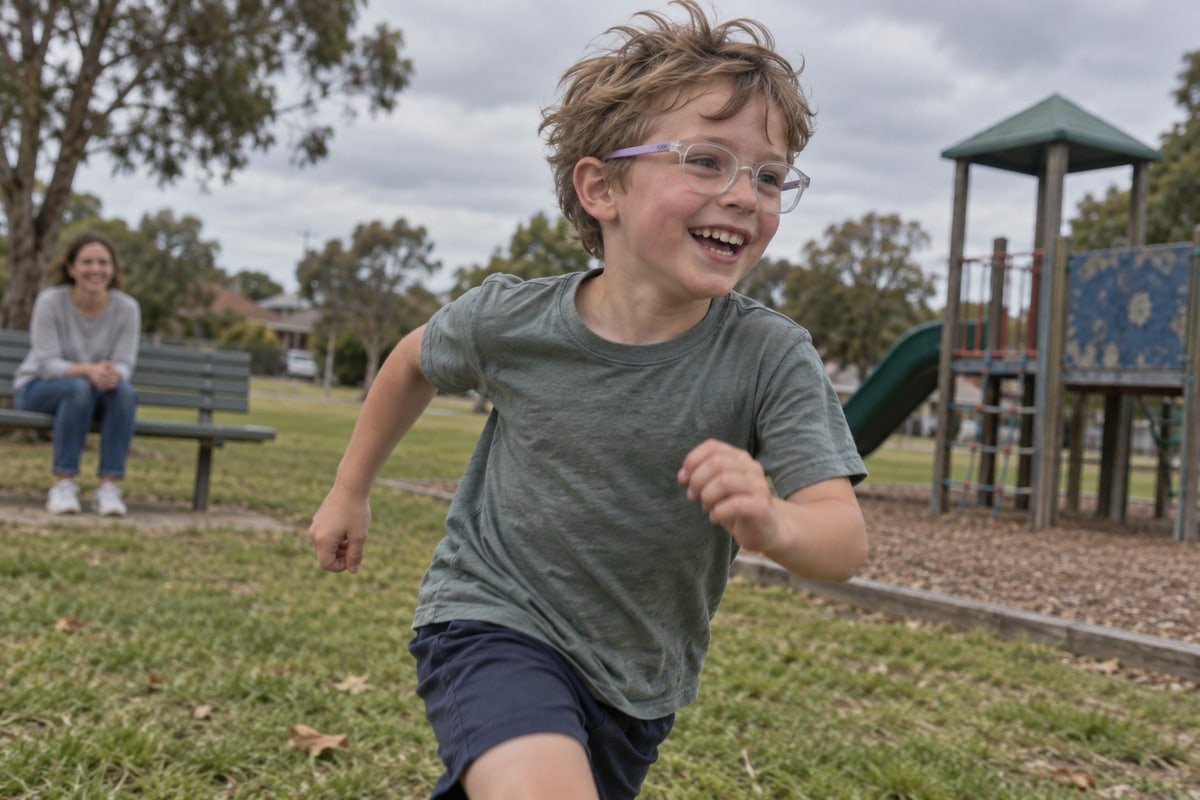
Fifteen years of making eyewear taught me something simple: a frame that hurts or scares a child ends up in a drawer, no matter how durable it is.
Flexible TR90 and TPEE frames feel safer because they bend away from the face on impact instead of snapping into sharp edges. They weigh roughly 18–22 grams, so they do not press on the nose, and their skin-friendly, hypoallergenic surfaces resist sweat and oils during long active days.
Safety comes from how the frame fails
A rigid acetate or metal frame stores energy until it breaks. The break is sudden and the edges can be sharp. A TR90 front absorbs the same energy through elastic deformation. It flexes, then rebounds. A TPEE temple does the same when a ball or a classmate hits it from the side. This is why the whole kids' market has shifted from "handle with care" glasses to eyewear built for rough use.
Comfort comes from lightweight eyewear construction
Weight is the quiet cause of most fit complaints. Heavy frames slide down, pinch the nose, and get pushed up all day. Lightweight eyewear construction in TR90 and TPEE removes that constant pressure. Soft-touch temples, perforated dots that add flex, and curved ear hooks keep the frame in place during running and climbing without tight clamping.
Skin-friendly polymers for sensitive faces
Children's skin reacts to nickel in metal frames and to plasticizers in cheap plastics. TR90 and TPEE are among the most common hypoallergenic eyewear materials for a reason. They are skin-friendly polymers with no metal contact points, and they resist skin oils, sweat, sunscreen, and common chemicals, so the surface does not degrade or turn brittle over years of wear.
| سيناريو | Rigid acetate / metal | TR90 & TPEE |
|---|---|---|
| Playground fall | Risk of snap, sharp edges | ينثني ويرتد |
| Sports and running | Slides, needs tight fit | Light, stays put with ear hooks |
| Hot car in summer | Possible warping | Better heat-deflection resistance |
| Sensitive skin | Nickel or plasticizer reactions | Hypoallergenic, BPA-free options |
| All-day school wear | Nose pressure, headaches | Low weight, less fatigue |
Care tips that protect the rebound
Flexible does not mean careless. Parents should avoid leaving frames on a dashboard for hours, should not twist a single spot repeatedly as a game, and should not let an optician apply high heat to force a permanent bend. These frames resist deformation. They are not damage-proof.
الخلاصة
Rigid kids' frames break and get abandoned. TR90 & TPEE kids optical frames bend, rebound, and stay comfortable. Pick a partner who tests that rebound, not just promises it.
هل أنت مهتم بتوريد المنتجات المذكورة في هذه المقالة؟ انظر التفاصيل واطلب عرض أسعار هنا:
ملاحظات ختامية
1. Scientific definition and engineering properties of thermoplastic polyamides like TR90 nylon. ↩︎
2. Authoritative overview of the injection molding process used to set the shape of TR90 and TPEE frames. ↩︎
3. Overview of the molecular structure and elastic behavior of thermoplastic elastomers like TPEE. ↩︎
4. Technical explanation of tensile strength in polymers, relevant to the durability of crystalline segments in TPEE. ↩︎
5. Official ISO standard for determining Izod impact strength of rigid plastics, as mentioned for raw material testing. ↩︎
مقالات أخرى قد تعجبك

هل تبحث عن شريك موثوق به للنظارات للأطفال؟
استكشف أكثر من 800 نمط جاهز ودعم OEM/ODM كامل مصمم خصيصًا لعلامتك التجارية.
اتصل بنا English
 Español de México
 Deutsch
 Français
 日本語
 العربية
 Português do Brasil