What to Do When Kids’ Sunglasses Nose Pads Deform or Break?
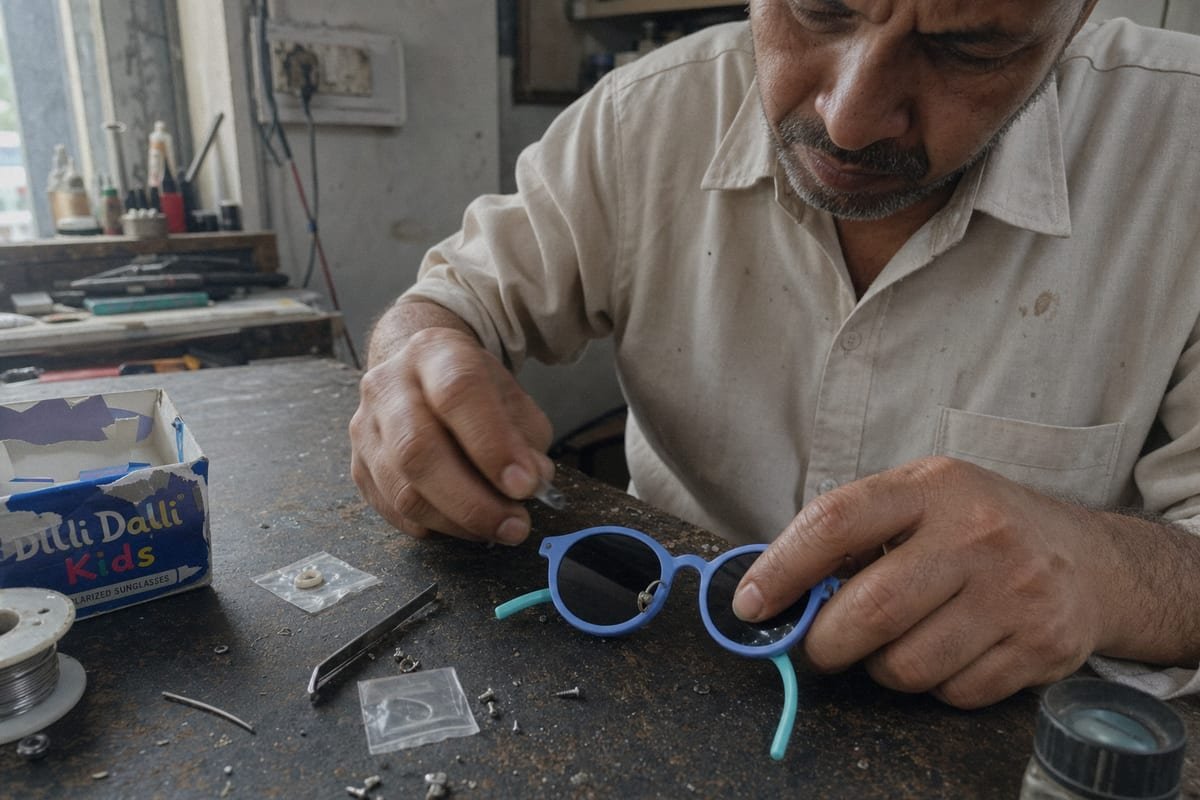
Kids’ sunglasses nose pads fail more than any other part. On our Taizhou production line 1, returned samples almost always show the same weak point: the bridge. Ignore it, and slipping, pinching, and lost sales follow.
When kids’ sunglasses nose pads deform, first inspect the fit and make a small, gentle adjustment. If a pad breaks or falls off, replace it rather than glue it. For broken mounts, cracked bridges, or stripped screws, choose professional repair or a full frame replacement.
The right fix depends on the damage type, the pad attachment style, and the child’s activity level. Below, I will walk through materials, supplier checks, flexible frames, and quality control — the four things that actually stop this problem from repeating.
How can I choose nose pad materials that resist deformation in hot weather?
Last summer, a buyer in Australia sent us photos of competitor sunglasses left in a hot car. The cheap PVC pads had warped flat. Our team sees this failure constantly.
Choose medical-grade silicone nose pads or TPEE-based integrated pads for hot climates. Silicone stays stable well above car-interior temperatures, resists yellowing, and stays soft on skin. Avoid cheap PVC or low-grade rubber, which softens, deforms, and hardens permanently after repeated heat exposure.
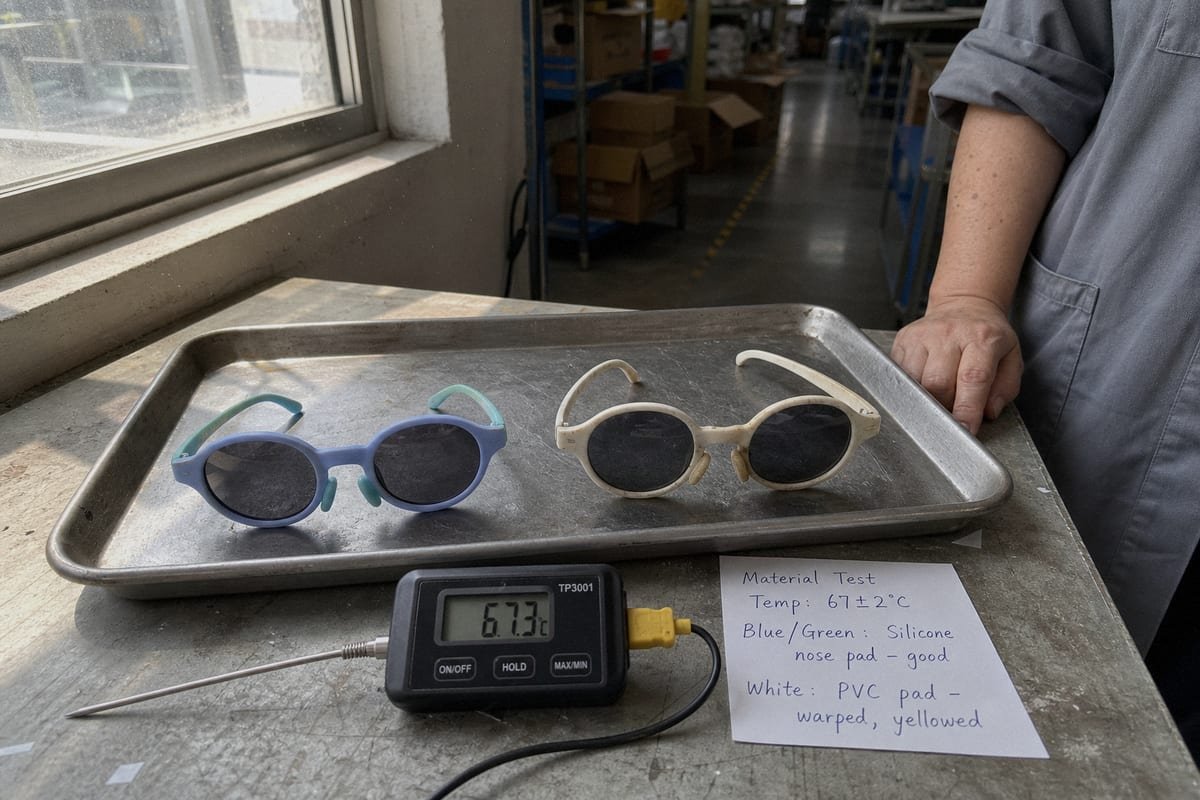
Heat is the silent killer of nose pads. A parked car in summer can exceed the softening point 2 of low-cost plastics. Kids also add sweat, sunscreen, and skin oils, which accelerate material breakdown. So material choice matters more than most buyers realize when they first source children's eyewear.
The materials we compare most often
When we develop a new style for a kids' brand, we usually put three or four pad materials on the table. Here is how they compare in real use:
| Material | Heat Resistance | Skin Comfort | Durability | Best For |
|---|---|---|---|---|
| Medical-grade silicone | Excellent | Very soft, hypoallergenic | High | Sensitive young skin, hot climates |
| TPEE (integrated pad) | Excellent | Soft, flexible | Very high | Active kids, sports styles |
| PVC / soft vinyl | Poor | Acceptable at first | Low; hardens and yellows | Budget promotional items only |
| Hard acetate pads | Good | Firm, can pressure-mark | Medium | Adult frames, not ideal for kids |
Silicone nose pads win on comfort and heat stability. They also matter for safety. Children's skin is thinner and more reactive than adult skin, so hypoallergenic eyewear parts 3 are not a luxury. They prevent contact dermatitis, red marks, and the itching that makes a child refuse to wear sunglasses at all.
Why integrated TPEE pads change the equation
There is another route we often recommend: skip separate pads entirely. Many of our children's styles mold the nose bridge 4 directly from flexible TPEE. No screw, no post, no glue joint. There is simply nothing to fall off. For toddlers who chew and twist their frames, this design removes the most common failure point. Anti-slip nose pads molded into the frame also grip better during running and cycling, because there is no rigid pad edge to lift away from the skin.
If a buyer still wants separate pads for an optical style, we specify silicone with UV stabilizers so the pads resist yellowing from sun and sweat.
What should I look for in a supplier to prevent recurring nose pad failures?
A procurement manager from Europe once told me she had switched suppliers three times for the same reason: pads kept falling off within months. That conversation shaped how we present our own factory checks.
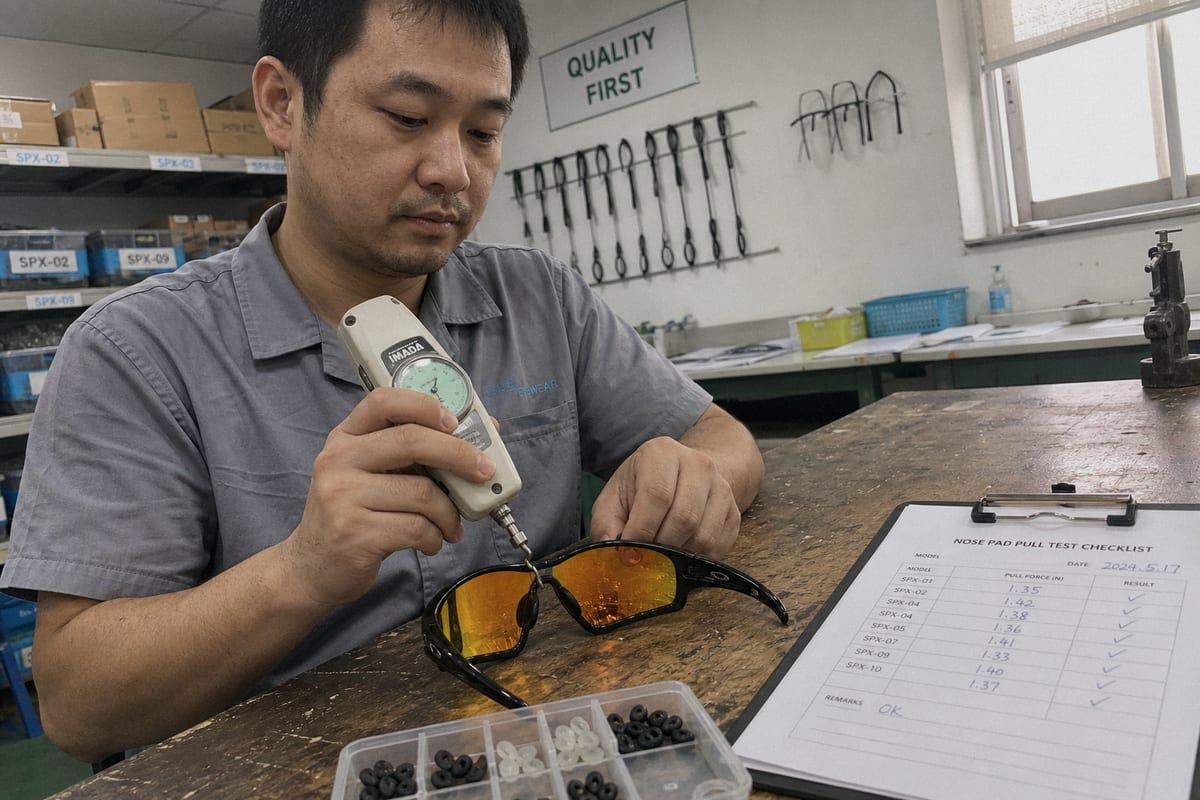
Look for a factory that specifies pad material grade, controls mounting hardware tolerances, performs pull-force and heat-cycle testing, and offers replacement nose pads as spare parts. Traders who cannot name the pad material or attachment tolerance will deliver recurring failures.
Recurring nose pad failure is almost never bad luck. It is a supply chain problem. When a supplier buys the cheapest pads on the market and presses them onto mismatched posts, the failure is built in before the container ships. So your job as a buyer is to ask questions that expose weak sourcing before you place the order.
Questions that separate factories from traders
In our experience exporting to 20+ countries, serious buyers ask about parts, not just prices. Here is a practical checklist:
- What exact material are the pads? A real factory answers with a material grade, not just "silicone."
- Are the pads screw-in nose pads, push-in nose pads, or integrated? The attachment type defines both durability and repairability.
- What is the pull-off force standard? Pads should survive a defined pull test, not just "feel secure."
- Do you heat-test assembled frames? Hot-car simulation catches deformation before customers do.
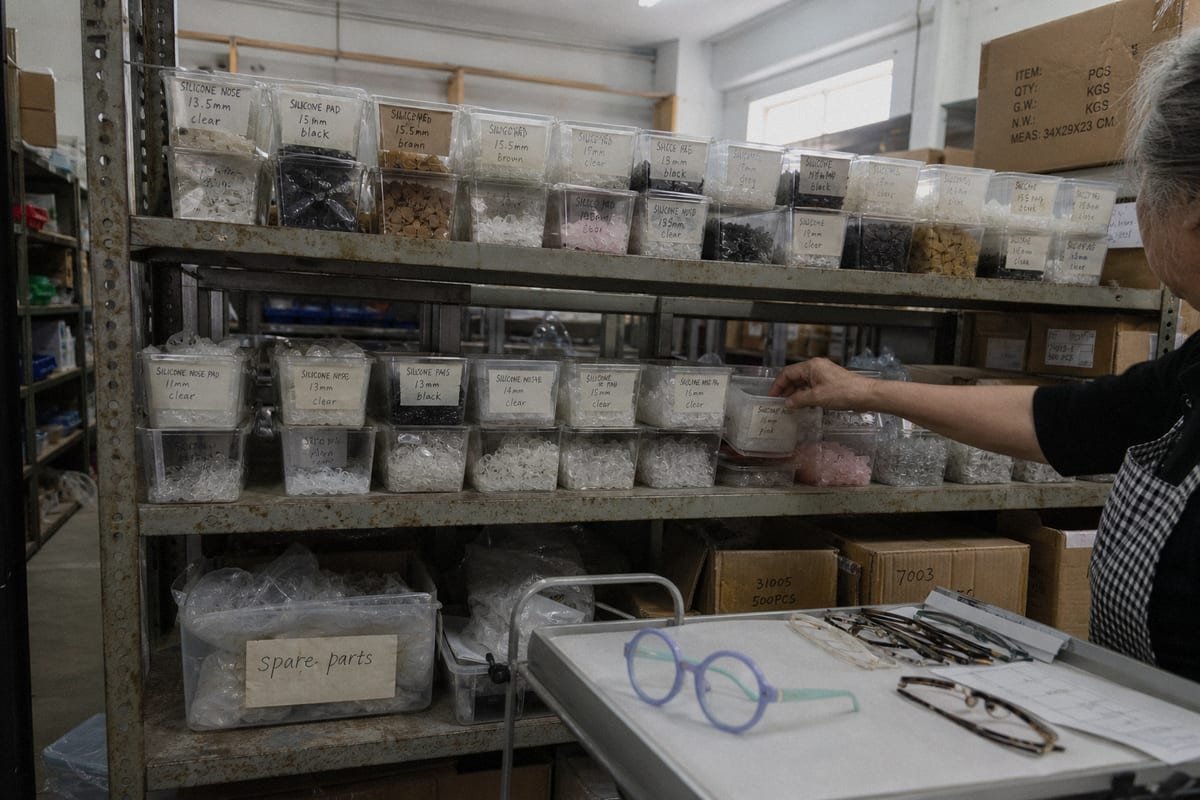
- Can you supply spare replacement nose pads with the shipment? Spares turn a warranty complaint into a two-minute fix for the end customer.
- Who makes the frames? A workshop with 5S management and in-house assembly controls pad mounting; a trader controls nothing.
Why spare parts support matters
We encourage our brand clients to include a small bag of replacement pads or point customers to an optical repair kit in their after-sales material. Parents appreciate it. A brand that helps a parent fix a loose pad keeps that customer. A brand that says "buy a new pair" loses them. Ask your supplier whether they can pack spares, and whether pads across their range are standardized. Standardized parts mean one spare bag serves many SKUs, which simplifies your after-sales logistics enormously.
Finally, check how the supplier handles nose pad arm adjustment on metal-detail styles. Poorly annealed pad arms snap when an optician bends them. Good factories specify the wire alloy for exactly this reason.
Can flexible TR90 or TPEE frames reduce nose pad breakage on active kids?
Drop tests are the most satisfying part of my week. When we throw a TPEE frame across the QC room and it bounces back into shape, buyers on video calls always smile.
Yes. Flexible TR90 and TPEE frames absorb the twisting, dropping, and bending forces that snap rigid pad mounts. Many flexible kids' frames use an integrated molded saddle bridge instead of separate pad arms, removing the mechanical failure point entirely for active children.
Nose pads usually break because the frame around them cannot flex. When a child sits on rigid sunglasses 5, the stress concentrates at the thinnest points — the pad posts and the bridge. Flexible materials spread that stress across the whole frame instead. The frame bends, then recovers. Nothing snaps.
How the two materials divide the work
We build many of our best-selling children's styles as TR90 fronts with TPEE temples, and the logic applies directly to bridge durability:
| Feature | TR90 | TPEE |
|---|---|---|
| Flexibility | High; springs back after bending | Very high; almost rubber-like |
| Weight | Very light | Very light |
| Bridge design option | Molded keyhole or saddle bridge | Fully integrated soft saddle bridge |
| Pad mount stress | Low; frame flexes before posts break | Near zero; no separate posts needed |
| Best age group | School-age kids, optical frames | Toddlers, babies, sports sunglasses |
A molded saddle bridge distributes pressure across a wide contact area on the nose. There is no pad arm to bend crooked, no screw to strip, and no pad to chew off. For toddlers, that last point is a genuine safety issue: a detached small pad is a choking hazard. Integrated designs eliminate it.
The fit trade-off to understand
One honest caveat. Integrated bridges cannot be adjusted the way traditional screw-in pads can. There is no eyeglass bridge adjustment 6 with pliers on a molded TPEE frame. So sizing matters more up front. That is exactly why we maintain around 800 existing styles across multiple bridge widths and age ranges — a buyer can select shapes that fit their target age group correctly instead of relying on after-sale adjustment. For prescription-oriented TR90 kids optical frames, we can still design adjustable pad options where opticians need them.
How do I evaluate a manufacturer's quality control for nose pad durability before ordering?
Fifteen years of eyewear production taught our team one lesson above all: durability is decided at the QC bench, not in the marketing brochure. Buyers who audit our process order with confidence.
Request the factory's QC plan in writing: incoming pad material checks, mounting torque or press-fit standards, pull-force testing, heat and sweat resistance tests, and final random inspection with defined AQL levels. Then verify with pre-shipment samples and a third-party inspection if needed.

You do not need to be an engineer to evaluate quality control. You need to know which checkpoints exist and ask for evidence at each one. A factory that documents its process will show you. A factory that improvises will change the subject.
The checkpoints that predict nose pad life
Here is how the QC chain looks inside a well-run workshop, and what each stage catches:
| QC Stage | What Is Checked | Failure It Prevents |
|---|---|---|
| Incoming materials | Pad material grade, hardness, color stability | Pads that harden, yellow, or deform in heat |
| Assembly | Screw torque on screw-in pads; press depth on push-in pads | Loose pads that fall off in weeks |
| In-process testing | Pull-force on mounted pads; flex cycles on bridges | Detachment during play and cleaning |
| Environmental testing | Heat cycling, artificial sweat exposure | Hot-car warping, sweat corrosion |
| Final inspection | Symmetry, sharp-edge check, random AQL sampling | Uneven fit, safety hazards, batch defects |
Symmetry deserves special attention. Both pads must sit at the same angle and height, or the sunglasses slide and press unevenly on a small face. Our final inspectors check this on every sampled unit because children notice discomfort instantly and simply stop wearing the product.
Practical steps before you commit
Order pre-production samples and abuse them yourself. Leave one pair on a sunny dashboard. Twist another. Pull the pads with your fingers. Then request golden samples that lock the approved standard for mass production. If the order is large, book a third-party pre-shipment inspection 7 and include pad security in the checklist explicitly. Also confirm what the frame ships with: a hard case, a cleaning cloth, and ideally spare adhesive nose pads or standard replacements for styles that use them. Those small accessories reduce your return rate more than any warranty text.
Conclusion
Deformed or broken kids' sunglasses nose pads mean one of three paths: adjust, replace, or repair professionally. Prevent repeats with silicone or TPEE materials, flexible frames, and documented supplier QC.
Footnotes
1. Wikipedia entry for Taizhou, a major global hub for eyewear manufacturing and production. ↩︎
2. Scientific definition of the softening point, a critical thermal property for eyewear plastics. ↩︎
3. Authoritative guide from the American Academy of Ophthalmology on eyeglass frame materials and hypoallergenic options. ↩︎
4. Wikipedia entry providing a clear definition and anatomical overview of the eyeglass frame bridge. ↩︎
5. Wikipedia overview of sunglasses, covering frame construction and material rigidity. ↩︎
More Articles You Might Like
Looking for a Reliable Kids Eyewear Partner?
Explore 800+ ready styles and full OEM/ODM support tailored to your brand.
Get in Touch English
  Español de México
  Deutsch
  Français
  日本語
日本語  العربية
  Português do Brasil