What Are the Design Differences Between Infant and School-Age TPEE Kids Sunglasses?
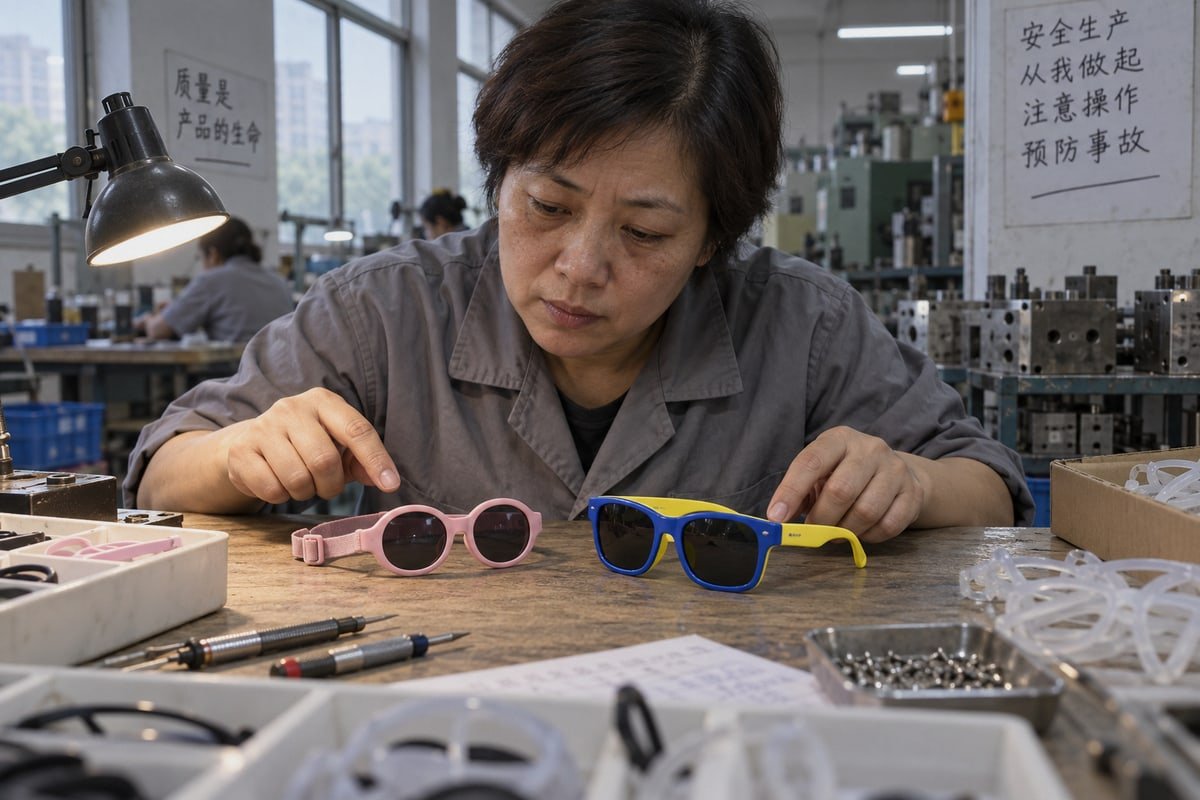
Buyers often ask our factory in Taizhou why TPEE kids sunglasses 1 can’t be one-size-fits-all. Get this wrong, and returns pile up while parents lose trust in your brand.
Infant TPEE kids sunglasses prioritize soft, strap-secured, wrap-around designs with smaller lenses (36–40mm) and screwless one-piece frames, while school-age models use larger lenses (44–48mm), standard temple arms, contoured nose bridges, and more fashionable silhouettes that support independent, active wear.
The differences run deeper than size. Retention systems, frame thickness, hinge design, and styling all change with age. Let me walk you through each design decision, one at a time.
How do I choose the right frame flexibility for different age groups?
A procurement manager from Australia once bent one of our infant samples 180 degrees during a video call. She was testing what we already knew: flexibility needs differ by age.
Choose maximum flexibility for infants — thicker TPEE frames that withstand teething, twisting, and full folding without cracking. For school-age children, select moderately flexible, thinner TPEE frames that balance flexible frame resilience with a lighter, more structured, adult-like feel.
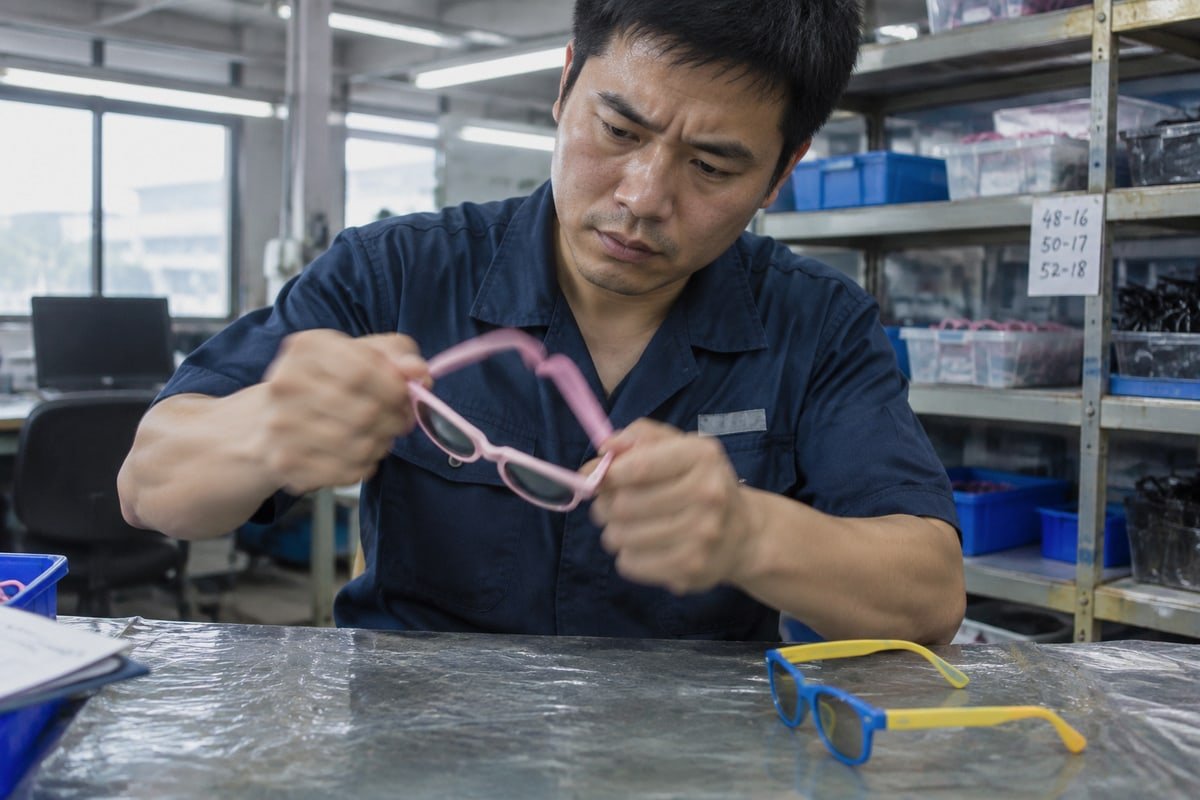
TPEE is the common thread across both age groups. It deforms instead of breaking, which is why it has become the default flexible material for young children's eyewear. But the way we tune that flexibility changes completely between an infant frame and a school-age frame.
Why infant frames need more material
Babies chew, pull, and bend everything. So infant frames use greater TPEE material thickness. The extra wall thickness means the frame survives teething pressure and extreme bending. In our workshop, we mold infant frames as single-piece injected units. There are no weak joints, and the whole frame returns to shape after being folded flat. One well-known approach in the 0–4 age category uses exactly this single-piece injected TPEE construction for virtual unbreakability.
Why school-age frames are thinned out
School-age kids want sunglasses that look like real sunglasses. So we thin the TPEE walls for a lighter, more refined profile. The frame still flexes when dropped on a playground or sat on in a backpack. But the design goal shifts from "survive a baby's grip" to "survive daily independent use while looking good."
| Design Factor | Infant (0–2 yrs) | School-Age (4–7 yrs) |
|---|---|---|
| TPEE wall thickness | Thicker, teething-resistant | Thinner, lightweight |
| Bend tolerance | Full 180° fold, extreme twist | High flex, structured recovery |
| Construction | Single-piece, screwless mold | Flexible 180-degree hinges |
| Feel on face | Soft, cushioned contact | Firm but forgiving fit |
One caution I always share with buyers: flexibility alone does not guarantee fit. A frame can be unbreakable and still slide off a poorly matched face. Sizing must come first; flexibility is the safety net, not the whole solution.
What safety features should I prioritize for infant versus older kids' sunglasses?
When we audit incoming orders from European baby brands, the compliance checklist for infant models is always longer than for school-age lines. There is a good reason for that.
For infants, prioritize screwless one-piece construction, BPA-free and phthalate-free TPEE, rounded edges, and adjustable elastic straps. For school-age kids, prioritize impact resistance ratings, shatterproof polycarbonate lenses, secure flexible hinges, and UV400 protection — which remains the non-negotiable baseline for both groups.
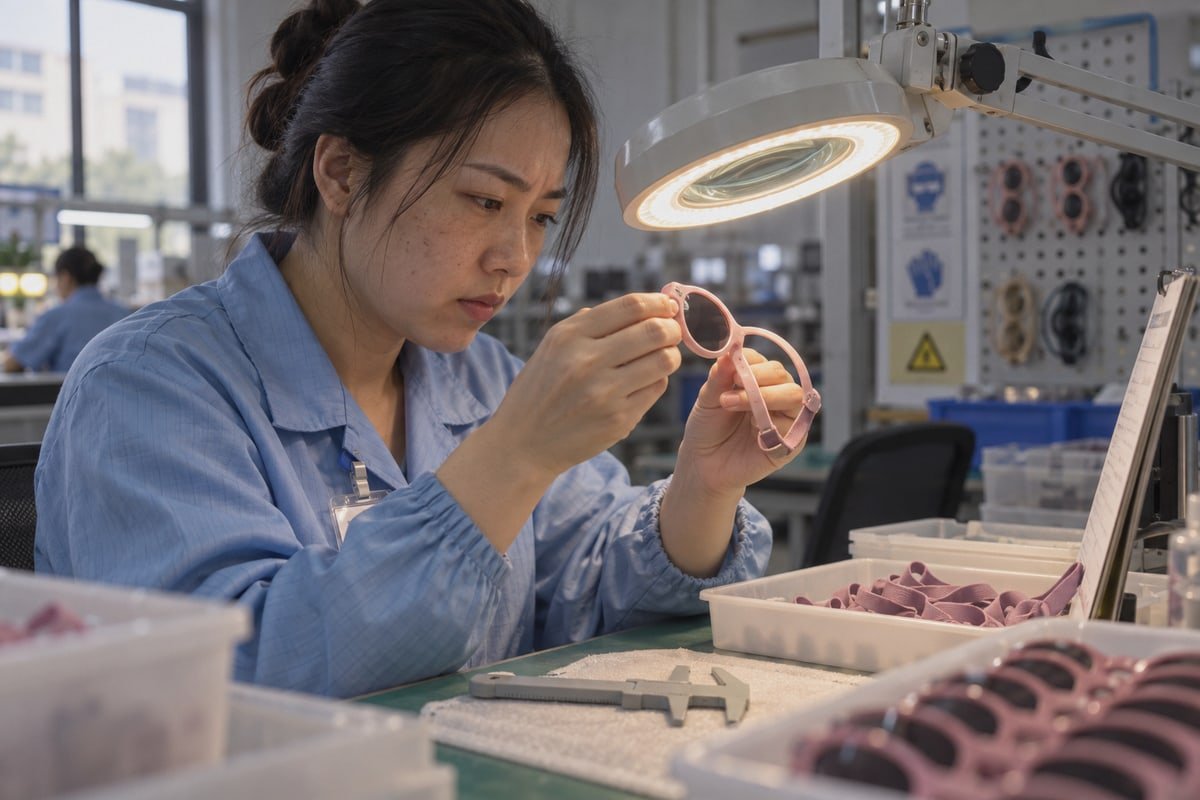
Safety design is where the two age groups diverge most sharply. An infant product is essentially protective gear. A school-age product is durable everyday eyewear. Each demands a different safety hierarchy.
Infant safety: eliminate every hazard at the source
Infant frames go in the mouth. That is not a possibility; it is a certainty. So the safety priorities are:
- Screwless hinge technology or no hinges at all. A single-piece mold means no tiny metal screws that could work loose and become choking hazards.
- BPA-free construction and phthalate-free material. Buyers in the US market must also account for CPSIA requirements 2 on lead and phthalates. We often position infant-grade TPEE against food-grade safety standards because parents judge it like a teething toy.
- Rounded edges everywhere. No sharp corners near delicate skin, no pinch points at the nose or ears.
- Adjustable elastic straps instead of rigid temples, so nothing presses on soft cartilage.
School-age safety: manage impact and real-world abuse
Older kids drop, throw, and sit on their sunglasses. Here the priorities shift to shatterproof polycarbonate lenses 3, verified impact resistance ratings, and flexible 180-degree hinges that flex outward instead of snapping. Compliance still matters. The relevant standards our QC team works against include EN ISO 12312-1 4 for Europe, ANSI Z80.3 for the US, and AS/NZS 1067 for Australia and New Zealand. Whichever market you sell into, UV400 protection is the true core requirement — polarization improves glare comfort, but it never replaces proper UV filtering.
How does lens size and fit change as my target age range gets older?
Fifteen years of measuring children's frames has taught our engineers one thing: facial growth patterns, not age labels, should drive sizing decisions.
Lens width grows from roughly 36–40mm for babies (0–2 years) to 40–44mm for toddlers and 44–48mm for kids aged 4–7. Bridges widen and become contoured, temples lengthen from 105–115mm to 115–125mm, and strap retention gives way to curved temple tips.
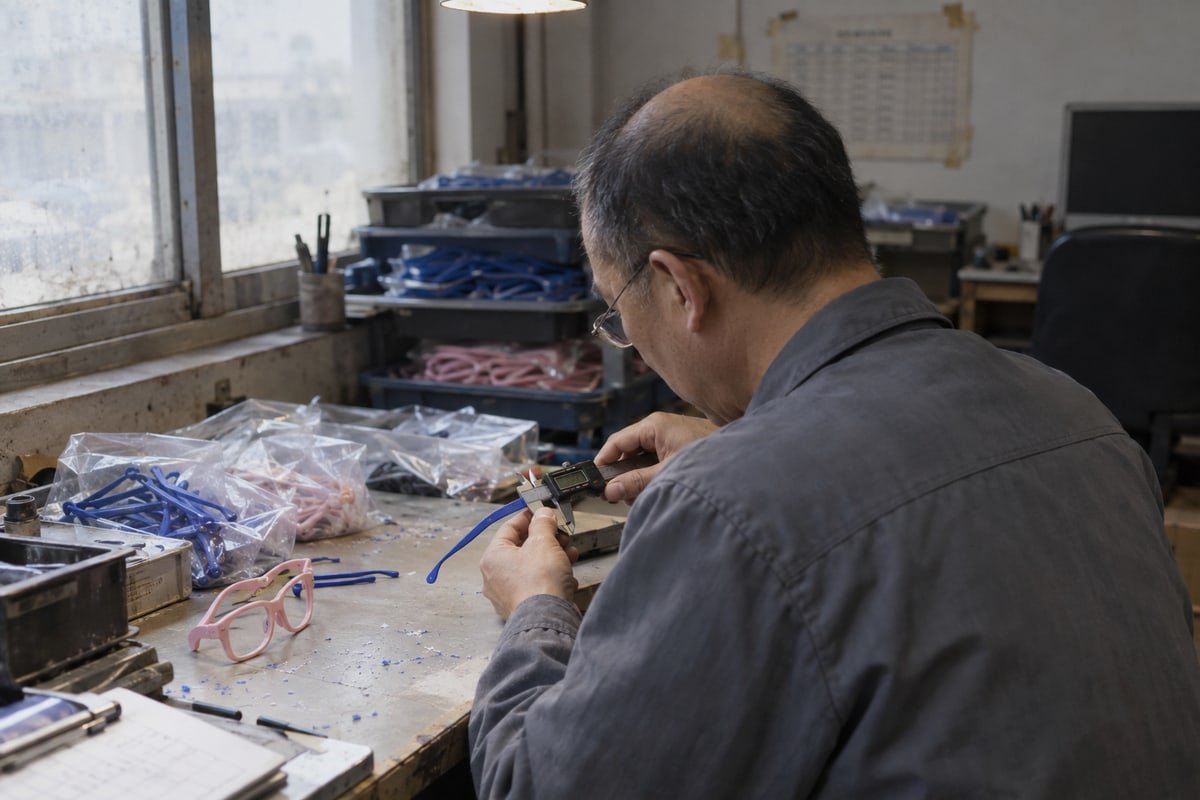
Sizing is where I see new brands make the most expensive mistakes. A frame that is 4mm too wide slides down a toddler's nose all day. Parents notice, and the product gets returned. This is why more brands now segment by tighter age bands instead of a broad "kids" label — it improves fit and measurably reduces returns.
The sizing progression, in numbers
| Age Band | Lens Width | Temple Length | Retention System |
|---|---|---|---|
| Baby 0–2 yrs | 36–40 mm | Strap replaces temples | Adjustable elastic straps |
| Toddler 2–4 yrs | 40–44 mm | 105–115 mm | Strap or short temples |
| Kids 4–7 yrs | 44–48 mm | 115–125 mm | Standard curved temples |
For reference, one popular school-age configuration in our catalog runs a 45mm lens, 15mm bridge, 123mm total frame width, and 125mm temples — a spec that comfortably serves the 4–8 range.
The nose bridge tells the real story
Infants have underdeveloped nasal bridges. So infant frames use a flat, integrated bridge that rests gently across the face, often paired with wrap-around frame geometry to block light from every angle. School-age frames graduate to a defined, ergonomic nose bridge that distributes weight properly and keeps larger lenses stable during running and sports. Some buyers ask us why they can't just scale one frame up or down. The answer is that a child's face doesn't grow proportionally — the bridge, cheekbones, and ear position all develop at different rates. Fit must be re-engineered at each stage, not merely resized.
Can I use the same TPEE material specifications across my entire kids' product line?
A Japanese buyer once asked us to quote one TPEE grade for her full 0–8 range to simplify sourcing. We had to talk her out of it — here is why.
No — while base TPEE stays consistent, infant lines need softer, thicker, food-contact-safe formulations with one-piece molding, whereas school-age lines can use firmer, thinner-walled TPEE, hinged construction, deeper lens grooves for Rx options, and features like vented frames or antimicrobial additives.
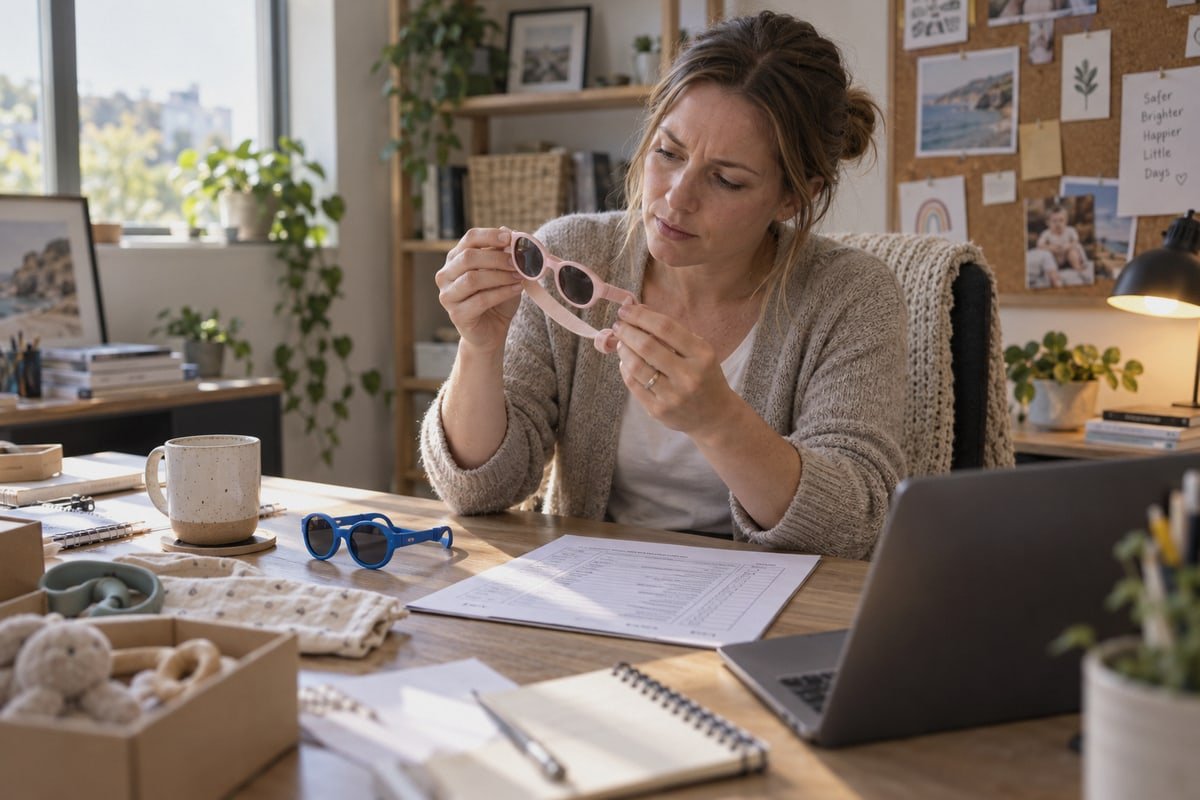
The material family can be shared. The material specification cannot. Think of TPEE as a platform, not a fixed recipe. Our production line runs different hardness grades, wall thicknesses, and additive packages depending on the target age.
What changes across the line
| Specification | Infant Line | School-Age Line |
|---|---|---|
| TPEE hardness | Softer, chew-tolerant grade | Firmer, shape-holding grade |
| Molding | Single-shot, screwless | Hinged, multi-component |
| Lens groove | Shallow, fixed sun lens | Deeper grooves, Rx-capable |
| Extra features | Strap anchors, soft edges | Vented frames, antimicrobial options |
| Lens options | UV400 impact-resistant | UV400 plus polarized triacetate lenses |
Where sharing specs makes sense — and where it doesn't
You can standardize the base polymer supplier, the color masterbatch system, and the UV400 lens sourcing. That keeps quality consistent and pricing efficient. What you cannot share is the functional spec. School-age frames increasingly need deeper lens grooves to accept prescription lenses — a feature that is pointless in the purely protective infant category. Some newer school-age designs add vented TPEE structures to prevent fogging during sports, and advanced formulations blend in antimicrobial additives for classroom and playground exposure. Infants simply don't need any of that; they need softness and security.
There is one more practical angle. With around 800 existing styles across both categories in our catalog, buyers can build a properly segmented age range without investing in new molds for every SKU. Test the market with existing tooling first, then customize colors, logos, lenses, and packaging once you know which age bands sell.
Conclusion
Infant TPEE kids sunglasses maximize softness, straps, and screwless security; school-age models add size, hinges, and style. Design by developmental stage, and your line will earn parents' trust.
Interested in sourcing the products mentioned in this article? See details and request a quote here:
Footnotes
1. Technical definition and properties of TPEE material used in flexible eyewear. ↩︎
2. Official US government resource for children’s product safety regulations and compliance. ↩︎
3. Information on the impact resistance and durability of polycarbonate used in safety lenses. ↩︎
4. International standard for sunglasses and related eyewear safety requirements. ↩︎
More Articles You Might Like


Looking for a Reliable Kids Eyewear Partner?
Explore 800+ ready styles and full OEM/ODM support tailored to your brand.
Get in Touch English
  Español de México
  Deutsch
  Français
  日本語
日本語  العربية
  Português do Brasil