What Age Ranges and Size Ratios Should I Choose for Kids’ Sunglasses?
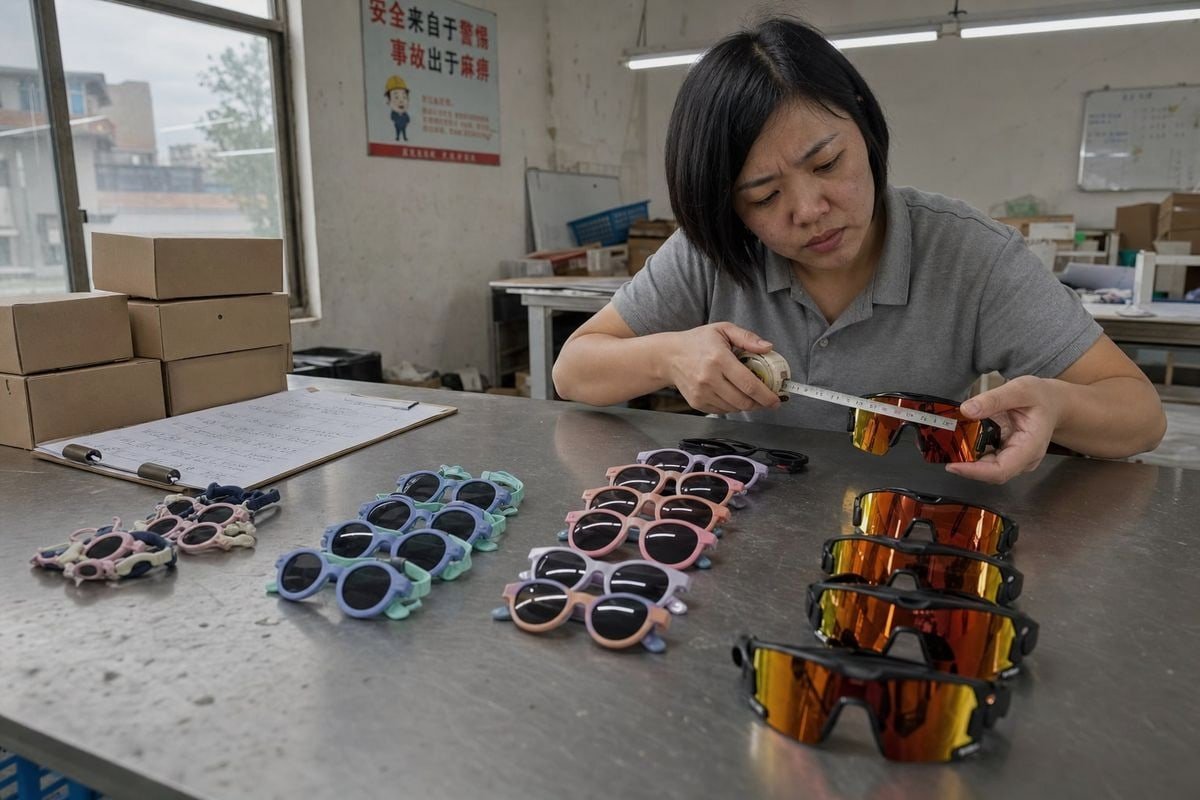
Choosing age ranges and size ratios for kids’ sunglasses stumps almost every new buyer who contacts our Taizhou factory nonprescription sunwear 1. Guess wrong, and unsold inventory piles up fast. Get it right, and every size sells through cleanly — here is how we help brands do exactly that.
Kids’ sunglasses should be grouped into four age ranges — baby (0–2), toddler (2–4), kids (5–10), and youth (11–16) — with lens widths scaling from about 35 mm to 52 mm. A practical order ratio is roughly 15% baby, 30% toddler, 40% kids, and 15% youth.
Age labels alone will not protect your margins. Below, I break down how sizing really works, how to split your order quantities, and when flexible frames beat fixed sizes.
How do I determine the right sunglasses size for different children's age groups?
Last spring, a buyer from Australia sent us a single sample and asked us to "make it in all ages." That one request turned into a two-week sizing workshop, because kids’ sunglasses do not scale like adult frames.
Match sunglasses size to age using lens width and frame width: babies (0–2) need 35–38 mm lenses and 115–120 mm frames; toddlers (2–4) need 40–42 mm lenses; kids (5–10) need 43–47 mm lenses; youth (11–16) need 47–52 mm lenses in 135–140 mm frames.
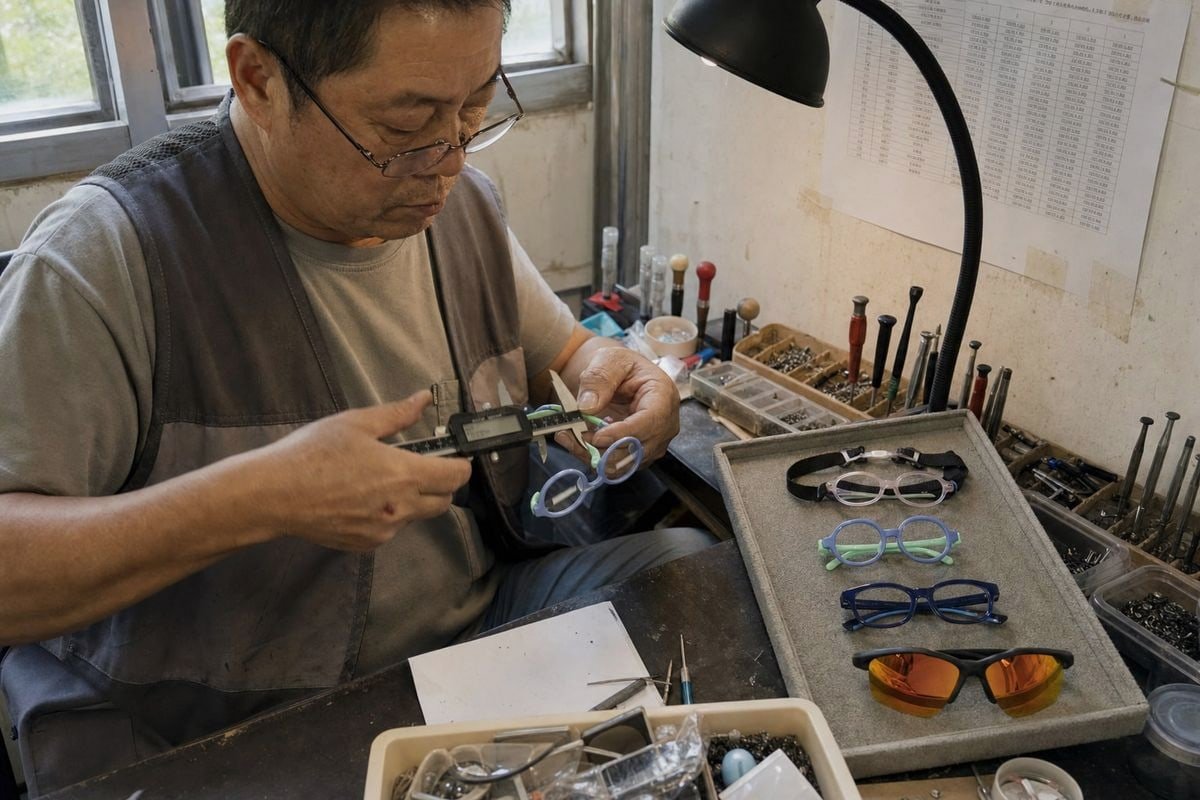
Age is only the starting point. Two four-year-olds can have very different head widths. So the real sizing language is measurements: lens width 2, bridge width, frame front width, and temple length. When we develop a new mold at our factory, we design around these four numbers first, then attach an age label afterward.
The core size map we recommend
| Age range | Lens width | Frame width | Temple length | Typical label |
|---|---|---|---|---|
| 0–6 months | Shade preferred | — | — | Not recommended |
| 6–24 months | 35–38 mm | 115–120 mm | 105–110 mm | Baby |
| 2–4 years | 40–42 mm | 120–128 mm | 110–118 mm | Toddler |
| 5–7 years | 43–45 mm | 125–132 mm | 115–122 mm | Kids (small) |
| 7–10 years | 45–47 mm | 132–138 mm | 120–128 mm | Kids (large) |
| 11–16 years | 47–52 mm | 135–140 mm | 125–130 mm | Youth / small adult |
Why bridge width matters more than buyers expect
Bridge width usually runs 13–18 mm for children. Babies and toddlers have undeveloped nasal bridges 3, so standard nose pads slide. That is why our baby styles use a low-set saddle bridge, often paired with an adjustable neoprene strap. Skip this detail and returns climb, no matter how good the lens is.
Two more rules we share with every client. First, if a child sits at the top of a stated age band, size up. Manufacturer age labels run wide, and the lower end of the range usually fits best. Second, verify fit with a simple stay-put test: the frame should hold during a 90-degree forward head tilt without sliding down the nose or pinching the temples.
What size ratio should I order across my product line to match real customer demand?
Order splits are the trade-off I discuss most with importers. Too many baby sizes and you sit on stock; too few toddler sizes and you miss your fastest-moving segment.
A balanced first order splits roughly 15% baby (0–2), 30% toddler (2–4), 40% kids (5–10), and 15% youth (11–16). The kids band sells fastest because it covers the widest school-age population and the longest wearing seasons.

Size ratios are really demand forecasts. In our fifteen years supplying children's brands across 20+ countries, we have seen a consistent pattern: the 5–10 kids band moves fastest, toddlers come second, and baby plus youth fill out the edges. But your channel changes the math.
Ratio by sales channel
| Channel type | Baby 0–2 | Toddler 2–4 | Kids 5–10 | Youth 11–16 |
|---|---|---|---|---|
| Baby/maternity brand | 35% | 40% | 20% | 5% |
| General kids' retailer | 15% | 30% | 40% | 15% |
| Outdoor/sports brand | 5% | 20% | 45% | 30% |
| Promotional products | 0% | 25% | 55% | 20% |
A few practical rules sit behind these numbers:
- Toddlers outgrow frames fastest, so repeat purchases are highest in the 2–4 band. Stock it generously if you sell direct to parents.
- Youth sizes overlap small adult frames, so wrap-around style sport models in 47–52 mm lenses can serve both markets and reduce your SKU risk.
- Baby sizes need extra accessories — head straps, cases, saddle bridges — which raise unit cost. Order them in colors that photograph well, because this band sells on emotion.
- Test before you scale. Because we hold around 800 existing styles, many of our clients launch with small mixed orders across three sizes, read the sell-through data for one season, then rebalance. That approach beats any theoretical ratio.
Also plan lens ratios, not just frame ratios. Polarized lenses justify a higher retail price in the kids and youth bands, while standard UV400 protection tinted lenses are usually enough for the baby band, where wearing time is shorter.
How can I get accurate sizing when my buyers are in different countries with different growth patterns?
A Japanese client once returned our standard kids sample with one note: the bridge sat too high. That single millimeter conversation reshaped how we spec frames for different regions.
Adjust for regional differences by tuning bridge width, nose pad height, and temple length rather than creating new age labels. Collect head-width data from your local market, request regional fit samples, and confirm fit with wear tests before committing to a full production run.
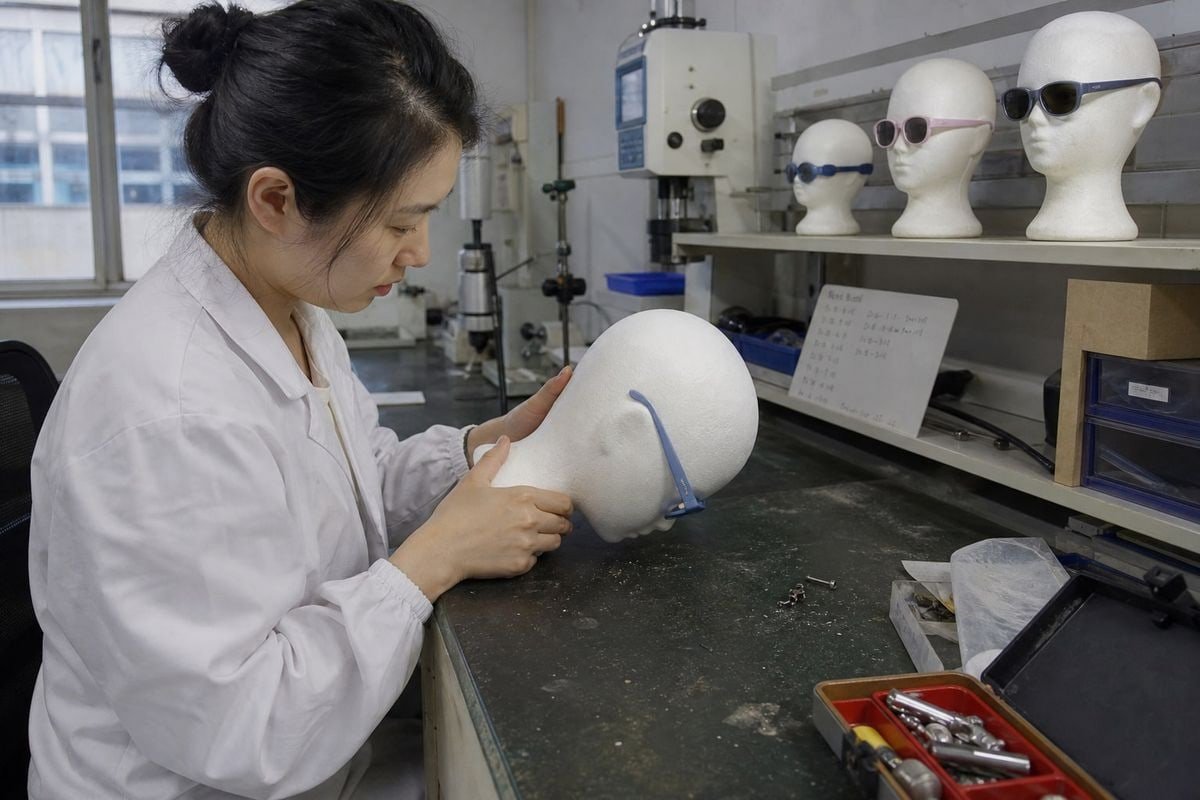
Growth charts differ by country, and facial structure differs even more. Average head width, nasal bridge height, and cheekbone prominence all vary by region. An age label that fits well in Germany can slide down noses in Japan or pinch temples in Brazil. The age bands stay the same worldwide; the fit geometry inside them should not.
What actually changes by region
In our export experience, three dimensions do most of the work:
- Bridge height and width. Lower nasal bridges are common across East Asian markets. We drop the bridge and widen the nose pads so the lens does not rest on the cheeks. This matters most in the toddler and kids bands.
- Temple length. Head depth varies. A temple length that grips well in one market can press behind the ears in another. Flexible TPEE frames forgive small mismatches because the temples flex outward instead of clamping.
- Frame front width. Broader face shapes need 2–4 mm more frame width at the same age. We often run two front widths on one style for clients selling in multiple regions.
A simple process that works
- Send us your target market and typical customer age bands.
- We pull comparable styles from our 800-style library that already fit that region.
- You test samples on real children locally — five to ten kids per size band is enough to spot problems.
- We adjust bridge, temples, or front width in the OEM stage before mass production.
One more note on standards. Different markets also reference different quality frameworks. Buyers shipping to the US frequently ask about ANSI Z80.3 standards 4 for nonprescription sunwear, while European buyers focus on EN ISO markings. Both expect full blocking of UVA and UVB rays 5, which is why we default to UV400 protection lenses regardless of destination. Sizing may flex by region; UV performance should not.
Should I offer adjustable or flexible fit options instead of fixed age-based sizing?
Flexibility is where our engineers spend most of their development hours. TPEE and TR90 are the reason many buyers found us in the first place, so I will be direct about what these materials solve — and what they do not.
Yes — flexible frames and adjustable options extend each size's usable age range and cut return rates, but they complement fixed sizing rather than replace it. The best lineups pair three or four fixed size bands with flexible materials, spring hinges, and strap accessories.
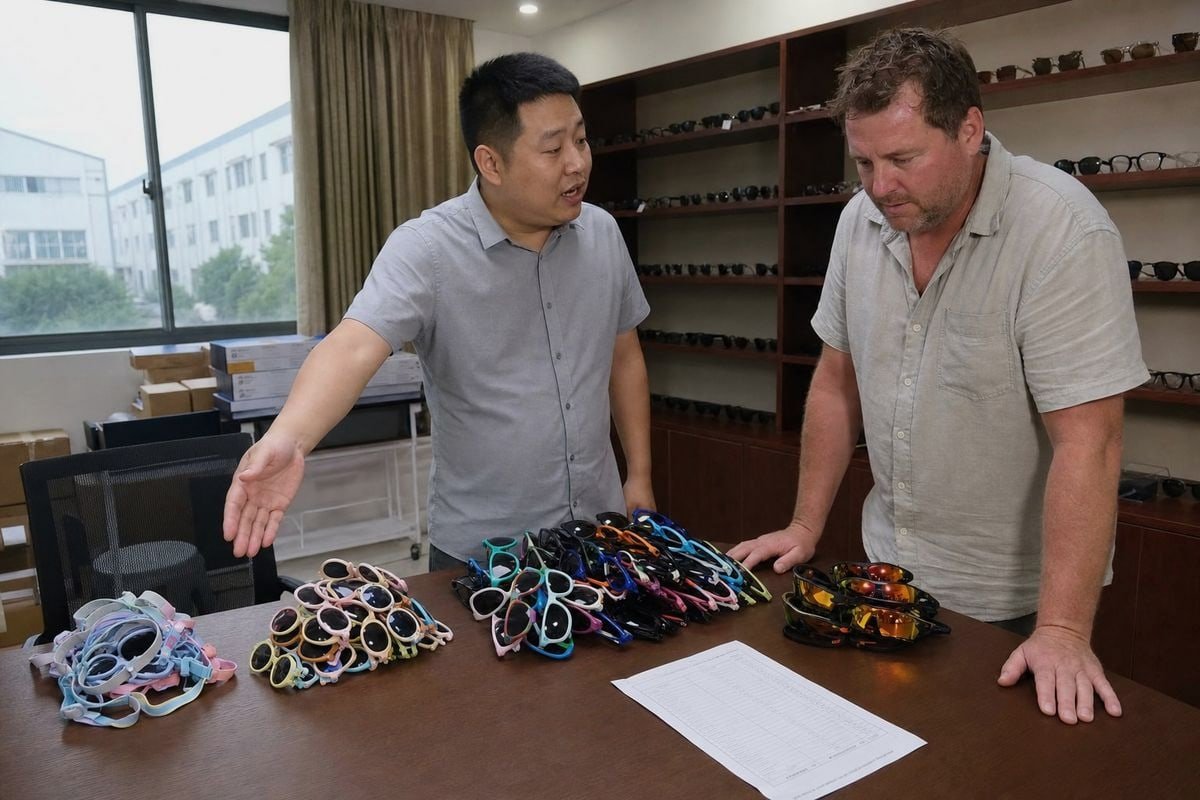
No single frame fits ages two through ten. But smart flexibility can stretch each size band by a year or more on each end. That means fewer SKUs, simpler inventory, and a wider real-world fit window per style.
Flexibility options compared
| Option | What it does | Best age band | Cost impact |
|---|---|---|---|
| Flexible TPEE frames | Bend without snapping; forgive rough handling | All ages, especially 0–7 | Moderate |
| TR90 frame + TPEE temples | Rigid front holds lens shape; soft temples flex to head width | 5–16 | Moderate |
| Outward spring hinges | Temples open past 90° to relieve lateral pressure during rapid head growth | 4–9 | Low–moderate |
| Adjustable neoprene strap | Holds frames on babies and toddlers with undeveloped bridges | 0–4 | Low |
| Rubberized temple tips | Add grip so frames pass the stay-put test | All ages | Low |
Where flexibility earns its cost
Impact resistance is the first payoff. Kids drop, sit on, and throw their sunglasses. Flexible frames bend and recover, and paired with polycarbonate lenses 6, the whole unit survives playground abuse that would crack standard acetate. Fewer breakages mean fewer complaints landing on your customer service desk.
Coverage is the second payoff. Children look upward at adults constantly, so their lenses need more vertical height than adult proportions suggest. Flexible wrap-around sport styles — like the shield designs in our performance line — block peripheral light from the sides while a taller lens blocks light from above. For everyday round or retro shapes, we keep the lens-to-face ratio generous for the same reason.
One caution: do not push lens darkness as a substitute for fit. Very dark Category 4 tints 7 are unnecessary for daily wear and limit the natural light a developing child needs. Well-fitted frames with quality UV400 lenses protect better than any extreme tint on a loose frame.
Conclusion
Wrong size ranges quietly drain a kids’ eyewear launch — dead stock in one band, sellouts in another. The fix is simple: four measurement-based age bands, channel-adjusted ratios, regional fit tuning, and flexible TPEE construction. Build on those four pillars, and your sunglasses line fits real children and real demand. If you want a sizing plan mapped to your market, our team is one email away.
Footnotes
1. General overview of sunglasses types and their protective functions. ↩︎
2. Explains standard eyewear measurements including lens width and bridge size. ↩︎
3. Defines the anatomical structure of the nasal bridge and its development. ↩︎
4. Accessible Wikipedia overview of the ANSI Z80.3 requirements for nonprescription eyewear safety and quality. ↩︎
5. World Health Organization guide on ultraviolet radiation and eye health. ↩︎
6. American Academy of Ophthalmology details the safety benefits of polycarbonate lenses. ↩︎
7. International standard defining filter categories for sunglass lenses. ↩︎
More Articles You Might Like



Looking for a Reliable Kids Eyewear Partner?
Explore 800+ ready styles and full OEM/ODM support tailored to your brand.
Get in Touch English
  Español de México
  Deutsch
  Français
  日本語
日本語  العربية
  Português do Brasil