Why Do TPEE Kids Sunglasses Prices Vary, and Which Features Are Worth It?
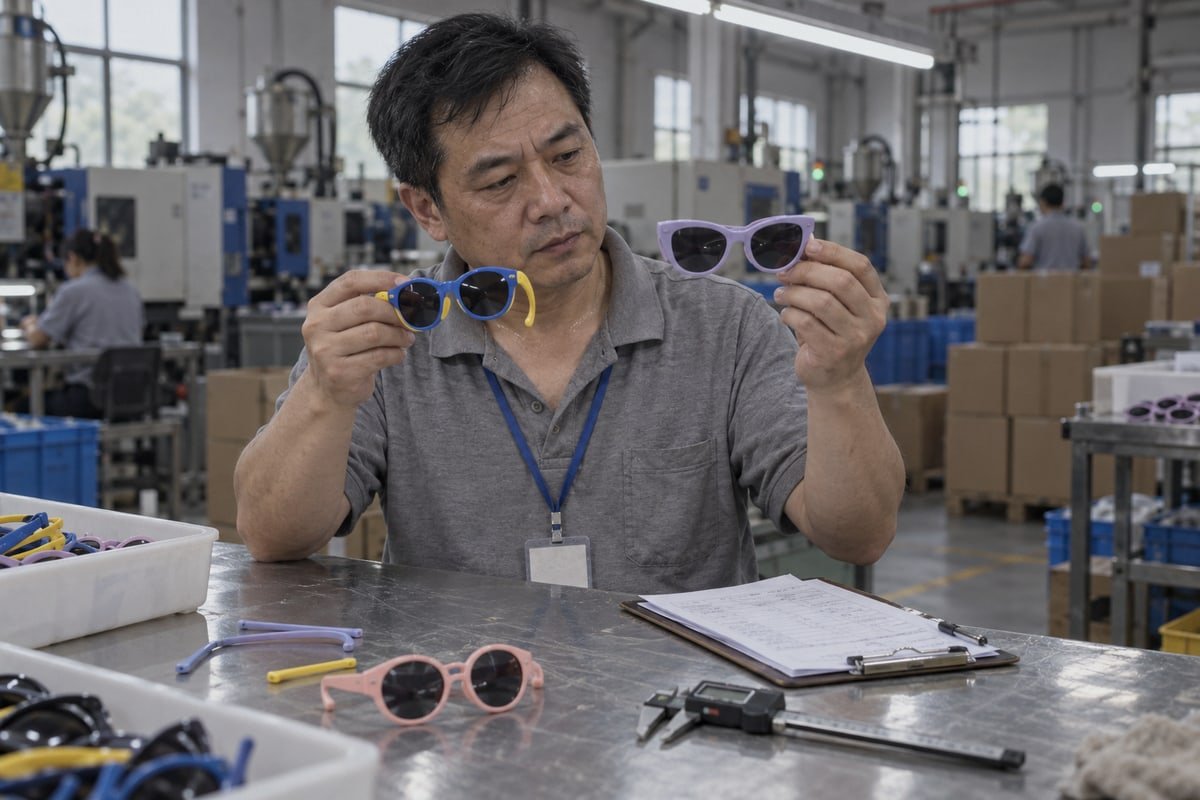
TPEE kids sunglasses prices swing wildly, and I see buyers pick the cheapest quote, then face returns. Our Taizhou production line taught us where that money really goes.
TPEE kids sunglasses prices vary because frame material is only one cost driver. Lens type, UV400 protection built into the lens, food-grade BPA-free TPEE, hinge design, straps, packaging, and order quantity shift the unit price. Verified UV protection, durable flexible frames, and secure fit are worth paying for.
In this article I will break the price down piece by piece. I will show you which costs protect a child’s eyes, which costs protect your brand, and which costs you can safely skip. I will also explain how quantity and supplier type change the number on your quote.
How Do Material Quality and TPEE Grade Affect the Price I Pay?
Last season our QC team rejected a batch of temples because the TPEE felt tacky after a humidity check. Same material name, very different grade.
TPEE grade affects price through Shore hardness calibration, food-grade BPA-free and phthalate-free compounding, wall thickness, and molding quality. Higher-grade TPEE bends back to shape without deforming and keeps lenses seated under pressure. Lower grades feel tacky, yellow faster, and let lenses pop out.
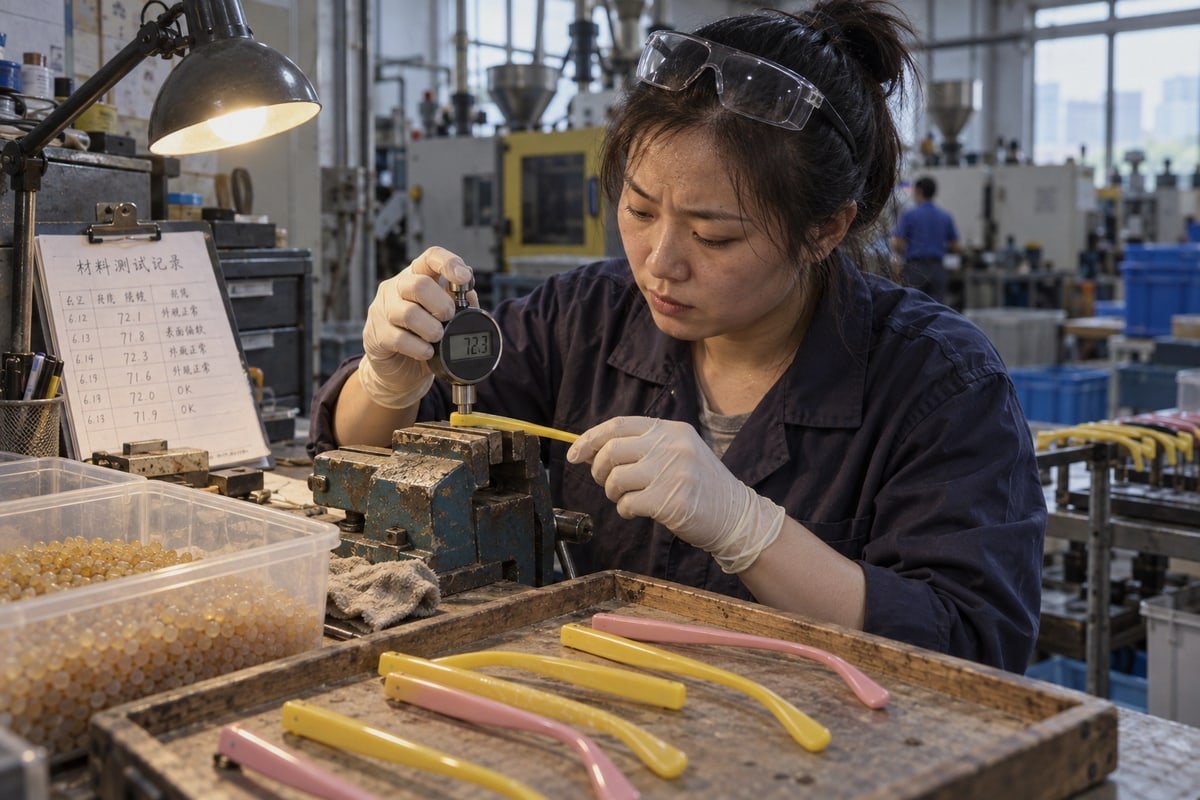
TPEE stands for thermoplastic polyester elastomer. It is a rubber-like plastic that bends, twists, and springs back. That memory-shape behavior is why TPEE costs more than PVC or basic PC to begin with. But the word "TPEE" on a quote tells you very little on its own. The grade, the additives, and the molding process decide the real cost and the real quality.
Shore Hardness Is the First Trade-Off
Every TPEE frame we develop starts with a hardness decision. A softer compound feels gentle on a baby's skin and is safe if the child chews it. A firmer compound grips the lens groove tightly so the lens does not pop out when a toddler sits on the glasses. Cheap frames often use whatever compound is on hand. Premium frames use a calibrated blend that balances both needs. That calibration costs money in trial molds and testing, and it shows up in TPEE kids sunglasses prices.
Safety Compounding Adds Cost You Cannot See
Children put frames in their mouths. So the compound matters. Higher-priced frames use BPA-free materials that are also phthalate-free and food-grade. Hypoallergenic frames avoid skin reactions on the nose bridge and behind the ears. These additives and the documentation behind them raise raw material cost. A supplier who cannot tell you what is in the compound is usually working with a cheaper grade.
TPEE vs TR90 vs PC at a Glance
| Material | Feel and flexibility | Melhor faixa etária | Custo relativo | Common weakness |
|---|---|---|---|---|
| TPEE | Soft, rubbery, fully bendable | Babies and toddlers | Mais alto | Lower grades feel tacky or loosen lens grip |
| TR90 | Firm but flexible, high impact resistance | School-age and active kids | Medium to higher | Less soft on skin than TPEE |
| PC (polycarbonate) | Rigid, lightweight | Casual, low-cost lines | Menor | Can crack or deform under stress |
Some buyers ask me whether TR90 is simply better than TPEE for older children. My honest answer is that the two solve different problems. TR90 gives structure. TPEE gives softness. That is why our TR90 frames with TPEE temples exist. The front stays crisp and holds the lens, while the temples stay soft on the ears. This hybrid approach costs more than a single-material frame, but it removes the "which one is better" argument for many brands.
Recyclability Is Becoming a Price Line
TPEE is fully recyclable, and more eco-conscious parents in Europe and Australia will pay for that story. Documenting circular-economy credentials takes extra effort on the factory side. If a supplier's quote includes that documentation, expect a small premium. If it does not, ask whether the material is even recyclable in practice.
Which Custom Features Are Worth the Extra Cost for My Brand?
A baby-brand buyer from Australia once asked me to drop the adjustable head strap to save cents. I asked how her toddlers would keep the glasses on.
Worth paying for: UV400 protection embedded in the lens, shatterproof polycarbonate or TAC polarized lenses, secure fit with an adjustable head strap for toddlers, durable hinge or hinge-less design, and retail-ready packaging. Skip trendy shapes, premium branding alone, and polarization for everyday school wear.
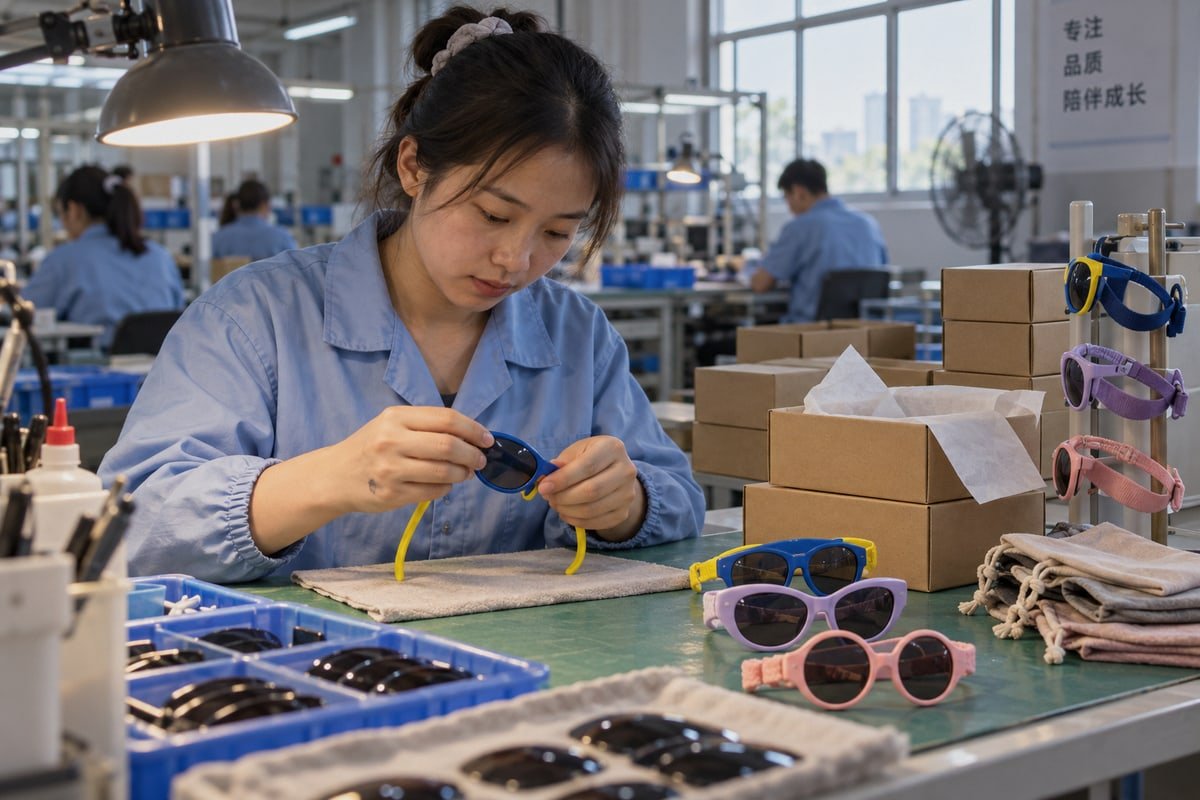
When a brand asks me to customize a style, I sort every request into three buckets. Does it protect the child? Does it protect the brand from returns and complaints? Or does it only make the product look different? The first two are usually worth the cost. The third is a judgment call.
The Feature Value Ranking
| Característica | Value bucket | Por que importa | Veredito |
|---|---|---|---|
| Proteção UV400 1 in the lens material | Child safety | Blocks 100% UVA/UVB and cannot scratch off like a surface coating | Always worth it |
| Filtros solares Categoria 3 | Child safety | Standard tint level for bright daylight without being too dark for indoor transitions | Worth it for outdoor lines |
| Shatterproof lenses (PC or TAC) | Child safety | Impact resistance for drops, throws, and playground contact | Worth it for active kids |
| Adjustable head strap | Fit and retention | Keeps glasses on toddlers; a pair on the floor protects nothing | Worth it under age 4 |
| Hinge-less or durable hinge design 2 | Durabilidade | Removes the most common breakage point and small-part choking risk | Worth it |
| Vacuum-deposited anti-scratch coating | Durabilidade | Chemically bonded, lasts far longer than dip coating | Worth it for retail lines |
| Polarized TAC lenses 3 | Clareza óptica 4 | Cuts glare at beach, snow, and water | Conditional |
| Melanin-infused HEV blue-light hybrid lens | Marketing plus | Adds indoor screen protection to outdoor UV | Conditional |
| Fashion colorways and trendy shapes | Appearance | Boosts shelf appeal, adds nothing to protection | Judgment call |
| Gift-style packaging and multi-packs | Margin | Raises perceived value, not eye safety | Judgment call |
Lenses Deserve the Biggest Share of Your Budget
Lenses are where cheap kids sunglasses fail first. A dark lens is not a protective lens. Premium models build UV400 protection into the polycarbonate or TAC lens body itself. Budget models spray a coating on top. Our production team can tell the difference in seconds with a UV meter, and so can a test lab. Category 3 sun filters give the right tint depth for bright days. Shatterproof lenses add impact resistance for the drops and throws that every parent expects.
Is Polarization a Major Upgrade or a Secondary One?
Many product pages sell polarized TAC lenses as the headline feature. I raise this with buyers directly. Polarization improves optical clarity by cutting glare. It does not replace UV protection. If your brand sells to beach, boat, and ski families, polarized TAC lenses are worth the cost. If your brand sells everyday school wear, put that money into lens embedding and a better frame grade first.
Fit and Design Protect Your Return Rate
A flexible frame technology story sounds good on a product page. But the real outcome is fewer replacements. The adjustable head strap on a toddler style, a durable hinge design or hinge-less construction, and soft nose contact points all reduce the "it broke in a week" reviews that hurt a young brand most. In our experience exporting to kids' brands in Japan and Europe, these three details separate a repeat order from a one-time trial.
How Does Order Quantity Change My Per-Unit Pricing?
Every quote I prepare balances two things: the buyer's cash tied up in stock versus the setup cost our line absorbs each colour change.
Order quantity lowers per-unit pricing because mold amortization, color-matching, lens cutting setup, and packaging tooling are fixed costs spread across more pieces. Choosing from existing styles removes mold fees entirely, so small brands can test the market at modest quantities without paying a heavy per-unit premium.
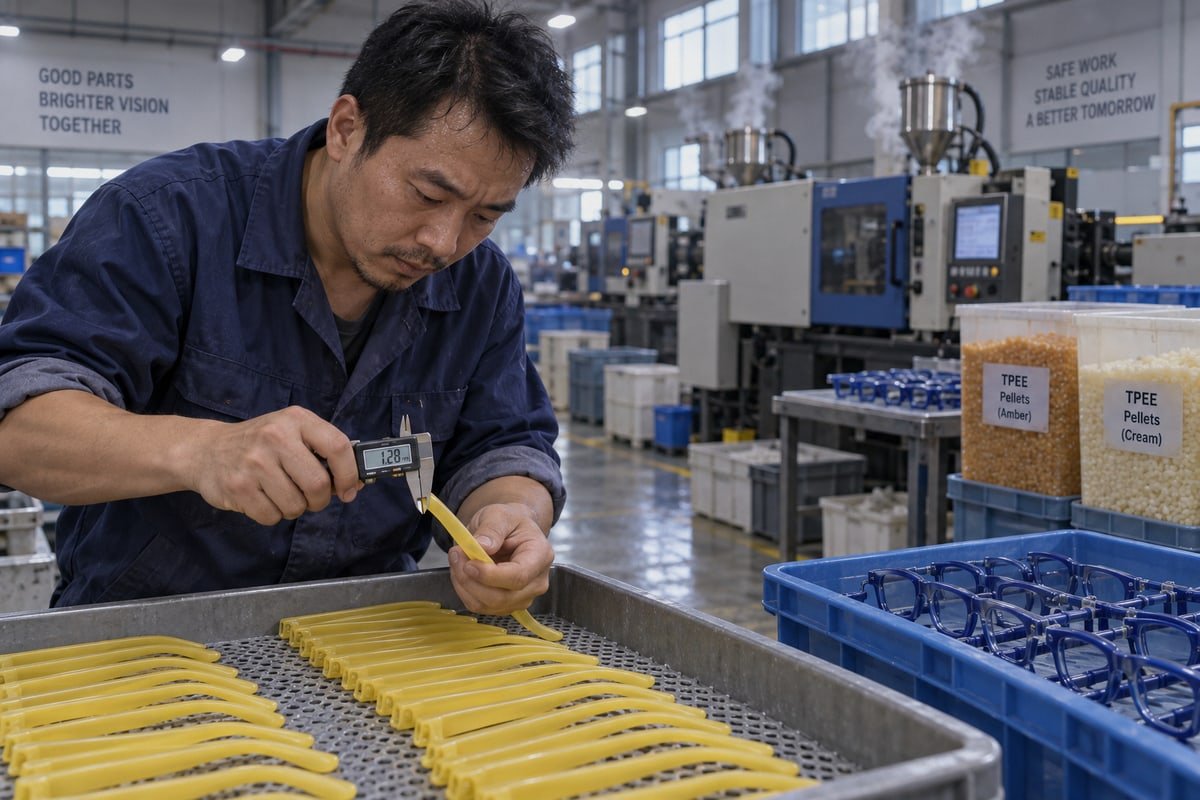
Buyers often assume the per-unit price falls in a straight line as quantity rises. It does not. It falls in steps, and each step matches a fixed cost that gets spread thinner. Here is how a quote for TPEE kids sunglasses is actually built on our side.
How a Quote Comes Together
- Frame mold. A new shape needs a steel mold. That cost sits on the first order unless you pick an existing style. This is the biggest single reason TPEE kids sunglasses prices look so different between a new brand and an established one.
- Material compound and color. Each color needs a masterbatch match and a test shot. Two-tone designs like our royal blue front with yellow temples need two matches and a hinge assembly step.
- Lens cutting and edging. Every lens shape needs its own cutting program. Polarized TAC lenses add alignment checks so the polarization axis is correct.
- Assembly and QC. Hinge insertion, strap fitting, and a flex test on every frame. This is mostly variable labor.
- Packaging tooling. Custom boxes, pouches, and cloths need print plates and die-cuts. These are fixed costs.
Fixed vs Variable Costs in Your Unit Price
| Item de custo | Tipo | Effect of larger orders |
|---|---|---|
| Frame mold | Fixed | Spreads to near zero at volume, or zero with an existing style |
| Color masterbatch and test shot | Fixed per color | Falls per unit; too many colors in a small order raises price |
| Lens cutting program | Fixed per shape | Falls per unit |
| Packaging print plates | Fixed | Falls per unit |
| TPEE compound, lenses, hinges | Variável | Roughly flat; small volume discounts on raw materials |
| Assembly labor and QC | Variável | Roughly flat |
Why Existing Styles Change the Math
We keep roughly 800 existing styles on our shelves, from the blush pink round frame to the lavender cat-eye to the two-tone square. A new brand can pick from these, add a logo, choose lens options, and design packaging. The mold line disappears from the quote. That is how a founder in Japan or Europe can launch a first collection without heavy tooling risk. Once the style proves itself, the brand can move to a custom mold with real sales data behind the decision.
A Word on Mixing Colors
A common request is many colors in a small run. Each color carries its own fixed setup. So a small order split six ways can cost more per unit than a larger order in two colors. I usually suggest starting with two or three proven colorways and expanding on the reorder.
What Hidden Factors Should I Watch for When Comparing Supplier Quotes?
Fifteen years in eyewear taught our team one hard lesson: the cheapest quote usually hides its cost somewhere, and it is often inside the lens.
Watch for UV400 claims without test reports, dark tint sold as protection, dip-coated lenses, recycled or non-food-grade TPEE, missing CE certification, trading companies posing as factories, unpriced packaging, and vague replacement warranties. Compare quotes on identical specs, request samples, and verify the workshop before committing.
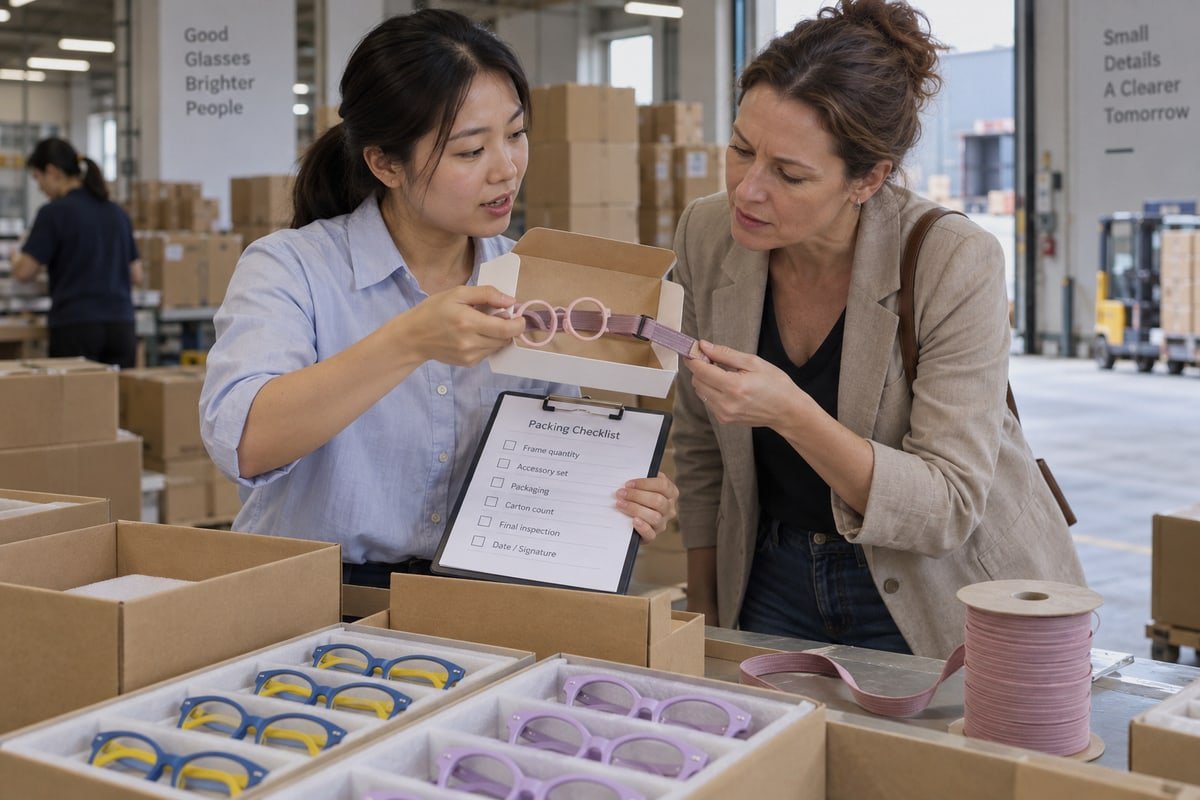
Two quotes that look similar on paper can describe very different products. The trick is to force both suppliers onto the same specification sheet before you compare a single number. Below are the gaps I see most often when buyers bring me competitor quotes.
The Dark Tint Myth
A dark lens with no UV claim can be worse than no sunglasses at all. The tint makes the pupil open wider, and if the lens does not block UV, more harmful light enters the eye. Any quote that says "dark lens" or "smoke lens" without stating UV400 protection or 100% UVA/UVB blocking should be treated as unprotected. Ask for the lens spec and a test report, not a marketing line.
Coating Method Hides in the Details
Anti-scratch and anti-reflective coatings sound identical on quotes. The method is what matters. Vacuum-deposited coatings are chemically bonded to the lens and last. Dip-coated lenses scratch and haze quickly, which kills optical clarity and drives one-star reviews. The cheaper quote is often the dip-coated one. Ask which process the supplier uses.
Factory or Trading Company?
A trading company adds margin and removes control. When a buyer visits our Taizhou workshop, they see about 120 workers, a 5S-managed floor, and the flex test station. A trading company cannot show you that. Ask for a video call from the production floor before you compare TPEE kids sunglasses prices.
Certification and Compliance Overhead
Products bound for Europe carry Certificação CE 5, and the marking should appear on the temple, like the engraved CE text on our lavender cat-eye style. That testing and labeling cost is part of a higher quote. A quote without it may be cheaper because the work has not been done.
Warranties and Retail Price Reverse Engineering
Premium brands often offer lost-or-broken replacement warranties. That policy is priced into the retail tag. When you see budget pairs under $10 to $15, retail pairs around $20 to $40, and durable investment pairs in the $30 to $80 range, the gap is partly lens quality and partly this built-in insurance. Work backward from your target shelf price and decide whether a warranty program belongs in your model before you judge a factory quote as "too high."
Quick Red-Flag Checklist
- UV400 or 100% UV stated only in the product title, not on a spec sheet
- Polarized TAC lenses quoted with no mention of UV performance
- "TPEE" with no hardness value, no BPA-free or phthalate-free statement
- Hinge type not specified when a durable hinge design or hinge-less build was requested
- Packaging, cloth, and case listed as "included" with no unit cost shown
- No physical sample offered before the first order
Conclusão
Price alone tells you little. Verify UV400 protection, TPEE grade, fit, and construction, then pick a factory partner who can prove all four before you commit.
Interested in sourcing the products mentioned in this article? See details and request a quote here:
Notas de rodapé
1. Official WHO Q&A regarding UV radiation levels and the importance of sun protection. ↩︎
2. General engineering overview of hinge mechanisms and their role in product durability and construction. ↩︎
3. Scientific explanation of wave polarization, which is the fundamental principle behind polarized eyewear lenses. ↩︎
4. Technical definition and engineering overview of optical clarity in transparent materials and lenses. ↩︎
5. Official European Commission documentation regarding CE marking requirements for products sold within the European Economic Area. ↩︎
Mais Artigos que Você Pode Gostar

Procurando um Parceiro Confiável em Óculos Infantis?
Explore mais de 800 estilos prontos e suporte completo OEM/ODM adaptado à sua marca.
Entre em Contato English
  Español de México
  Deutsch
  Français
  日本語
日本語  العربية
  Português do Brasil