What Are the Common Lens Materials in TPEE Kids Sunglasses: PC vs Acrylic?
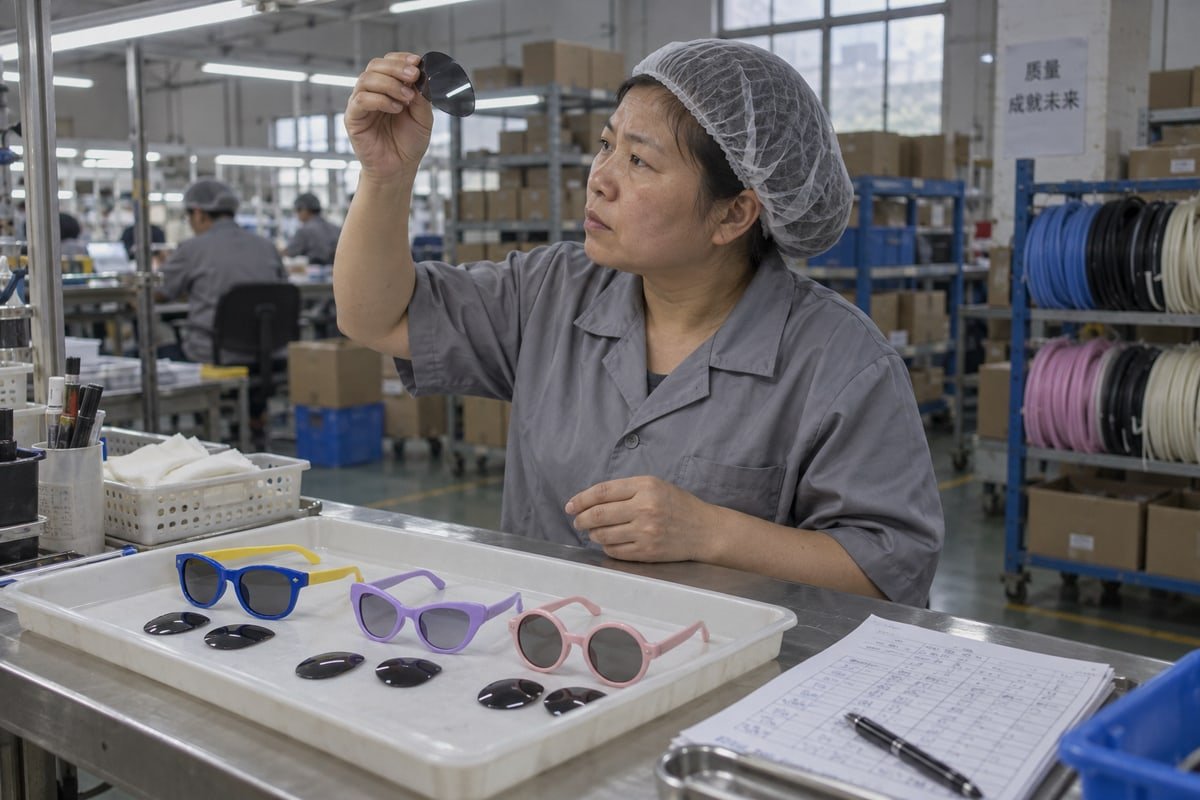
Buyers ask our Taizhou team one thing about common lens materials in TPEE kids sunglasses: is PC worth it, or will acrylic do? Choose wrong, and returns follow.
The common lens materials in TPEE kids sunglasses are polycarbonate (PC) and acrylic. PC is shatterproof, lightweight, and blocks UV400 inherently, so it is the safety standard for children. Acrylic is cheaper with better optical clarity, but it is brittle and suits low-risk fashion or promotional use.
The frame gets most of the attention in a kids’ collection. The lens does most of the protecting. Below, I walk through how we compare [PC and acrylic](https://okayeyewear.com/pc-vs-acrylic-lenses-kids-sunglasses-difference-in/) on our production line, what the UV400 and impact numbers really mean, what you can customize, and how to check a supplier’s claims before you commit to a bulk order.
How do I choose between PC and acrylic lenses for my kids sunglasses line?
A procurement manager from Melbourne once sent us two quotes for the same round pink frame: one PC, one acrylic. The price gap was small; the risk gap was not.
Choose PC lenses for any kids sunglasses line meant for daily wear, school, sports, or travel, because PC resists impact and blocks UV400 inherently. Choose acrylic only for lowest-cost promotional or fashion pieces where the lens is unlikely to face drops, bending, or rough handling.
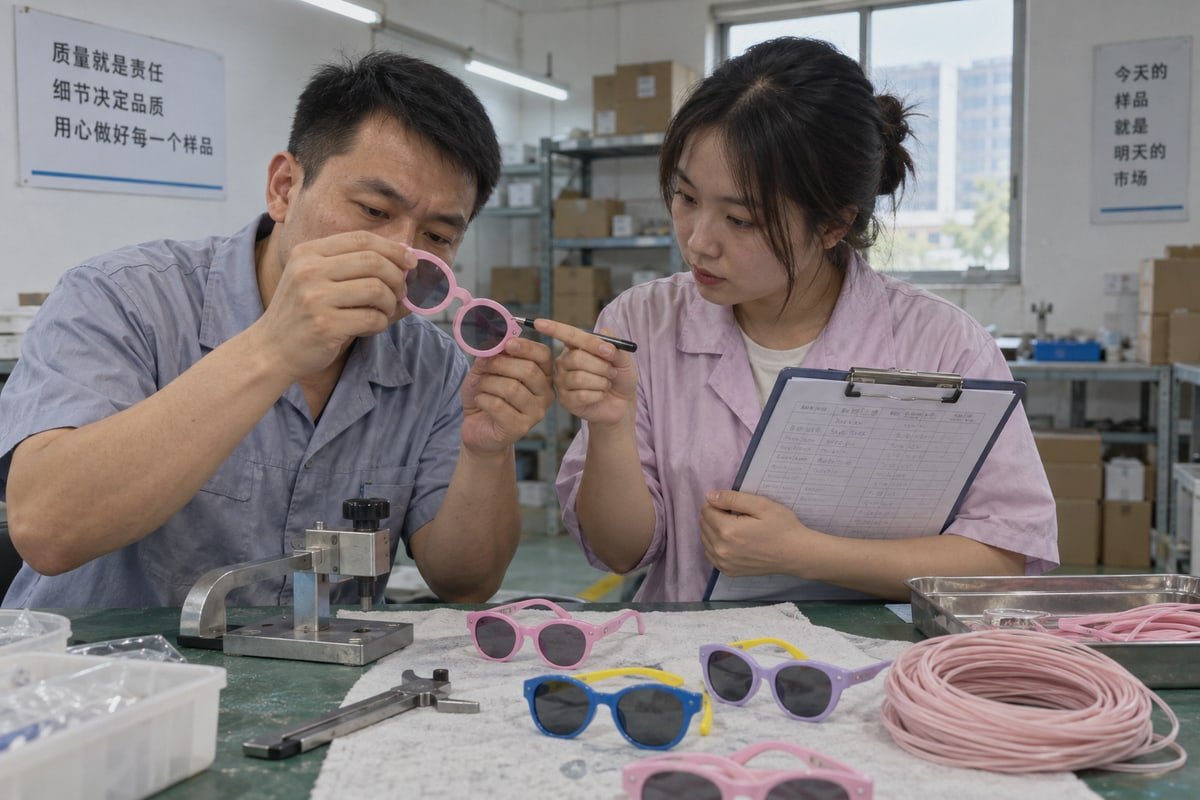
The decision in one table
| Fator | PC (polycarbonate) | Acrylic |
|---|---|---|
| Resistência ao impacto 1 | Very high; deforms instead of splintering | Low; brittle, can crack into sharp shards |
| Proteção UV400 | Inherent to the material | Usually needs a surface coating |
| Clareza óptica | Good; lower Abbe value 2, slight edge distortion | Higher Abbe value; less chromatic aberration |
| Weight and thickness | Roughly 20–30% thinner and lighter | Light, but thicker at equal strength |
| Scratch behavior | Soft when raw; needs a hard coat | Harder when raw; still needs a coat for kids |
| Heat and aging | Stable; may yellow after years | Can warp under heat; prone to stress crazing |
| Custo | Gama média | Mais Baixo |
| Melhor ajuste | Daily wear, school, sport, travel | Giveaways, low-risk fashion |
Why a TPEE frame raises the stakes for the lens
TPEE is a flexible frame material. That is the whole point of it. A child can twist the front, sit on it, or pull the temples apart, and the frame springs back. But every twist also flexes the lens groove. This is where lens pop-out happens. PC has a higher modulus of elasticity 3 than acrylic, so it holds tension against the groove and stays seated. Acrylic tends to pop out or crack at the edge.
Temperature matters too. TPEE and PC have similar thermal expansion 4 coefficients. When a child moves from an air-conditioned car to a hot beach, the lens and frame expand together. The lens does not loosen or rattle. Acrylic behaves differently, and we have seen loose lenses in cheaper programs after summer use.
One more point. Lower-grade TPEE can contain plasticizers. In long contact, these can cause stress crazing in acrylic lenses, which shows up as fine micro-cracks. We rarely see this with PC. So the frame and the lens are a system. A flexible frame does not make a fragile lens safe.
What about CR-39 or Trivex instead?
Some optical suppliers will suggest CR-39 resin for children. In my experience, CR-39 is heavier and less impact-resistant than PC. Trivex is excellent, but its cost pushes most kids' sunglass programs out of their target retail price. For sun lenses in a TPEE frame, PC remains the balanced default. Most of our roughly 800 existing styles ship with PC lenses for this reason, and acrylic is offered mainly for promotional runs when a buyer specifically requests it.
Which lens material offers better UV400 protection and impact resistance for children?
On our QC bench, we drop a steel ball onto sample lenses before a style enters the catalog. PC lenses dent or flex. Acrylic samples have cracked into sharp pieces.
Polycarbonate offers better UV400 protection and impact resistance for children. Its chemical structure blocks UV to 400nm without relying on coatings, and it deforms rather than shatters under impact. Acrylic needs a UV coating to reach UV400 and can crack into sharp shards when struck hard.
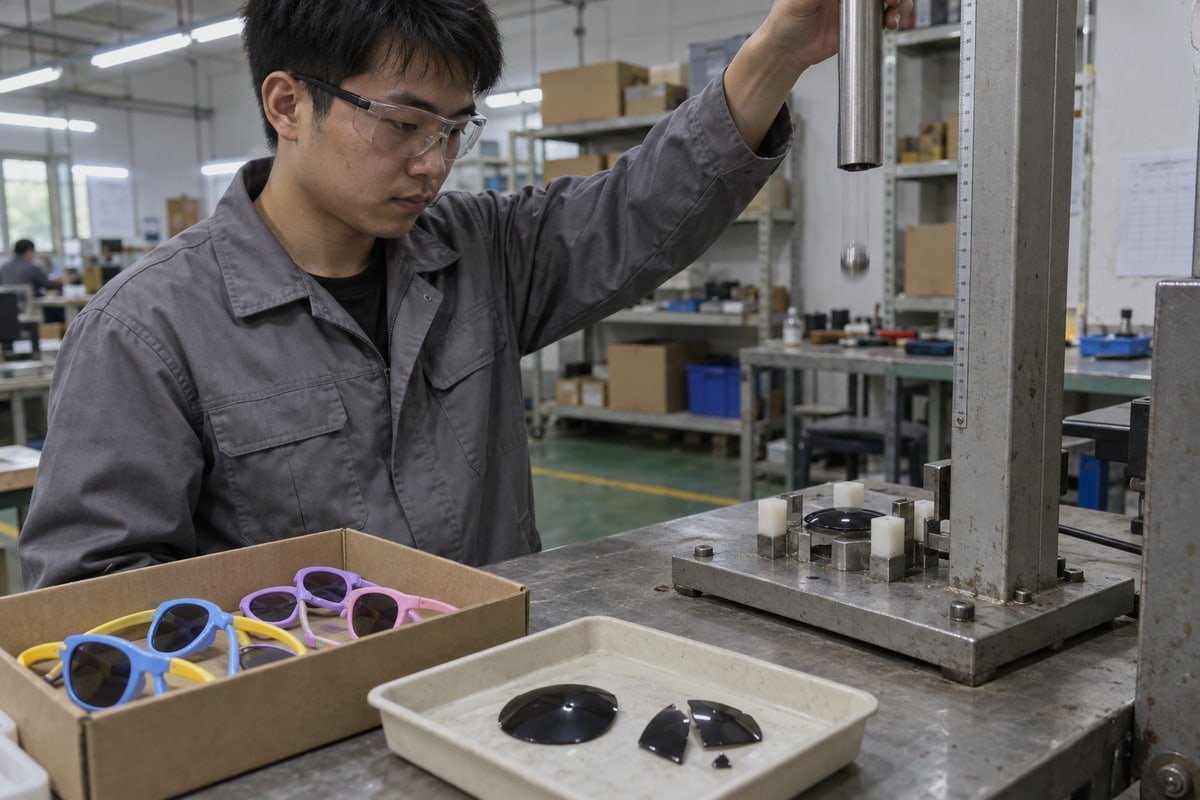
What happens at the moment of impact
Think about how children actually use sunglasses. They drop them on concrete. They get hit by a ball. They sit on them in the car. Impact resistance is not a marketing feature here. It is the reason the product exists.
PC absorbs energy by deforming. The lens bends, takes a small dent, and stays in one piece. That is what shatterproof lenses mean in practice. Acrylic is far more brittle. Under a hard, sharp impact it can fracture and produce shards with edges. Near a child's eye, that is the worst possible failure mode.
The drop ball test is the simplest way to see this. A steel ball falls from a set height onto the lens. PC passes routinely. Acrylic is much less predictable, especially in thin fashion lenses.
| Verifique | PC behavior | Acrylic behavior | Por que é importante para crianças |
|---|---|---|---|
| Teste de bola de queda | Flexes or dents, stays whole | Can crack or shatter | Sharp fragments near the eye |
| Frame bending | Stays seated in groove | Pops out or edge-cracks | Kids twist TPEE frames daily |
| UV400 without coating | Blocks to 400nm inherently | Lets UV through | Coating can be skipped or wear off |
| Hot car dashboard | Estável | May warp | Warped lens distorts vision |
UV400 is a material question before it is a coating question
PC blocks ultraviolet light up to 400nm because of its chemistry. Even an uncoated PC lens gives full UV400 protection. Acrylic does not. It needs a UV-absorbing layer applied to the surface. That is fine if the coating is applied well. It is a problem when a low-cost supplier skips it or applies it unevenly. A dark tint hides this. The lens looks protective, but it is not.
Weight, thickness, and the nose-slide problem
PC is roughly 20 to 30 percent thinner and lighter than acrylic at the same strength. For a toddler with a small nose bridge, this is the difference between glasses that stay on and glasses that slide down every minute. Lightweight durability is why we pair PC with our armações TPEE e TR90. The frame is light and soft. The lens does not add unnecessary weight.
The honest limits of PC
I do not want to oversell PC. It has a lower Abbe value than acrylic, so a child may notice slight color fringing at the very edge of the lens. It can yellow after years of sun exposure. Raw PC is also soft, so it needs a scratch-resistant coating to survive sandbox life. Acrylic wins on raw optical clarity. But in kids' sunglasses, safety and survivability come first. We accept slightly lower optics for a lens that does not shatter.
Can I customize lens color, tint, or polarization when working with a TPEE frame manufacturer?
Every custom lens request forces one trade-off in our workshop: more visual features, or lower cost per unit. Polarized film adds glare control but also adds a lamination step.
Yes. A TPEE frame manufacturer with full OEM/ODM support can customize lens color, tint depth, gradient, mirror coating, and polarization. Polarized options usually use TAC film or polarized PC. You can also add logos, packaging, and accessories while keeping UV400 protection on every lens.
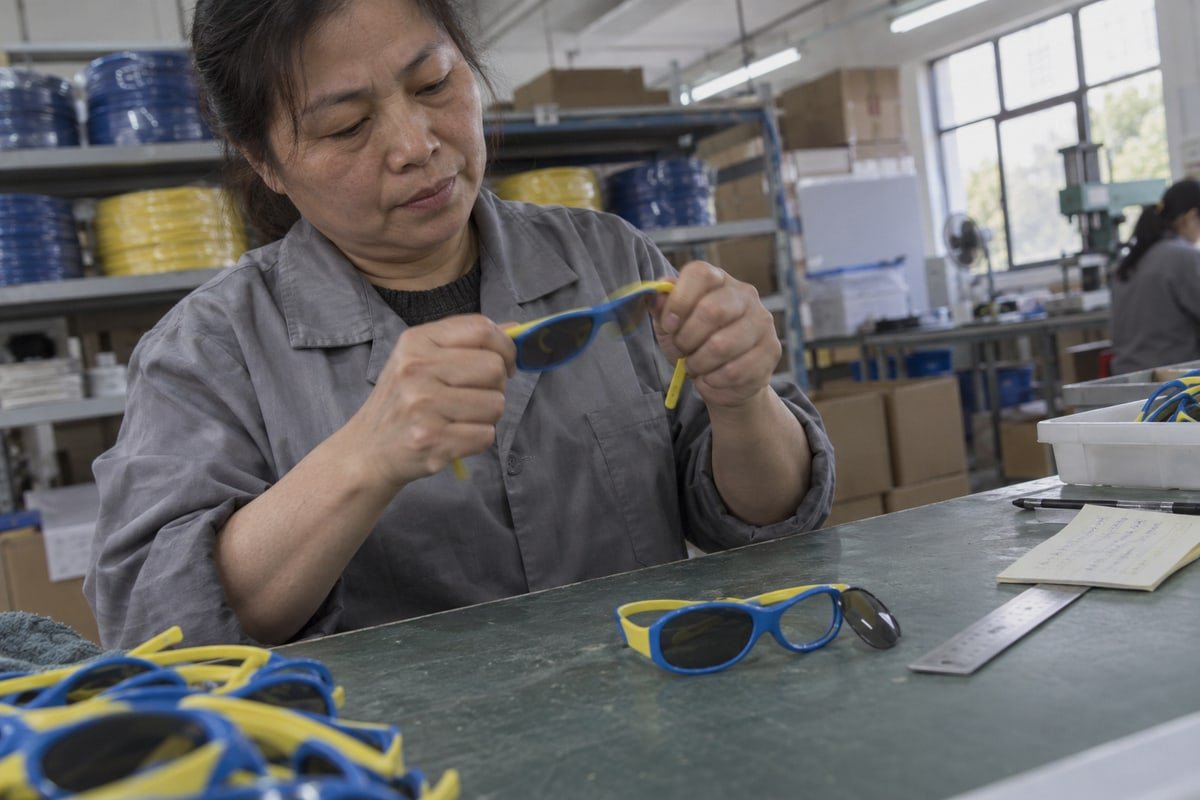
How a custom lens spec moves through our factory
Here is the process we follow with brand clients. It is the same whether you are in Japan, Germany, or Australia.
- Pick a base style. Most brands start from our existing range of about 800 styles. The royal blue front with yellow temples, the lavender cat-eye, and the translucent blush-pink round frame are all common starting points. No mold investment is needed.
- Confirm the lens base material. We recommend PC for any style aimed at daily wear. Acrylic is possible for promotional runs, but we flag the risks in writing.
- Choose the tint. Solid smoke grey is the most neutral for true color perception. Brown adds contrast. Gradient tints suit fashion styles. Mirror coatings are popular for sporty color-block frames.
- Decide on polarization. Polarized lenses cut reflected glare from water, snow, and car hoods. Useful for beach and outdoor brands. Less important for a school-run product.
- Add coatings. A scratch-resistant coating is standard on our PC lenses. Anti-reflective coating on the back surface is optional.
- Brand it. Laser or print logos on the temple or lens corner. Choose cases, cleaning cloths, straps, and retail boxes.
- Approve a pre-production sample. Nothing goes to bulk until you sign off on a physical sample.
Polarized PC or TAC film? A buyer objection worth addressing
Some buyers point out that many kids' sunglasses on the market use polarized TAC lenses, not PC. That is true. TAC is a polarizing film lens. It is thin, light, and cheap to polarize. The trade-off is that TAC does not match the impact resistance of PC. For a toddler product, I steer brands toward polarized PC, where the polarized film is sandwiched inside the polycarbonate. For an older-child fashion line, TAC can be acceptable. We tell clients which one they are getting. Not every supplier does.
Colors that sell without hurting the eye
A few practical notes from our color work:
- Keep tint density in the medium range for children. Very dark lenses reduce visibility in shade.
- Mirror coatings look great on square color-block frames but scratch faster. Pair them with a strong hard coat.
- Grey and brown remain the safest choices for gender-neutral collections like the pink round style.
- Pastel frame colors photograph well with fully opaque dark grey lenses, which is why our lavender cat-eye uses that combination.
Environmentally friendly materials matter to our European clients. TPEE and TR90 frames meet requests for BPA-free frames. We can supply material declarations alongside the lens spec so your compliance file is complete.
How do I verify lens quality and safety compliance before placing a bulk order?
Years ago we learned that a CE mark printed on a temple proves very little by itself. Real verification means documents, samples, and tests you can repeat.
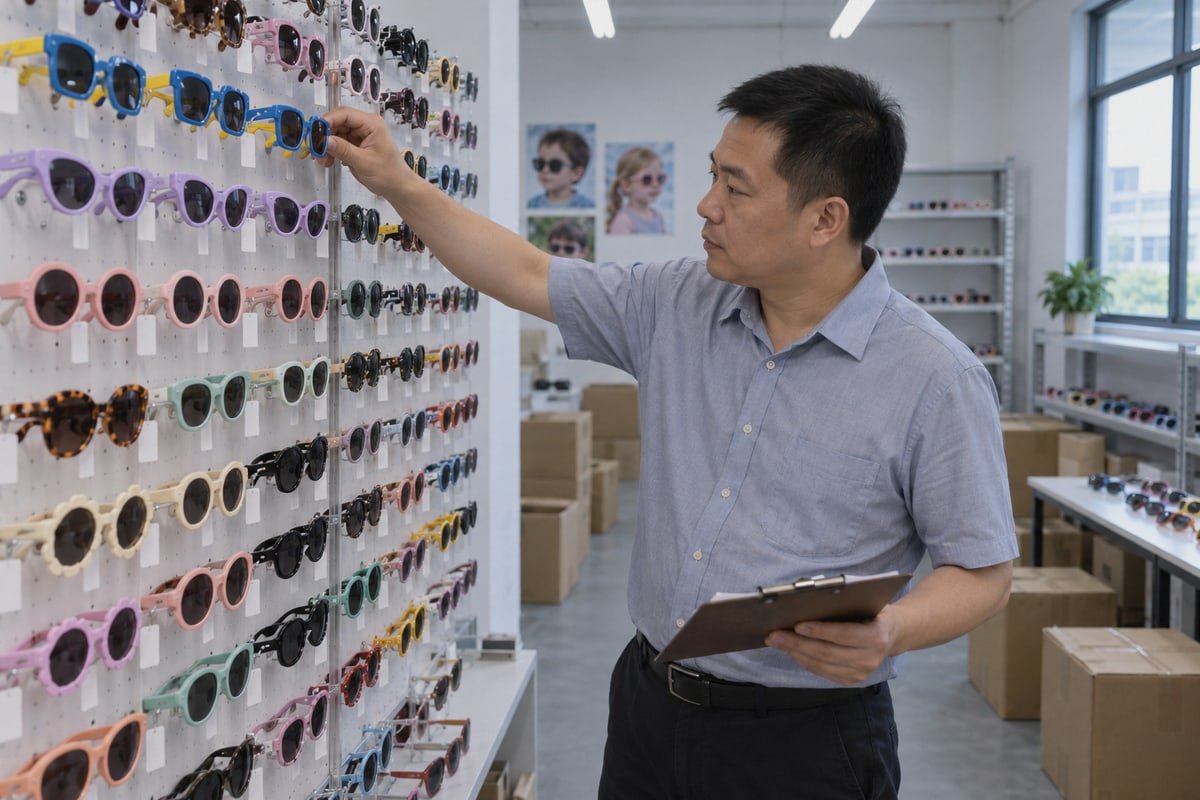
Verify lens quality by requesting pre-production samples, a UV transmission report showing UV400 blockage, drop ball test results for impact resistance, and material declarations for BPA-free frames. Confirm the lab, the standard used, and the batch, then audit the factory's QC process before bulk payment.
A verification checklist you can send to any supplier
| Verifique | O que solicitar | What a good answer looks like |
|---|---|---|
| Proteção UV400 | Spectrophotometer transmission report | Named lab, batch number, date, curve showing blockage to 400nm |
| Resistência ao impacto | Drop ball test record or video | Method described, ball weight and height stated, PC lens stays whole |
| Market standard | Test report to your region's sunglass standard | For example EN ISO 12312-1 for the EU, ANSI Z80.3 for the US, AS/NZS 1067 for Australia |
| Material da lente | Resin grade sheet | Supplier name and grade for the PC or acrylic used |
| Material da armação | Declaração de material | Confirms TPEE or TR90 grade and BPA-free frames status |
| Revestimento | Scratch-resistant coating spec | Hard coat listed on the lens spec, sample survives a rub test |
| Montagem | Lens retention after bending | Twist the sample; no pop-out, no edge cracks |
Read the CE mark correctly
In the EU, sunglasses are treated as Category I personal protective equipment. That means the manufacturer or importer self-declares conformity. The CE mark on the inner temple of our lavender cat-eye is a legal requirement, not a third-party seal. So ask for the Declaração de Conformidade 5 and the technical file behind it. If a supplier cannot show you the test report that supports the mark, the mark is just ink.
Test the frame and lens as a system
Do not test the lens alone. Bend the TPEE frame in your hand for a full minute. Twist the front. Then check that the lens is still seated and the groove is not deformed. Leave a sample in a hot car for an afternoon. Then look for warping or rattling. These two simple checks catch most acrylic and low-grade TPEE problems before they reach a store shelf. If the supplier used lower-grade TPEE with heavy plasticizers, acrylic lenses may show stress crazing after weeks of contact. Ask what TPEE grade is used and whether it has been paired with your chosen lens before.
Ask about aging and recycling
PC can yellow slowly with years of sun exposure. Ask how the supplier's coatings slow this. On sustainability, TPEE is often chosen because it is recyclable. But PC lenses carry multi-layer functional coatings, and those currently need manual separation before recycling to avoid contaminating a batch. If your brand makes recycling claims, this detail belongs in your product copy.
Audit the factory, not the catalog
Finally, verify the maker. We run a 5S-managed workshop with about 120 workers and 15 years of eyewear experience. A short video walkthrough of the injection line, the lens-cutting area, and the QC bench tells you more than any brochure. A trading company cannot show you that. A real factory can, and should.
Conclusão
Flexible TPEE frames protect a child's face only if the lens holds up too. Pick PC for real-world wear, acrylic for low-risk fashion, and verify every claim before bulk ordering.
Interested in sourcing the products mentioned in this article? See details and request a quote here:
Notas de rodapé
1. Official international standard for sunglasses safety and impact resistance requirements. ↩︎
2. Explains the optical property related to color fringing mentioned in the article. ↩︎
3. Defines the mechanical property determining how lenses resist deformation when the TPEE frame flexes. ↩︎
4. Scientific explanation of how materials expand with temperature changes. ↩︎
5. EU regulatory framework defining sunglasses as personal protective equipment and compliance requirements. ↩︎
Mais Artigos que Você Pode Gostar


Procurando um Parceiro Confiável em Óculos Infantis?
Explore mais de 800 estilos prontos e suporte completo OEM/ODM adaptado à sua marca.
Entre em Contato English
  Español de México
  Deutsch
  Français
  日本語
日本語  العربية
  Português do Brasil