Whose Info Must Be on Kids Sunglasses Labels for Australia’s Safety Standard?

Kids sunglasses labels for Australia trip up more buyers than any other detail we handle at our Taizhou factory. One missing name on a swing tag can hold an entire shipment.
Kids sunglasses labels for Australia must identify the manufacturer or supplier responsible for the product in the Australian market — typically the Australian importer or brand owner, not the retailer. Labels must also show the lens category number, category description, usage information, and any required warning statements.
That is the short answer. But who exactly counts as the “supplier”? And what happens if you get it wrong? Let me walk you through what we have learned shipping children’s eyewear to Australian brands.
How do I know which safety standard applies to my kids sunglasses before labeling?
A few years back, an Australian importer asked us to label their order to "the toy standard." We had to pause the order and explain why that would have been a costly mistake.
Kids sunglasses sold in Australia fall under the Consumer Goods (Sunglasses and Fashion Spectacles) Safety Standard 2017, which is based on AS/NZS 1067.1:2016. This mandatory standard applies to both adult and children's sizes, so kids sunglasses receive no labeling exemption whatsoever.
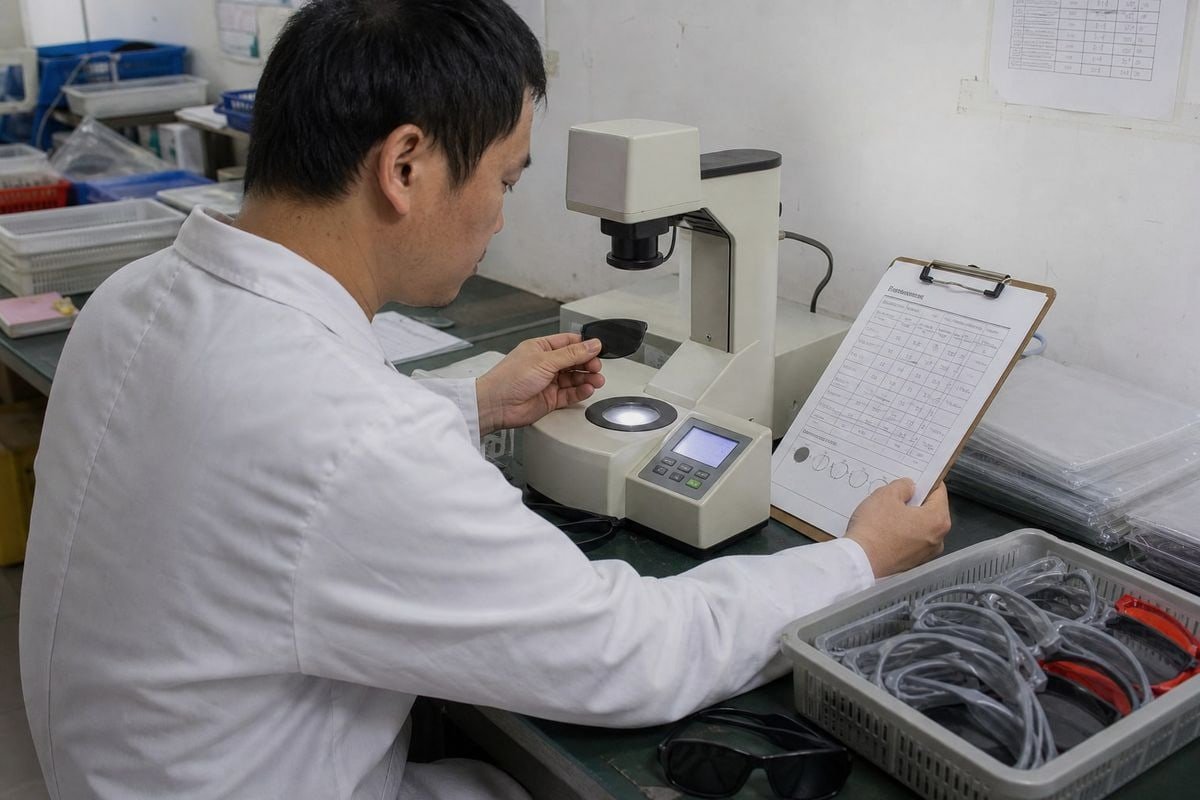
The first thing I tell every new buyer is this: the Australian rule is a mandatory product safety standard, not a voluntary quality guideline. The ACCC mandatory standards framework 1 enforces it, and non-compliant sunglasses can be seized, recalled, or fined. It has applied in full since 1 July 2019.
Sunglasses vs. fashion spectacles
The standard distinguishes real sunglasses from fashion spectacles 2. This fashion spectacles classification matters for kids' products. If a pair of glasses provides little or no sun glare reduction, it must be labeled as fashion spectacles — not sold as sunglasses. Many playful, novelty kids' frames fall into this trap when buyers assume any tinted lens counts as a sunglass.
How to confirm which category your product sits in
Here is the process we follow before any Australian order goes into production:
- Test the lenses for light transmittance and UV protection levels 3 at a qualified lab.
- Assign the correct lens category (0 to 4) based on the test report.
- Match the label wording to that category, referencing AS/NZS 1067.1:2016.
- Confirm the product is not a specialty item (prescription glasses and certain protective eyewear follow different rules).
| Product type | Covered by the 2017 mandatory standard? | Labeling implication |
|---|---|---|
| Kids sunglasses (categories 1–4) | Sim | Full labeling required |
| Fashion spectacles (category 0) | Sim | Must be labeled as fashion spectacles |
| Toy sunglasses sold as toys | Depends on positioning | High-risk grey zone — get advice |
| Prescription eyewear | Não | Different regulatory pathway |
The grey zone is real. If a product looks like sunglasses and is sold to be worn outdoors, Australian regulators treat it as sunglasses. We advise buyers never to rely on a "toy" label to escape the sunglasses standard.
What exact information must I include on the label to meet Australian requirements?
Our QC team keeps a printed label checklist pinned above the packing line for Australian orders. Every swing tag gets checked against it before cartons are sealed.
Australian sunglasses labels must show the identity of the manufacturer or supplier, the lens category number (0–4), the matching category description in English, usage information including sun glare protection level, and any required warnings — such as a statement that the sunglasses are not suitable for driving.
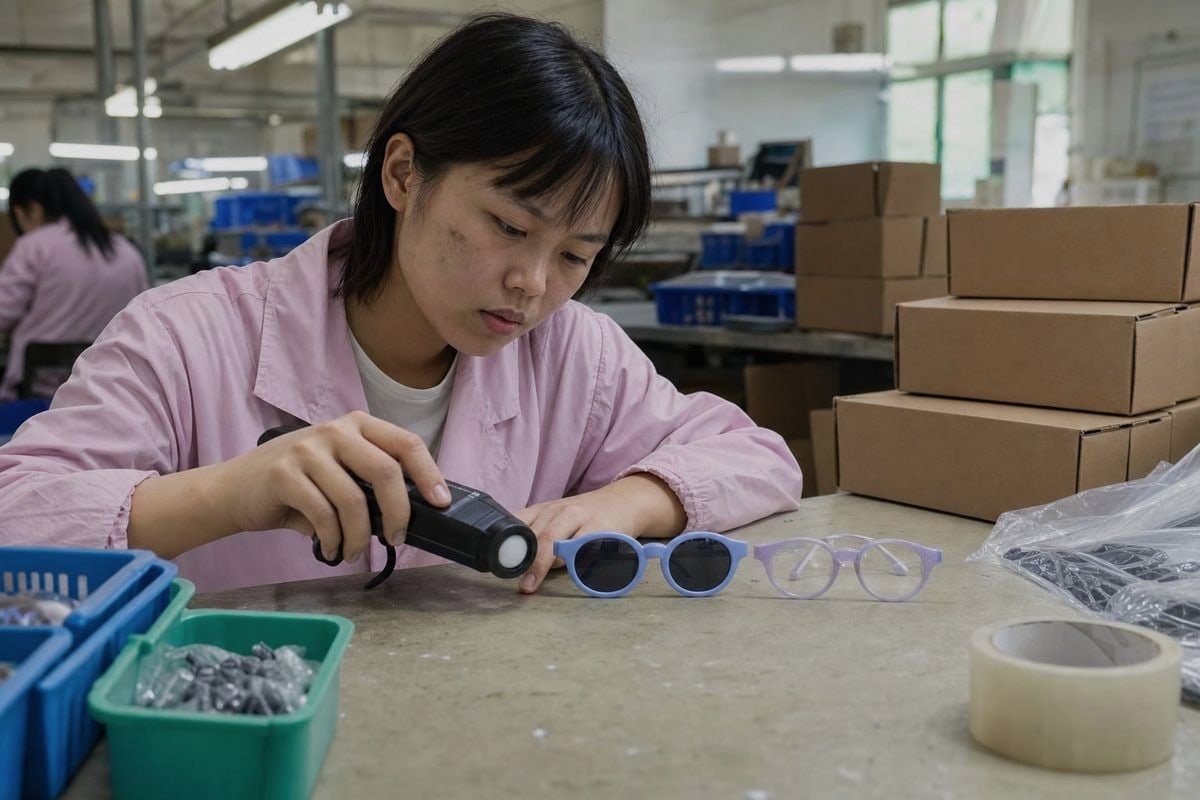
Let me break each element down, because "supplier identification" is where most confusion lives. The label must identify the entity responsible for placing the product on the Australian market. In practice, that usually means the Australian importer address or the local brand owner — not the overseas factory alone, and not the retail store unless the retailer is also the supplier of record. When an international brand sells through a local fulfillment center, the Australian entity acting as importer of record 4 is the one whose details anchor legal accountability. I should be clear: the standard's text lists the required data fields, but it does not spell out every edge case of who counts as the supplier, so treat this as a practical compliance reading, not a quoted legal definition.
The core label fields
| Label element | What it must show | Common example |
|---|---|---|
| Supplier identification | Name of the manufacturer or Australian supplier | Brand owner or importer name and address |
| Lens category number | A number from 0 to 4 | Categoria 3 |
| Category description | English wording matching the number | "General purpose sunglasses" |
| Usage information | Protection level guidance | "High protection against sun glare" |
| Warnings/symbols | Any mandatory restriction | "Not suitable for driving at night" |
| Standard reference | Compliance statement | AS/NZS 1067.1:2016 |
What the lens category communicates
The lens category number is the consumer-facing shorthand for UV protection levels and light transmission. Category 0 covers fashion spectacles with minimal glare reduction. Categories 2 and 3 cover most kids' everyday sunglasses. Category 4 lenses are very dark, built for extreme glare, and are never suitable for driving — a warning that must appear on the label.
Two more points from recent buyer conversations. First, a QR code linking to digital test reports is a nice extra, but it cannot legally replace the physical swing tag or lens sticker at the point of sale. Second, model identification — a model number or name — supports traceability and recalls, so we print it on every tag even when a buyer forgets to ask.
Can my manufacturer help me prepare compliant labels and documentation before shipping?
One trade-off we discuss with nearly every new Australian client is speed versus certainty: skip pre-shipment label review and ship a week earlier, or verify everything and sleep well.
Yes — a capable manufacturer can arrange lens testing, print compliant swing tags with your supplier identification and lens category details, and compile the test reports and compliance documentation before shipping. The legal responsibility stays with the Australian supplier, but the factory does the heavy lifting.
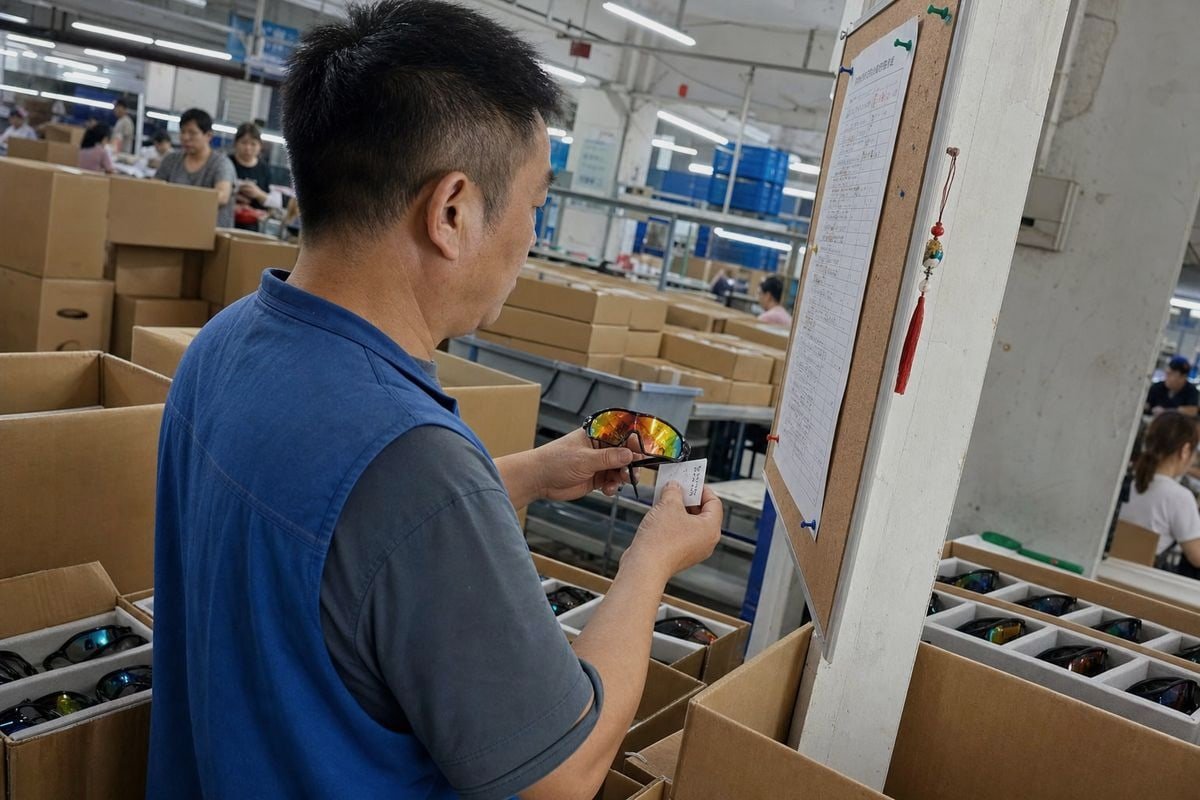
At OKAY EYEWEAR, label preparation is part of our standard OEM/ODM service for Australian buyers, alongside custom colors, logos, lenses, and packaging. Here is how the workflow runs on our side, and where you as the buyer must step in.
A typical pre-shipment compliance workflow
- Lens testing. We send lens samples to a lab for transmittance and UV testing against AS/NZS 1067.1:2016. Our UV400 and polarized lens options are engineered with these thresholds in mind.
- Category assignment. The test report determines the lens category. We never guess this number.
- Label artwork. You supply your Australian entity name and address; we design the swing tag with the category number, English description, usage wording, and warnings.
- Buyer sign-off. You or your compliance advisor approve the artwork. This step is non-negotiable in our process.
- Print and apply. Our 5S-managed workshop prints tags with non-migratory, non-toxic inks — an emerging expectation for children's products, since kids chew on everything.
- Documentation pack. Test reports, label proofs, and packing records travel with the shipment paperwork.
What the factory cannot do for you
We cannot decide who your supplier of record is, and we cannot sign compliance on your behalf. Product safety labeling responsibility under Australian consumer protection regulations 5 sits with the entity supplying the goods in Australia. What a good factory does is make it nearly impossible for a required field to be missing when your goods land. With around 800 existing styles available, many of our buyers also test the Australian market first with pre-tested designs before investing in custom molds — the compliance documentation carries over with far less friction.
What mistakes should I avoid when labeling kids sunglasses for the Australian market?
The most expensive lesson I have watched a buyer learn involved a pallet of relabeled stock — every price sticker had been placed directly over the lens category information.
Avoid five mistakes: using only a brand name without full supplier identification, omitting the lens category number or description, covering required label information with price stickers, skipping mandatory driving warnings, and ignoring choking-hazard warnings on kids sunglasses with detachable decorative parts.
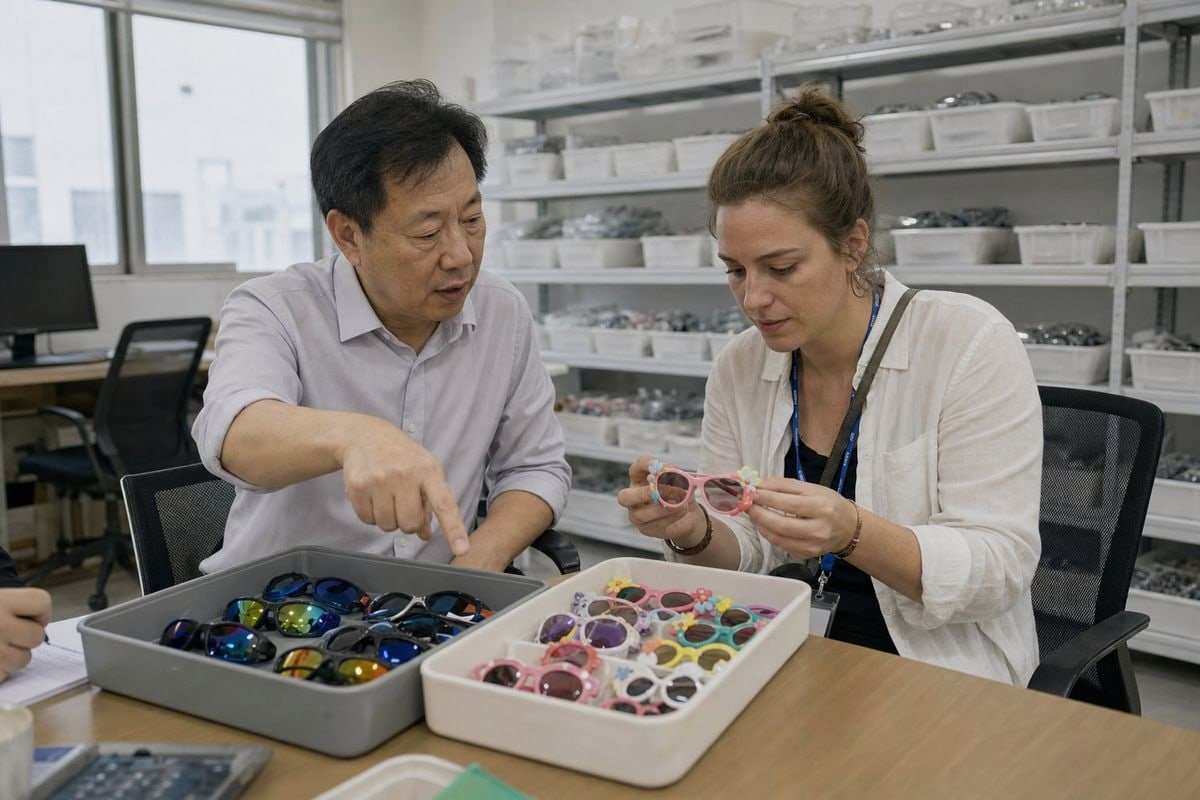
Each of these mistakes is cheap to prevent and expensive to fix after arrival. Let me rank them by how often we see them and how badly they hurt.
| Mistake | How often we see it | Consequence |
|---|---|---|
| Brand name only, no supplier identity or address | Muito comum | Non-compliant label; possible recall exposure |
| Missing lens category number or description | Common | Fails a core requirement of the standard |
| Price stickers covering required information | Common at retail | Label deemed not clear and legible |
| No driving warning on category 4 or night-restricted lenses | Ocasional | Direct safety non-compliance |
| No choking warning on detachable decorative parts | Occasional on kids' styles | Overlaps with toy safety rules for under-3s |
The brand-name trap
A logo is not supplier identification. "SunnyKids™" printed on a temple arm tells a regulator nothing about who is legally accountable. The label needs the actual business name — and best practice includes the Australian importer address — so consumers and regulators can trace the responsible entity.
Kids-specific pitfalls
Children's styles carry extra risks. Detachable charms, clip-on decorations, or removable nose pads can create small parts, which pulls in choking hazard warnings 6 and effectively merges eyewear labeling with toy safety requirements for children under three. This is one reason our kids' frames use flexible TPEE and TR90 construction 7 with minimal detachable hardware — fewer small parts means fewer warnings needed and fewer real hazards on a child's face. Also, do not confuse Australia's lens category system with Eye Protection Factor style marketing claims; the mandatory label fields come from the standard, and marketing claims must never replace or contradict them.
Conclusão
Australian labels must name the responsible manufacturer or supplier, show the lens category, and carry required warnings. Get those fields right before shipping, and your kids sunglasses clear the market cleanly.
Notas de rodapé
1. Official Australian government page detailing the mandatory safety standards for sunglasses and fashion spectacles. ↩︎
2. Wikipedia entry explaining the classification of sunglasses and fashion spectacles under various international standards. ↩︎
3. ARPANSA provides authoritative information on UV radiation protection and sunglass standards in Australia. ↩︎
4. Australian Border Force guide on the legal responsibilities of importing goods into Australia. ↩︎
5. ACCC page explaining consumer rights and business obligations under Australian consumer law. ↩︎
6. Official safety guidelines for products intended for young children, specifically regarding small parts and choking. ↩︎
7. Technical background on the thermoplastic material commonly used in high-quality eyewear frames. ↩︎
Mais Artigos que Você Pode Gostar
1 de agosto de 2026
A Fábrica Deve Lidar com a Embalagem e Rotulagem de Óculos de Sol Infantis, ou Usar um Fornecedor Designado?
1 de agosto de 2026
Armazém Próprio vs. Envio Direto do Fornecedor: Qual Reduz os Custos de Devolução para Marcas de Óculos de Sol Infantis?
1 de agosto de 2026
Armazém Direto ao Porto ou Estiva no Exterior: Qual Economiza Mais no Envio de Óculos de Sol Infantis?
Procurando um Parceiro Confiável em Óculos Infantis?
Explore mais de 800 estilos prontos e suporte completo OEM/ODM adaptado à sua marca.
Entre em Contato English
  Español de México
  Deutsch
  Français
  日本語
日本語  العربية
  Português do Brasil