TPEE vs TR90 vs PC: Which Material Is Best for Kids’ Sunglasses?
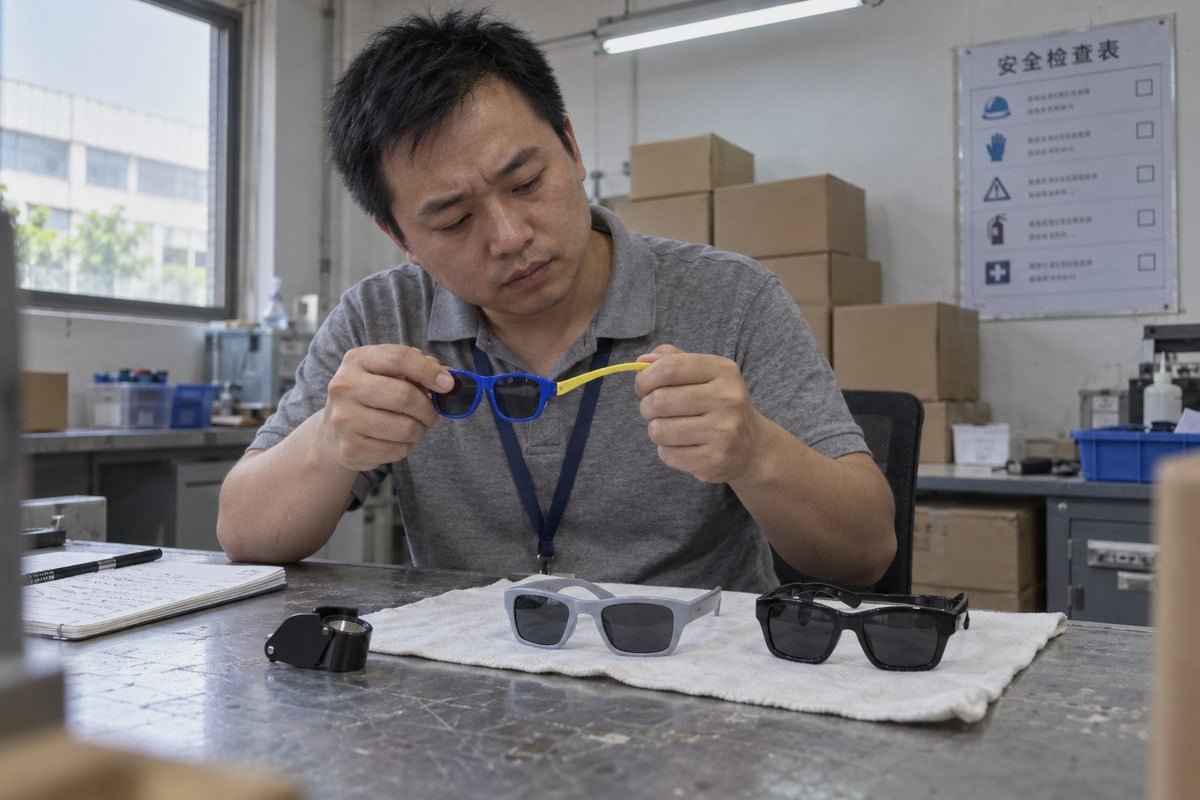
Every season, buyers ask the same question about kids’ sunglasses material 1: TPEE, TR90, or PC? Pick wrong, and frames crack, pinch, or get returned. Our factory has tested all three.
There is no single best kids’ sunglasses material. TPEE is best for babies and toddlers because it is softest and bends without breaking. TR90 is the best all-round frame for active kids aged three and up. PC is best for impact-resistant lenses and budget frames.
That short answer hides a lot of detail. Below, I walk through safety, comfort, durability, and how to pick a material for your brand without paying for new molds. I will keep it practical and honest, including where the industry claims come from marketing rather than lab reports.
How do I know which material is safest for my kids' sunglasses line?
Last year, our QC team bend-tested a buyer's PC reference sample and the temples showed stress lines within a few flexes. That changed how I judge safety.
The safest kids' sunglasses material bends instead of cracking. Rate each option on flexibility, BPA-free composition, hypoallergenic skin contact, and small-part risk. TPEE scores highest for toddlers, TR90 for active kids, and PC is safest as a shatterproof lens rather than a frame.
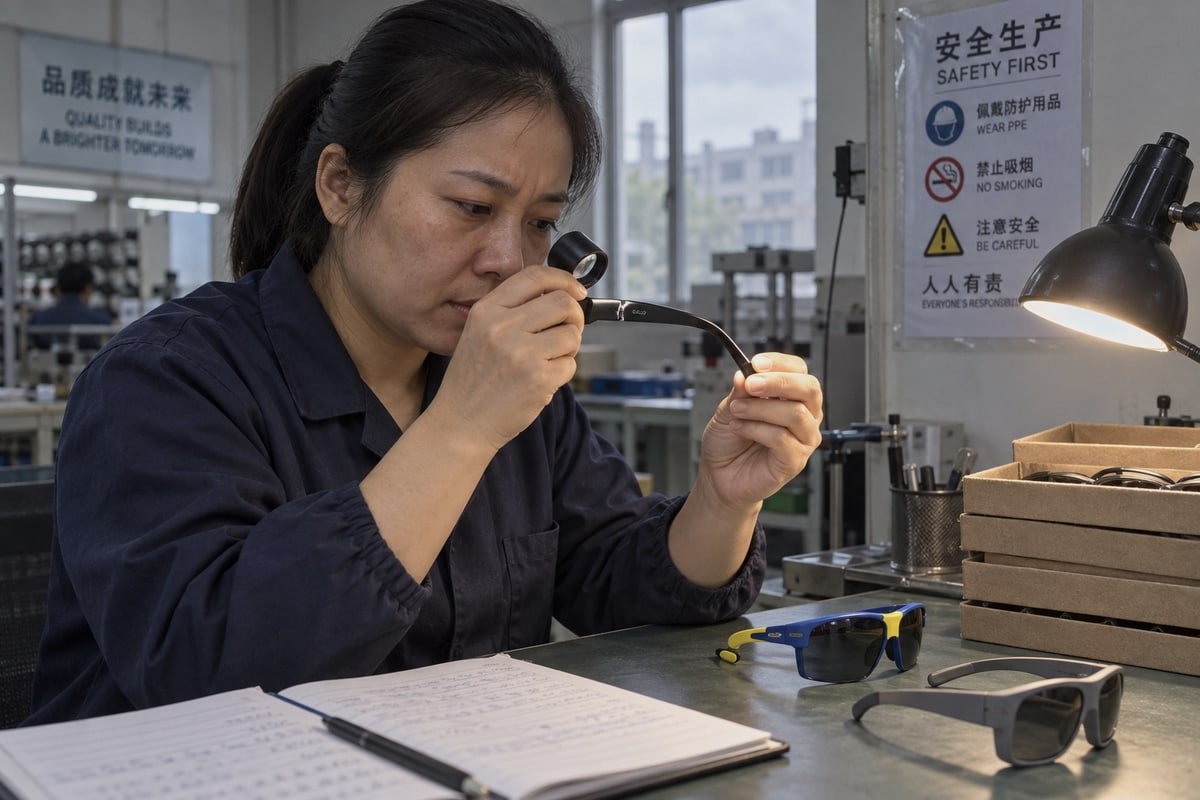
Safety is the first thing a founder or procurement manager asks me about. It is also the thing most product pages blur. So let me break it into checks you can actually verify.
The four safety checks we run on every kids' frame
| Safety check | TPEE | TR90 | PC |
|---|---|---|---|
| Bends without cracking | Yes, up to 180 degrees | Yes, springs back | Limited, can stress-crack |
| armações livres de BPA | Sim | Sim | Depends on grade, must be verified |
| Hypoallergenic skin contact | Yes, soft-touch | Yes, widely rated hypoallergenic | Generally yes, but hard and cold |
| Small metal hinges | Often none, one-piece design | Usually small metal hinges | Usually small metal hinges |
The first check matters most. A frame that cracks can leave a sharp edge near a child's eye. A frame that bends and returns cannot. This is why flexible thermoplastics, both TPEE and TR90, have become the market trend for kids' active eyewear.
Why brittle frames are the real risk
PC has excellent impact resistance against a single sharp hit. That is why it is the industry standard for lentes inquebráveis 2. But a frame lives a different life than a lens. Kids twist temples, sit on frames, and stuff them into bags. Under that kind of repeated bending, PC lacks fatigue resistance and can eventually snap. In our workshop, we do not run PC as a main frame material for this reason. We keep it in the lens category, where its strengths belong.
Small parts and the toddler question
For babies and toddlers, I always steer buyers toward one-piece TPEE frames. TPEE is a thermoplastic elastomer with a rubber-like texture, and most TPEE designs have no small metal hinges. That removes a choking hazard entirely. TR90 frames usually do use small hinges, which is fine for a four-year-old but less ideal for a one-year-old who chews everything.
Frames and lenses are two separate decisions
One clarification I make on every call: Proteção UV400 3 comes from the lens, not the frame. A soft TPEE frame with a poor lens is not safe. A rigid PC frame with a proper UV400 lens does protect the eyes. When you audit a supplier, ask for frame material and lens material separately, and ask for the lens test report separately too.
What makes TPEE, TR90, and PC different in comfort and flexibility for children?
Softness versus structure is the trade-off I weigh on nearly every kids' project. Go too soft and the frame slides; go too stiff and the child refuses to wear it.
TPEE is a thermoplastic elastomer that bends 180 degrees and feels rubbery and warm on skin. TR90 is a nylon memory plastic that is ultra-light and springs back to shape. PC is a rigid polycarbonate that is light but stiff, so it offers the least frame flexibility.
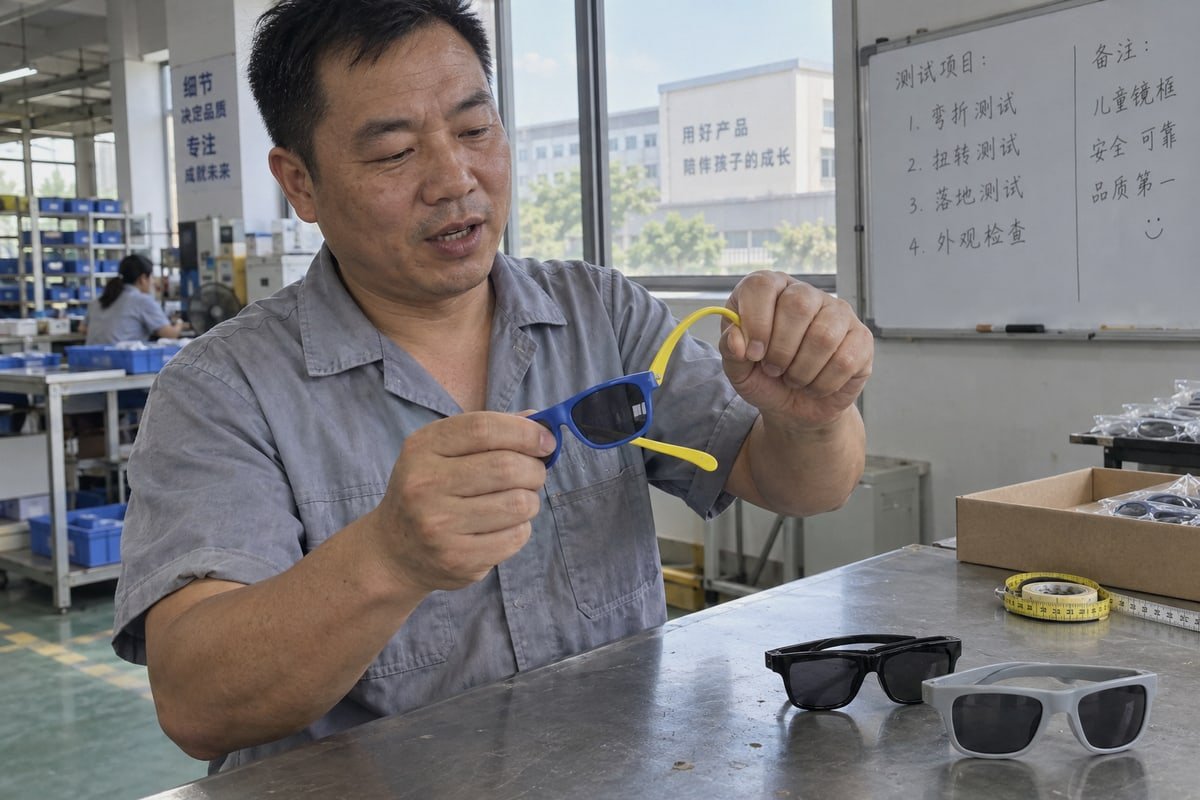
Comfort decides whether a child keeps the sunglasses on. That is the whole game for a kids' brand. A pair that sits in the stroller pocket does nothing for the child and nothing for your reviews. Here is how the three materials compare on the points that matter to small faces.
| Critério | TPEE | TR90 | PC |
|---|---|---|---|
| Frame flexibility | Mais alto | Muito alto | Moderado |
| Softness on skin | Mais alto | Médio | Baixo |
| Peso | Muito leve | Ultra-light | Leve |
| Memória de forma | Bom | Excelente | Justo |
| Comfort for toddlers | Excelente | Bom | Justo |
| Melhor ajuste de idade | 0 to 3 years | 3 to 12+ years | Older kids, lenses, budget lines |
What each material actually is
TPEE significa elastômero de poliéster termoplástico. Think of it as a plastic that behaves like a firm rubber. You can fold a TPEE frame in half and it comes back. That is the source of the "unbreakable" marketing you see on premium toddler lines.
TR90 is a nylon-based thermoplastic polyamide. It was developed in Switzerland and is often sold under the Grilamid name. It is what people mean when they say memory plastic. Bend a temple out, and it returns to its original angle.
PC is polycarbonate. It is the same family of material used in safety goggles. It is light and strong against impact, but it is not built to flex again and again.
Why weight matters more for kids than adults
One industry figure I find useful: TR90 is described as up to 50% lighter than acetate and roughly 30 to 35% lighter than PC. On an adult face, a few grams barely register. On a two-year-old's nose, those grams decide whether the frame slides down every minute. That is why lightweight comfort is the first thing I mention when a buyer asks why our TR90 optical frames cost more than a generic PC pair.
Sensory comfort and skin contact
Some children are sensitive to texture. Parents of kids with sensory processing sensitivities often tell buyers that hard, cold plastic against the temple is enough to trigger a refusal. TPEE has a soft-touch feel that stays closer to body temperature. TR90 sits in the middle. PC is the hardest of the three. This is why hypoallergenic materials alone are not enough; the tactile feel has to be right too.
The hybrid answer we use most
In practice, I rarely see a pure winner. Our most requested construction is a TR90 front 4 with TPEE temples. The front holds its shape and takes lens inserts cleanly. The temples wrap the ears softly and bend out of the way when a child pulls the frame off sideways. It gives an older toddler the structure of TR90 with the forgiveness of TPEE where the frame touches skin.
Which material offers the best durability for active kids who play hard?
An Australian outdoor brand once sent me photos of their previous supplier's frames, snapped at the hinge after one beach season. They wanted to know what would survive.
TR90 offers the best durability for active kids. It combines high impact resistance, shape memory, chemical resistance to sunscreen, and heat stability. TPEE wins on fatigue resistance from repeated bending. PC resists sharp impacts well but fails sooner after repeated flexing or hot-car exposure.
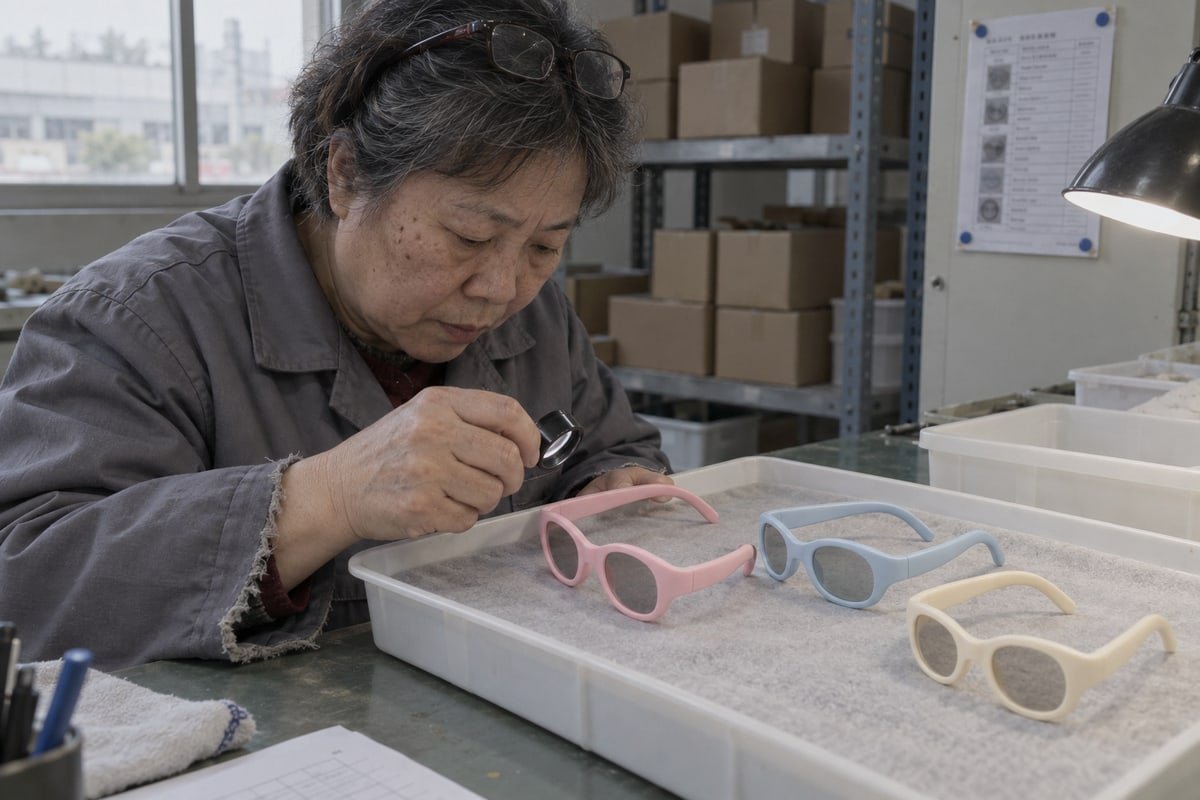
"Durable" is a vague word. Kids break sunglasses in specific ways, and each material fails differently. So I rate durability by stress type rather than by one score.
Three ways kids actually break sunglasses
- Repeated bending. Temples pulled outward hundreds of times. TPEE handles this best. TR90 handles it very well. PC develops stress cracks over time.
- Sharp impact. A dropped pair on concrete, or a ball to the face. PC is strongest here, which is why it dominates shatterproof lenses. TR90 and TPEE both absorb the hit by flexing.
- Environment. Sunscreen, sweat, salt water, and heat. This one surprises buyers, and it is where TR90 pulls ahead.
| Fator de durabilidade | TPEE | TR90 | PC |
|---|---|---|---|
| Fatigue from repeated bending | Excelente | Muito bom | Ruim |
| Single sharp impact | Alto | Alto | Excelente |
| Sunscreen and skin-oil resistance | Bom | Excelente | Justo |
| Heat stability in a hot car | Fair, can lose tension | Excelente | Bom |
| Shape retention after abuse | Bom | Excelente | Justo |
The hot-car problem
Here is a concrete trade-off I raise with every buyer selling into Australia, the Middle East, or Southern Europe. TPEE is wonderfully soft, but it has lower thermal stability than TR90. A TPEE frame left on a car dashboard in summer can slowly relax and lose its grip. TR90 keeps its structural tension in the same conditions. So for a sports line for kids aged five and up, I recommend TR90 fronts even when the buyer loves the TPEE feel.
Resolving the "which is best overall" debate
Some suppliers will tell you TR90 is the best kids' material, full stop. Others will insist TPEE is superior because it is softer. Both are half right. TR90 is the better all-rounder for a child who runs, climbs, and plays sport. TPEE is the better choice for a child who chews, drops, and folds the frame in half. If your brand targets both ages, plan two constructions rather than forcing one material to do both jobs.
Pair the frame with the right lens
One durability failure has nothing to do with the frame material itself. When a very flexible TPEE frame is fitted with a rigid PC lens, the frame flexes more than the lens can follow, and the lens pops out. For our TPEE toddler styles, we pair the frame with TAC lenses 5 that flex with it. For TR90 fronts, both PC and polarized TAC options work well because the front holds its shape. This is a detail worth checking on any sample, not just the bend test.
A quick note on honesty: most published comparisons, including the figures above, come from manufacturers and retailers rather than independent labs. Treat them as industry consensus, and ask your supplier for real samples and real testing on your own designs.
How do I choose the right material for my brand without investing in new molds?
The most expensive lesson I have watched new brands learn is paying for a custom mold before they know which material their customers actually want.
Choose from existing open-mold styles instead of cutting new tooling. Match the material to your age group first, then customize colors, logos, lenses, and packaging on proven frames. This lets you test TPEE and TR90 in the market with low risk before committing to a custom mold.
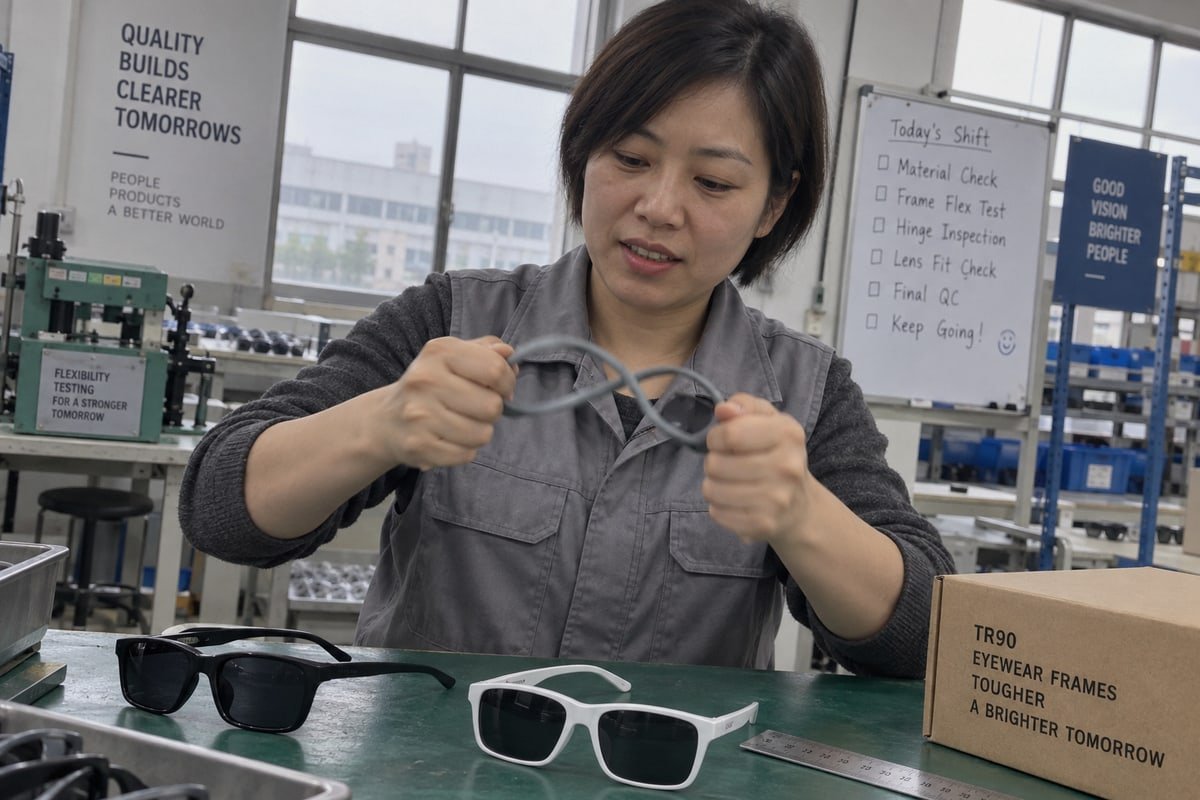
A new mold is a serious commitment. It locks you into one shape, one size, and one material before you have sold a single pair. In our Taizhou factory, we keep around 800 existing styles in TPEE and TR90 exactly so buyers do not have to take that risk on day one. Here is the process I recommend.
A five-step path to your first collection
- Define the age band first. Babies and toddlers point to TPEE. Ages three to twelve point to TR90 or a TR90-front, TPEE-temple hybrid. The material decision follows the age, not the other way around.
- Pick shapes from existing molds. A bold two-tone square frame in royal blue and yellow suits an active boys' and girls' outdoor line. A soft lavender cat-eye works for a fashion-led range. A blush-pink round frame reads as gender-neutral and toddler-friendly. All three exist as open styles today.
- Choose the lens. UV400 protection is non-negotiable. Polarized options add value for beach and water brands. Match lens flexibility to frame flexibility as discussed above.
- Customize what does not need tooling. Colors, logo printing or engraving, lens tints, cases, pouches, hang tags, and retail packaging. This is where your brand identity lives, and none of it requires a new mold.
- Test, then invest. Once a style proves itself in your market, a custom mold becomes a calculated decision rather than a gamble.
What you can change without a mold
| Personalização | Requires new mold? | Typical lead-time impact |
|---|---|---|
| Frame color and two-tone combinations | Não | Mínimo |
| Logo on temple or lens | Não | Mínimo |
| Lens tint, UV400, polarized | Não | Mínimo |
| Packaging, case, hang tag | Não | Depends on print supplier |
| New frame shape or size | Sim | Significativo |
Why a real factory matters at this stage
When you are testing a market, you need consistent samples, clear answers, and a partner who will still be there for reorders. Our workshop runs about 120 workers under gerenciamento 5S 6, and we have fifteen years in eyewear. That means the TR90 frame you approve in sample form comes off the same line in production. It also means our engineers can tell you plainly when a TPEE style will not hold a PC lens, or when a TR90 front is the wrong call for a nine-month-old. Buyers in more than twenty countries rely on that kind of straight talk, and it is worth more than a lower unit price from a trader who has never handled the material.
Conclusão
Picking a kids' sunglasses material blindly risks cracked frames and returns. Match TPEE to toddlers, TR90 to active kids, and PC to lenses. Then test on existing styles first.
Interested in sourcing the products mentioned in this article? See details and request a quote here:
Notas de rodapé
1. Overview of thermoplastic elastomers, the material class used for flexible and durable children’s eyewear frames. ↩︎
2. Scientific data on the impact resistance and durability of polycarbonate in optical and safety applications. ↩︎
3. Official health authority guidelines on ultraviolet radiation protection and safety standards for sunglasses. ↩︎
4. Technical specifications from the primary manufacturer of high-performance polyamides used in premium eyewear frames. ↩︎
5. Technical information on cellulose triacetate, the material used for flexible polarized lenses in children’s sunglasses. ↩︎
6. Explanation of the 5S lean manufacturing system used to maintain quality and efficiency in eyewear production. ↩︎
Mais Artigos que Você Pode Gostar
Procurando um Parceiro Confiável em Óculos Infantis?
Explore mais de 800 estilos prontos e suporte completo OEM/ODM adaptado à sua marca.
Entre em Contato English
  Español de México
  Deutsch
  Français
  日本語
日本語  العربية
  Português do Brasil