How to Tell When TR90 Kids Optical Frames Need Replacement?

TR90 kids armações ópticas 1 rarely snap, so worn pairs quietly stay in use. On our Taizhou production line, returned samples show how a few simple checks catch this early.
TR90 kids optical frames need replacement when they show cracks, loose hinges that cannot be tightened, warping that will not reset, repeated slipping, peeling coating, or when a growth spurt makes the frame too small. Adjust minor fit issues; replace once structure or fit fails.
Below, I walk through the warning signs, the growth timeline, the material fatigue clues, and the questions worth asking your supplier resina de memória termoplástica 2. Each part builds on the last.
What are the warning signs that my TR90 kids optical frames are wearing out?
Last season, our QC team pulled a returned sample whose temples looked perfect optical frame size 3. The hinges, though, had lost all tension. Looks alone hide a lot.
The main warning signs are stress cracks near the bridge or lens rims, hinges that wobble or will not tighten, frame stretching that causes bridge slippage, peeling or cloudy coating, red marks behind the ears, and lenses that rotate in loosened grooves.

I find it easiest to sort every sign into one of four buckets: safety, fit, function, and condition. Safety problems mean replace now. The others need a closer look. The table below is the same checklist we give brand partners who handle returns.
The four-bucket inspection table
| Balde | Tirados em segundos, todas as vezes | O que geralmente significa | Ação |
|---|---|---|---|
| Segurança | Hairline cracks or splits at the bridge, lens rims, or temple hinge area | The thermoplastic has fatigued and can fail suddenly | Substituir imediatamente |
| Segurança | Sharp or chipped edges, exposed hinge pins | Impact damage or worn hardware | Substituir imediatamente |
| Ajuste | Frame slides down the nose, child keeps pushing it up | Frame stretching or the child has outgrown the width | Adjust once; replace if it returns |
| Ajuste | Red marks behind the ears or on the nose bridge | Temples too short or bridge too narrow for the face | Move up a size |
| Função | Temples flop open or closed, screws will not hold | Hinge tension gone, threads stripped | Substitua |
| Função | Lenses rotate or shift in the rim | Lens grooves have widened; optical center moves | Substitua |
| Condição | Peeling coating, deep scratches, pitting | Surface finish breaking down | Monitor; replace if paired with fit issues |
| Condição | Cloudy white film or discoloration | Long-term absorption of skin oils and sweat | Clean first; replace if it persists |
Why hinges fail before the plastic does
Children take glasses on and off many times a day. Each cycle works the hinge. On our line, we test hinge open-and-close cycles before a style ships, but real-world use adds twisting, drops, and single-hand removal. When a temple no longer stays where you set it, the frame cannot hold the lenses at the correct angle. Vision suffers before anything looks broken.
The lens groove problem nobody notices
This one matters most for optical frames. As the rim relaxes, the internal groove that grips the lens edge can widen. The lens then rotates a few degrees. For a single-vision lens with cylinder correction, that shift changes where the prescription lands on the eye. The frame looks fine. The child squints. Check by holding the frame up and gently pressing the lens edge; any movement is a replacement sign.
How often should I replace TR90 optical frames as my child grows?
A procurement manager in Australia once asked us why her reorder sizes kept shifting upward every few months. The answer was simple: children grow faster than frames wear.
Most growing children need a new TR90 optical frame size roughly every one to two years, and sooner during growth spurts. Replace when the frame becomes too narrow, temples feel short, slipping persists after adjustment, or a prescription lens update calls for a different lens size.

Growth is the number one reason a kids' frame retires early. The plastic may have years of life left. The face does not. This is why we keep the ~800 existing styles in our catalog spread across several width and temple-length steps, so a brand can stock a size ladder instead of a single "kids" size.
How growth shows up on the frame
| Age stage | Typical change | First sign on the frame | Recommended check |
|---|---|---|---|
| Toddler and preschool | Rapid head width growth | Temples splay outward, bridge slippage on the nose | Every two to three months |
| Early primary school | Nose bridge develops, face lengthens | Red marks behind ears, temple tip wear from pushing up | Every three to four months |
| Late primary and pre-teen | Growth spurts in bursts | Frame looks narrow, lenses sit too close to the lashes | Every school term |
I want to stress one point. The frame does not stretch to follow the child. Frame stretching happens, but it is uneven and it weakens the temples. A stretched TR90 frame is not a bigger frame. It is a tired frame.
A simple monthly fit routine for parents and retailers
- Look at the child from the front. The eyes should sit near the center of each lens, not pushed toward the nose.
- Look from the side. The temple should run straight back and curve down just behind the ear, not press into it.
- Ask the child to tilt the head forward and shake gently. Slipping means the fit or the grip is gone.
- Check the ear area and nose for red marks after an hour of wear.
- Confirm the current prescription is still valid. A prescription lens update is a good moment to review frame size at the same time.
Can accessories delay the next size?
Yes, within limits. Silicone nose pads and anti-slip ear hooks can buy a few extra months when the only problem is slipping. On our TR90 frames with TPEE temples, the soft temple material already grips better than rigid plastic. But accessories cannot fix a frame that is too narrow. When the temples splay, the fit stage is over.
Can I tell if the TR90 material has weakened from daily wear or damage?
Early in our TR90 work, we learned a hard lesson: flexibility hides fatigue. A temple that bends many times without breaking can still crack later.
Yes. Weakened TR90 shows loss of memory, meaning the frame no longer snaps back to shape, plus whitening stress marks, a tacky or cloudy surface, deep scratches or pitting, and skin irritation that cleaning cannot fix. Any of these means the thermoplastic has fatigued.
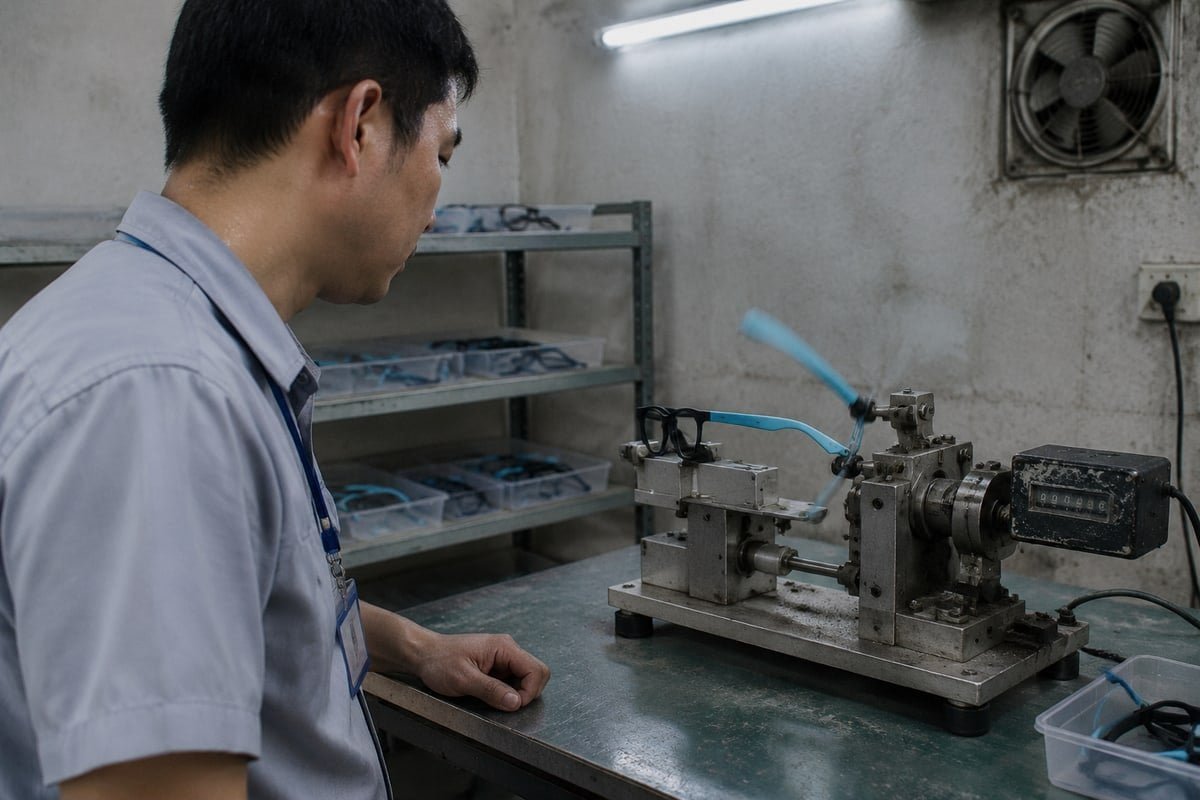
Here is the objection I hear most from new buyers: "TR90 is a resina de memória termoplástica 4, it bends and returns, so why would it ever need replacing?" It is a fair question. TR90 does have excellent impact resistance and shape memory, which is exactly why we chose it for children's optical frames. But memory is not permanent. Every deep bend moves polymer chains a little. Heat, sunlight, and chemicals move them further. Eventually the frame stops returning to its molded shape. At that point the optical center drifts and the temples lose grip.
The gentle bend test
Hold the frame by the front and flex one temple outward a short way, then release. A healthy TR90 temple returns fully and immediately. A fatigued one returns slowly, stops short, or shows a pale line at the hinge end. That pale line is a stress mark. Do not push further to "see if it breaks." Aggressive reshaping is what creates stress cracks in the first place. Small, controlled adjustments by an optician are fine. Forceful bending is not.
Surface clues and what causes them
| O que você percebe | Causa provável | Adjust or replace? |
|---|---|---|
| Frame springs back slowly or sits out of shape | Loss of memory elasticity from repeated stress | Substitua |
| Pale or white marks near hinges or bridge | Micro stress cracks forming under the surface | Substitua |
| Sticky or tacky feel on temples | Polymer breakdown from sunscreen or insect repellent contact | Substitua |
| Chalky fade on the top bar and temples | UV exposure damage from long outdoor use | Monitor; replace if brittle |
| Cloudy white film that returns after cleaning | Skin oils and sweat absorbed into the surface | Substitua |
| Recurring rash or "eyeglass acne" at contact points | Micro-porosity in aging plastic trapping bacteria | Substitua |
| Light scuffs only | Normal wear | Keep using |
A note on skin contact
We select TR90 and TPEE partly because they are a material hipoalergênico 5 choice for children with sensitive skin. That protection fades as the surface ages. Once micro-pores open up, cleaning no longer reaches what is trapped inside. If a child develops irritation on a frame that was fine for months, the material has changed, not the child.
Should I consult my eyewear supplier before replacing my child's TR90 frames?
We weigh one trade-off constantly at our Taizhou factory: adjust a frame and keep it in service, or replace it and protect the child. Your supplier can help decide.
Yes, consult your supplier first. A good eyewear manufacturer can confirm whether a fault is a one-off or a batch issue, supply replacement temples, nose pads, or screws, advise on the next size up, and update materials or hinges before your reorder.

For a parent, the first stop is usually the optician. For a brand or importer, the first stop should be the factory. Those two roles answer different questions, and mixing them up wastes time.
Who answers what
| Pergunta | Best person to ask | Por quê |
|---|---|---|
| Can this specific pair be adjusted safely? | Optician | They can see the frame and the child together and make controlled adjustments |
| Is this the right size for the current prescription? | Optician | Lens size, pupil distance, and frame width must match |
| Are other units from this batch showing the same fault? | Supplier | The factory holds batch records, material lots, and QC data |
| Can I get spare temples, silicone nose pads, or screws? | Supplier | Replacement parts come from the same tooling and color match |
| Should the next order change hinge type or temple material? | Supplier | The factory can move a style from all-TR90 to TR90 front with TPEE temples |
| Which sizes should I stock for this age range? | Supplier | The catalog spans many width and temple-length steps |
What to send us when a frame fails
When a brand partner reports a problem, the most useful package is short. Clear photos of the fault, the style code and color, roughly how long the child wore the frame, and how it was used. Outdoor sports use with sunscreen tells us one story. Classroom use with frequent on-and-off cycles tells another. With that, our engineers can usually tell whether the cause is normal end of life, a fit mismatch, or something we need to address on the line.
How the answer changes your next order
This is where a real factory earns its place. After fifteen years making children's eyewear, we have adjusted hinge screws, changed temple tip shapes to reduce temple tip wear, and shifted certain styles to TPEE temples because buyers told us what came back. Our 5S-managed workshop keeps those changes consistent from lot to lot. Full OEM/ODM support means a brand can also add branded spare-part kits to retail packaging, which extends frame life for the customer and reduces returns for the brand.
Replacement is sometimes the honest answer. When it is, we would rather tell a buyer that clearly than let a worn frame stay on a child's face.
Conclusão
Worn TR90 frames rarely announce themselves. Check hinges, fit, and surface monthly, replace at the first structural sign, and lean on your manufacturing partner for the rest.
Interessado em adquirir os produtos mencionados neste artigo? Veja detalhes e solicite um orçamento aqui:
Notas de rodapé
1. ISO provides international standards for the quality and testing of spectacle frames. ↩︎
2. Explains the shape-memory polymer science behind TR90’s flex-and-return behavior and eventual fatigue. ↩︎
3. The FDA regulates prescription eyewear and frames as medical devices to ensure safety. ↩︎
4. Wikipedia explains the chemical properties and industrial applications of polyamide materials like TR90. ↩︎
5. The AAO offers guidance on eye health and safe materials for pediatric eyewear. ↩︎
Mais artigos que você pode gostar

8 de novembro de 2026
Por Que as Armações Ópticas Infantis em TR90 Ficam Amarelas e Quebradiças, e O Que Acelera Isso?

7 de novembro de 2026
Quanto Tempo Duram as Armações Óticas Infantis em TR90 Antes da Substituição?

6 de novembro de 2026
Qual informação da etiqueta os pais verificam primeiro nas armações de grau infantis de TR90?
Procurando um parceiro confiável em óculos infantis?
Explore mais de 800 modelos já desenvolvidos e suporte OEM/ODM completo sob medida para a sua marca.
Entre em contato English
 Español de México
 Deutsch
 Français
 日本語
 العربية
 Português do Brasil