What Hangtag Info Do Parents Check First on TR90 Kids Optical Frames?
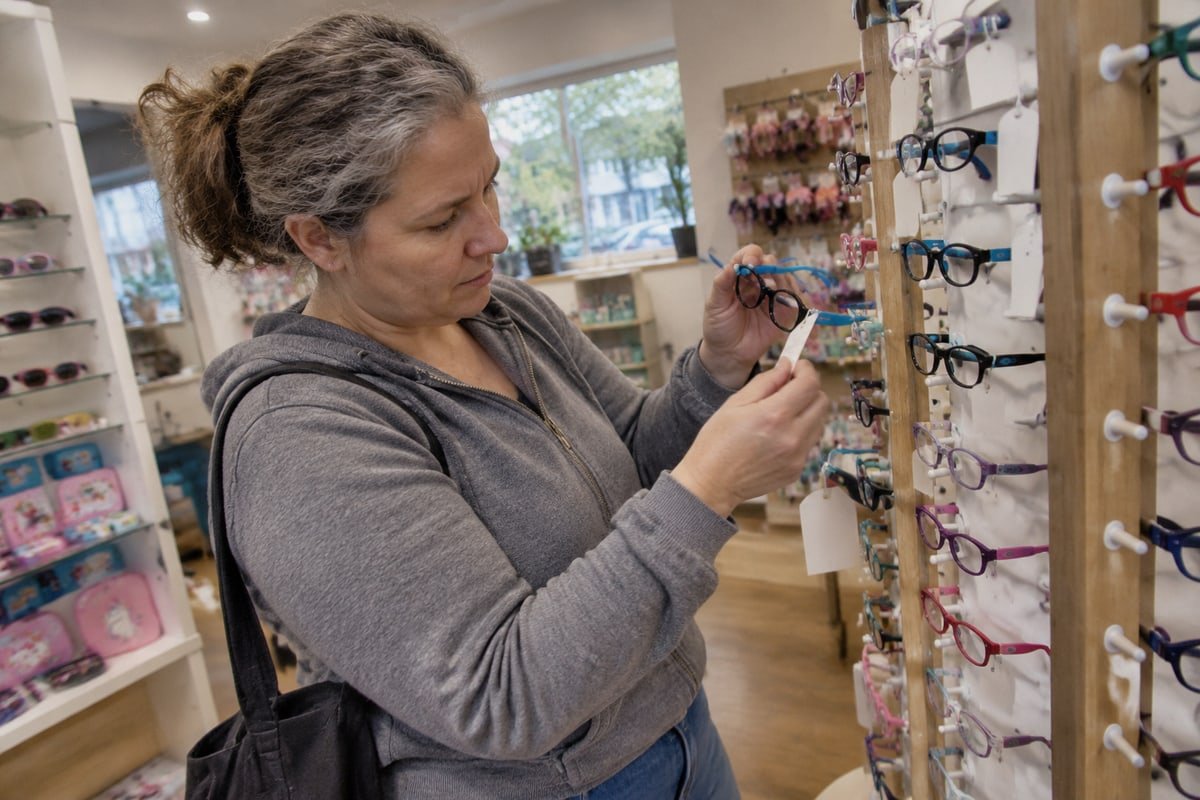
Parents flip a hangtag on [TR90](https://okayeyewear.com/screwless-spring-hinge-tr90-kids-optical-frame-fits-child/) kids optical frames and decide in seconds pediatric frame sizing numbers 1. Vague tags lose sales; our Taizhou line learned to print what they scan first.
Os pais verificam primeiro o material nas armações ópticas infantis em TR90, procurando por TR90 ou polímero de memória flexível, depois a faixa etária e o tamanho, e a seguir marcas de segurança como livre de BPA, hipoalergênico e CE. Flexibilidade, dobradiças com mola e peso vêm a seguir. Estilo e cor ficam por último, uma vez garantidos a durabilidade e o ajuste.
The order matters. A parent is not shopping for fashion. A parent is asking two questions: will this survive my child, and will my child keep it on? The rest of this article breaks the hangtag into four blocks that answer those questions fast. I will share what we print, what we leave out, and why.
Last spring our QC team pulled a hangtag proof because the safety line read 'child safe' with no standard behind it. A vague claim is worse than none.
Destaque a certificação livre de BPA, o status de material hipoalergênico e as marcas regulatórias adequadas ao seu mercado, como a conformidade com a marcação CE para a Europa e a conformidade de materiais reconhecida pela FDA para os EUA. Adicione a conformidade química REACH, acabamento de pintura não tóxica e UV400 para lentes. Imprima apenas alegações comprovadas por um relatório de teste atual.

Safety is the second thing parents read, right after the material name. It is also the block where brands make the most mistakes. Some print too little. Others print marks they cannot support. Both cost trust.
Match the marks to the market
Our buyers come from more than 20 countries. Each market reads a different set of symbols. A tag built for Europe needs Conformidade da marcação CE 2 and REACH chemical compliance. A tag for the US often needs a line about FDA approved materials, because retailers there ask for it. Australian and Japanese buyers tend to ask for the full material declaration 3 and the test report behind it. So the first step is simple. Ask your importer which marks their retailers demand. Then print only those.
| Mercado | Marks parents expect | What sits behind the mark |
|---|---|---|
| UE / Reino Unido | CE, REACH | Chemical limits, product safety file |
| EUA | FDA-related material statement, BPA-free | Material declarations, lab report |
| Australia / Japan | Material declaration, UV400 | Lens test report, material data sheet |
| Global | Hypoallergenic, non-toxic paint finish | Skin contact and coating tests |
Print the claim, not the adjective
"Safe" is an adjective. "BPA-free certification, report available on request" is a claim. Parents trust the second. In our experience exporting TR90 kids optical frames, the hangtags that convert best use three short lines: the material safety claim, the regulatory mark, and the lens claim. UV400 belongs on optical frames too, because many of our optical styles carry blue-light or UV-blocking demo lenses.
Do not forget the paint
Colored frames need a non-toxic paint finish line. Our two-tone round frame, matte black front with glossy sky-blue temples, uses a coating that passes skin-contact testing. Parents do not ask about paint by name. They do ask "is the color safe if my child chews the temple?" One icon answers that.
Como Explico os Benefícios do Material Flexível aos Pais na Etiqueta?
Every hangtag we design fights the same trade-off: engineers want to say polyamide thermoplastic, parents want to hear it will not snap. We choose the parent.
Explain TR90 in plain outcomes: it is a flexible memory polymer that bends under pressure and springs back, resists impact and cracking, and weighs about 30% less than acetate. Pair this with spring hinge durability, skin-friendly thermoplastic, and a bend-test icon so parents see fewer replacements and better comfort.
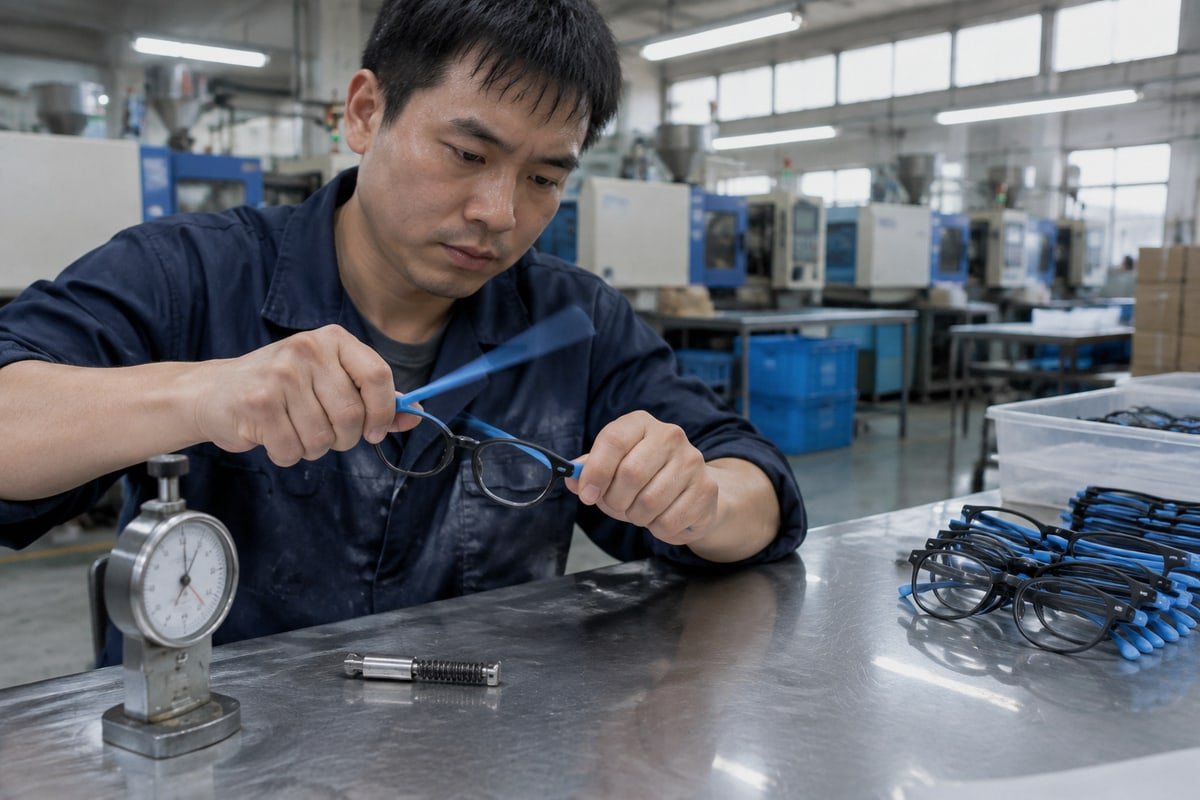
Parents do not buy chemistry. They buy outcomes. So the material block on the tag should translate every technical term into something a tired parent can picture. Here is how we do it.
Translate the engineer's words
| Engineer says | Parent reads | Por que funciona |
|---|---|---|
| Thermoplastic nylon / polyamide | Dobra e volta ao normal | Answers "will it snap?" |
| Flexible memory polymer | Holds its shape after twisting | Answers "will it stay straight?" |
| Resistência ao impacto | Survives drops and playground falls | Answers "how many will I buy this year?" |
| Lightweight frame construction | About 30% lighter than acetate | Answers "will my child keep it on?" |
| Skin-friendly thermoplastic | Hypoallergenic, no rash | Answers "is it okay for sensitive skin?" |
Notice the last column. Every line answers a fear. That is the whole job of the hangtag.
How TR90 compares to the alternatives
Parents also compare. They have seen silicone baby glasses and metal frames. A short comparison strip on the tag or the back card removes doubt.
- TR90: flexible, light, impact resistant, structured enough to hold lenses correctly. Our default for preschool and school age.
- Silicone / TPEE: softer, ideal for babies and toddlers. We use TPEE temples on TR90 fronts for the best of both.
- Acetato: rich color, but heavier and more prone to cracking when twisted.
- Acetato de Celulose: light and strong, but rigid and costly for a frame a child will outgrow.
Two objections I hear from buyers
First: "Silicone is better for ages 0 to 3." Often true. That is why we developed Frentes de TR90 com hastes de TPEE. The front holds the lens shape. The temples stay soft against a baby's head. The tag can say "TR90 front, soft TPEE temples" and satisfy both camps.
Second: "The hinge breaks before the plastic does." Also true. A flexible frame with a stiff hinge fails at the hinge. So our tag never lists TR90 alone. It lists the material and the hinge together: flexible memory polymer front 4, spring hinge durability rated for repeated opening. Parents understand that pairing at a glance.
What Sizing and Fit Details Do Parents Look for Before Buying Kids' Optical Frames?
A procurement manager from Australia once asked me why her first order sold slowly. Her tag listed one size, 'kids'. Toddlers and eight-year-olds do not share a bridge.
Parents look for a clear age range, then the three pediatric frame sizing numbers: lens width, bridge width, and temple length in millimeters. They also want frame weight in grams, adjustable silicone nose pads or a keyhole bridge note, and a QR code to a fit guide.

Fit is where a durable frame becomes a good frame. A TR90 front can survive a year of recess and still be a bad buy if it slides down the nose every minute. Parents know this from experience. That is why size details are the third thing they read, and often the thing that decides the purchase.
The four fit fields we always print
- Age range. Print a real span, such as a preschool band or an early school band. One word like "kids" tells a parent nothing.
- Three sizing numbers. Lens width, bridge width, and temple length in millimeters. Optical shops read these daily. Parents learn them fast once they see them printed the same way on every tag.
- Frame weight in grams. Lightweight frame construction is a promise. Grams are the proof. A number sits better on a tag than "ultra-light".
- Bridge and nose note. Some of our styles use a keyhole bridge, like our round two-tone frame. Others use adjustable silicone nose pads. Say which one, because flat-bridged children and narrow-bridged children need different answers.
Why fit beats material as the final filter
I raise this objection myself with buyers because it is true. Fit matters more than material at the moment of wearing. A frame that pinches behind the ear will end up in a backpack. TR90's flexibility helps here. The temples can be gently heat-adjusted at the optical shop, and the curved temple tips on our frames follow the ear without pressure. The tag should tell parents this. A line like "temples adjustable by your optician" removes the fear of a wrong fit.
Add a digital fit path
Many of our brand clients now print a QR code that opens a virtual fit guide or a printable size ruler. It also serves as a digital authenticity check. Parents scan, measure their child's face, and choose with confidence. The code costs nothing on the tag and saves returns later.
We learned the hard way that a hangtag without care notes invites returns. One retailer sent back frames clouded by sunscreen, calling it a defect.
Yes. Include short care instructions and a plain warranty line. Parents read both as proof the frame will last. Cover cleaning, heat, and chemical resistance to sunscreen and sweat, then state the warranty period, what it covers, and how to claim, ideally through a QR code.

Care and warranty are the last things parents read, but they are not optional. They close the sale by answering the quiet question: "what happens when something goes wrong?" A good tag handles this in five icons and two sentences.
Care icons that prevent complaints
TR90 has good chemical resistance, but no plastic is immune to everything. Sunscreen, sweat, skin oils, and hot car dashboards are the real enemies of children's eyewear. So we recommend a small icon strip.
| Icon | Mensagem | Why parents need it |
|---|---|---|
| Water drop | Rinse with cool water, dry with soft cloth | Prevents lens scratching from dry wiping |
| Sun with cross | Do not leave in hot car | Heat can warp any plastic frame |
| Bottle with check | Resists sunscreen, sweat, and skin oils | Confirms chemical resistance for active play |
| Hand with grip | Pontas de haste antiderrapantes | Signals grip-tech for sweaty play |
| Two arrows | Replaceable temples available | Shows modular design, not disposable |
That last row matters more each year. Parents like knowing a snapped temple can be replaced instead of the whole frame. Where a style supports modular temples, we print the symbol and the spare-part path.
The warranty line
Keep it plain. State the period, state what it covers, and state how to claim. Most of our brand partners cover manufacturing defects and hinge failure under normal use. They exclude lost frames and deliberate damage. A QR code to the claim form does the rest. This is also where our OEM support helps. We print the brand's own warranty text, in the brand's language, on retail-ready packaging, so the tag matches the website and the box.
Why this block builds trust
A brand that explains care is a brand that expects the product to last. Parents read it that way. In our 15 years of making children's eyewear, the tags with care and warranty blocks have drawn fewer "defect" returns, because parents knew what was normal wear and what was not.
Conclusão
Parents scan TR90 kids optical frame hangtags for material, size, safety, and care in seconds. Print those clearly, back each claim, and the frame sells itself.
Interessado em adquirir os produtos mencionados neste artigo? Veja detalhes e solicite um orçamento aqui:
Notas de rodapé
1. Authoritative medical guidance on selecting and sizing optical frames for children. ↩︎
2. Official EU guide on CE marking requirements for products sold in the European Economic Area. ↩︎
3. International standard for spectacle frames, covering requirements for material safety and testing. ↩︎
4. Technical overview of the polymer properties that provide flexibility and memory in eyewear. ↩︎
Mais Artigos que Você Pode Gostar

7 de novembro de 2026
Quanto Tempo Duram as Armações Óticas Infantis em TR90 Antes da Substituição?

5 de novembro de 2026
Como combinar SKUs de tamanho e cor para armações ópticas infantis em TR90 por faixa etária?

4 de novembro de 2026
Quais Fatores Levam os Pais a Recomprar Armações Ópticas Infantis TR90?
Procurando um Parceiro Confiável em Óculos Infantis?
Explore mais de 800 estilos prontos e suporte completo OEM/ODM adaptado à sua marca.
Entre em Contato English
 Español de México
 Deutsch
 Français
 日本語
 العربية
 Português do Brasil