How to Prevent Suppliers from Reselling My Kids’ Optical Frame Designs?
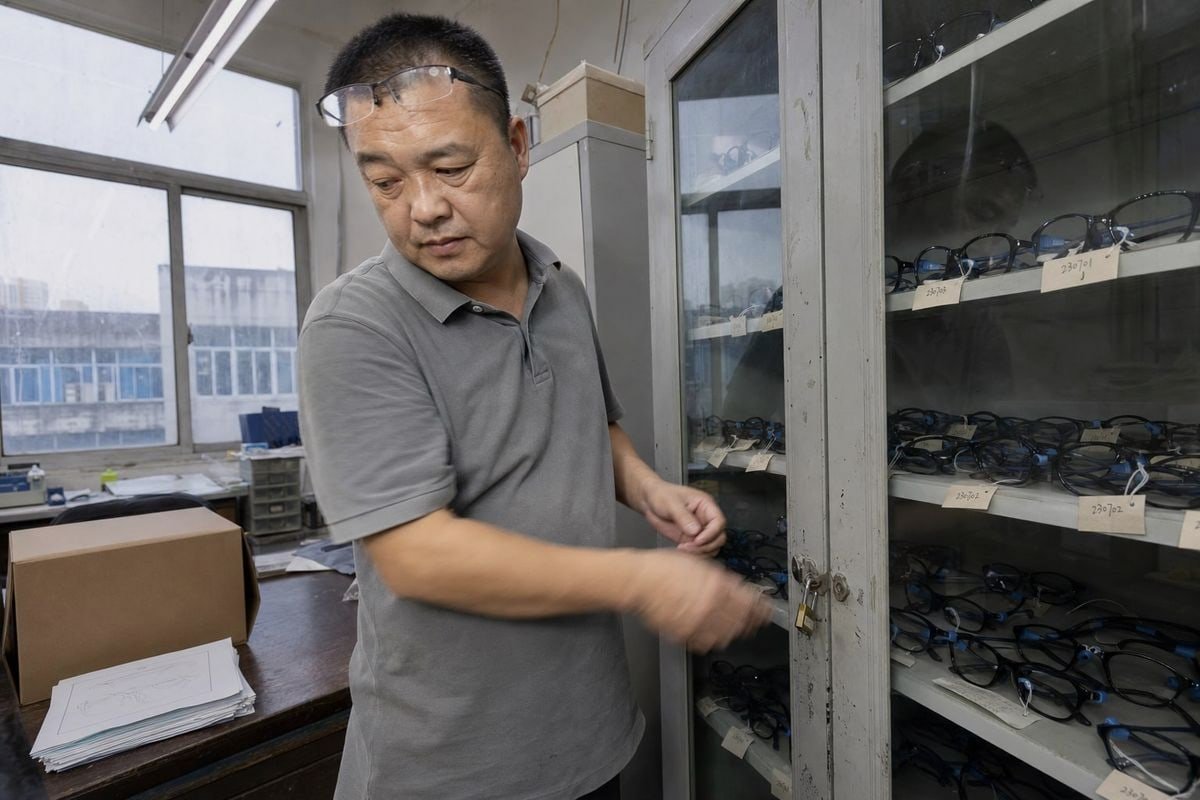
You need to prevent suppliers from reselling your kids’ optical frame designs before you share a single CAD file. In our Taizhou workshop, I have seen what happens when brands skip that step. A founder spends a year perfecting a flexible TR90 frame 1, ships the drawings to three quote-hunting factories, and six months later a near-identical frame appears on a B2B marketplace under someone else’s name. The damage is quiet, hard to trace, and expensive to undo. The good news is that prevention is engineered, not lucky — and it is far cheaper than litigation.
To prevent suppliers from reselling kids’ optical frame designs, layer your protection: sign an NNN agreement before disclosure, register design patents and trademarks in the manufacturing country, lock mold ownership into your manufacturing agreement, compartmentalize what each supplier sees, and monitor marketplaces after launch.
One document alone will not save you. Below, I walk through the four questions buyers ask us most often, and I answer them from the factory floor side of the table.
How can I use NDAs and contracts to legally protect my kids' optical frame designs?
A brand owner from Australia once emailed me a full tech pack — hinge tolerances, colorways, packaging art — before we had signed anything. I asked her to stop and send a contract first. She was surprised a factory would say that. We did, because a supplier who respects paperwork before payment is the supplier you want.
A generic NDA is not enough. Use an NNN agreement covering non-disclosure, non-use, and non-circumvention, written in the factory's local language and enforceable in local courts. Add explicit IP ownership, mold ownership, and breach penalty clauses to your manufacturing agreement.
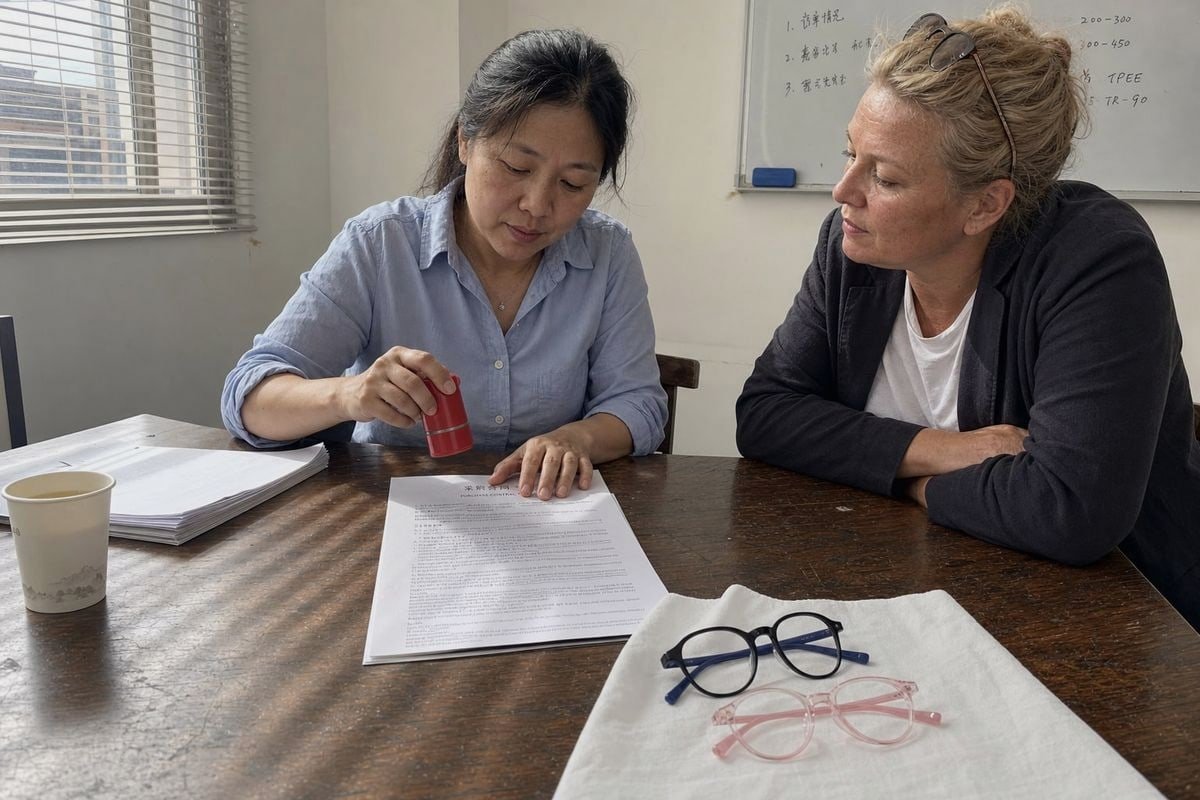
The biggest mistake I see is treating a Western-style NDA as a magic shield. Most NDAs only cover secrecy. They say nothing about a factory using your design for its own catalog, or circumventing you to sell directly to your retailers. That is why the careful advice always points to an NNN agreement 2 instead.
What an NNN agreement must actually cover
An effective NNN agreement for eyewear covers three separate promises. Non-disclosure stops the factory from sharing your files. Non-use stops the factory from producing your frame for itself or another client. Non-circumvention stops the factory from going around you to your customers or distributors. Miss any leg and you leave a door open.
Enforceability matters just as much as content. If your factory is in China, the agreement should be bilingual (English and Chinese), governed by Chinese law, enforceable in a Chinese court, and stamped with the manufacturer's official company chop. A beautifully drafted contract that only a New York court can enforce is close to useless against a Taizhou workshop.
Contracts do not create ownership — registration does
Here is a buyer objection I hear often: "My contract says I own the design, so I'm covered." Not quite. A contract binds only the party who signed it. If a third party copies your frame, your contract is irrelevant. That is why you pair contracts with registered intellectual property rights 3 — a design patent 4 for the frame's appearance and trademark registration for your brand name and logo. Crucially, register in the manufacturing country before sharing files, because most manufacturing hubs run on a first-to-file basis, not first-to-use.
| Legal Tool | What It Protects | When to Put It in Place |
|---|---|---|
| NNN Agreement | Disclosure, use, and circumvention by your supplier | Before sending any drawing or sample |
| Design Patent | The ornamental look of the frame | Before disclosure; file in target and manufacturing markets |
| Trademark Registration 5 | Brand name, logo, and packaging identity | Before production; first-to-file jurisdictions first |
| Manufacturing Agreement | Ownership of molds, samples, drawings, and derivative works | Before tooling payment |
Be realistic, too. Some frame shapes are too common or too functional to monopolize with a single filing. A rounded rectangular kids' frame silhouette, by itself, may not be registrable everywhere. Protect what is distinctive — your specific temple pattern, your colorway system, your brand — and use contracts to cover the rest.
What should I look for in a manufacturing partner to reduce the risk of design theft?
Every quotation we send involves a trade-off I think about carefully: how much do we show a prospective buyer, and how much should they show us? The same calculation should run in your head when you evaluate a factory. A partner's attitude toward your confidentiality tells you how they treat everyone's.
Choose a real factory, not a trader, with a track record serving branded clients, willingness to sign an NNN agreement, documented file-access controls, employee confidentiality agreements, sample tracking procedures, and transparent references. Export-oriented factories have stronger commercial incentives to protect proprietary designs.
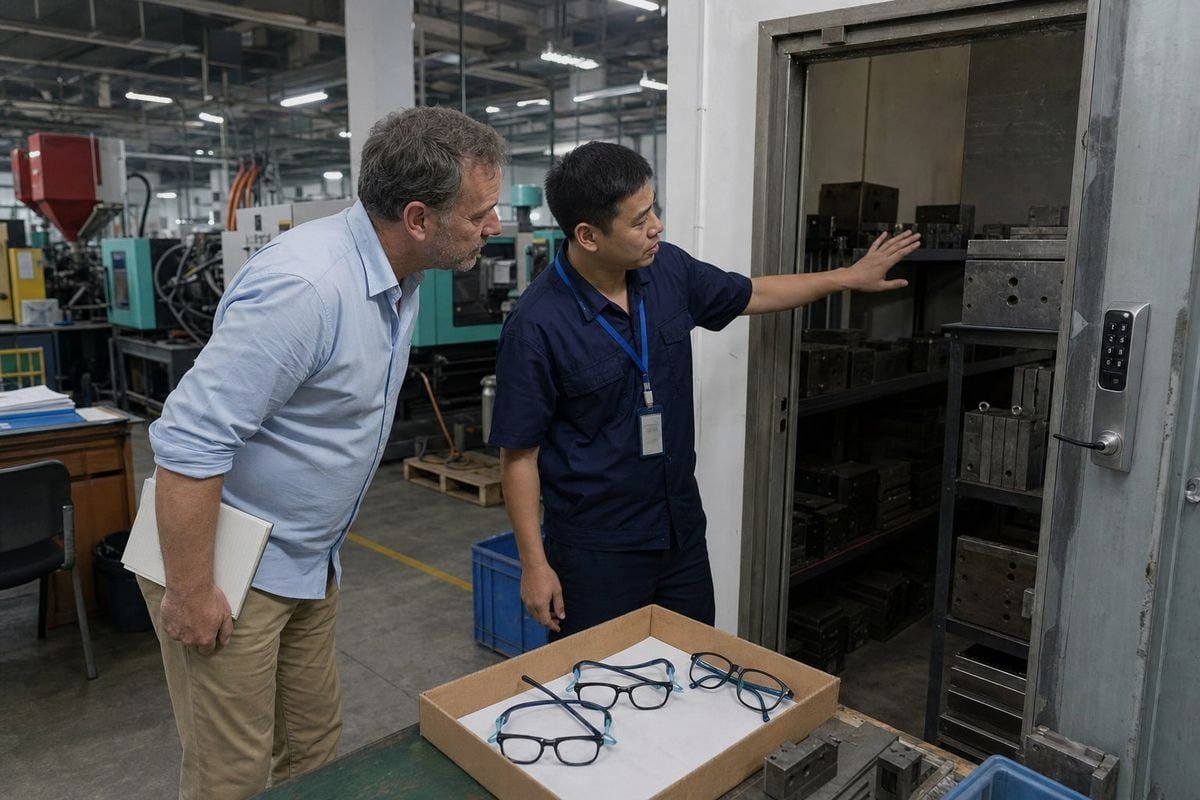
Design theft rarely starts with a villain. It usually starts with sloppiness: a sales rep forwarding your tech pack to a subcontractor, a sample left on a showroom shelf, a mold reused because nobody said not to. So when you audit a potential partner, you are really auditing their discipline.
Signals worth checking before you commit
First, confirm you are dealing with a factory, not a trading company. Traders route your files through factories you never meet, which multiplies your exposure. At our own facility, buyers can video-tour the workshop, meet the engineers, and see our 5S-managed production lines — a trader cannot offer that, because there is nothing behind the curtain.
Second, look at their client mix. A factory that lives on OEM manufacturing 6 for international brands has skin in the game. One leaked design can end relationships worth years of orders. Their incentive structure protects you. A factory that mainly sells its own generic stock on B2B platforms has weaker reasons to keep your files private.
Third, test their paperwork reflexes. Send them your NNN agreement and watch the reaction. A professional partner reviews it, negotiates reasonable points, and signs with the company chop. A partner who stalls, waves it off as "unnecessary between friends," or refuses local-law jurisdiction is showing you exactly how a dispute would go.
| Green Flag | Por Que Importa |
|---|---|
| Signs a local-language NNN without drama | Shows they expect to be held accountable |
| Existing catalog of their own styles | Less hungry to copy yours; check ours has ~800 styles buyers can license instead of tooling from scratch |
| Employee confidentiality agreements in place | Leaks usually come from individuals, not companies |
| Documented sample control and disposal | Prototype leakage is a top imitation pathway |
| Long-tenure branded clients as references | Their reputation is collateral for your designs |
One more practical point buyers overlook: relationships help, but they are not a substitute for controls. I genuinely believe trust between a brand and a factory is the foundation of good product development. I also insist my own clients put everything in a manufacturing agreement anyway. Trust and paperwork are partners, not rivals.
How do exclusive tooling and mold ownership agreements help safeguard my designs?
Years of running injection tooling 7 for children's frames taught me a lesson the hard way: the mold is the design. Drawings can be redrawn and samples can be reverse-engineered, but a steel mold reproduces your frame perfectly, at scale, at midnight, without your knowledge. Control the mold and you control the single most dangerous asset in the chain.
Mold ownership clauses in your manufacturing agreement make you the legal owner of custom tooling. Combined with engraved ownership marks, wrapped storage between runs, batch traceability, and mandatory return or destruction after production, they make unauthorized ghost-shift production detectable and legally actionable.
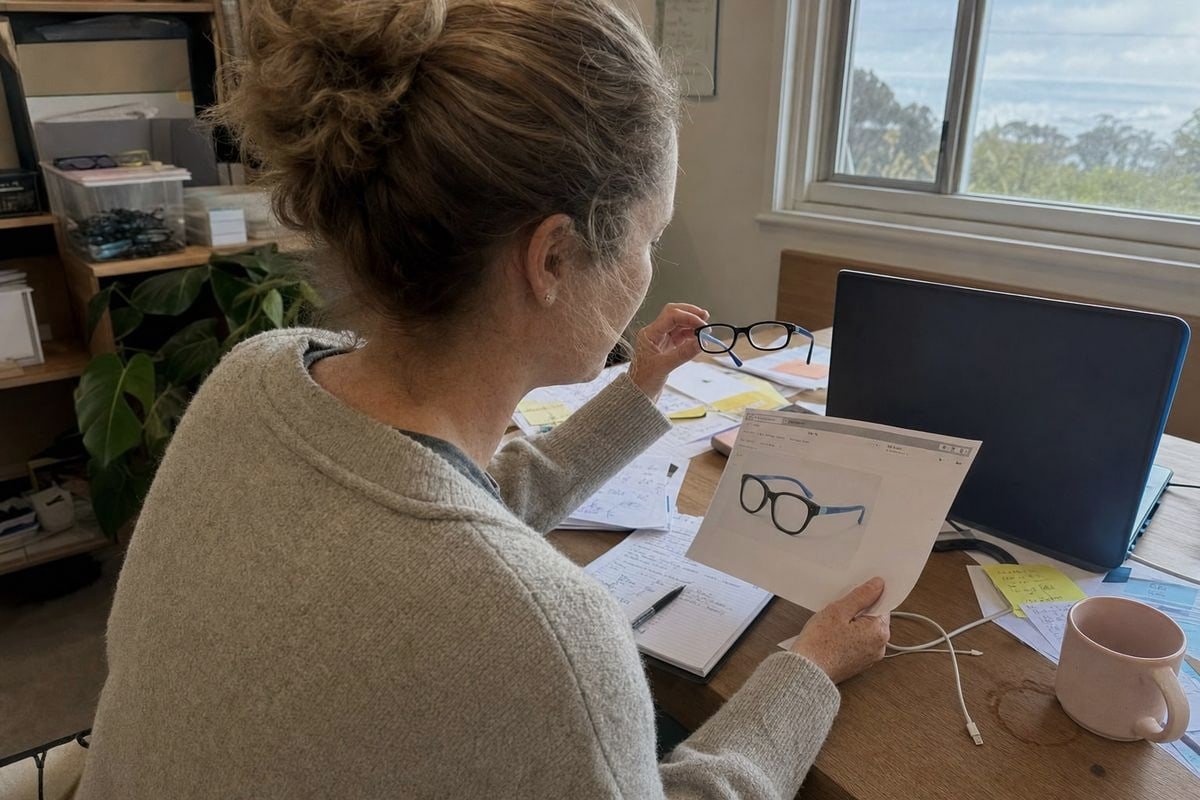
When a buyer pays for custom tooling at our factory, that mold belongs to them — and the contract says so explicitly. This is not generosity. It is how professional OEM manufacturing should work, and it is your strongest eyewear-specific lever, because generic product-protection advice rarely mentions it.
A practical mold-control checklist
Here is the process I recommend to every brand commissioning custom kids' frames:
- Put ownership in writing. Your manufacturing agreement should state that you own all molds, tooling, drawings, master samples, and derivative works, and that the factory holds them only as a custodian.
- Engrave the steel. Have your ownership mark or a serial number etched directly into the mold cavity block. If frames from that mold ever surface elsewhere, the tooling itself becomes evidence.
- Control storage between runs. Require molds to be wrapped, tagged, and stored separately from the factory's general tooling, with a log of every mounting and dismounting.
- Demand batch traceability. A capable factory can tell you which line, which day, and which operator produced a given batch. If suspicious units appear on the market, traceability tells you whether they came from your mold.
- Define the endgame. At the end of the relationship, the contract should mandate return of the tooling or verified destruction, ideally confirmed by a third-party inspector before the final payment releases.
Colorways and master samples extend the same logic
Tooling control extends beyond steel. For kids' eyewear, exclusive colorway specifications are a real contractual lever — our two-tone TPEE temple designs and silicone hinge connectors are defined by exact color and texture specs, and a contract can bar the factory from offering those combinations to anyone else. Keep a signed master sample for every SKU and compare each batch against it. Deviation is your early-warning system.
For brands not ready for tooling investment at all, there is a lower-risk path: launching from a factory's existing style library — we maintain roughly 800 — under your own trademark registration. No custom mold means no custom mold to steal, and you can move to proprietary tooling once volumes justify it.
What red flags indicate a supplier might be reselling my kids' eyewear designs to competitors?
A European client once forwarded me a marketplace listing and asked, quietly, whether the pink translucent acetate frame in the photo was hers. It was not our production — but the incident showed me how brands actually discover leaks: too late, by accident, from a screenshot. You can do much better with deliberate monitoring.
Warning signs include your exact frame geometry appearing in the supplier's catalog or on B2B platforms, unexplained material consumption or yield gaps, resistance to unannounced audits, vague answers about mold storage, gray-market units surfacing in your channels, and the factory suddenly quoting your competitors similar designs.
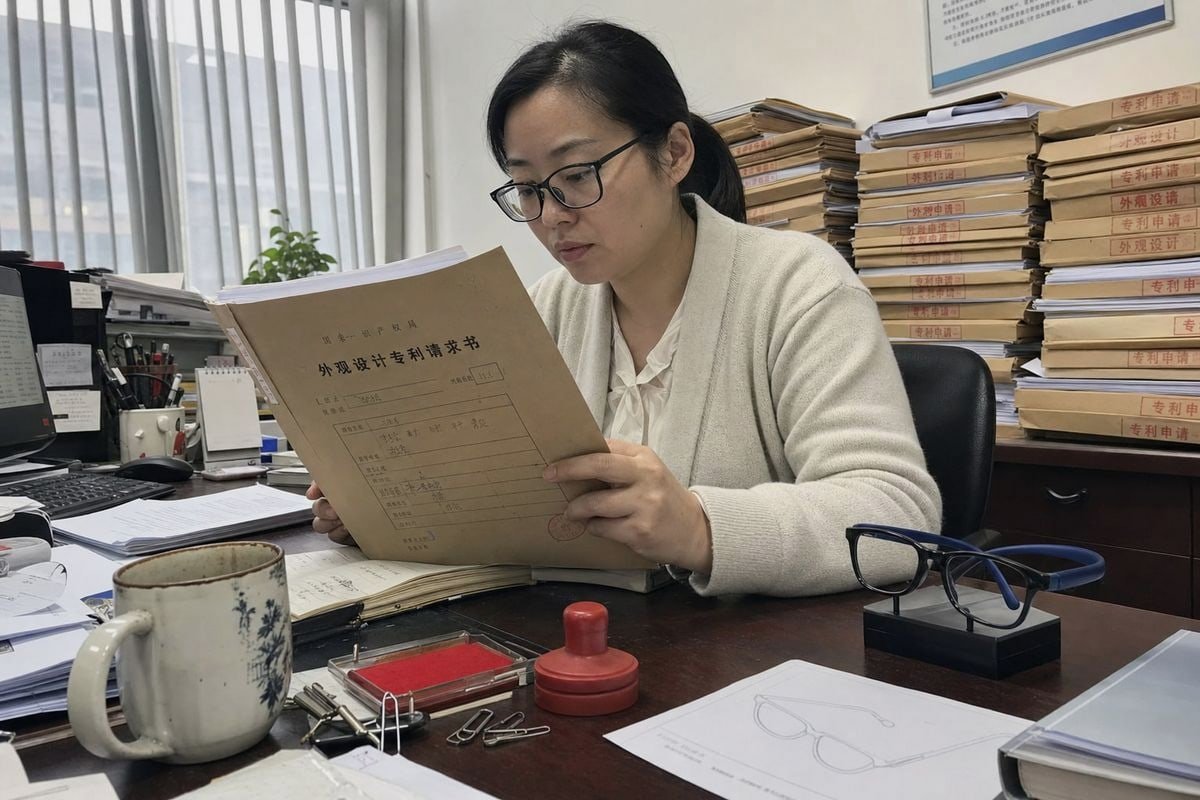
First, be precise about what "reselling" means, because the remedy depends on the misconduct. There are four distinct patterns, and each leaves different fingerprints.
| Type of Misconduct | Como Parece | Primary Remedy |
|---|---|---|
| Direct design resale | Your exact frame sold to another brand | NNN breach claim plus design patent enforcement |
| Derivative copying | A near-identical line built from your drawings | Non-use clause and IP infringement action |
| Overrun diversion | Excess authorized units leaking into gray markets | Batch traceability, quantity audits, contract penalties |
| Tooling reuse | Your mold, lens shape, or colorway run for a competitor | Mold ownership clause and audit evidence |
Operational red flags inside the factory
Watch material consumption against output. If the factory buys enough TR90 pellets or acetate sheet 8 for 12,000 frames but reports 10,000 delivered, ask where the difference went. Legitimate scrap rates are consistent; ghost shifts are not. Watch behavior around audits, too. A partner with nothing to hide welcomes unannounced visits and shows you the wrapped, tagged molds. A supplier who needs three weeks' notice before you can see your own tooling is telling you something. Also notice quoting behavior: if a supplier starts pitching your competitors frames with your hinge pattern or dotted temple texture, your files have traveled.
Market-side detection
After launch, run regular marketplace sweeps. Reverse image search your product photos monthly. Newer AI-driven visual recognition tools can scan for your frame silhouette across e-commerce sites even when the seller strips your brand name from the listing. Some brands go further and embed covert markers — laser-etched micro codes inside the temple — so a seized frame can be traced to a specific mold and batch.
If you find infringement, do not fire off an angry email. Preserve evidence first: screenshots with dates, purchased samples, correspondence. Then send a concise, professional demand backed by your registered intellectual property rights and your non-circumvention clause. Marketplace takedowns and customs recordals often resolve matters faster and cheaper than court — and a supplier who knows you monitor is a supplier who thinks twice.
Conclusão
Prevention beats litigation. Layer an NNN agreement, design patent filings, mold ownership, supply chain security, and monitoring — and choose a factory whose reputation depends on protecting your kids' frame designs.
Notas de rodapé
1. Technical thermoplastic material known for being lightweight and flexible, commonly used in children’s eyewear. ↩︎
2. Specialized contract used in international manufacturing to protect against disclosure, use, and circumvention. ↩︎
3. Global legal standards for protecting and enforcing ownership of creative designs and brand identifiers. ↩︎
4. Legal protection for the unique visual characteristics and ornamental design of a manufactured product. ↩︎
5. The process of legally protecting brand names and logos to prevent consumer confusion. ↩︎
6. Business model where a factory produces goods that are marketed and sold by another company. ↩︎
7. Authoritative technical overview of injection molding processes and mold construction. ↩︎
8. Common material used in high-quality eyewear frames, often monitored to detect unauthorized production runs. ↩︎
Mais Artigos que Você Pode Gostar
5 de agosto de 2026
Acetato de Celulose Bio-Baseado vs. Regular: Qual a Diferença para Armações Infantis?
5 de agosto de 2026
Quão Recicláveis São os Materiais de Armações Ópticas Infantis e Quais Alternativas Ecológicas Existem?
5 de agosto de 2026
As Armações Ópticas Infantis Branqueiam ou Envelhecem em Armazenamento e Como Controlar as Condições do Armazém?
Procurando um Parceiro Confiável em Óculos Infantis?
Explore mais de 800 estilos prontos e suporte completo OEM/ODM adaptado à sua marca.
Entre em Contato English
  Español de México
  Deutsch
  Français
  日本語
日本語  العربية
  Português do Brasil