How to Get a CPSC Lab Test Report and CPC for Kids Optical Frames?

Getting a CPSC lab test report and CPC for kids optical frames confuses many buyers we work with. Miss one document, and U.S. Customs can hold your entire shipment.
To get a CPSC lab test report and CPC for kids optical frames, send samples to a CPSC-accepted third-party laboratory for testing against applicable children’s product safety rules, then the U.S. importer or domestic manufacturer issues the Children’s Product Certificate based on those passing results.
The lab never issues the CPC. That single misunderstanding causes most delays. Let me walk you through the whole workflow, step by step.
How do I know which CPSC tests my kids optical frames actually need?
Last year, a buyer sent us a test request listing only lead in paint for a glossy black TR90 frame with TPEE temples. Our compliance colleague flagged three more rules they had missed.
Kids optical frames typically require testing for total lead content in substrates, lead in surface coatings, phthalates restrictions on plasticized parts, and FDA impact resistance under 21 CFR 801.410, plus permanent tracking label requirements under CPSIA for children's products.
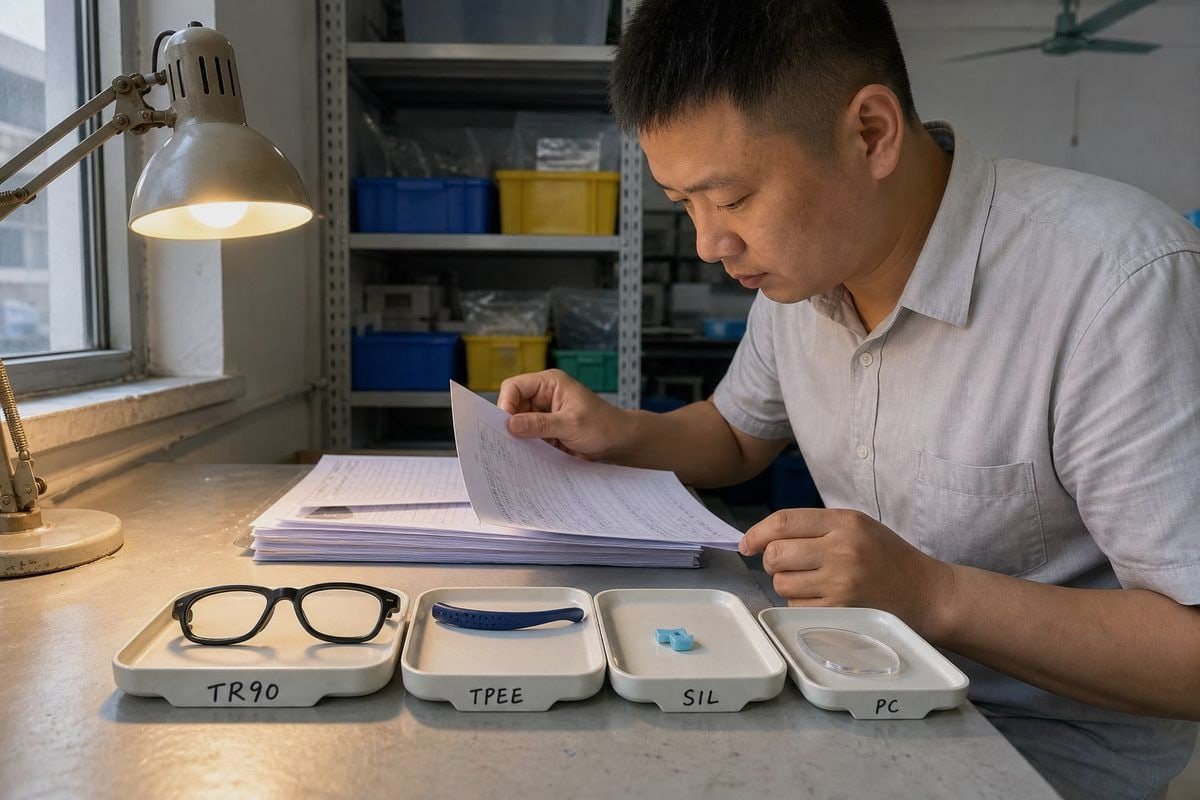
The first step is classification. You must confirm your frames are a children's product, meaning they are primarily intended for children 12 and under. Frame size, marketing images, packaging graphics, and age grading all count. If your product page shows a child model, regulators will treat it as a children's product. Misclassification leads to the wrong testing protocol, so do a real risk assessment before you contact any lab.
Once classified, map each material to a rule. This is where material declarations from your factory matter. At our workshop in Taizhou, we keep material declarations on file for every TR90, TPEE, acetate, and silicone component we use, because each material triggers different children's product safety rules.
Match each frame component to a rule
| Componente | Likely applicable rule | Why it applies |
|---|---|---|
| TR90 or acetate frame front | Total lead content limits (substrate) | All accessible substrate parts of children's products |
| Painted or coated surfaces | Lead in paint and surface coatings | Any surface coating on a children's product |
| Soft TPEE temples, silicone tips | Phthalates restrictions | Plasticized materials that children may mouth or touch |
| Demo or prescription lenses | FDA impact resistance (21 CFR 801.410 1) | All eyeglass lenses sold in the U.S. |
| Product or packaging | Tracking label requirements | Permanent markings required under CPSIA compliance |
One warning about ASTM F963 standards: those apply to toys. Optical frames are generally not toys, but novelty kids sunglasses shaped like toys can blur the line. When in doubt, ask the lab to review your exact product photos and intended use before quoting the test scope.
Can my manufacturer help me prepare for CPSC testing before I place an order?
In our experience exporting children's eyewear to 20+ countries over 15 years, buyers who involve the factory before testing spend far less on retests. The ones who test blind often pay twice.
Yes. A capable manufacturer can supply material declarations, past test reports for reference, correctly labeled production samples, and component sourcing records before you order. This pre-testing preparation reduces failure risk, shortens lab turnaround, and ensures the tested sample matches actual mass production.

A factory cannot issue your CPC, and a factory's old report usually cannot substantiate your certificate. But good preparation from the factory side is worth real money. Here is what we do for buyers before third-party testing, and what you should ask any supplier to provide.
A pre-testing checklist to request from your factory
- Material declarations for every component. Frame front, temples, silicone tips, hinges, screws, coatings, and printing inks. Restricted substances should be identified at the design phase, not after production.
- Reference test data. We keep historical test results for our TR90 and TPEE material batches. These do not replace your own testing, but they tell you the pass risk before you spend on lab fees.
- Production-representative samples. The tested sample must match what ships. Same colors, same coatings, same lens type. A sample from a different color run can invalidate your report.
- Tracking label mockups. CPSIA requires permanent markings showing manufacturer, production date, and batch information. We engrave or print these on the inner temple, and buyers approve the layout before production.
- Component consistency commitments. If we change a masterbatch or ink supplier mid-order, your test report may no longer describe your product. Ask your factory to lock the bill of materials in writing.
One more practical point. With around 800 existing styles in our catalog, many buyers pick a proven flexible frame instead of opening a new mold. That lowers testing risk too, because the materials and construction already have a compliance history behind them.
What documents and information do I need to issue a valid CPC?
A procurement manager once emailed me a one-line "certificate of compliance" from another supplier and asked if it counted as a CPC. It did not. It was missing five of the seven required elements.
A valid CPC requires seven elements: precise product identification, citation of each applicable children's product safety rule, the certifying importer or manufacturer's name and contact details, the test-records contact person, date and place of manufacture, testing dates and locations, and the CPSC-accepted laboratory's identity.

The CPC is a self-issued document. There is no government form, no filing fee, and no approval stamp. That flexibility is also the trap, because an incomplete CPC is a non-compliant CPC. Everything must be in English, including the supporting test report, and the certificate must be furnished to distributors and retailers and shown to CPSC or Customs on request. Note also that CPSC has been moving toward electronic filing (eFiling) of certificate data with Customs for imports, so keep your CPC data clean and digital-ready.
The seven required CPC elements
| # | Required element | Common mistake we see |
|---|---|---|
| 1 | Product identification | Description too vague to match one specific model |
| 2 | Each applicable safety rule cited | Listing only lead in paint, omitting substrate lead and phthalates |
| 3 | Certifier name, address, phone | Listing the Chinese factory instead of the U.S. importer |
| 4 | Test records contact person | Field left blank or pointing to the lab |
| 5 | Date and place of manufacture | Only a country name, no city or month |
| 6 | Date(s) and place(s) of testing | Missing entirely, or not matching the report |
| 7 | CPSC-accepted lab identification | Naming a lab not accepted for the relevant scope |
Certificate, summary, or full report?
Buyers often confuse three documents. A full test report shows actual measured results per component, with photos, dated and signed by the lab. A test summary is a one-page pass statement, useful for quick review but weak as evidence. The CPC is your own written certification built on the full report. Marketplaces such as Amazon increasingly ask for the actual third-party report, and they cross-check that the model number, rules, and lab on the CPC match the report exactly. Keep all three aligned, word for word.
How long does the whole CPSC testing and CPC process usually take?
The trade-off I weigh most often with buyers is speed versus certainty. Rushing samples to a lab before locking materials saves a week on paper, then costs three weeks in retesting when a coating changes.
Plan for roughly three to six weeks in total. Confirming test scope and choosing a CPSC-accepted laboratory takes about one week, laboratory testing typically takes one to three weeks, and drafting and verifying the CPC takes a few days once passing results arrive.

Timelines vary by lab workload, test scope, and how clean your paperwork is. Based on the orders we support from our Taizhou factory, here is a realistic breakdown for a first-time importer of kids optical frames.
Typical timeline from sample to certificate
| Estágio | Typical duration | What slows it down |
|---|---|---|
| Product classification and rule mapping | 2–5 days | Unclear age grading, missing material declarations |
| Selecting a CPSC-accepted laboratory | 2–4 days | Lab not accepted for the specific test scope |
| Shipping production samples to the lab | 3–7 dias | Sending pre-production samples that differ from bulk |
| Third-party testing | 7–20 days | Phthalates plus lead plus impact testing queued separately |
| Report review and CPC drafting | 2–4 days | Report and CPC details that do not match |
Two verification steps deserve extra time. First, check the lab on CPSC's official accepted-laboratory search tool before you pay. General ISO/IEC 17025 accreditation alone is not enough; the lab must be CPSC-accepted for the exact tests your frames need. Second, before finalizing the CPC, compare the model number, product photos, tested rules, test dates, and lab identity against the report line by line. Component-part testing can sometimes support the certificate, but the certification must still reflect the finished frames as sold. Then build in ongoing discipline: periodic re-testing when materials or suppliers change, and supplier audits so your compliance evidence stays current, not frozen at your first order.
Conclusão
Getting a CPSC lab test report and CPC for kids optical frames is a workflow, not a purchase. Test at a CPSC-accepted lab, then certify carefully as the importer.
Notas de rodapé
1. Details the specific FDA regulation for impact resistance of eyeglass and sunglass lenses. ↩︎
Mais Artigos que Você Pode Gostar

5 de agosto de 2026
Acetato de Celulose Bio-Baseado vs. Regular: Qual a Diferença para Armações Infantis?

5 de agosto de 2026
Quão Recicláveis São os Materiais de Armações Ópticas Infantis e Quais Alternativas Ecológicas Existem?
5 de agosto de 2026
As Armações Ópticas Infantis Branqueiam ou Envelhecem em Armazenamento e Como Controlar as Condições do Armazém?
Procurando um Parceiro Confiável em Óculos Infantis?
Explore mais de 800 estilos prontos e suporte completo OEM/ODM adaptado à sua marca.
Entre em Contato English
  Español de México
  Deutsch
  Français
  日本語
日本語  العربية
  Português do Brasil