How Do I Convert Factory Style Numbers Into SKUs for Kids’ Optical Frames?

Buyers often ask me how to convert factory style numbers into SKUs for kids’ optical frames. They receive our catalog codes, then their POS rejects duplicates, listings clash, and reorders stall. Our production team sees this confusion weekly — and it is completely avoidable.
To convert factory style numbers into SKUs for kids’ optical frames, keep the supplier style number as the base, then append fixed codes for color, size, and material. Use one consistent formula, such as KID-KM0005-BLK-46, and record the mapping in a translation table.
That formula sounds simple. But the details decide whether your inventory runs smoothly or breaks. Let me walk you through what to include, how to stay consistent, and what to avoid.
What Information Should I Include When Building SKUs From Factory Style Numbers?
During a recent order review with a European importer, I noticed their spreadsheet listed our TR90 kids optical frame three times under one style code. Three colors, one code — and their eyewear inventory management collapsed at reorder time.
A kids' optical frame SKU should include the factory style number, a color code, a size indicator based on lens width or full frame dimensions, and optionally a material or age-band code. These four optical frame attributes cover picking, filtering, and reordering needs.

First, understand the difference between three codes that look similar but do different jobs. A factory style number identifies the model in the supplier's catalog. A frame size code, like 46-17-130, records the frame dimensions in millimeters — lens width, bridge width, and temple length 1. A SKU is your internal stock keeping unit structure 2, built for your own system. The style number alone is not a SKU. It usually does not change when the color changes, so it cannot separate your blue frame from your pink one.
The Four Core Attributes
For children's eyewear, size matters more than in adult lines. Kids' frames cluster in narrow bands — roughly 41–46 mm lens width for ages 4–6, 46–48 mm for ages 7–9, and 48–52 mm for ages 10–13. If your SKU hides the size, your staff cannot pick the right frame quickly, and dispensing errors rise.
| Attribute | Por Que Importa | Example Code |
|---|---|---|
| Style number | Links back to the factory catalog for reordering | KM0005 |
| Color | Separates variants that share one style number | BLK, PNK, NVY |
| Tamanho | Critical for children's eyewear sizing and fit | 46 or 46/17/130 |
| Material or age band | Useful for TR90, TPEE, or silicone-tipped frames | TR, TP, or A46 |
In our own catalog of roughly 800 existing styles, we assign one style number per model and separate color codes per variant. When your product identification system mirrors that split, your reorder emails to us become one line instead of a paragraph of clarification.
Take our two-tone black-and-navy sporty frame with silicone cable temples, and our translucent pink acetate-look frame. Both may sit in the same size band, but they need different color codes, and possibly different material codes, in your system. Encoding those optical frame attributes 3 keeps product data accuracy high across every channel you sell on.
How Do I Keep My SKU System Consistent Across Multiple Frame Colors and Sizes?
There is a trade-off I weigh whenever I help a new brand set up their codes: full measurement precision versus short, readable codes. Encoding 46-17-130 is exact, but staff scan a simple size band faster.
Keep SKUs consistent by fixing the field order, the delimiter, and the abbreviation list before launch. Use a parent SKU for each style and child SKUs for every color-size combination, and never change a code once it has shipped or sold.
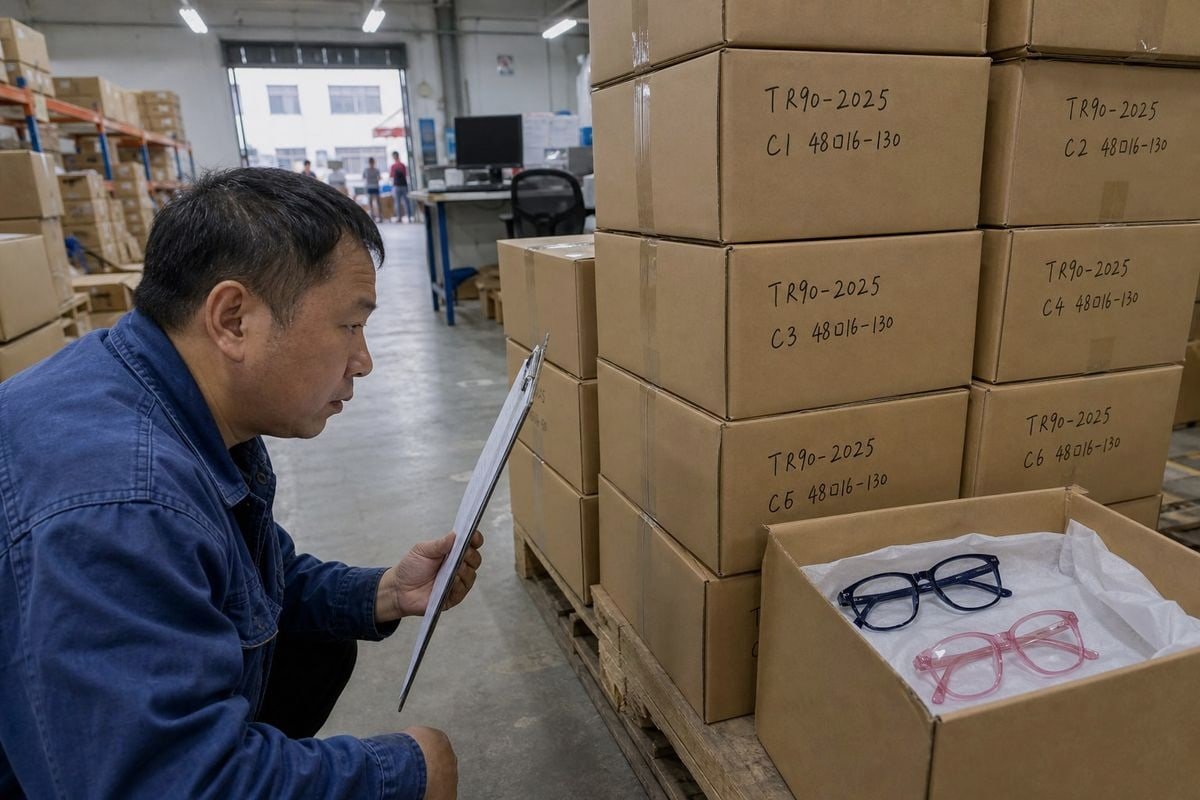
Consistency is a discipline, not a formula. The parent-child model is the backbone. The parent SKU represents the style itself, such as KID-KM0005. Each child SKU adds the variant: KID-KM0005-BLK-46, KID-KM0005-PNK-48. This structure lets you report on the whole style's performance while still tracking each variant for retail inventory optimization.
Fix Your Rules Before You Need Them
Write down your SKU nomenclature rules on one page. Decide your delimiter — a hyphen is safest, because slashes and spaces break some inventory software integration and barcode tracking tools. Decide your color abbreviations once: BLK always means black, never BK in one file and BLACK in another. Decide whether size means lens width only or the full triplet.
A simple decision guide:
- Fix the field order: category, style, color, size.
- Choose one delimiter and ban all others.
- Publish an abbreviation table for colors and materials.
- Create the parent SKU first, then generate all child SKUs at once.
- Lock codes after first sale — corrections go in the product database, not the SKU.
| Business Type | Recommended Format | Exemplo |
|---|---|---|
| Boutique optician | Short, readable | KID-KM0005-BLK-46 |
| E-commerce seller | Variant-friendly, filterable | K-KM0005-PNK-48 |
| Wholesaler / distributor | Precise, warehouse-grade | KD-KM0005-BLK-461713 |
One lesson from our 5S-managed workshop applies directly here: labels only work when everyone reads them the same way. The same is true for your codes. When one of our long-term distributors standardized their child SKUs across our sizes, their reorder accuracy improved noticeably, and mixed-size shipments stopped being a support topic between us.
Some sellers prefer fully opaque numeric SKUs, like 1169096. That works if software does all the reading. But in a pediatric dispensary where a human grabs a 46 mm frame off a board, a human-readable code prevents mis-keys and wrong picks.
Can I Align My SKU Structure With OKAY EYEWEAR's Style Numbering for Easier Reordering?
A procurement manager from Australia once emailed our team a reorder list of internal codes with no mapping back to our styles. It took three back-and-forth emails to confirm which frames she meant. That experience shaped how we now advise every buyer.
Yes. Embed the OKAY EYEWEAR style number unchanged inside your SKU, add your own prefix and variant suffixes, and maintain a translation table mapping each internal SKU to our style number and color code. Reorders then need only your table, not guesswork.

The safest approach is model number conversion by extension, not replacement. Keep our style number intact as the core of your SKU. If our catalog lists a TR90 frame with TPEE temples as style OK-8012 in navy and pink, your SKUs might read KID-OK8012-NVY-46 and KID-OK8012-PNK-46. Anyone on your team — or ours — can trace the code back to the source style in seconds.
Build a Translation Table on Day One
A translation table 4 is a simple spreadsheet or database view. One row per variant. It becomes the single source of truth connecting your storefront, your POS, and our factory catalog.
| Your SKU | Factory Style | Factory Color | Tamanho | Material | Age Band |
|---|---|---|---|---|---|
| KID-OK8012-NVY-46 | OK-8012 | NVY | 46-17-125 | TR90/TPEE | 7–9 yrs |
| KID-OK8012-PNK-46 | OK-8012 | PNK | 46-17-125 | TR90/TPEE | 7–9 yrs |
| KID-OK8020-BLK-48 | OK-8020 | BLK | 48-18-130 | TR90/TPEE | 10–13 yrs |
Two practical notes from our side of the relationship. First, MOQs typically apply per style and per colorway, so a clean table helps you plan orders across age brackets and avoid accidental under-minimum requests. Second, when you order OEM/ODM versions — custom colors, your logo on the temple, your packaging — we can assign a dedicated style variant code for your exclusive version. Your SKU then maps to your custom spec, not the open-catalog item, which protects product data accuracy as your line grows.
Store secondary details — lens type, UV400 rating, packaging version — as database attributes, not SKU segments. Attributes can change; shipped SKUs should not.
What Mistakes Should I Avoid When Creating SKUs for a New Kids' Optical Frame Collection?
Fifteen years of exporting children's eyewear has shown our team the same handful of SKU mistakes, repeated across new brands in twenty-plus countries. Most are cheap to prevent and expensive to fix after launch.
Avoid ambiguous characters like O and 0, overly long codes, missing size fields, reusing SKUs for revised frames, and creating one SKU for multiple colors. Also avoid changing a live SKU; instead, version the product record and keep historical codes intact.

The most damaging mistake is the one my European importer made: one SKU covering several colors. Sales reports then show a style "selling well" while one colorway is actually dead stock. Every distinct color, size, and material combination needs its own child SKU — no exceptions.
The Mistakes That Hurt Most
Ambiguous characters come next. The letter O and the number 0, I and 1, look identical on a picking label. When a tired staff member keys a barcode manually, these characters cause mis-picks. Choose one, ban the other, and keep barcode tracking clean.
Skipping the size field is a kids-specific error. Adult retailers sometimes get away with size-free SKUs. Children's ranges cannot. Lens widths run from roughly 36–39 mm for toddlers up to 49–52 mm for young teens. Two otherwise identical frames in different sizes are different products. Your SKU must say so.
Then there is silent SKU reuse. Suppose we upgrade a frame's temple material from standard TR90 to TR90 with softer TPEE tips at your request. If you keep the old SKU, your historical data mixes two different specs. Instead, use light version control: retire the old code, issue a new child SKU, and note the change in your product database. This keeps inventory discrepancies from creeping into your reporting.
Finally, resist over-encoding. A code carrying material, safety certification, lens type, warehouse zone, and season becomes unreadable. Encode what staff use to pick and reorder — style, color, size — and let your inventory software carry everything else as attributes. If you expect future variants, such as blue-light lens options, simply reserve a suffix position now rather than inventing codes you do not need yet.
Conclusão
Messy codes quietly drain margin through mis-picks and stalled reorders. Convert factory style numbers into structured SKUs — style, color, size, mapped in one table — and your kids' frame inventory runs itself.
Notas de rodapé
1. Explains the standard measurements for eyeglass frames and their significance. ↩︎
2. Defines Stock Keeping Unit (SKU) as an internal identifier for inventory tracking. ↩︎
3. Provides a glossary of terms related to eyewear, including various frame and lens attributes. ↩︎
4. Clear definition and explanation of a translation table in a data context. ↩︎
Mais Artigos que Você Pode Gostar
5 de agosto de 2026
Acetato de Celulose Bio-Baseado vs. Regular: Qual a Diferença para Armações Infantis?

5 de agosto de 2026
Quão Recicláveis São os Materiais de Armações Ópticas Infantis e Quais Alternativas Ecológicas Existem?
5 de agosto de 2026
As Armações Ópticas Infantis Branqueiam ou Envelhecem em Armazenamento e Como Controlar as Condições do Armazém?
Procurando um Parceiro Confiável em Óculos Infantis?
Explore mais de 800 estilos prontos e suporte completo OEM/ODM adaptado à sua marca.
Entre em Contato English
  Español de México
  Deutsch
  Français
  日本語
日本語  العربية
  Português do Brasil