On-Site vs Third-Party Audits: How Do They Differ in Coverage for Kids Optical Frames Suppliers?
On-site vs third-party audits 1 is a question buyers ask me weekly at our Taizhou factory. Choose wrong, and a hidden resin swap or expired test report reaches shelves under your brand.
On-site audits cover physical factory reality—equipment, material storage, process control, working conditions, and whether corrective actions are truly implemented. Third-party audits cover standardized, documented verification against frameworks like ISO 9001 or SMETA. For kids optical frames suppliers, they address different risk layers and work best combined.
The two methods are not substitutes. They look at different things. Below, I break down exactly what each covers, where each fails, and how to sequence them when qualifying a children’s eyewear supplier.
What does an on-site audit actually cover that a third-party report might miss for kids optical frames suppliers?
Last spring, a German buyer spent two days walking our injection workshop. He later told me his third-party report had never once mentioned our raw-resin storage room.
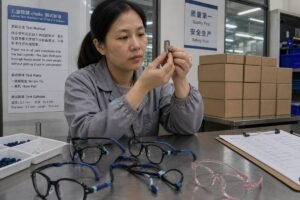
An on-site audit covers what reports miss: real material storage, resin invoice cross-referencing to prevent TR90 substitution, day-to-day manufacturing process control, in-house test equipment calibration, and whether corrective actions were actually implemented—not just documented—on the production floor.
Here is how the coverage actually splits, based on what auditors do in each format:
| Coverage Area | On-Site Audit | Third-Party Report |
|---|---|---|
| Factory legitimacy and real capacity | Verified physically | Verified via documents and a sampled visit |
| Material authenticity (TR90, TPEE) | Warehouse check plus invoice cross-referencing | Rarely covered in depth |
| Manufacturing process control | Observed under normal production pressure | Snapshot against a checklist |
| Quality management system depth | Tested in practice, end to end | Assessed against the standard's clauses |
| Test equipment calibration | Checked at the machine | Certificate review only |
| Corrective action implementation | Confirmed on the floor over time | Tracked as a workflow status |
Why the Chain of Evidence Matters for TR90
Material substitution is the quiet risk in children's frames. A dishonest factory can replace genuine TR90 2 with cheaper plastics that look identical when molded. Only a physical warehouse inspection—matching resin bags, purchase invoices, and batch codes on the production floor—builds a chain of evidence a paper report cannot. When buyers visit us, I hand them our resin invoices unprompted, because this is exactly where trust is won or lost.
Audit-Ready vs Everyday Discipline
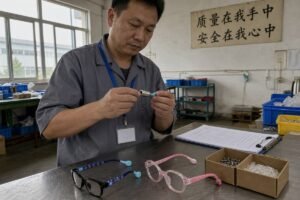
A factory can be "audit-ready" for one scheduled day yet sloppy the other 364. On-site auditors watch how operators handle rejects, whether batch coding 3 is applied in real time, and whether our 5S-managed workshop looks lived-in or staged. Advanced audits now even review IoT sensors on injection molding machines, monitoring real-time pressure and temper
Footnotes
1. ISO provides the international framework for third-party audits and conformity assessment to ensure global quality standards. ↩︎
2. ISO 12870 specifies the fundamental requirements and testing methods for spectacle frames and their materials. ↩︎
3. NIST provides resources for manufacturing standards and traceability, which are essential for verifying batch coding and material origin. ↩︎
More Articles You Might Like

Looking for a Reliable Kids Eyewear Partner?
Explore 800+ ready styles and full OEM/ODM support tailored to your brand.
Get in Touch English
  Español de México
  Deutsch
  Français
  日本語
日本語  العربية
  Português do Brasil