What Tools and Cleaning Agents Are Safe for Kids’ Sunglasses?
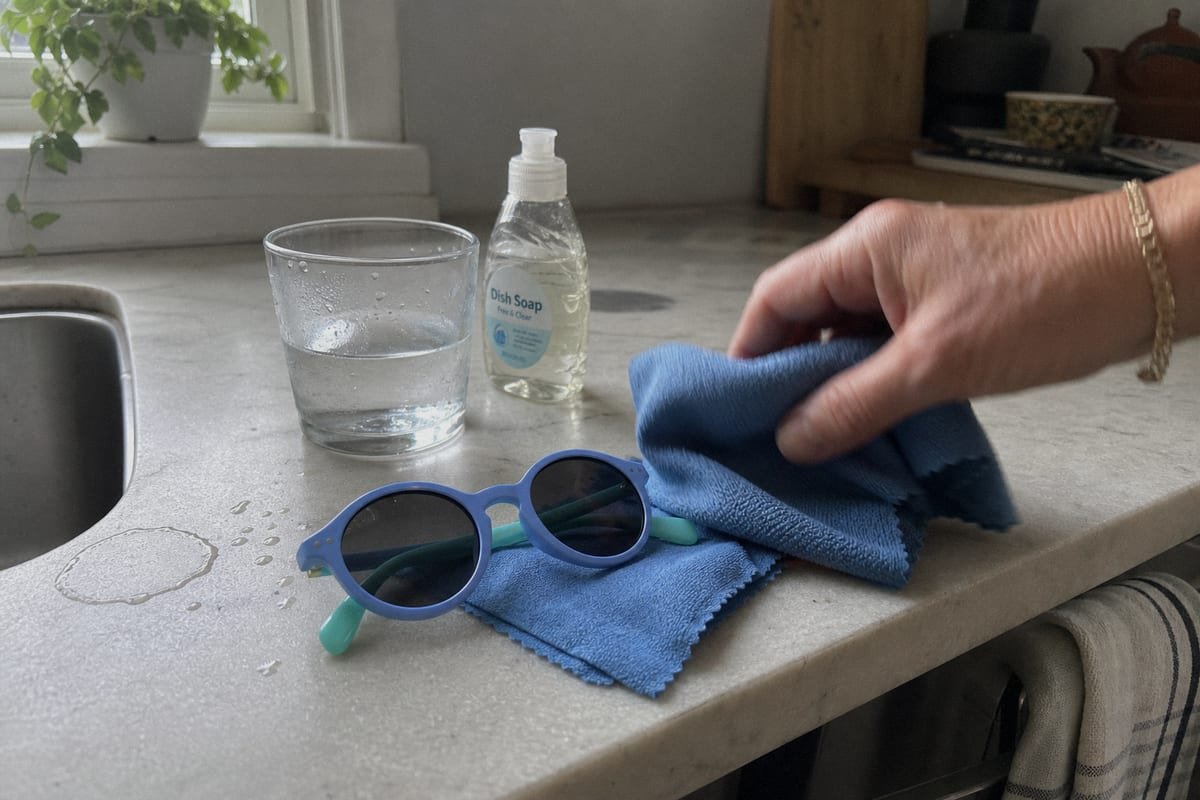
Parents constantly ask me which tools and cleaning agents are safe for kids’ sunglasses, because on our production line I see how quickly the wrong cleaner ruins a lens.
The safest tools and cleaning agents for kids’ sunglasses are a clean microfiber cleaning cloth, lukewarm water, and one drop of mild, lotion-free dish soap or an alcohol-free, ammonia-free lens spray. Avoid paper towels, glass cleaners, vinegar, and hot water, which damage coatings.
The good news is that safe cleaning does not require special equipment ポリカーボネートレンズのケア 1. Below, I break down what works at home, what to avoid, and what retail buyers should include in their eyewear kits.
What household items can I safely use to clean my kids' sunglasses at home?
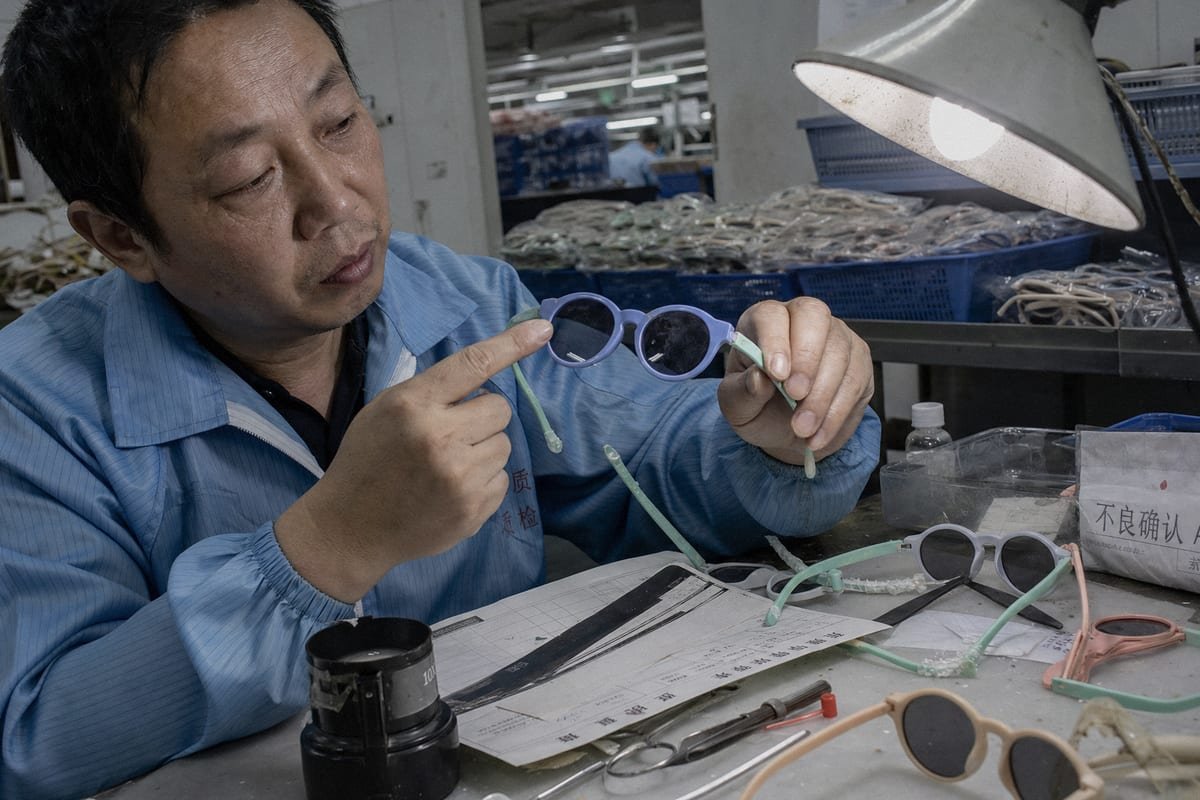
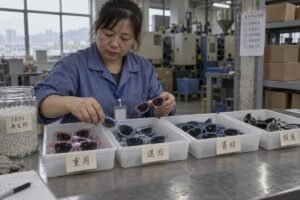
During a quality check at our Taizhou factory last spring, a returned sample taught us something simple: most "lens damage" complaints actually start in the family kitchen sink.
Safe household items for cleaning kids' sunglasses include a lukewarm water rinse, one drop of mild dish soap without lotion, a dedicated microfiber cleaning cloth, and clean fingertips. Rinse first to remove grit, wash gently, rinse again, then dry with microfiber only.
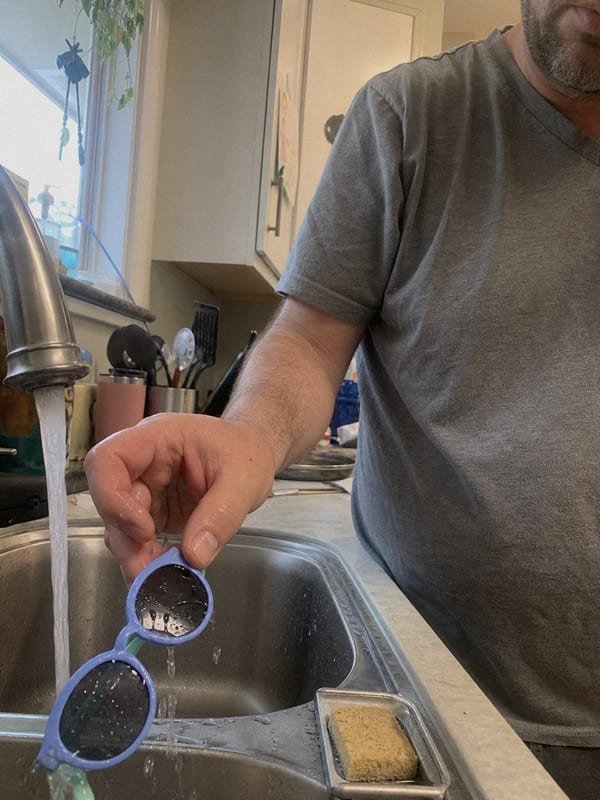
You almost certainly already own everything you need. The trick is using these items in the right order. Kids' sunglasses collect sand, sunscreen, snack grease, and fingerprints. If you wipe first without rinsing, that grit acts like sandpaper on the lens. That is how most micro-scratches happen — not from drops, but from careless wiping.
The safe home cleaning routine, step by step
- Hold the sunglasses under a lukewarm water rinse for ten seconds. This flushes away sand and dust before anything touches the lens.
- Apply one small drop of mild dish soap to your fingertips. Choose a lotion-free formula, because moisturizers leave a film on lenses.
- Gently rub the lenses, frame, nose bridge, and temple tips.
- 石鹸が残らないように、徹底的にすすぎます。.
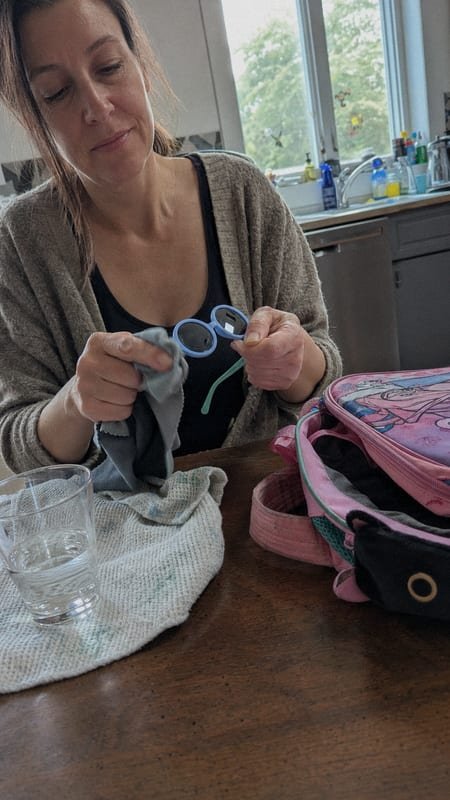
- Shake off excess water and dry with a clean マイクロファイバークリーニングクロス 2. Or simply let them air-dry.
Which household items pass the safety test?
| Household Item | 安全ですか? | 理由 |
|---|---|---|
| Lukewarm tap water | はい | Removes abrasive particles before wiping |
| Mild, lotion-free dish soap | はい | Dissolves oils and sunscreen without harming coatings |
| Microfiber cloth (clean) | はい | Lifts smudges without scratching |
| Paper towels or tissues | いいえ | Wood pulp fibers cause micro-scratches |
| Shirt tails or clothing | いいえ | Fabric traps grit and drags it across lenses |
| 熱湯 | いいえ | Heat can warp frames and stress lens coatings |
In our experience shipping to families in 20+ countries, this simple routine handles ninety percent of everyday grime. Non-toxic cleaning solutions matter especially for children, because residue on nose pads sits directly against sensitive skin all day.
Which cleaning agents should I avoid because they damage TR90 or TPEE lenses and frames?
Flexible-material expertise is the core of what we build, and after fifteen years molding TR90 frames with TPEE temples, we know exactly which chemicals these materials tolerate — and which they do not.
Avoid ammonia-based glass cleaners, vinegar, bleach, rubbing alcohol, acetone, baking soda, and toothpaste on kids' sunglasses. These agents strip scratch-resistant coatings, cloud polycarbonate lenses, and can dry out or discolor flexible TR90 and TPEE frame materials over time.
TR90とTPEEで 3 are excellent materials for children. They flex instead of snapping, they are lightweight, and they feel soft against a child's face. But their polymer structure has a weakness: aggressive solvents. When a harsh chemical soaks into these materials repeatedly, the plasticity that makes them safe can degrade. I have examined frames returned from the field that turned brittle at the hinge area, and the culprit was almost always household cleaner, not manufacturing.
Lenses are even less forgiving. Kids' sunglass lenses are usually polycarbonate with a scratch-resistant coating and a UV400 treatment 4. Proper polycarbonate lens care means avoiding anything acidic, alkaline, or alcohol-heavy. Ammonia and vinegar chemically attack the coating layer. Once that layer clouds or peels, the lens cannot be repaired — only replaced.
The avoid list, and what each agent damages
| Cleaning Agent | Damage to Lenses | Damage to TR90/TPEE Frames |
|---|---|---|
| Ammonia glass cleaner | Strips anti-reflective and UV coatings | Dulls surface finish |
| 酢 | Etches and clouds coating layers | Can whiten matte finishes |
| Rubbing alcohol / acetone | Crazes coating, causes hazing | Dries and embrittles flexible polymers |
| Bleach | Destroys coatings and tint | Discolors pastel and matte colors |
| Toothpaste / baking soda | Abrasive particles scratch lenses | Scratches glossy frame surfaces |
| All-purpose sprays | Leaves chemical residue near eyes | Residue irritates children's skin 5 |
Why residue matters more for children
Adults notice a chemical smell and rinse again. A toddler simply puts the sunglasses on. Whatever residue sits on the nose pads transfers to skin and can migrate toward the eyes. This is why we always recommend an alcohol-free lens cleaner or plain soap and water for children's eyewear, and why buyer specifications increasingly demand it.
How do I clean scratches or smudges off polarized lenses without ruining the coating?
One trade-off we weigh constantly when specifying polarized and mirrored lenses for sport styles — like our wraparound shield designs — is that richer coatings deliver better glare protection but demand gentler cleaning.
Clean polarized lenses by rinsing with lukewarm water, washing with one drop of mild dish soap, and drying with a clean microfiber cloth. Never rub dry lenses or use abrasives. True scratches cannot be safely removed; polishing compounds destroy the polarizing and mirror layers.
First, an honest distinction. Smudges are surface oils, and they clean off easily. Scratches are physical damage cut into the coating or lens body. No safe home method removes a real scratch from a polarized lens. Internet tricks — toothpaste, baking soda paste, car wax — all work by abrasion. On a mirrored gradient lens, like the orange-to-gold shield lenses we produce for kids' sport sunglasses, abrasion grinds straight through the mirror layer and leaves a dull, blotchy patch far uglier than the original scratch.
Smudges, however, respond beautifully to gentle care. Polarized lens safety comes down to three rules. Never wipe a dry lens, because dry wiping drags particles. Never use heat, because hot water or a car dashboard can delaminate the polarizing film. Never use solvents, because alcohol and ammonia haze the mirror coating.
Smudge removal that protects the coating
- Rinse both lens surfaces under lukewarm running water.
- Apply a drop of mild dish soap and rub gently with fingertips in straight strokes, not circles.
- Rinse until the water sheets off cleanly.
- Blot — do not scrub — with a fresh microfiber cloth.
- For touch-ups between washes, use lens cleaning wipes or an alcohol-free lens cleaner labeled safe for coated lenses.
Preventing the next scratch
Prevention beats repair every time. Store sunglasses in a hard case or microfiber pouch, never lens-down in a beach bag. Replace or wash the microfiber cloth regularly; a dirty cloth becomes an abrasive tool. In our workshop, we handle mirrored lenses with dedicated cloths that get laundered on a fixed schedule, and we suggest families adopt the same habit monthly.
What cleaning tools and kits should I recommend to retail buyers for their kids' eyewear packaging?
A procurement manager from an Australian kids' brand recently asked us to build a complete retail-ready care kit around one of our pastel round frames, and the project reshaped how I think about packaging.
Retail buyers should package kids' sunglasses with a branded microfiber cleaning cloth, a microfiber pouch or hard case, a printed care card, and optionally an alcohol-free lens spray. These low-cost additions reduce warranty claims, extend product life, and increase perceived retail value.

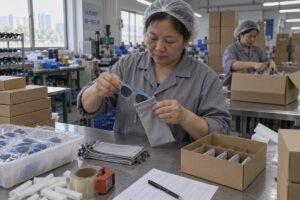
A care kit is not decoration. It changes product outcomes. When a child's sunglasses ship with only a poly bag, the first cleaning happens with a tissue or a shirt hem, and the first storage spot is the bottom of a backpack. When the same sunglasses ship with a pouch and cloth, both habits improve on day one. Through our OEM/ODM program, we supply custom-branded cloths, cases, pouches, and care cards alongside our roughly 800 existing frame styles, so brands can build a retail-ready presentation without tooling investment.
Tiered kit recommendations for buyers
| Kit Tier | 目次 | 最適 |
|---|---|---|
| 必須 | Microfiber cloth + care card | Value lines, promotional programs |
| 標準 | Cloth + microfiber pouch + care card | Mainstream kids' and baby brands |
| プレミアム | Cloth + hard case + alcohol-free spray + care card | Polarized sport styles, gift sets |
Newer tools worth evaluating
Some buyers now ask about advanced options. A soft-bristled brush, ideally food-grade silicone 6, clears sand from hinges and the crevices of flexible rubberized frames — very relevant for toddler eyewear. Stabilized hypochlorous acid 7 sprays offer rinse-free, non-toxic disinfection that is gentle on children's skin. For in-store or clinic settings, ultrasonic cleaners with plain water dissolve sticky juice residue from frame joints, and UV-C sanitizing boxes disinfect without moisture. We advise buyers to treat these as optional upsells, not core requirements. The essentials — microfiber, mild cleaner, protective storage — deliver most of the benefit.
What the care card should say
Keep it short. Rinse first with lukewarm water. Use mild soap or lens spray. Dry with the included cloth. Never use paper products or household cleaners. Store in the pouch. Five lines, translated for the target market, printed on recycled stock to match the eco-friendly positioning of TPEE and TR90 materials.
結論
Grit and harsh chemicals quietly destroy kids' sunglasses. The fix is simple: microfiber, lukewarm water, mild soap. We help brands package that care into every retail-ready pair.
脚注
1. Background on polycarbonate’s chemical properties explains why certain cleaners damage lens coatings. ↩︎
2. Explains why microfiber’s fine synthetic fibers lift smudges without scratching optical coatings. ↩︎
3. ISO sets material and safety standards guiding manufacturers on polymer components in eyewear. ↩︎
4. FDA explains why verified UV400-level protection matters for children’s sunglasses lenses. ↩︎
5. CDC guidance on why children’s skin is more sensitive to chemical residues and exposures. ↩︎
6. Background on silicone polymers supports why food-grade silicone brushes are safe near children’s eyewear. ↩︎
7. EPA regulates hypochlorous acid as a registered antimicrobial disinfectant for consumer use. ↩︎

 English
  Español de México
  Deutsch
  Français
  日本語
日本語  العربية
  Português do Brasil