Are TR90 & TPEE Kids Sunglasses Recyclable? Disposal Tips Explained?
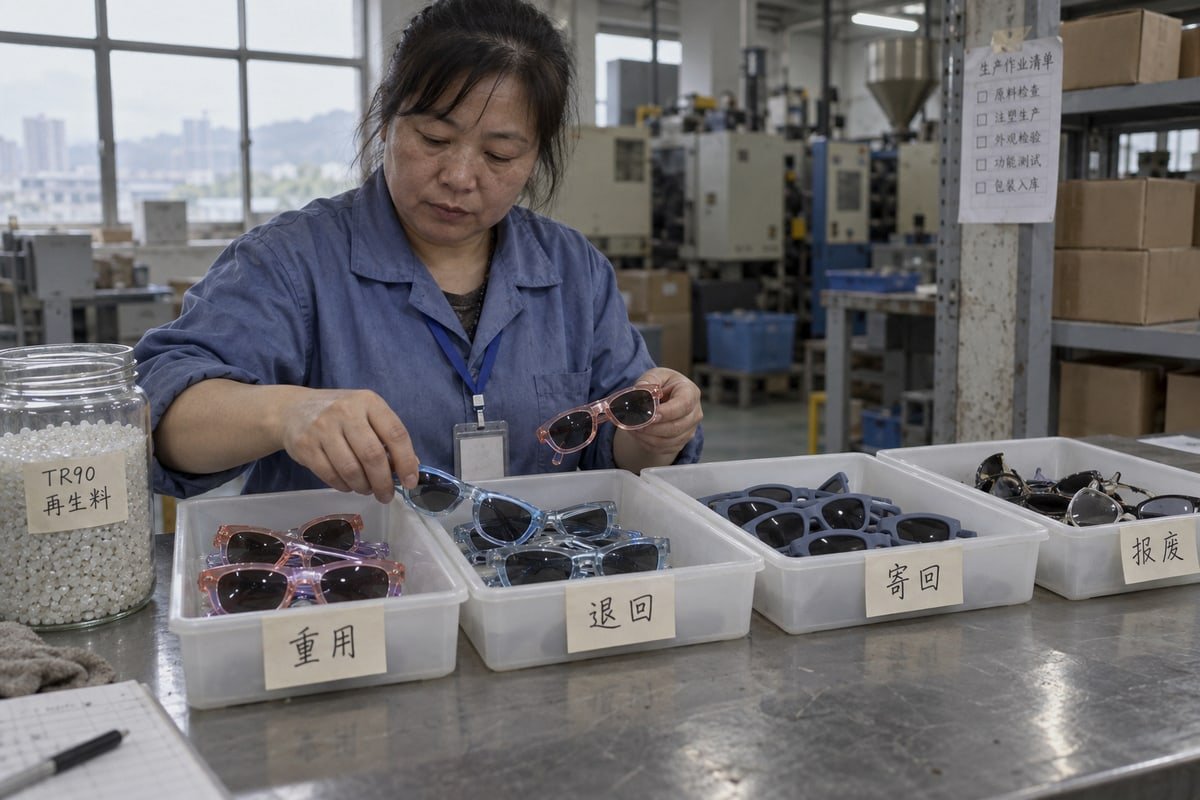
Every season, buyers ask us whether the TR90 & TPEE kids sunglasses leaving our Taizhou line are recyclable. The honest answer worries some. It shouldn’t, once you understand disposal.
TR90 & TPEE kids sunglasses are recyclable in principle because both are thermoplastics that can be remelted. In practice, most curbside programs reject them due to mixed materials and missing resin codes. The best disposal path is reuse first, brand take-back second, mail-in recycling third, and general waste last.
That gap between “recyclable” and “actually recycled” is the whole story. Below, I break it down section by section. I cover the frame, the temples, the alternatives, and how to talk about all of it with your customers.
How can I tell if my TR90 sunglasses are actually recyclable at end of life?
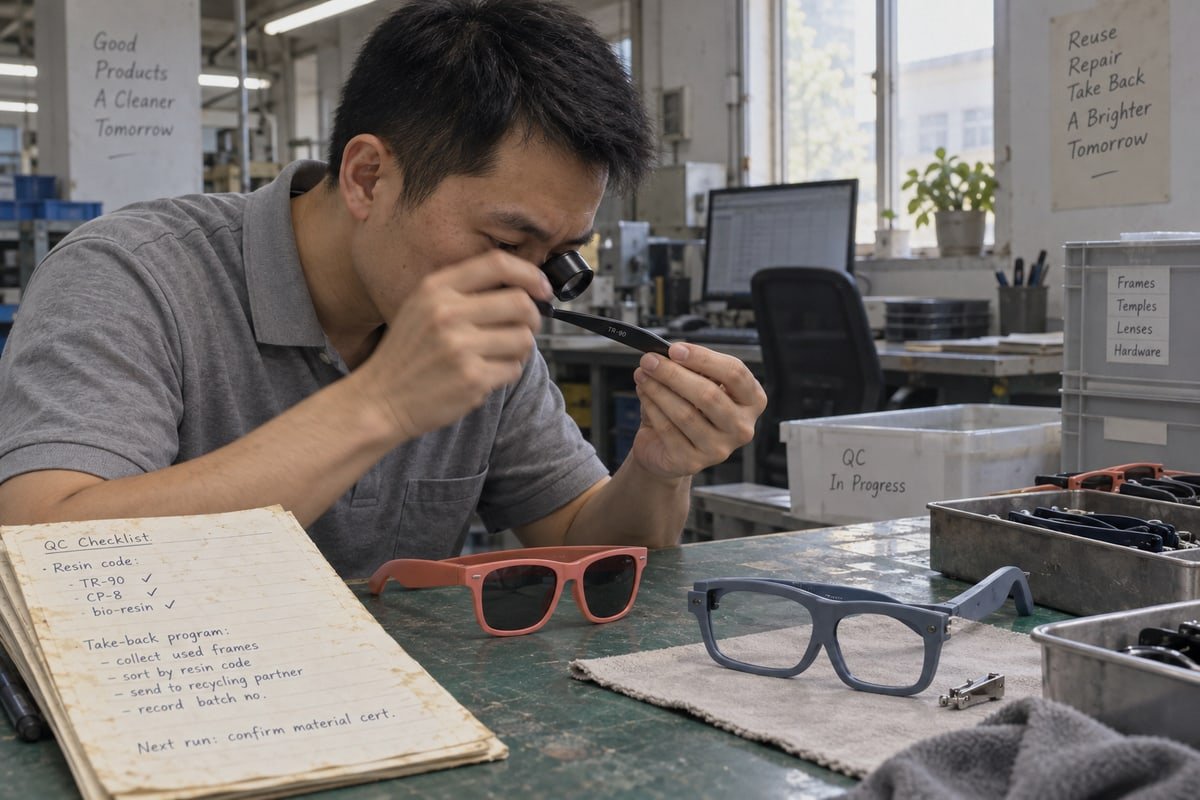
Last year our QC team traced a batch of regrind pellets from TR90 runner scrap back into test frames. That experiment taught me where recyclability really starts.
Check three things: whether the frame is marked as TR90 or thermoplastic polyamide, whether your local recycler accepts resin code 7 or engineering plastics, and whether the brand runs a take-back program. If all three fail, your TR90 sunglasses are recyclable in theory but not in your local system.
What TR90 actually is
TR90 is a trade name. It comes from Grilamid TR90, a nylon-based thermoplastic polyamide. Most grades are built on nylon 12 1 chemistry. The nylon 12 properties matter here. The resin is low density, flexible, chemically stable, and very hard to crack. That is why we use it for the fronts of our kids' frames. A child can sit on a pair, and the frame springs back.
It is also a thermoplastic, not a thermoset. A thermoset cures once and cannot be remelted. A thermoplastic can be melted and reshaped many times. In our own workshop, clean runner scrap from 射出成形 2 goes back into the process. So the material itself passes the first test.
Why the frame still fails at the curb
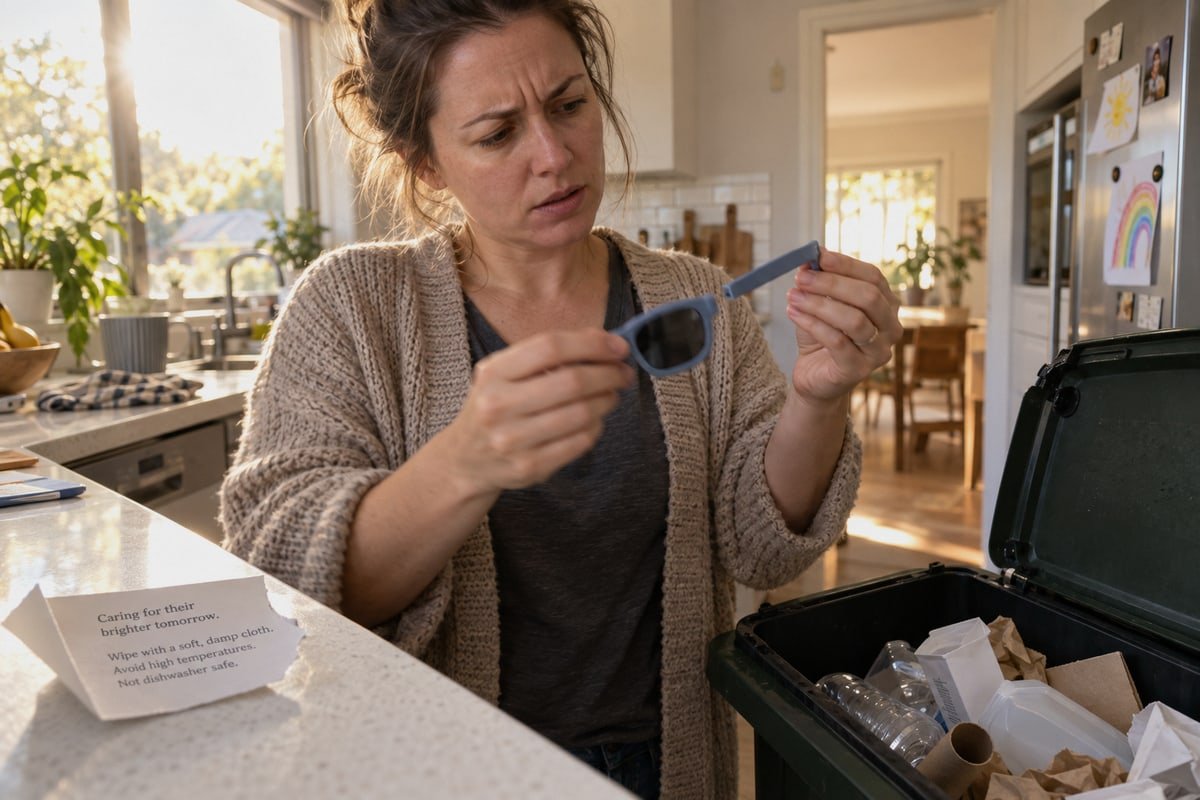
Municipal sorting depends on plastic resin identification codes. Those are the numbers 1 through 7 inside the triangle. TR90 has no dedicated code. Most local centers file it under 7, meaning "other." In practice, code 7 items are almost always sent to landfill or incineration. A kids' frame is also small, colored, and mixed with lenses and metal. Sorting equipment cannot separate it economically.
Here is how the marketing claims line up against the real world:
| Claim you will read | What it really means | What it does not mean |
|---|---|---|
| "TR90 is 100% recyclable" | The resin can be remelted | Your council will accept it |
| "Can be recycled through industrial plastic programs" | Engineering-plastic recyclers exist | They take single pairs from households |
| "Fully recyclable eyewear" | Material-level claim | Lenses, hinges and coatings are included |
| "Molecular recycling for TR90" | 新興 chemical processes 3 can return TR90 to monomers | The technology is available at your local depot today |
A quick test you can run
- Look for a TR90 or PA marking inside the temple. If there is none, ask the brand.
- Call or search your local recycler for "engineering plastics" or "polyamide" acceptance.
- Check whether the brand or retailer offers optical frame recycling or a return envelope.
- If none of these works, treat the pair as reusable first and general waste last.
The molecular recycling point deserves a note. Newer chemical processes can break TR90 back into raw monomers with no quality loss. That is promising for closed loops. But it is a plant-scale industrial process, not a curbside one. So for now, the honest answer remains: recyclable material, hard-to-recycle product.
What should I know about disposing of TPEE temples and rubber components safely?
A procurement manager in Australia once asked me if the matte pink TPEEテンプル on our coral wayfarer style could go in her council's soft-plastics bin. Short answer: no.
TPEE temples are a thermoplastic polyester elastomer, not vulcanized rubber, so they are BPA-free and non-toxic. They need industrial processing rather than household recycling. Separate them from lenses and metal hinges, check for a take-back or mail-in program, and otherwise dispose of them with general mixed waste.
TPEE is not rubber, even though it feels like it
TPEE behaves like rubber but processes like plastic. That is why we chose it for temples. It bends around a child's ear, resists sweat, and springs back after abuse. Unlike vulcanized rubber 4, it has no cross-linked sulfur bonds. So it can be remelted. Its thermal stability is high, and it is one of the BPA-free materials we specify for anything that touches a child's skin. We also use phthalate-free plastics across our kids' range, because soft components are the ones children chew on.
"Safely" has two meanings here. The first is personal safety. TPEE and TR90 are not hazardous waste. You do not need special handling. Just do not burn them at home, because any plastic releases fumes when burned in open air. The second meaning is environmental safety, which is where the sorting work comes in.
Break the pair into its parts
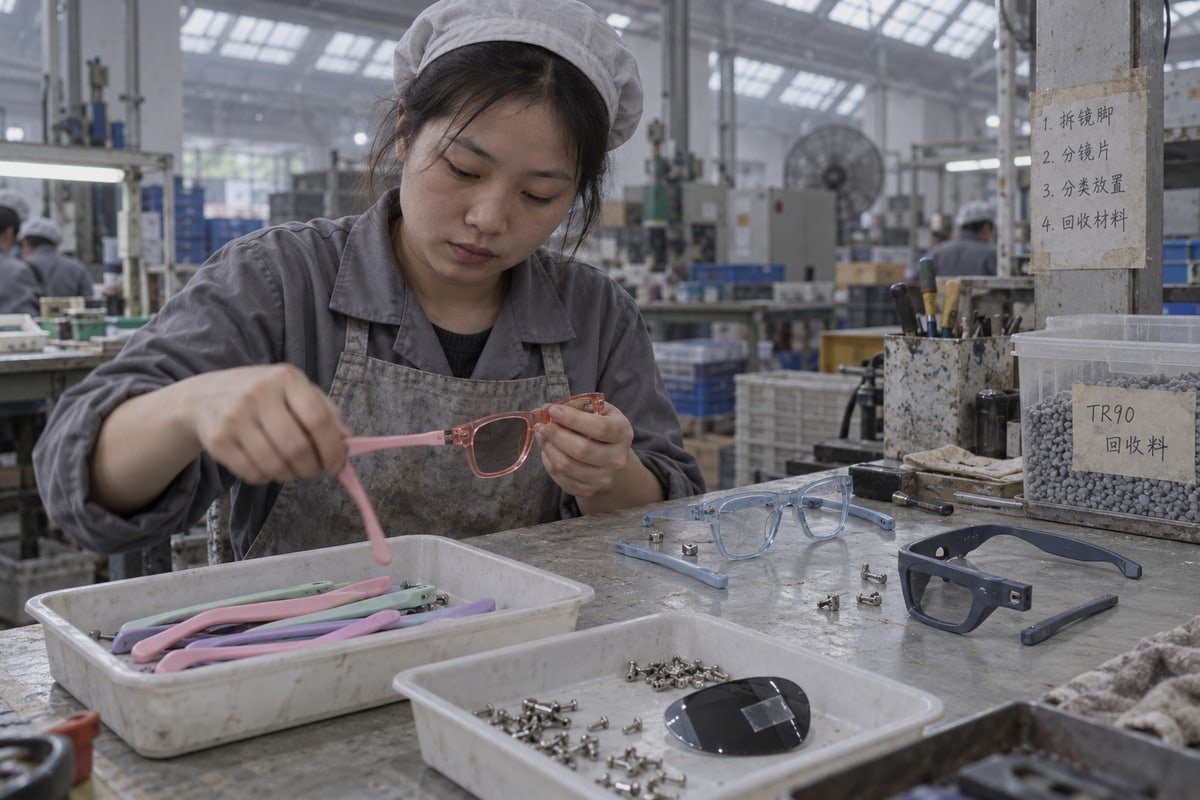
A pair of kids' sunglasses is a small assembly, not one material. Each part goes to a different place:
| コンポーネント | Usual material | Where it can go |
|---|---|---|
| フレームフロント | TR90 thermoplastic polyamide | Take-back, mail-in, or engineering-plastic recycler |
| テンプル | TPEE thermoplastic polyester elastomer | Take-back, mail-in, or general waste if none exists |
| レンズ | Polycarbonate or TAC, often coated and polarized | Not accepted with frame plastics; general waste |
| Hinges, rivets, screws | Steel or nickel alloy | Scrap metal, if your center accepts small metal |
| ノーズパッド | Silicone or TPEE | General waste unless a program accepts them |
A simple disposal sequence
- Confirm the pair is truly beyond reuse. A loose hinge or scratched lens is often repairable.
- Pop the lenses out. Polycarbonate and TAC lenses are incompatible with frame recycling streams.
- Unscrew or push out the metal hinges. Keep metal and plastic apart.
- Look for a mail-in option. TerraCycle-style zero-waste boxes are often the only route that actually diverts these polymers from landfill.
- If no program exists, place the parts in general mixed waste, not the recycling bin. A wrong item in the recycling stream can contaminate a whole load.
One more idea worth passing to your customers: TPEE is stable enough for closed-loop upcycling. Industrial recyclers have turned it into flexible cable organizers and garden ties. That only works at scale, but it shows the material has a second life when it is collected properly.
Are there eco-friendlier alternatives to TR90 and TPEE for my kids' eyewear line?
Durability versus recyclability is the trade-off our engineers weigh most often. A frame that survives three summers on an active child may beat a recyclable one that breaks in one.
Yes. Recycled TR90 and recycled nylon blends, GRS-certified recycled PET, and partly plant-based Bio-TR90 all exist. However, none is automatically easier to recycle than standard TR90 or TPEE. For kids' eyewear, durability, repairability, and a take-back channel usually cut more waste than switching resins alone.
The main eco-friendly eyewear alternatives at a glance
| オプション | それは何ですか | Sustainability claim | Recycling reality | Fit for kids' frames |
|---|---|---|---|---|
| Recycled TR90 / recycled nylon | Post-consumer or industrial nylon regrind blended with virgin resin | Lower virgin-resin demand | Same as standard TR90; no curbside path | Good; near-identical flexibility and impact resistance |
| Bio-TR90 | TR90 with partial plant-derived content | Reduced fossil input | Not more recyclable than TR90; not compostable | Good; same nylon 12 properties |
| GRS-certified recycled PET | Recycled polyester, often from bottles | Verified recycled content with chain of custody | Better known resin, but eyewear still a specialty stream | Fair; stiffer than TR90 for active use |
| Standard TR90 with TPEE temples | Virgin engineering thermoplastics | Long product life, BPA-free and phthalate-free | Thermoplastic, industrial recycling only | Excellent; our core spec |
Why durability is the greener lever
The sustainable fashion lifecycle for a child's sunglasses is short. Kids outgrow frames. They also lose and break them. The biggest environmental cost is not the resin type. It is the number of pairs bought and thrown away per child. That is where the extreme impact resistance of TR90 and TPEE pays off. A frame that survives being dropped, bent, and sat on does not need replacing. Fewer replacements means less resin, less packaging, and less shipping.
When I look at our translucent sky-blue style, or the chunky slate-blue frame we make for younger kids, the eco argument is the same. The material is chosen so the pair lasts. That is not a marketing line. It is the reason we run flex and drop checks on every production batch.
How to reduce waste without a new resin
Switching materials is not the only move. A brand can cut waste in three quieter ways:
- Skip new molds. Choosing from our existing 800 styles means no steel tooling for a test launch and no dead stock if a color does not sell.
- Design for repair. Screw hinges instead of glued joints let a retailer swap a temple rather than bin the pair.
- Plan the return path. A take-back envelope or a partnership with a mail-in recycler turns a "recyclable" claim into a real one.
If you still want a recycled or bio-based resin, we can develop it through our ODM process. Just go in with clear eyes. Bio-TR90 is not fully plant-based, and recycled nylon does not make the pair easier for a parent to recycle at home.
How can I communicate sustainability and disposal information to my customers?
I learned this the hard way when a European brand returned our first packaging draft because it said "recyclable" with no explanation. Honest, specific wording earns more trust.
Communicate sustainability by stating the exact materials, saying clearly that curbside recycling is unlikely, and giving a ranked disposal path: donate, return, mail-in recycle, then general waste. Print it on packaging, the product page, and a hangtag. Avoid unqualified words like "100% recyclable" without a program behind them.
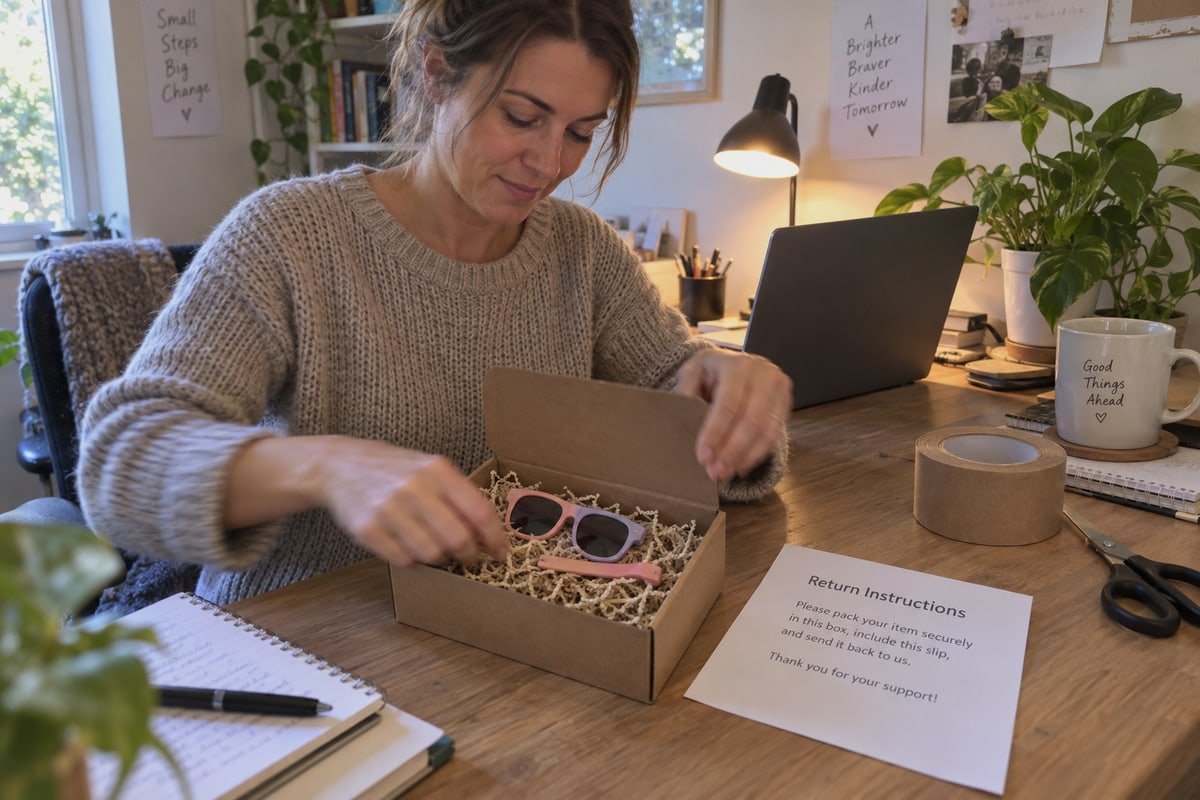
Say what it is, then say what to do
Parents do not need chemistry. They need a decision. So the message has two parts. First, name the materials plainly: TR90 front, TPEE temples, polycarbonate polarized lenses. Second, give a ranked action list. We build this into the retail-ready packaging we produce for clients, and the wording is always the same order.
- Still usable? Donate. Eyewear donation programs such as Lions Club International collect frames and repurpose them for communities that need them.
- Broken but returnable? Send it back. If the brand runs an Extended Producer Responsibility scheme, say so, and mention any credit or discount offered for returned frames.
- No return option? Use a mail-in recycler that accepts mixed eyewear.
- None of the above? Place it in general waste, not the recycling bin.
Claims to use and claims to avoid
| Say this | Not this | 理由 |
|---|---|---|
| "Made from thermoplastic TR90 and TPEE, which can be recycled through specialist programs" | "100% recyclable" | The first is true at the product level; the second implies curbside acceptance |
| "Not accepted in most household recycling; please return or donate" | "Please recycle" | Directs the parent to the path that actually works |
| "BPA-free and phthalate-free materials" | "Non-toxic eco plastic" | Specific, checkable safety claims beat vague ones |
| "Built to last: impact-resistant frame for active kids" | "Sustainable design" | Durability is the real environmental benefit and it is provable |
Where the message should live
Put the short version on the hangtag. Put the full version on the product page and inside the case. Add a QR code linking to your take-back instructions if you run one. When we develop custom packaging, we leave a clear panel for this text so the disposal note is not buried under the barcode.
One last point for buyers in markets like Japan, Australia, and the EU. Regulators there are tightening rules on green claims. A specific, modest statement protects your brand. A bold, unproven one creates risk. Honest disposal guidance 5 is not a weakness. It signals that you understand the product from the injection machine to the end of its life.
結論
Kids' sunglasses rarely fit the blue bin, and that frustrates parents. But durable TR90 & TPEE frames, honest labels, and a take-back plan turn that problem into brand trust.
Interested in sourcing the products mentioned in this article? See details and request a quote here:
脚注
1. International standard for polyamides like nylon 12 used in high-performance eyewear frames. ↩︎
2. Technical standards and research on precision manufacturing processes including plastic injection molding. ↩︎
3. Government agency information on advanced recycling methods and chemical processing for plastic waste. ↩︎
4. Authoritative source defining vulcanization as a thermoset process, providing a clear contrast to recyclable thermoplastics like TR90. ↩︎
5. Federal authority providing guidelines on environmental marketing and the substantiation of product disposal claims. ↩︎
 English
  Español de México
  Deutsch
  Français
  日本語
日本語  العربية
  Português do Brasil