Will TR90 & TPEE Kids Sunglasses Deform in Car Heat? What’s the Temperature Limit?
Every summer, buyers ask us the same question about TR90 and TPEE kids sunglasses and car heat 耐衝撃性基準 1. A warped frame means returns, so our production line takes it seriously.
TR90 and TPEE kids sunglasses can deform in car heat, but only under prolonged, extreme conditions. Closed cabins reach 54°C/130°F on a 32°C/90°F day, and dashboards hit 60–70°C/140–158°F. Above 60°C, TPEE parts and lens coatings begin failing; TR90 fronts hold shape longer.
That short answer hides a lot of detail. The frame, the temples, the hinges, and the lenses all react to heat differently. Below, I break each part down, give you the real numbers, and show you how to check a supplier’s claims before you place an order.
Will the sunglasses I'm sourcing really hold up if they're left in a hot car?
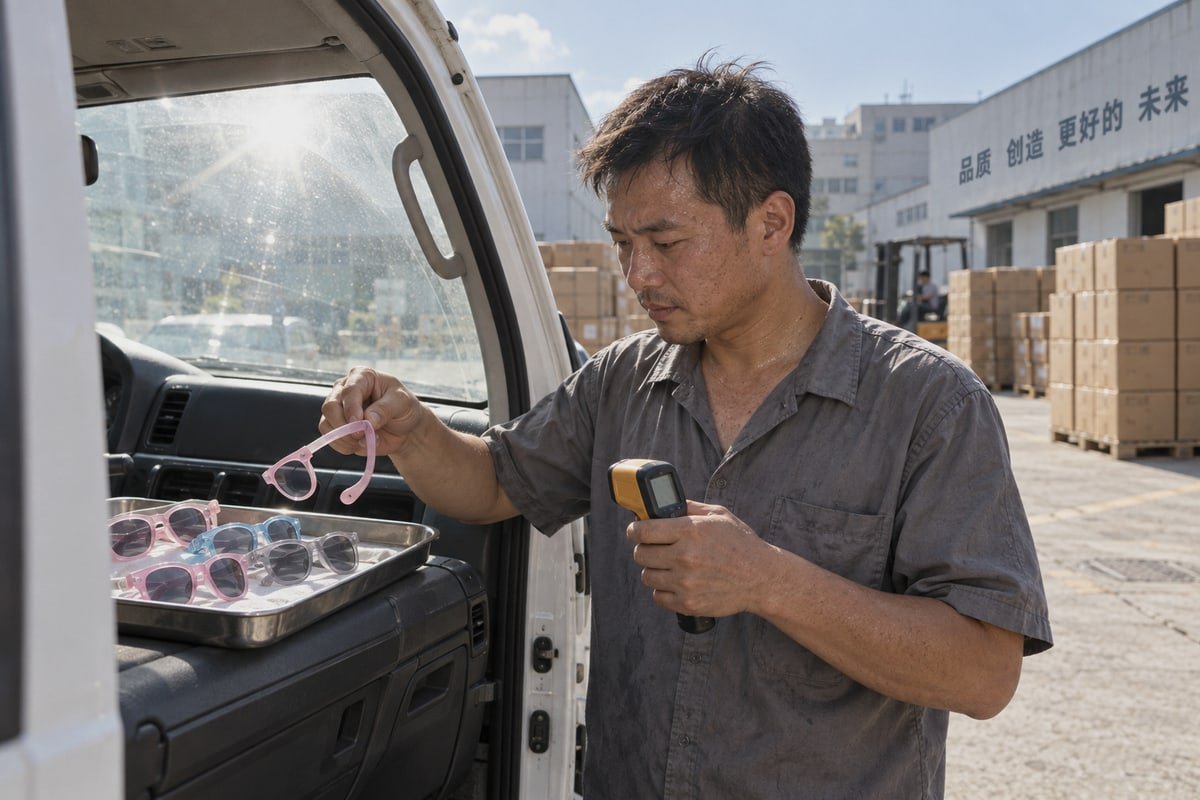
Last July, our QC team left a tray of sample frames inside a parked van in Taizhou for one afternoon. The results shaped how we answer this question.
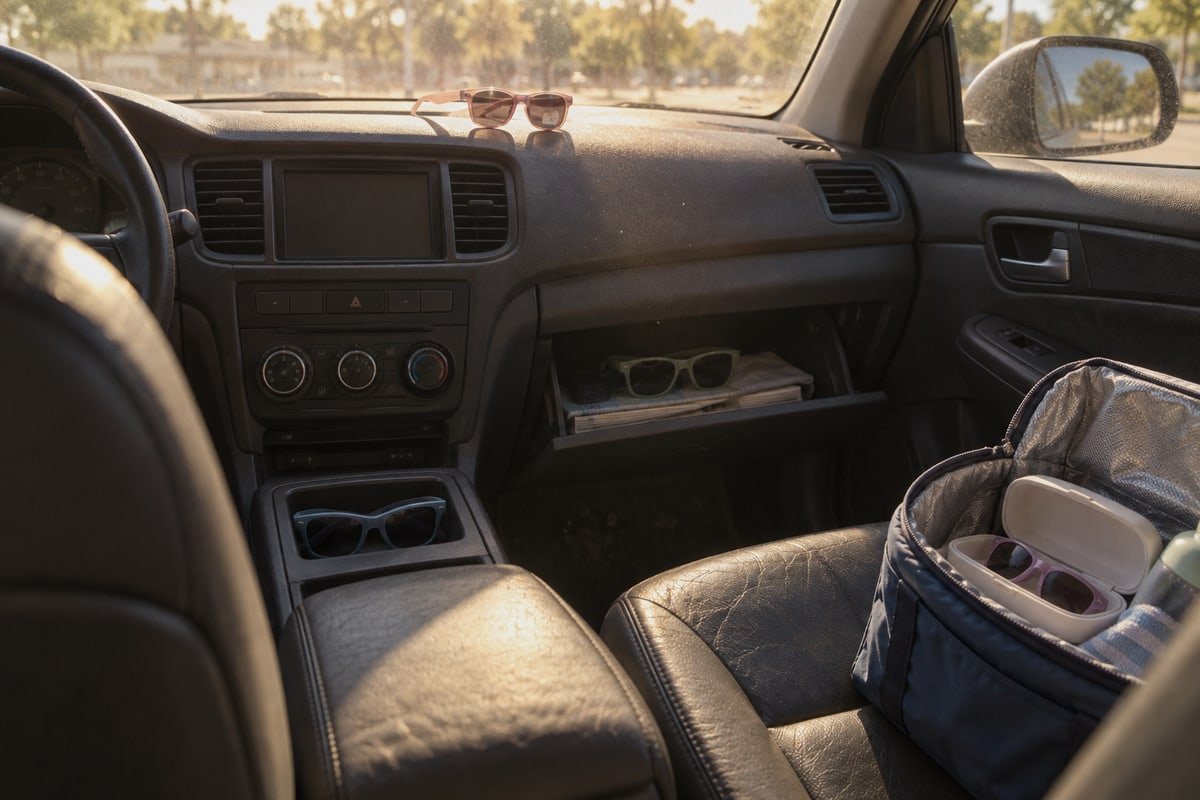
Yes, TR90 and TPEE kids sunglasses generally hold up in a hot car for short periods, but not indefinitely. Cabin air above 54°C/130°F softens TPEE temples first, and dashboard surface heat of 65°C+ can damage lens coatings within about 30 minutes. Store them out of direct sun.
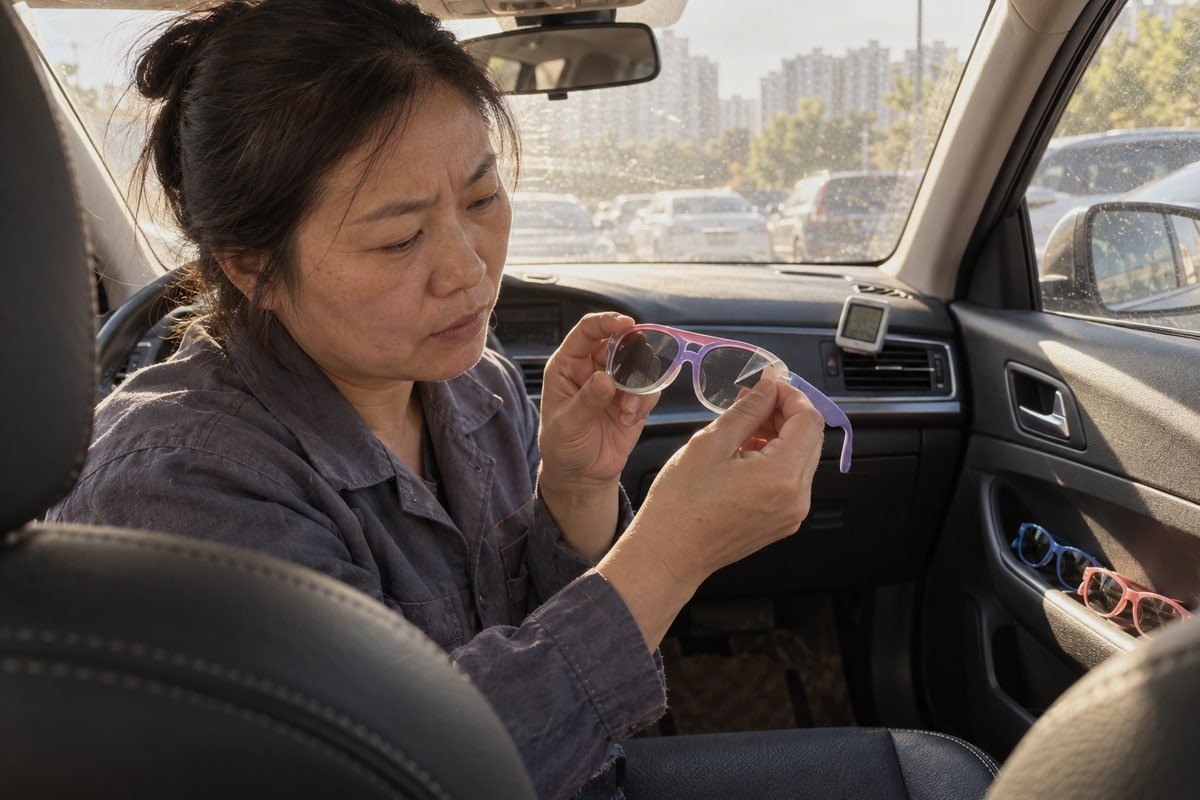
The van test taught me one thing above all. The frame fronts came out fine. The soft TPEE temple tips felt noticeably softer to the touch. A few lens stickers had started to lift at the edge. Nothing "melted." But the damage had started, and it started in the softest and thinnest parts first.
What car heat actually does, stage by stage
Heat does not attack a pair of kids' sunglasses all at once. It works in a sequence. Once you understand the sequence, you can predict which frames will survive and which will not.
- Frame softening. The polymer chains loosen. The frame front is still solid, but it can now take a set if something presses on it.
- Temple creep. The TPEE temples are the most flexible part. Under heat plus pressure from a case or a seat, they slowly bend and stay bent.
- Hinge loosening. The metal rivets stay put, but the plastic around them expands and relaxes. The hinge feels looser when the frame cools.
- Lens coating damage. Polarized TAC lenses use adhesive layers and hard coats. These layers can bubble or peel at around 60°C/140°F.
- Lens distortion. In the worst cases, the lens itself warps in the rim and the optics go slightly off.
Stages one and two are usually reversible if the frame cools without pressure on it. Stages four and five are not.
Where the sunglasses sit matters more than the outside temperature
Dashboard surface heat is the real enemy. Surfaces in direct sun run hotter than the cabin air around them. A dark dashboard can sit at 65–70°C while the air near the floor stays much lower.
| 車内の保管場所 | Typical summer temperature | Risk to TR90/TPEE kids sunglasses |
|---|---|---|
| Dashboard in direct sun | 65–93°C / 150–200°F | High: coating damage and temple creep likely |
| Seat or door pocket in sun | 54–65°C / 130–150°F | Elevated: TPEE softening, sticker lifting |
| Center console (closed) | 49–60°C / 120–140°F | Moderate: caution above 60°C |
| Glove box | 45–55°C / 113–131°F | Lower: still not truly heat-safe |
| Hard case in a cooler bag | Near ambient | Low: recommended for hot climates |
So the honest answer is this. The sunglasses you are sourcing will very likely survive a school run or a supermarket trip. They may not survive a full afternoon on the dashboard in Brisbane in January. That is not a material flaw. It is physics, and it applies to every plastic frame on the market.
What's the exact temperature limit before these TR90 and TPEE frames start to warp?
Choosing between a softer, more flexible TPEE temple and a firmer blend is a trade-off we weigh on every kids' style. Softer feels nicer; firmer resists heat better.
There is no single exact limit. TR90's glass transition temperature sits around 100–120°C, but practical softening under load starts near 57–70°C. Softer TPEE loses integrity at 65–70°C, and lens coatings can fail at 60°C. Treat 60°C/140°F as the working caution line.
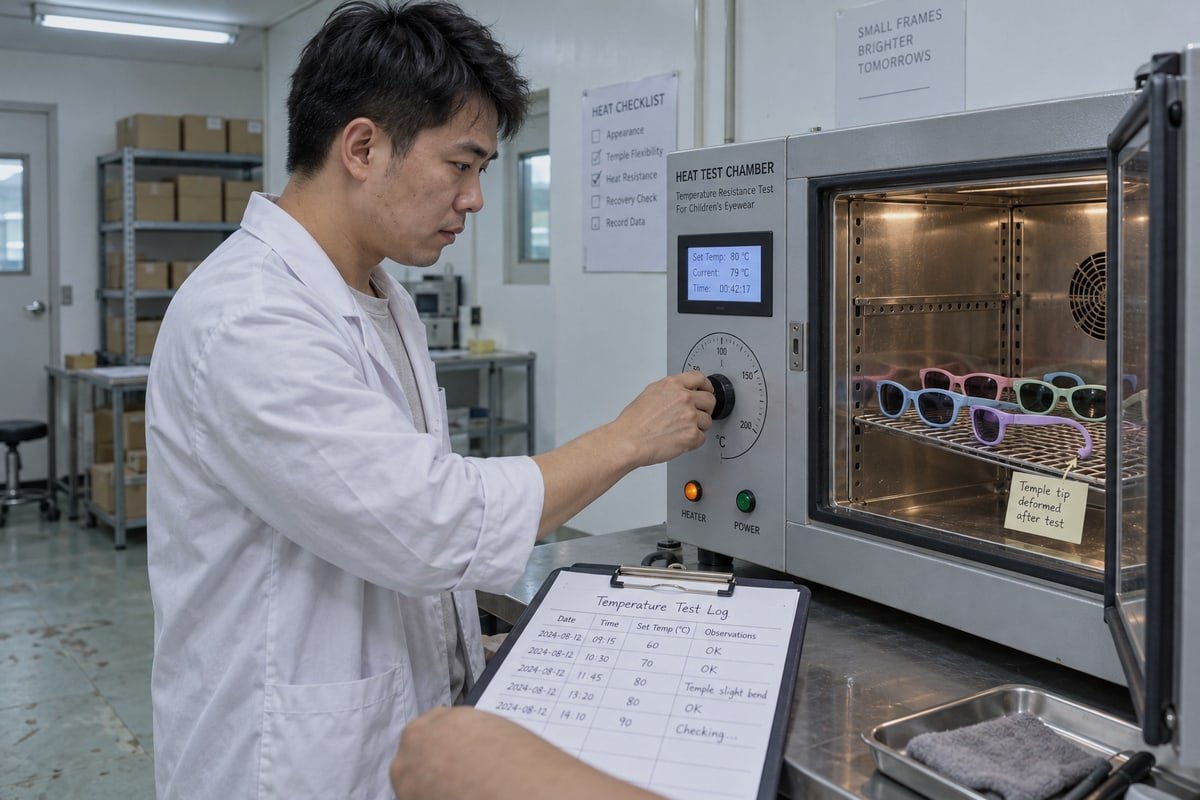
I get asked for "the number" almost every week. I understand why. A single number is easy to put on a spec sheet. But when I give one number without context, it gets misread. So let me explain why the heat limit is really four different numbers.
Why one temperature is never enough
Material engineers measure heat resistance in several ways. Each method answers a different question.
| 測定 | それがあなたに伝えること | Typical TR90 value | Why it matters for car heat |
|---|---|---|---|
| Glass transition temperature 2 (Tg) | Point where the polymer changes from rigid to rubbery | 100–120°C / 212–248°F | Car heat rarely reaches this, so permanent frame-body melting is unlikely |
| Thermal deformation temperature (HDT) | Temperature at which a loaded sample bends a set amount | Roughly 57–70°C / 135–158°F depending on load and method | This is closer to real-world softening under pressure from a case or seat |
| Long-term service temperature | Highest temperature for continuous use without property loss | Lower than HDT, varies by grade | Repeated hot days add up even if no single day crosses the line |
| Coating and adhesive failure point | Where lens hard coats and polarizing film layers let go | Around 60°C / 140°F or lower | Often the first visible damage, even if the frame is fine |
The confusion comes from mixing these up. A supplier who quotes only the glass transition temperature is telling the truth, but not the useful truth. The frame will not melt in a car. It can still take a bend at 65°C if a heavy bag is sitting on it.
TPEEが適している点
TPEE is a thermoplastic elastomer. We use it for temples, temple tips, and flexible hinge sections because it is soft, safe, and bends without cracking. That softness has a price. Lower Shore hardness TPEE grades begin losing structural integrity 3 at 65–70°C. That is inside the normal range of a parked car in summer.
This is the trade-off I mentioned. A very soft TPEE temple is wonderful on a toddler's face. A slightly firmer grade keeps its shape better on a hot day. We tune this per style and per target market. A frame headed for Northern Europe can use a softer blend than one headed for the Middle East.
The practical risk bands we use
Instead of one number, I give buyers three bands.
- Up to 49°C/120°F: Normal use. Frame structural integrity is not affected.
- 49–60°C/120–140°F: Caution rises sharply. Avoid pressure on the frame. Lens stickers and coatings start to be at risk.
- Above 60°C/140°F: Deformation of TPEE parts and coating damage become much more likely. Above 65°C/150°F, prolonged exposure is high risk.
These bands are more honest than a single figure. They also line up with what the parts actually do in a hot car.
How do I verify these materials truly outperform cheaper plastic in extreme heat?
A procurement manager from Australia asked us to prove our frames beat the cheap plastic ones in her warehouse. Her request became a checklist we now share with every buyer.
Verify heat performance by requesting material datasheets showing glass transition and heat-deflection temperatures, then run a simple oven or hot-car sample test at 60°C and 70°C for 30–60 minutes. Compare frame shape, hinge tightness, and lens coating condition against a standard plastic control sample.
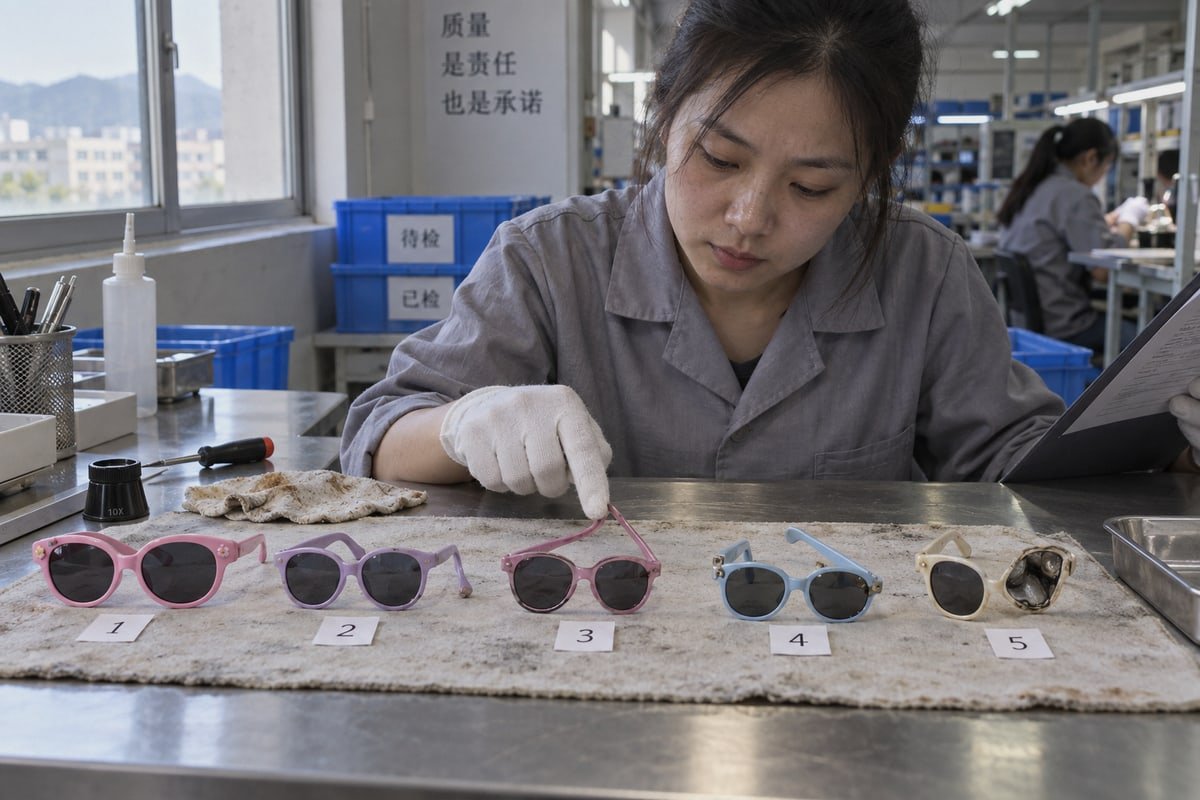
The fastest way to see the difference is a side-by-side table. This is how I usually start the conversation with a new buyer.
| フレーム素材 | Heat tolerance in car conditions | Flexibility and shape memory properties | Child safety profile | Typical cost tier |
|---|---|---|---|---|
| TR90 (nylon copolymer) | Good; frame body stable below roughly 60°C under load | Excellent; flexes and returns to shape | BPA-free thermoplastic, lightweight, shatter-resistant | 中間からプレミアム |
| TPEE(熱可塑性エラストマー) | Moderate; softer grades weaken at 65–70°C | Excellent; very soft bend, no sharp break | Very soft on skin, no rigid edges | ミッド |
| アセテート | Fair; can warp and lose adjustment in cabin heat | Low; can crack when forced | Heavier, rigid, less suited to toddlers | 中間からプレミアム |
| Standard injection plastic (PC or cheap PP) | Poor to fair; often warps and coatings peel | Low; brittle when bent | Can snap into sharp fragments | 低 |
The table is a starting point. It is not proof. Proof comes from three steps.
Step one: read the datasheet, not the brochure
Ask for the raw material datasheet from the resin supplier. Look for the glass transition temperature and the heat-deflection temperature. Check the test load used for the deflection figure. A number tested at a low load will look better than one tested at a high load. Both are "true." Only one tells you how the frame behaves with a case on top of it. Heat-resistant polymers are not all the same, and the grade matters as much as the family name.
Step two: run your own simple heat test
You do not need a laboratory. You need a small oven with a thermometer and a few samples.
- Place one sample of each frame in the oven at 60°C for 30 minutes. Put a light weight on the temples to simulate a case.
- Remove, let cool flat, and check: does the temple return to shape? Is the hinge still tight? Are the lens coatings clear?
- Repeat at 70°C for 60 minutes with fresh samples.
- Repeat the 60°C test five times on the same sample to check for heat-cool cycling fatigue.
Include a cheap plastic frame as a control. The gap between the two usually shows up at the second or third cycle, not the first.
Step three: check the standards behind the claims
There is no universal industry-published "safe temperature limit" for kids' sunglasses. So I tell buyers to look at what does exist. Ask for ISO 12312-1 compliance data 4 on the lenses and frames. Ask for impact resistance standards test reports, and for ASTM F2213 5 where that applies to your market. Ask for UV400 lens verification 6. A supplier that can show these reports on request is far more likely to have real material control behind their heat claims. A supplier that only shows a brochure is asking you to take it on faith.
On our side, we keep resin batch records for every TR90 and TPEE grade we run. When a buyer asks which grade is in a given style, we can answer from the record, not from memory.
Can I confidently market these frames to my customers in hot climates?
One lesson from fifteen years of shipping to 20-plus countries: heat claims sell, but overstated heat claims come back as complaints. We now word every spec carefully.
Yes, you can market TR90 and TPEE kids sunglasses for hot climates as heat-tolerant, flexible, and safer than acetate or standard plastic. Do not call them heat-proof. Pair the claim with clear care guidance: keep them out of parked cars above 49°C/120°F and never on the dashboard.
I want to address the two sides of this debate directly, because your customers will raise both.
The objection: "TR90 is good enough for hot weather, so why the warnings?"
Some buyers tell me the warnings hurt sales. They point out that TR90 frames flex, return to shape, and outperform acetate in heat. All of that is true. A TR90 front will survive a hot day far better than an acetate front. 素材の選択が第一 is exactly why parents choose these frames for active kids.
The other objection: "Repeated cabin heat still ruins them, so the claims are hollow"
Other buyers worry about the opposite. They have seen frames come back with loose hinges, faded color, and lifted coatings even though nothing "melted." They are also right. Repeated heat-cool cycling causes cumulative micro-fatigue in TPEE and TR90 joints. UV plus heat speeds up color fading and hinge lubricant breakdown. None of this is visible on day one.
How I resolve it for our buyers
Both sides describe the same product under different conditions. So the marketing message should carry both truths. Here is the claim language I recommend.
| Claim you can make with confidence | Claim to avoid | 理由 |
|---|---|---|
| "Heat-tolerant TR90 frame with flexible TPEE temples" | "Heat-proof" or "will never warp" | The TPEE parts and coatings fail at 60–70°C, which cars reach |
| "Flexes and returns to shape in everyday use" | "Unbreakable in any condition" | Shape memory properties weaken after repeated heat cycles |
| "Safer and lighter than acetate or rigid plastic" | "Safe to leave in the car" | Cabin temperatures above 54°C are routine in summer |
| "BPA-free, UV400, polarized lens options" | "Lenses immune to heat" | Coating adhesives are often the first thing to fail |
Give the parent a care card, not just a claim
The most effective thing we have done for hot-climate buyers is a small printed care card inside the retail box. It says three things in plain words. Do not leave the sunglasses on the dashboard. Store them in the case, out of direct sun. If they get hot, let them cool flat before wearing.
That card turns a potential complaint into a demonstration of care. It also protects your brand. When a parent reads a clear warning and ignores it, the return conversation is very different from one where no warning existed.
Because we hold around 800 existing styles, a brand entering a hot market can test two or three frame and temple combinations without paying for new molds. If the softer TPEE temple gets complaints from Dubai but praise from Copenhagen, we switch the grade for the Dubai order and keep the rest of the design the same. Custom colors, logos, lens tints, and the care card itself all fall under our normal OEM/ODM scope, so the hot-climate version can look identical on the shelf while being tuned differently underneath.
結論
Hot cars will not melt TR90 and TPEE kids sunglasses, but heat above 60°C can still damage them. Verify the specs, set honest claims, and store them smart.
Interested in sourcing the products mentioned in this article? See details and request a quote here:
脚注
1. Trade.gov offers guidance on international impact resistance standards and safety regulations for exported consumer goods. ↩︎
2. Comprehensive overview of the glass transition temperature, a critical thermal property for understanding polymer flexibility and stability. ↩︎
3. Peer-reviewed scientific perspectives on the structural integrity of polymers when subjected to varying thermal environments. ↩︎
4. The International Organization for Standardization’s official page for the primary standard governing sunglasses and related eyewear. ↩︎
5. Official site for ASTM International, providing the standard test methods for evaluating material performance under specific conditions. ↩︎
6. Confirms UV protection standards referenced when verifying sunglasses lens safety claims. ↩︎

 English
  Español de México
  Deutsch
  Français
  日本語
日本語  العربية
  Português do Brasil