How Is Frame Flexibility Tested in TR90 & TPEE Kids Sunglasses to Ensure Quality?
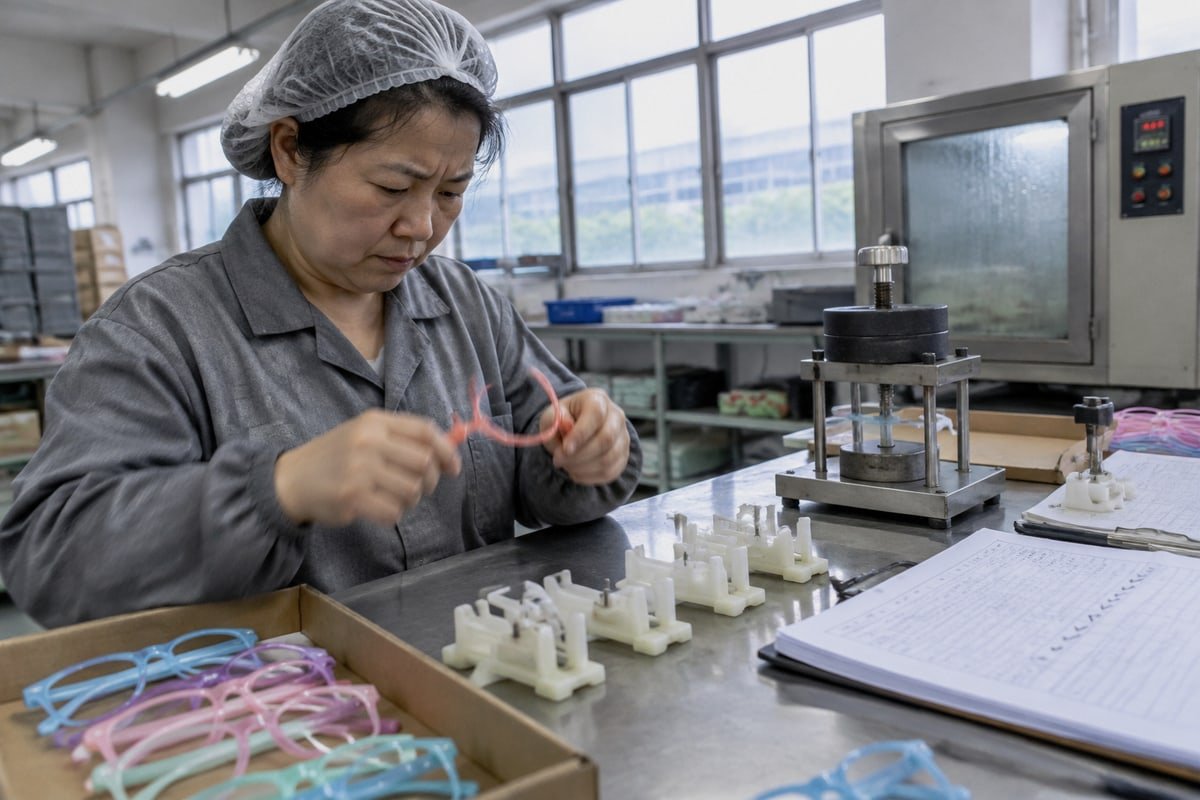
Parents buy kids sunglasses; children sit on them within a week material safety data 1. Frame flexibility testing for TR90 and TPEE kids sunglasses is how our production line prevents that.
Frame flexibility in TR90 and TPEE kids sunglasses is tested through repeated bend, twist, and compression cycles, checking that frames recover shape without stress whitening, cracking, or lens loosening. Factories add hinge endurance, bridge deformation, thermal, and impact tests referenced to ISO 12870 and FDA drop-ball rules.
Below, I walk through each test, the standards behind them, the QC checks worth requesting, and the documents a serious factory should show you before you pay a deposit.
What Testing Methods Confirm My TR90 & TPEE Frames Won't Snap Under Daily Wear?
Last spring one of our QC technicians pulled a translucent pink wayfarer sample off the line, twisted it 180 degrees, and held it up to the light.
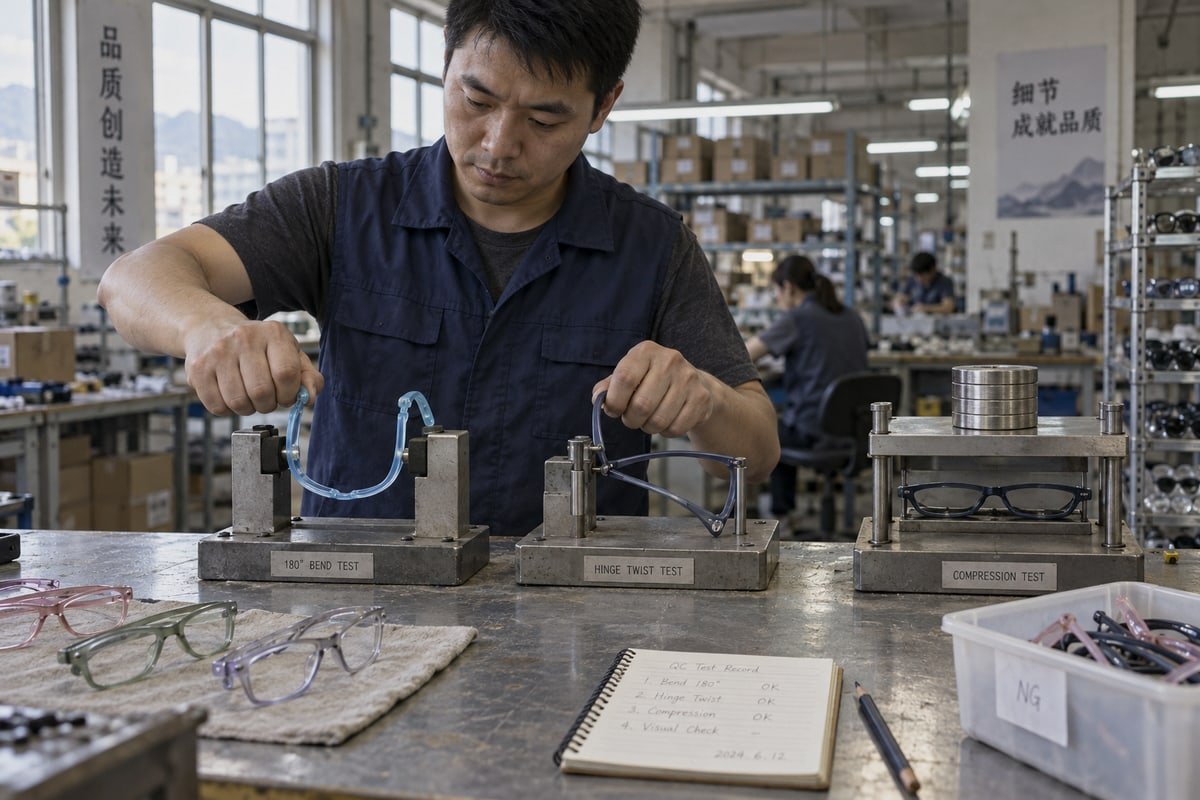
Three core methods confirm TR90 and TPEE frames won't snap: a 180-degree memory flex test for shape recovery, a torsion test for temple twisting, and a compression test that simulates sitting on the glasses. Each is repeated in fatigue cycles and inspected for stress whitening, creasing, or cracks.
She was not checking whether the frame bent. Everybody knows TR90 bends. She was checking whether it came back, and whether the flex points stayed clear or turned cloudy. That is the difference between a soft frame and a durable one.
Flexibility Is Not the Same as Durability
A frame can feel rubbery in your hand and still fail a child in a week. Real frame flexibility testing asks four questions at once. Does the frame return to shape? Does it stay clear at the stress points? Do the lenses stay seated? Do the hinges still close smoothly afterward? If any answer is no, the frame is flexible but not durable.
TR90 gets its recovery from memory plastic properties. You bend it, and it moves back toward its molded shape instead of staying warped. TPEE, a 熱可塑性ポリエステルエラストマー 2, is softer and more rubber-like. It absorbs impact well and grips a toddler's head, but it needs a well-designed lens groove or it can pop open under twist.
The Three Hands-On Tests We Run First
| テスト | What we do | Pass looks like | Fail looks like |
|---|---|---|---|
| Memory flex test | Bend the front 180 degrees, temple to temple | Full return to shape within seconds | Permanent bow, creasing, whitening at the bridge |
| Torsion test | Twist one temple against the other | No sound, no deformation, hinge still tight | Audible cracking, loose rivet, lens edge lifting |
| Compression test | Press the closed frame flat under body-weight load | Rebounds, lenses stay seated | Snapped bridge, lens pushed out of groove |
These are screening checks, not certifications. But they catch most bad resin batches and mold problems before formal fatigue testing even starts.
Why Stress Whitening Is the Early Warning
Stress whitening, or crazing, is a faint cloudy line at a high-flex point. On our translucent frames it is easy to spot. It means the polymer chains 3 are separating. A frame with crazing may survive today's test and snap next month. So our inspectors reject it on sight, even if the frame still flexes.
Temperature Changes Everything
Torsion resistance changes with temperature. TPEE is tested at sub-zero conditions, down to -30°C in specialized labs, because standard plastics turn brittle in the cold. At the other end, frames are held at high heat to prove they do not lose their memory in a closed car. A frame that only passes at room temperature has not really been tested.
How Do I Know My Supplier's Flexibility Tests Match International Safety Standards?
A procurement manager from Australia once asked me a sharp question: which standard actually covers frame flexibility? My honest answer was that none does directly.
No single standard measures frame flexibility directly. Instead, match supplier tests to EN ISO 12312-1 for sunglasses, ISO 12870 for frame bridge deformation and endurance, and FDA 21 CFR 801.410 drop-ball impact for US lenses. Ask which clauses each in-house test references and request matching reports.
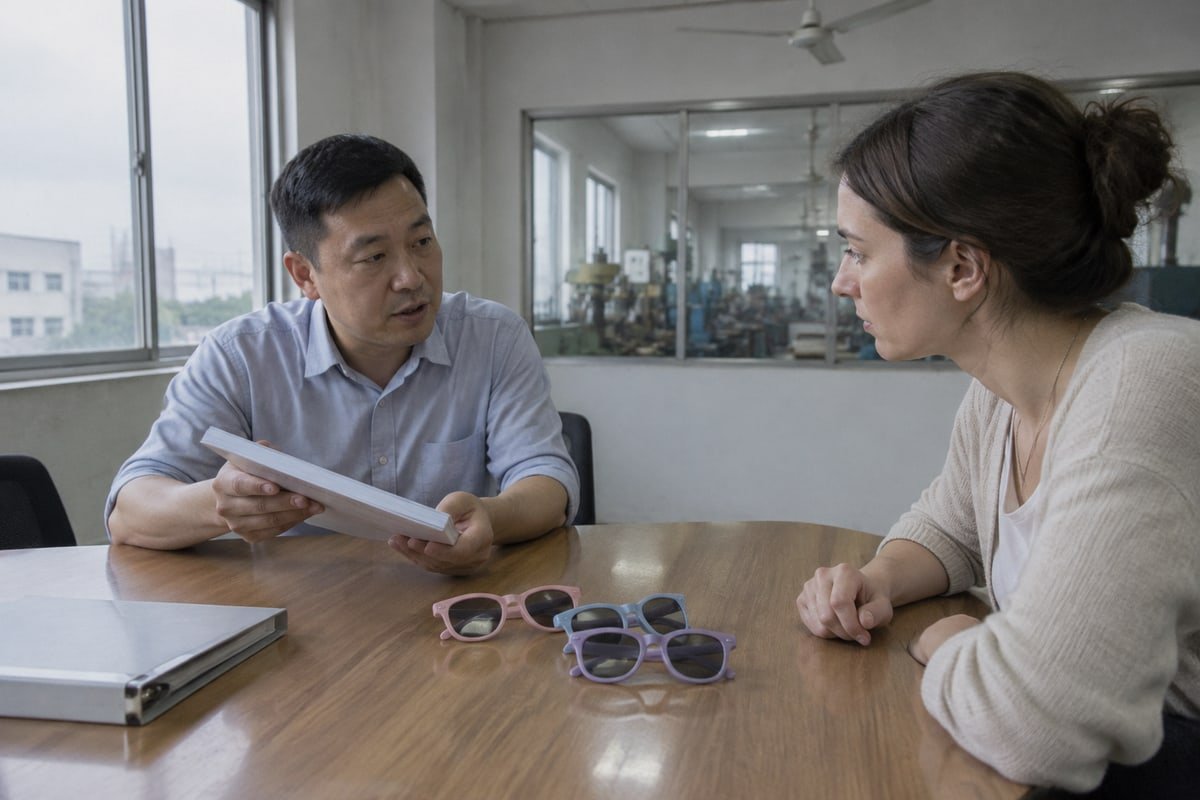
That answer surprised her, and it surprises most buyers. The standards world is built around lenses, optics, and frame geometry. Flexibility sits between those categories. So the right question is not "which standard proves flexibility" but "which standards does your flex testing feed into."
The Standards That Actually Apply
| 標準 | それがカバーするもの | Why it matters for a flexible frame |
|---|---|---|
| EN ISO 12312-1 | General sunglasses: UV filtering, optical quality, robustness, labeling | The baseline for the EU and much of Asia-Pacific; a flexible frame must still pass its robustness clauses |
| ISO 12870 | Spectacle frames: bridge deformation, temple endurance, sweat and heat resistance | Closest thing to a formal frame flex standard; bridge deformation and endurance cycling come from here |
| 衝撃安全性 | Impact resistance of lenses sold in the US | A 5/8-inch steel ball dropped from 50 inches; the lens must not fracture, and the frame must hold it |
| ANSI Z87.1 | 労働安全保護メガネ | Different use case, but its impact language is often borrowed in marketing |
| ASTM F803 | Sports protective eyewear | High-velocity impact; relevant only if the product is sold as sports goggles |
Why the Drop-Ball Test Still Matters for Frames
子供製品証明書 FDA drop-ball test is lens-focused. But think about what happens when a steel ball hits a lens in a very soft frame. The lens flexes, the groove opens, and the lens can eject. So a frame that is too flexible can fail a lens test. This is why we tune TPEE lens grooves tighter than TR90 grooves in our own molds. Impact resistance is a system property, not a lens property.
Compliance Language Versus Marketing Language
Here is where I push back on a common buyer objection. Many suppliers describe their products as unbreakable eyewear frames or "virtually indestructible." That is persuasive copy. It is not a compliance claim. No standard defines "unbreakable." When we write product sheets, we use "highly flexible" or "damage-resistant" and then attach the test method that supports it. If your supplier cannot connect a durability word to a clause number, treat the word as marketing.
Material safety is a separate track. BPA-free materials and heavy-metal limits 4 belong to chemical testing, not mechanical testing. Ask for both.
What Quality Control Checks Should I Request Before Placing a Bulk Order?
Every kids frame we mold forces a choice between softness and structure. Push TPEE too soft and lenses pop out under twist; push TR90 too stiff and hinges crack.
Before a bulk order, request seven checks: flex-cycle fatigue testing with stress-whitening inspection, hinge endurance for thousands of open-close cycles, lens-retention under torsion, tension pull tests on temples, thermal stability at high heat, sweat and sunscreen chemical resistance, and a cosmetic inspection of mold lines and gate marks.
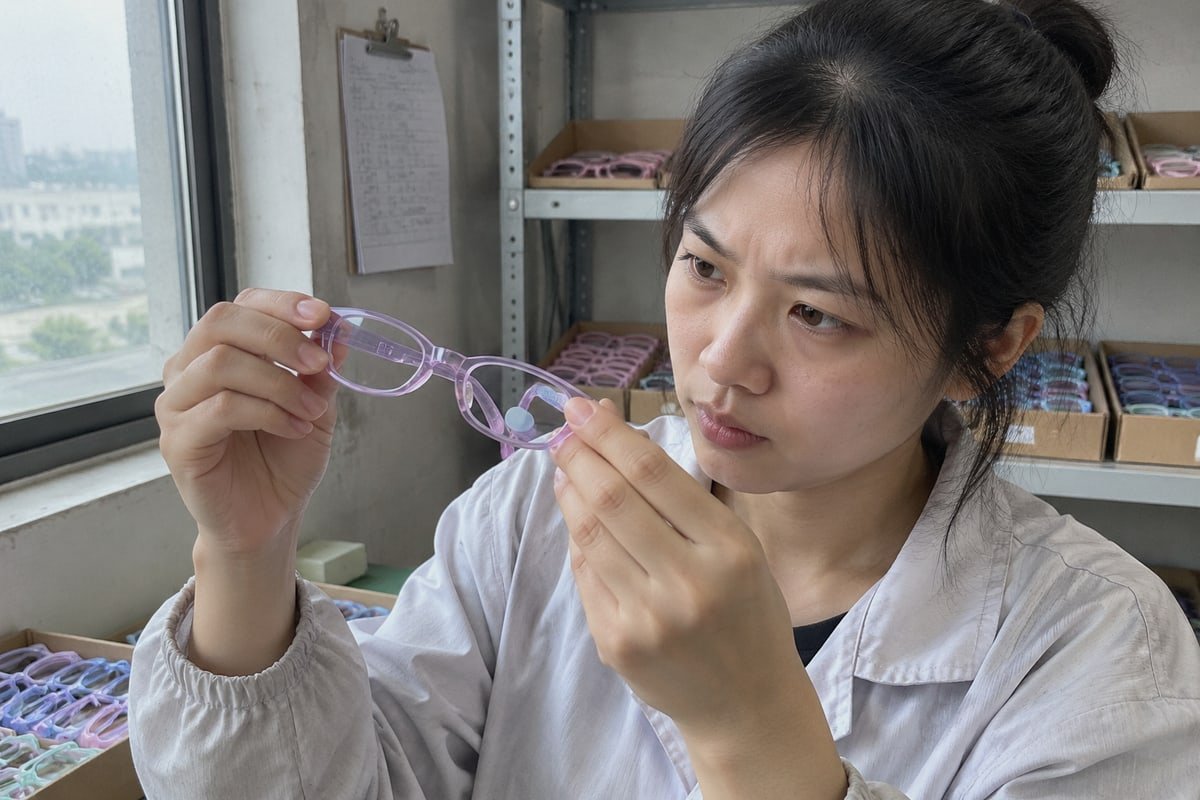
That trade-off is why I never trust a single sample. One frame can be tuned to impress. A QC plan has to prove the whole batch lands in the same window. Here is the process we ask buyers to hold us to, in the order it happens.
Step 1: Pre-Production Sample Approval
- Flex-cycle fatigue testing. The sample is bent repeatedly and checked after set intervals for whitening, warping, and loss of rebound.
- Hinge durability. Temples are opened and closed for thousands of cycles. On our rivet-hinge wayfarer styles, we also check that the rivet does not loosen and the temple tension stays even.
- Lens retention under torsion. The frame is twisted with lenses in place. The lens edge must not lift from the groove.
- Tension pull test. Temples are pulled outward to simulate a child yanking the glasses off. This checks tensile strength at the temple root, the most common break point.
Step 2: Material and Environment Checks
- Thermal stability. Frames are held at high heat to confirm the memory does not relax. A frame that warps in a parked car is a return, not a sale.
- Chemical and sweat resistance. Samples are exposed to artificial sweat 5, skin oils, and common sunscreens. We look for brittleness, discoloration, or tackiness. For TPEE we also watch hydrolytic stability, since long humidity exposure can make poor elastomer grades sticky.
- UV aging. Frames sit in a UV chamber to confirm the polymer does not harden and lose flex. This is what stops "sun-snapping" after one summer.
Step 3: In-Line and Final Inspection
Cosmetic checks come last but tell you a lot. Visible gate marks, flow lines, or sink marks near the bridge often mean inconsistent melt temperature. Inconsistent melt means inconsistent flexibility. Our 5S-managed workshop runs these checks at the press and again at final random inspection.
Resolving the "Flexible Feels Cheap" Objection
Some buyers worry that flexible frames feel flimsy on shelf. I understand that. The fix is structural, not material. Thicker rims, a slightly stiffer TR90 front paired with softer TPEE temples, and a snug lens groove give a premium hand-feel while keeping the recovery. Because we already have around 800 styles tooled, most buyers can find that balance without paying for a new mold.
Can I See Real Test Data or Certifications Before Choosing My Manufacturing Partner?
Fifteen years in eyewear taught our team one thing about trust: a buyer who sees the test report before the deposit rarely disputes a shipment later.
Yes. A credible manufacturing partner should share third-party lab reports for EN ISO 12312-1 or FDA drop-ball testing, material safety data for BPA-free materials, in-house fatigue and hinge cycle records, and sample frames for your own bend test, all before you commit to a bulk order.
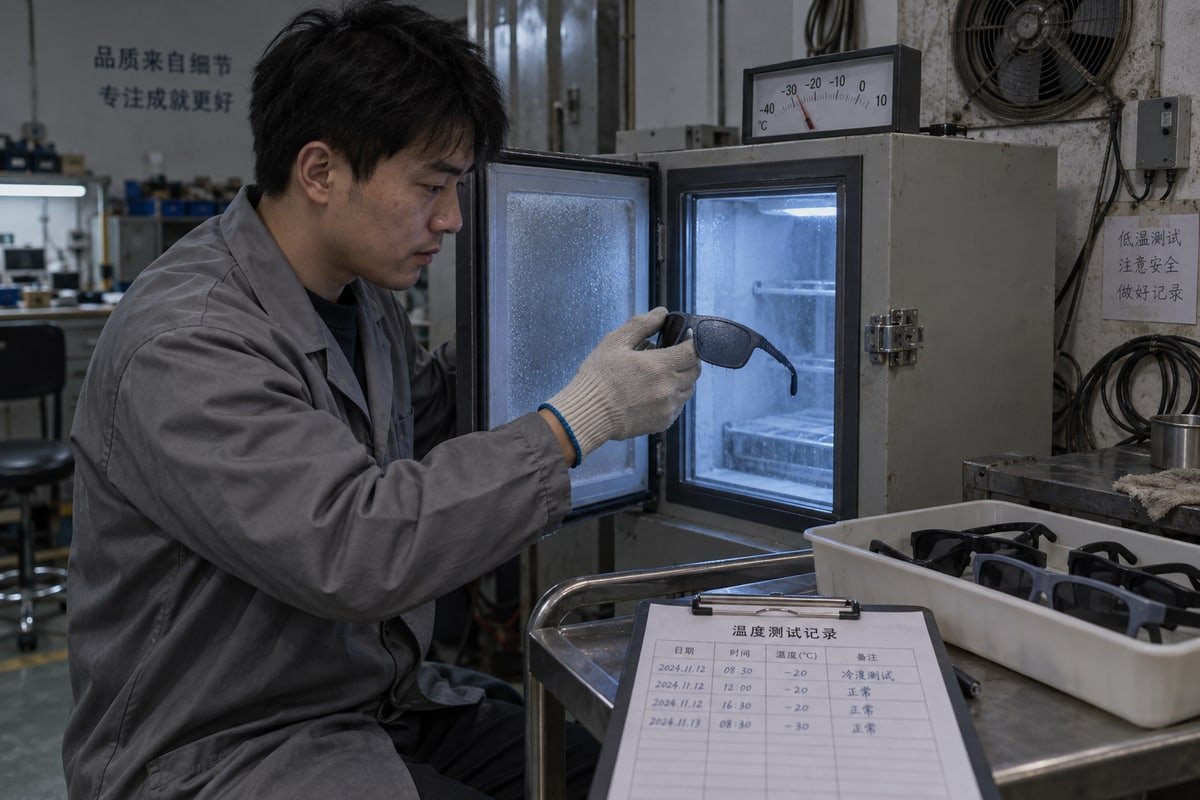
The reason is simple. Test data moves the conversation from opinion to evidence. Once a buyer and a factory agree on what "pass" means, the rest of the relationship is easier. So here is what to ask for, and how to read it.
The Document Set Worth Requesting
| 文書 | Who issues it | 登録番号 | 赤信号 |
|---|---|---|---|
| Lens and sunglasses test report | Third-party lab | UV400 filtering, optical class, impact per EN ISO 12312-1 or FDA drop-ball | Report is for a different model or is several years old |
| Frame endurance record | Factory QC or lab | Hinge cycles, bridge deformation, flex-cycle results | Only a pass/fail word with no cycle count or method |
| Material safety declaration | Resin supplier plus lab | BPA-free materials, heavy-metal and phthalate limits | Declaration covers a resin grade different from your frame |
| 出荷前検査レポート | Factory or your inspector | Batch sampling, defect counts, photos | Sampling size is not stated |
| Production samples | 工場 | Your own bend, twist, and compression test | Samples arrive in a different color or thickness than the bulk order |
Reading a Report Without a Lab Background
You do not need to be an engineer. Check three things. First, the model number on the report matches the frame you are buying. Second, the method or clause is named, not just the standard. Third, the numbers are there, such as cycle counts, drop height, or force applied. If a supplier sends only a certificate cover page, ask for the full report.
What We Share and Why
For buyers in 20+ countries, we prepare test data around the target market. An Australian brand needs different lens documentation than a Japanese optical distributor. We run the flex, torsion, and hinge checks in-house and arrange third-party lens testing to the standard the buyer specifies. Then we send samples so the buyer's team can twist them, sit on them, and hand them to a real child.
Factory Visit or Video Audit
If you cannot travel to Taizhou, ask for a live video walk of the molding area, the QC bench, and the packing line. A real factory with about 120 workers can show you a hinge-cycle machine running, not just a photo. A trading company usually cannot.
結論
Kids will bend, twist, and sit on their sunglasses. Test recovery, hinge durability, and lens retention before you order, and that abuse becomes proof of quality, not a return.
Interested in sourcing the products mentioned in this article? See details and request a quote here:
脚注
1. Official guidelines for managing and documenting material safety information in industrial production. ↩︎
2. Technical definition and properties of thermoplastic polyester elastomers used in flexible manufacturing. ↩︎
3. Scientific overview of polymer structures and how chain separation affects material integrity. ↩︎
4. Official European Chemicals Agency list of restricted chemical substances in consumer products to ensure safety. ↩︎
5. International standard for testing how materials react to human sweat exposure. ↩︎
 English
  Español de México
  Deutsch
  Français
  日本語
日本語  العربية
  Português do Brasil