Do TR90 Kids Sunglasses Degrade in Storage? What Temperature & Humidity Are Required?
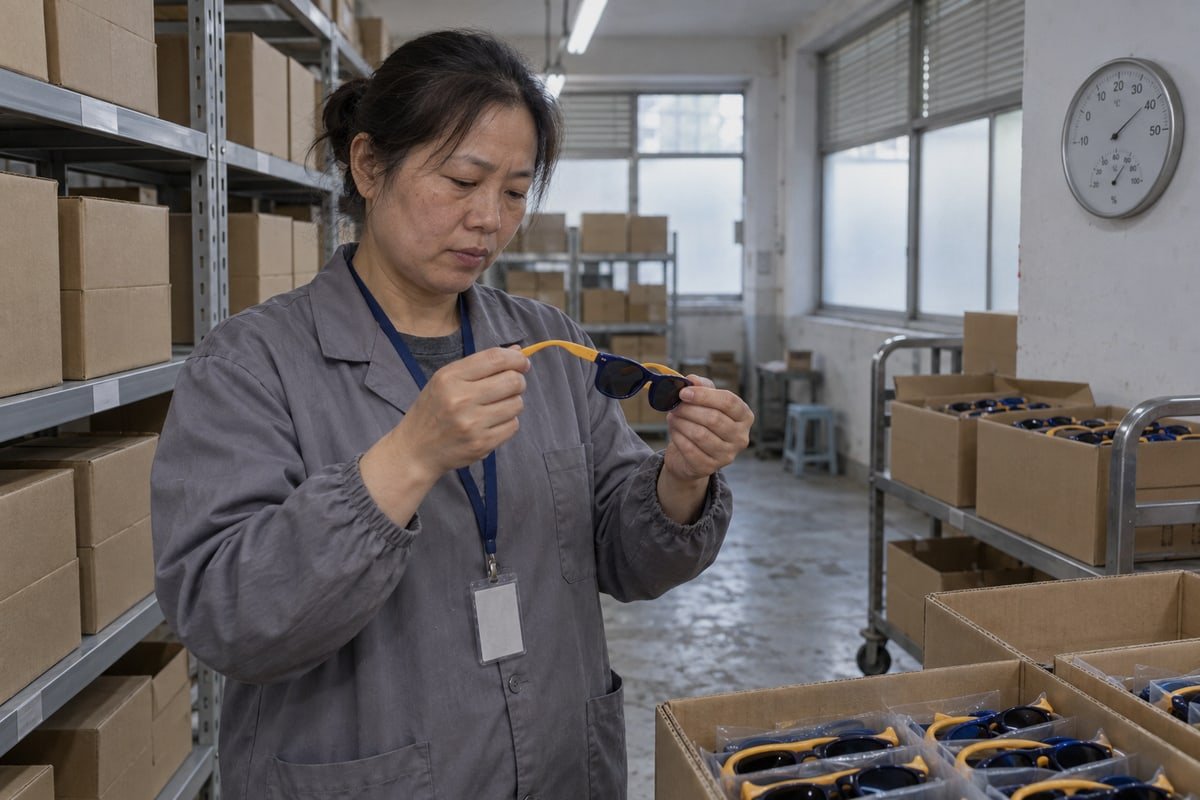
Last summer a distributor asked me whether TR90 kids sunglasses in a warm warehouse were quietly dying. Many buyers share that fear. Our Taizhou production line has real answers.
TR90 kids sunglasses do not meaningfully degrade in normal indoor storage. The frame stays stable from about -20°C to 80°C. Keep them at 15–25°C and 40–50% relative humidity, away from sunlight and hot cars. Lenses, coatings, and hinges are the real weak points, not the frame.
Let me break this down step by step. First, I will show you how to spot damage. Then I will give you the exact temperature and humidity numbers. After that, we cover prevention and the questions you should ask your supplier.
How Do I Know If My TR90 Kids Sunglasses Have Degraded in Storage?
Our QC team opened a sample carton that had sat beside a boiler-room wall for a season. The frames looked fine at first glance. The hinges told a different story.
Check for frame warping, a sticky or tacky surface, yellowing or faded pigment, stiff or seized hinges, and lens coating bubbles or peeling. Flex the temples gently. Healthy TR90 springs back. Degraded material feels stiff, cracks, or stays bent.
What TR90 Actually Is
TR90は 熱可塑性ポリアミド 1. The best-known grade is Grilamid TR90. Frame makers often call it a memory resin. You can bend a temple and it returns to shape. That gives it high 耐衝撃性 2 and very low moisture absorption. Those two traits are why we chose it, alongside TPEE, for children's frames at our Taizhou factory. A child sits on the glasses. The frame flexes and survives.
Buyers often tell me the material is "nearly indestructible." I understand why. In normal use it comes close. But indestructible in use is not the same as unchanged in storage. The frame is resilient, not permanent. And the parts around it age faster than the polymer does.
A Five-Point Inspection Table
| Sign | What You See or Feel | 可能性のある原因 | Component at Risk |
|---|---|---|---|
| フレームの歪み | Temples splayed, lenses not level | Heat above 80°C | 追加のカラーラウンド |
| Tacky surface | Sticky, dull feel | Plasticizer migration from cheap airtight plastic | Surface finish |
| Yellowing or fading | Color shift, dull pigment | Photo-oxidation from UV light | Pigment and topcoat |
| Stiff or seized hinges | Grinding, no smooth swing | Corrosion or salt crystallization | Metal hardware |
| Coating bubbles or peeling | Milky spots, edge lift | Humidity above 60% | Lens coatings |
The Bend Test We Use
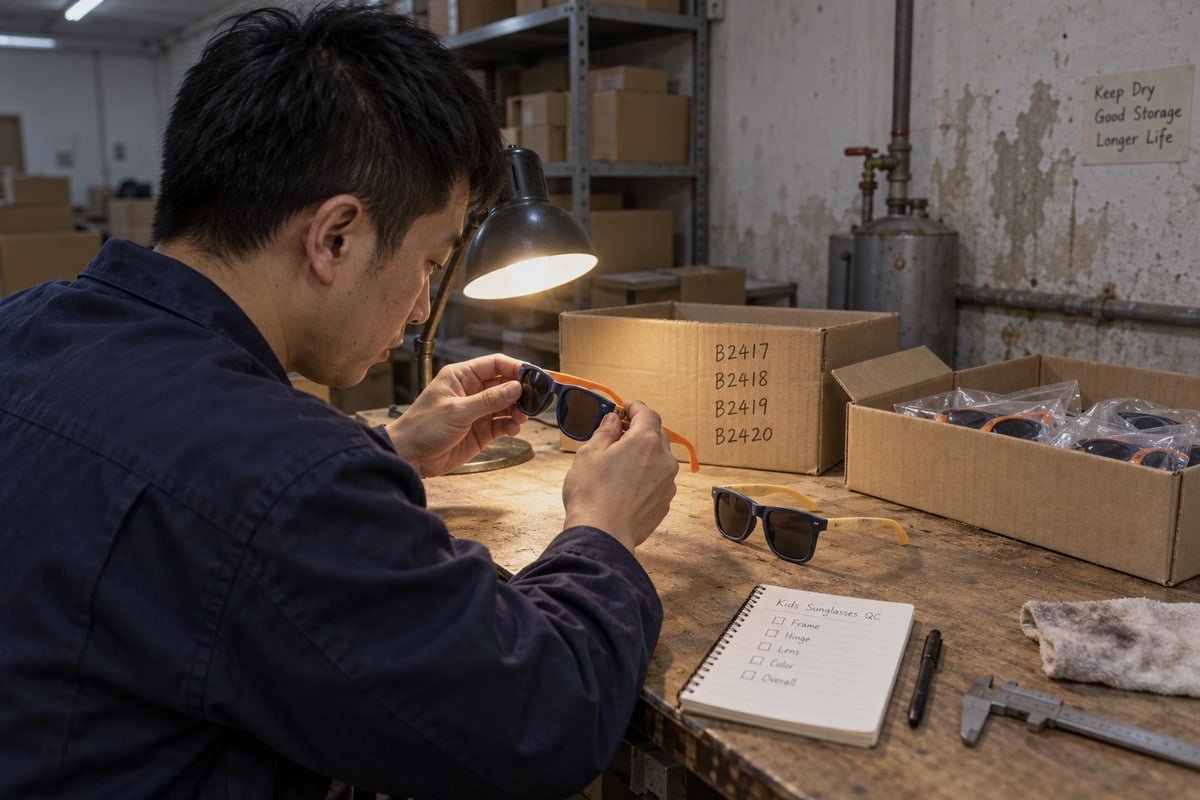
On our line, inspectors gently flex each temple outward and let go. Healthy TR90 springs back at once. Then they open and close the hinge several times. It should move with even resistance. Finally they check the lens edges under a lamp. If you follow the same three steps on stored stock, you will catch most problems early.
Any frame that stays bent has crossed into thermal degradation. Any frame that snaps has suffered material embrittlement. That is rare, but it is real after very dry or very cold storage. A matte navy sport wraparound and a glossy black oval both fail the same way, so the test does not change by style.
What Storage Temperature and Humidity Range Should I Maintain for TR90 Frames?
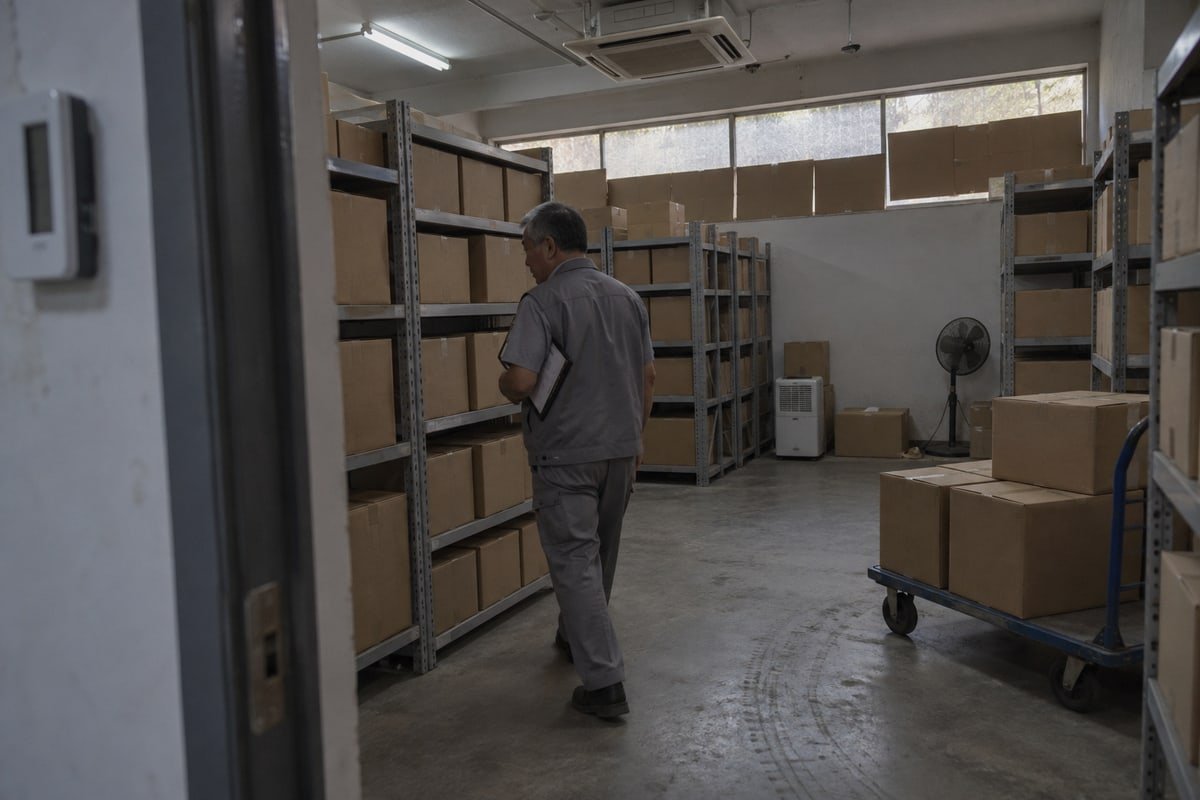
Climate control costs money, and every warehouse manager weighs that against risk. In our 5S管理ワークショップ 3 we settled on a simple rule. Cool, dry, shaded, and consistent beats fancy equipment.
Maintain 15°C to 25°C (59°F to 77°F) and 40% to 50% relative humidity for TR90 frames. The polymer tolerates -20°C to 80°C, but above 80°C it can warp. Humidity over 60% risks lens coating delamination, while below 20% raises brittleness.
Why Published Temperature Numbers Disagree
Different sources quote different heat limits for TR90. That confuses buyers. The reason is simple. Each number measures a different thing.
| Figure You May See | What It Actually Measures | What It Means for Storage |
|---|---|---|
| -20°C to 80°C | Range where the finished frame holds shape in product testing | The practical safe storage window |
| 80°C to 100°C | Long-term service temperature of the raw polymer | Frame survives but can lose shape memory over time |
| 120°C | Short-burst tolerance | Not a storage figure at all |
| 135°C | Heat deflection temperature | Lab bending test under load |
| 155°C | Glass transition temperature | Point where the polymer chains soften |
The raw material can take a lot of heat. The finished frame cannot take as much. Lens coatings, decorative hardware, and the painted topcoat on a two-tone frame like our navy-and-orange wayfarer style all have lower limits. That is why we use 80°C as the working ceiling for frame warping. A closed car dashboard in summer can pass that line. A parked car is the single most common place kids' sunglasses get ruined, and that counts as storage, even for one afternoon.
Humidity: The Frame Versus Everything Else
TR90 absorbs about 1.5% moisture at 23°C and 50% relative humidity. That is low for a nylon-family material. Hydrolysis of the polymer is very slow at room temperature. So the frame itself shrugs off damp air. Hinges, screws, and polarized lens films do not.
| Relative Humidity | Effect on TR90 Frame | Effect on Hinges and Lenses |
|---|---|---|
| Below 20% | Slight brittleness on first flex | ミニマル |
| 40% to 50% | Ideal, stable | Ideal, stable |
| Above 60% | Little change | Coating delamination, screw corrosion |
Some buyers argue TR90 is so durable that storage rules barely matter. I half agree. The frame usually survives. But your customer buys the whole product. A peeling lens or a green screw is still a return. Keep the room steady, too. Rapid swings between cold and hot create micro-fractures in the finish, and those grow into peeling over time.
Can I Prevent TR90 Material From Yellowing or Becoming Brittle During Long-Term Storage?
A product manager from Australia emailed me photos of a competitor's yellowed frames and asked if ours would follow. I told her yellowing is mostly a light and chemistry problem.
Yes. Store TR90 sunglasses in a hard case, away from direct and indirect UV light. Clean off sunscreen, bug spray, and skin oils before storage. Keep humidity between 40% and 50%, avoid airtight cheap plastic boxes, and prevent rapid temperature swings.
Where Yellowing Really Comes From
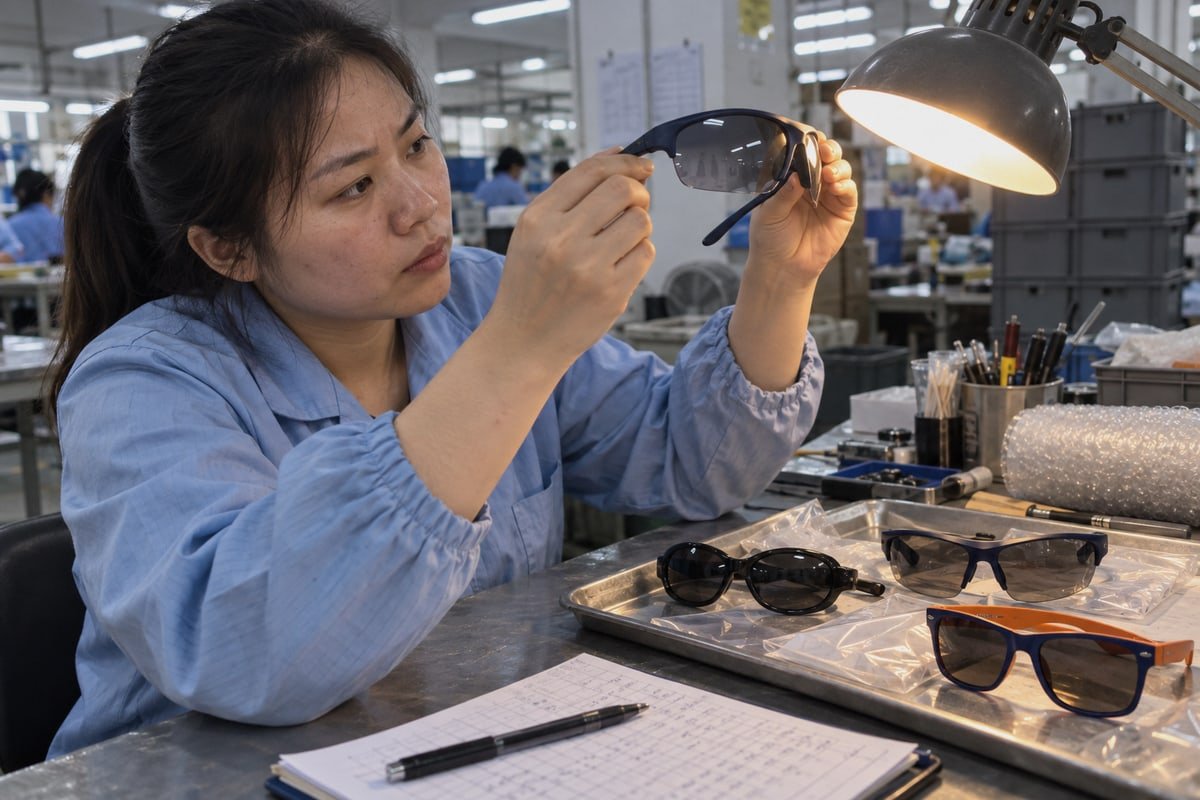
Yellowing in TR90 is photo-oxidation. UV light breaks bonds in the polymer surface and the pigment. Even indirect daylight through a shop window does this slowly. Good compounders add UV stabilizers 4 to the resin. We specify stabilized material for our frames, and deep colors like glossy black or navy hide early change better than pale pastels. Still, stabilizers slow the process. They do not stop it. Shade is the real cure.
Brittleness has a different cause. TR90 is slightly hygroscopic. A small amount of moisture actually keeps the polymer chains supple. In ultra-dry air below 20% humidity, that moisture leaves. The frame can feel stiff and may snap on first wear. It usually recovers after a few days in normal air. Deep cold storage adds the same risk. Sustained heat is worse. It causes true thermal degradation, and that never recovers.
A Seven-Step Pre-Storage Routine
- Wipe off sunscreen, bug spray, and skin oils with mild soap and water. These residues cause stress cracking and surface pitting on TR90 over months.
- Dry the frame fully, especially around the hinges and nose pads.
- Place each pair in a hard-shell case, not a soft pouch alone.
- Avoid airtight low-quality plastic containers. Off-gassing can leave a tacky surface. Use breathable cartons or fabric-lined cases instead.
- Choose a shaded shelf away from windows and lamps.
- Keep the room between 15°C and 25°C and 40% to 50% humidity, and avoid moving stock between cold and warm zones often.
- Flex the temples and check the lens edges every few months.
Kids-Specific Risks to Warn Parents About
Children's sunglasses live in backpacks, lockers, beach bags, and steamy bathrooms. A beach bag adds salt and sand. A bathroom pushes humidity above 60% every morning. A locker adds crush pressure. None of these attack the frame quickly. But together, they wear down the finish, hinges, and lenses far faster than any warehouse would. For brand owners, printing simple care advice on the case insert is cheap. It also reduces complaints.
Why Does My Supplier's Packaging and Warehouse Environment Affect TR90 Sunglasses Shelf Life?
Fifteen years in eyewear taught me that shelf life starts at the factory door, not in the shop. A frame that ships damp or crushed arrives older than its date.
Packaging and warehouse conditions set the starting point for shelf life. Airtight low-grade plastic can cause plasticizer migration and tacky surfaces. Stacked soft pouches cause frame misalignment. Humid or salty warehouses corrode hinges. Hard cases, breathable cartons, and climate control preserve TR90 quality.
The Chain From Factory to Shelf
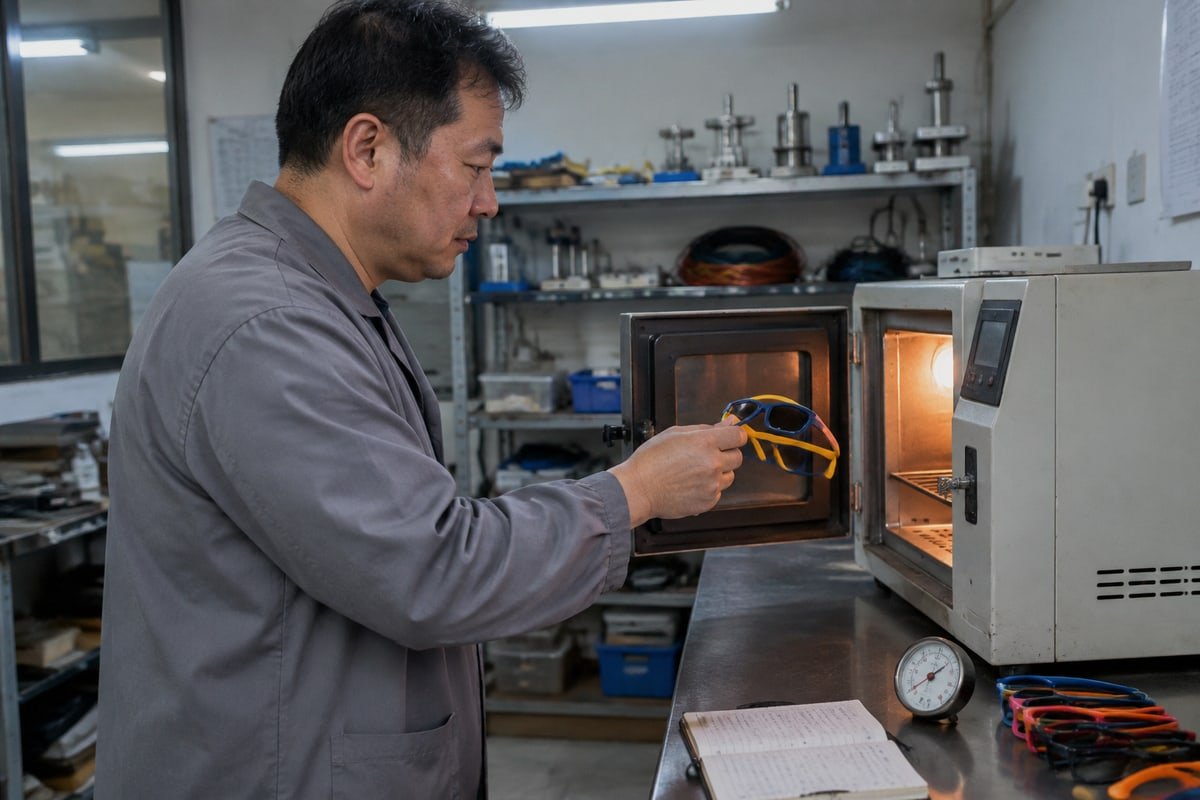
Shelf life is a chain. It starts at molding, passes through packaging, ocean freight, your warehouse, and finally the retail shelf. Every link can add stress. A frame that spends six weeks in a hot, damp container arrives with hinges already at risk. That is why we pack finished frames only after they have cooled and stabilized. It is also why every carton in our 5S-managed workshop is labeled and stored off the floor.
Packaging Choices and Their Risks
| Packaging Type | Main Risk in Storage | 積載強度 |
|---|---|---|
| Loose in poly bag, stacked | Crush misalignment, scratches | Avoid for retail stock |
| Cheap airtight plastic box | Plasticizer migration, tacky finish | Avoid |
| Soft microfiber pouch only | Pressure warping if stacked | Fine short-term, not for bulk |
| Hard-shell case in breathable carton | Lowest risk | Standard for branded orders |
Constant mechanical pressure matters more than people expect. TR90 is flexible. But a soft pouch under a stack of boxes for months can push the frame past its recovery point. The result is permanent misalignment, and no heat gun fixes it cleanly. For TR90 kids sunglasses headed to retail, the hard case is not an accessory. It is part of the product.
Coastal and Humid Warehouses
Buyers in coastal markets face one more issue. Salty air reaches the hinge barrels. Microscopic salt crystals form in the tiny gaps. When a customer finally opens the temples, the hinge seizes or a screw shears. The frame did nothing wrong. The hardware did. This is where hinge quality and screw plating matter as much as the polymer. On our TR90 frames with TPEE temples, the flexible temple absorbs some of that load, but we still inspect hinge plating 5 on incoming parts.
Questions Worth Asking Your Supplier
The third viewpoint I hear is that the frame is a non-issue and storage problems are all about lenses, hinges, and coatings. That is mostly true. So direct your questions at those parts. Ask whether cases are hard-shell. Ask about hinge plating and screw material. Ask whether polarized films are edge-sealed. Ask how long finished goods sit before packing. With around 800 existing styles, we can usually show a buyer the exact case, carton, and hardware spec before they commit to an order. A good partner welcomes those questions.
結論
Worried frames are dying in storage? Under cool, dry, shaded conditions, TR90 kids sunglasses hold up well. Control heat, humidity, light, and packaging, and shelf life takes care of itself.
Interested in sourcing the products mentioned in this article? See details and request a quote here:
脚注
1. Official manufacturer documentation for Grilamid TR90, the specific polymer discussed in the article. ↩︎
2. Scientific definition of impact resistance, a key mechanical property of TR90 eyewear. ↩︎
3. Explains the lean manufacturing methodology used to maintain quality standards in the production facility. ↩︎
4. Technical explanation of how chemical stabilizers prevent photo-oxidation and yellowing in polymers. ↩︎
5. Provides context on the metal finishing process used to protect sunglass hardware from corrosion. ↩︎


 English
  Español de México
  Deutsch
  Français
  日本語
日本語  العربية
  Português do Brasil