Will Sweat and Sunscreen Corrode TR90 Kids Sunglasses Frames?
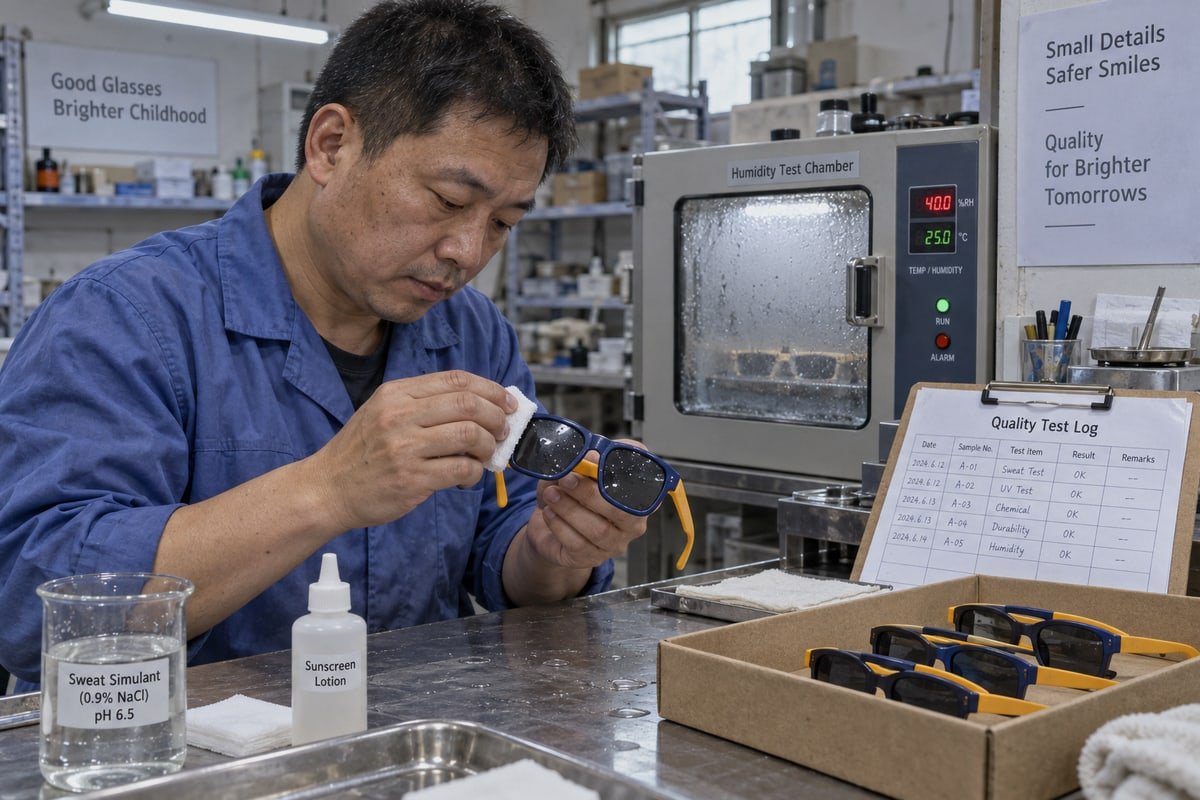
Buyers often ask me whether TR90 kids sunglasses frames survive sweat and sunscreen. On our production line in Taizhou, we test exactly this before any style ships.
No, sweat and sunscreen will not corrode TR90 kids sunglasses frames. TR90 is a thermoplastic polyamide with strong chemical resistance and low moisture absorption. However, metal screws, hinges, and lens coatings can still degrade, so proper cleaning and quality hardware remain essential.
That short answer hides some important detail. The [frame material](https://okayeyewear.com/tr90-vs-pc-silicone-kids-sunglasses-frame-best/) is only one part of the sunglasses. Let me walk you through what actually happens outdoors, what can fail first, and what to check before you place an order.
How does TR90 material resist sweat and sunscreen exposure during outdoor activities?
During one of our summer batch tests, our QC team wiped frames with sunscreen daily for weeks. The TR90 bodies came out fine. I want to explain why.
TR90 is a nylon-based thermoplastic polyamide with a tightly bonded molecular structure. It absorbs very little moisture, so sweat beads on the surface instead of soaking in. Its chemical resistance also protects it from sunscreen oils, skin acids, and salts during outdoor activities.

The science here is simple, and it matters for anyone sourcing kids' eyewear. TR90 is a memory polymer. That means it snaps back to its original shape after bending. The same molecular density that gives it flexibility also keeps liquids out. Low moisture absorption 1 means the frame stays dimensionally stable in humid, sweaty conditions. It will not swell, warp, or soften at the beach or on a sports field.
Sweat is mildly acidic and full of salts. Those salts attack metal alloys aggressively. But they have almost no effect on a nylon-based polymer. Sunscreen is a similar story. The frame body shrugs off common lotion formulas, including chemical filters like avobenzone, far better than acetate does.
There is one nuance worth knowing. Because TR90 is hydrophobic, sweat beads rather than absorbs. Those beads can dry and concentrate salt deposits in high-friction spots like the nose bridge. That does not corrode the frame, but it can irritate a child's skin if the glasses are never rinsed. This is a hygiene issue, not a material failure.
How TR90 compares under sweat and sunscreen
| 素材 | 耐汗性 | Sunscreen resistance | 通常の故障モード |
|---|---|---|---|
| TR90 (thermoplastic polyamide) | 素晴らしい | 素晴らしい | Surface finish dulling only |
| アセテート | 普通 | Fair to poor | Frame discoloration, dulling |
| Cheap metal alloy | 悪い | 普通 | Corrosion, green residue |
| Titanium | 素晴らしい | 素晴らしい | Rarely fails, but costly |
For active kids, TR90 combines this chemical resistance 2 with impact resistance and hypoallergenic properties. That is why we build most of our children's range around it, often paired with even softer TPEE temples for comfort.
What signs of chemical damage should I check for when sourcing kids' sunglasses frames?
A distributor in Australia once returned samples from another supplier showing sticky matte finishes after sunscreen contact. We inspected them together, and the lesson stuck with me.
Check for surface haze, sticky or tacky matte finishes, uneven color fading on high-contact areas, greenish residue around metal hinges and screws, cloudy or peeling lens coatings, and hairline stress cracking near hinge assemblies. These reveal weak coatings or poor hardware, not TR90 failure.
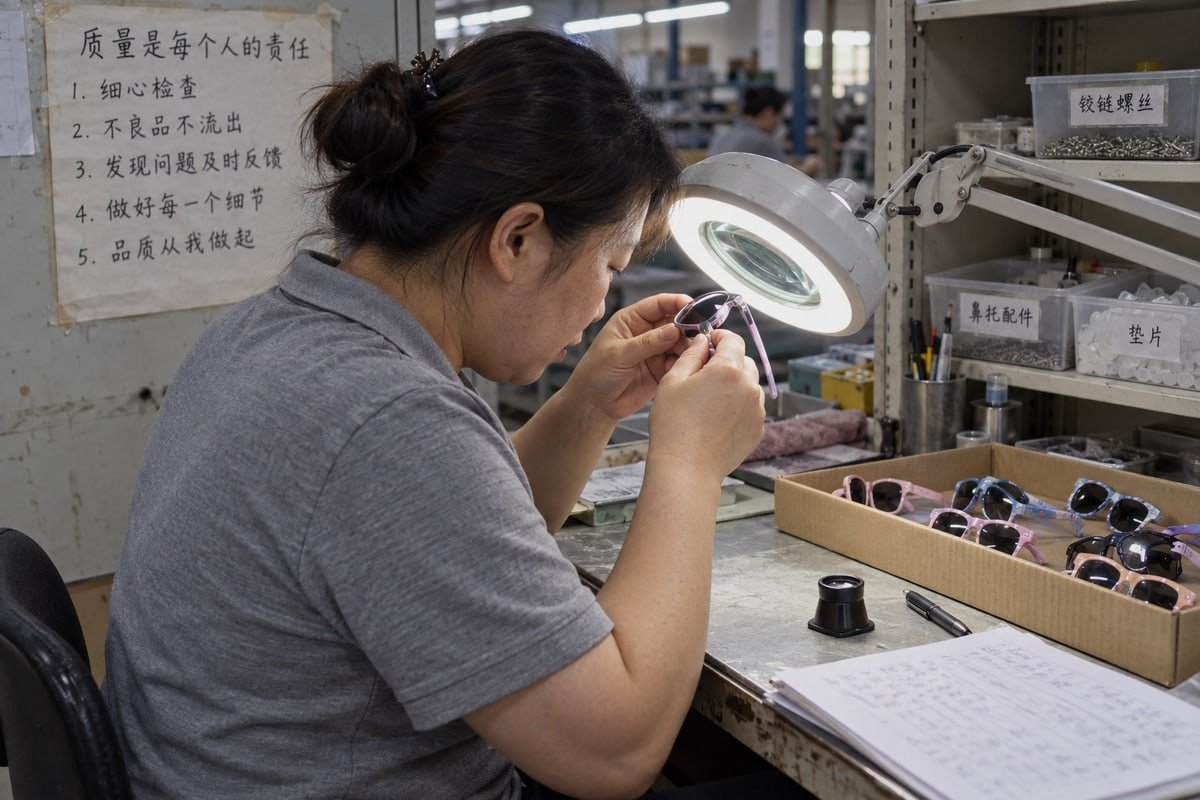
Here is the key insight from years of quality control: the TR90 frame body almost never fails first. The weak links are the layers and parts attached to it. When you evaluate samples, work through this checklist.
The six warning signs, in order of frequency
- Sticky matte finishes. Matte-finished frames use a separate coating layer over the base polymer. Cheap coatings can turn tacky or appear to "melt" when sunscreen chemicals attack them. Rub sunscreen on a matte sample and check it after 48 hours.
- Surface haze. Dried sunscreen residue can bond to a poorly finished surface and create a permanent haze that will not wipe off. Quality finishes release residue with mild soap and water.
- Green or dark residue at hinges. Sweat-induced salt buildup corrodes low-grade metal screws and hinges even while the TR90 stays intact. Ask what hinge metal your supplier uses.
- Photobleaching. UV light can catalyze reactions between sunscreen chemicals and frame pigments. The result is uneven, localized color fading on the temples and nose area. Well-dispersed, stable pigments resist this.
- Cloudy lens coatings. Chemical sunscreen ingredients like oxybenzone can dissolve top-layer lens coatings before touching the frame at all. Check anti-reflective and mirror coatings closely on returned field samples.
- Stress cracking at the hinge assembly. Sunscreen oils can migrate into microscopic gaps around hinges. Combined with mechanical flexing, this can cause environmental stress cracking over time. Look for hairline lines radiating from screw holes.
When we develop a new style at our factory, we run sunscreen exposure checks on the actual finish and hardware combination, not just the raw material. A material data sheet tells you about TR90. It tells you nothing about the coating a specific factory sprayed on top.
Can I request additional coatings or treatments to improve my frames' chemical resistance?
Yes, and buyers ask us this often. Our OEM/ODM team weighs a real trade-off here: every added treatment improves one property but can affect cost, texture, or lead time.
Yes. Reputable OEM manufacturers can apply protective clear coats, upgraded UV-stable paint systems, anti-corrosion hinge plating, hydrophobic lens treatments, and hardened anti-scratch coatings. These treatments protect finishes and hardware from sweat and sunscreen, since the TR90 base already provides strong chemical resistance.
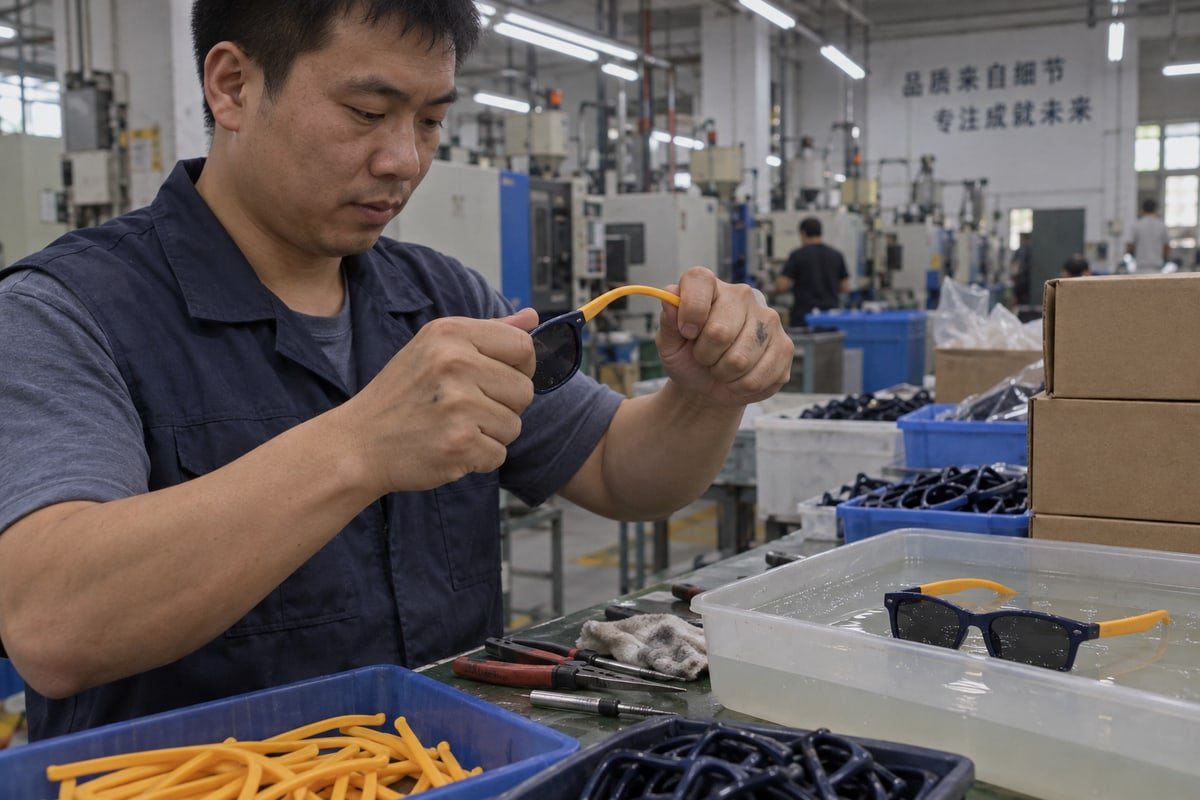
Let me be honest about where treatments help and where they are wasted money. The TR90 core does not need extra chemical protection. What benefits from treatment are the surfaces, colors, lenses, and hardware around it.
Treatments worth requesting from your supplier
| Treatment | 何を保護するか | に最適 |
|---|---|---|
| UV-stable topcoat | Frame color and finish from photobleaching | Bright colors, beach-market styles |
| Higher-grade matte lacquer | Matte texture from turning sticky | Any matte or rubberized finish |
| Anti-corrosion hinge plating or polymer hinges | Screws and hinges from sweat salt buildup | Sport and swim-adjacent lines |
| Hardened anti-scratch lens coating | Polycarbonate lenses from micro-abrasion | Kids who wipe lenses on clothing |
| Hydrophobic lens layer | Lenses from sunscreen smearing and haze | Premium and polarized ranges |
Two practical notes from our workshop. First, mineral sunscreens containing zinc oxide or titanium dioxide behave like micro-abrasives. When a child wipes the frame with residue still on it, those particles scour the finish and dull it prematurely. A hardened topcoat slows this, but you should still tell end customers to rinse before wiping. Second, screwless or polymer hinge designs remove the corrosion problem entirely, which is why several of our roughly 800 existing styles use flexible one-piece constructions with TPEE temples.
If you are launching a new kids' line, we usually recommend testing your target coating on existing styles first. That way you validate the finish in your market without heavy mold investment.
Why does material quality matter more than price when my sunglasses face daily sweat exposure?
Fifteen years in eyewear has taught our team one hard lesson: the cheapest sample and the reliable sample can look identical on day one. Day ninety tells the truth.
Daily sweat exposure relentlessly tests every weak component. Low-grade materials show frame discoloration, corroded hardware, and peeling coatings within a season, driving returns and damaging your brand. Quality TR90, stable pigments, and proper hardware cost slightly more but survive years of active use.
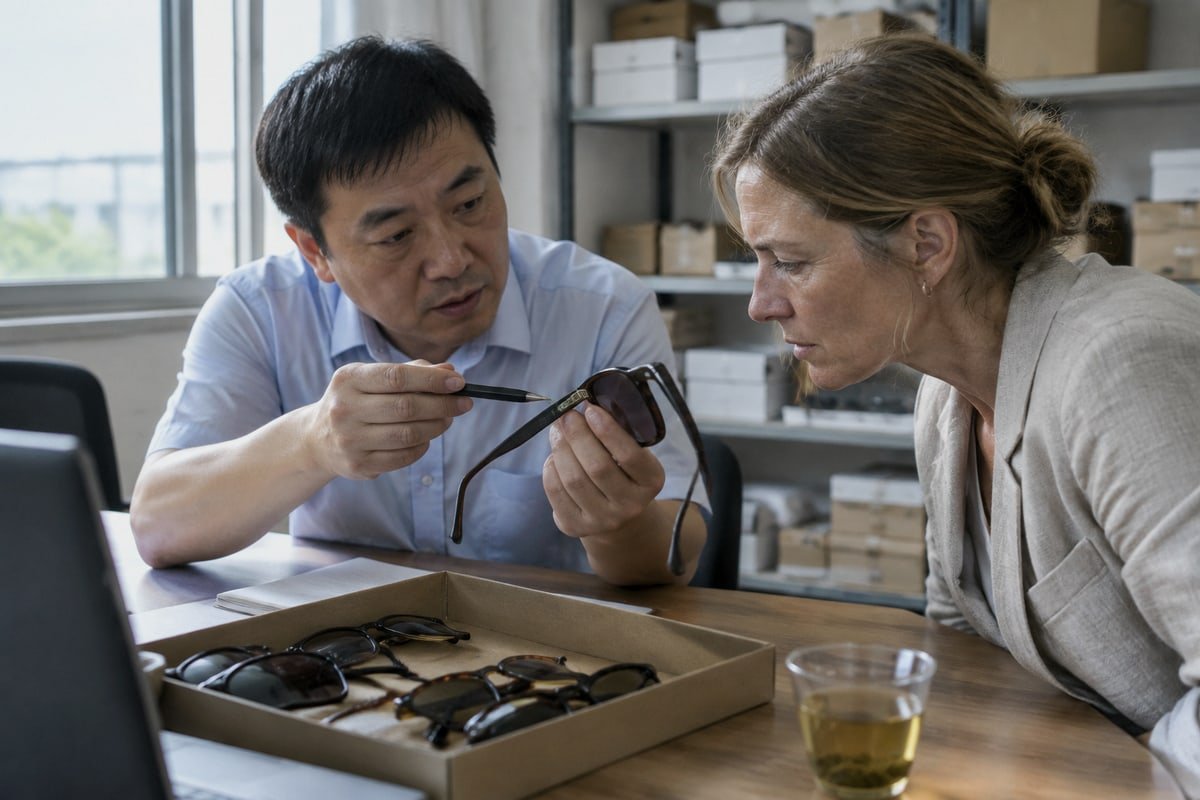
Price pressure is real in kids' eyewear. But sweat exposure is not an occasional event for children. It is daily, repeated chemical stress on every joint, coating, and pigment. Cheap products fail in slow motion, and the parent blames your brand, not the factory.
Where cheap products cut corners
Not all "TR90" is equal. Some low-cost frames use recycled or blended nylon with inconsistent memory polymer behavior. Others use genuine TR90 but pair it with the cheapest possible screws, unstable dyes, or one-pass paint jobs. The frame material survives; the product still fails.
Consider what a parent actually experiences over one summer:
| Timeline | Low-quality frame | Quality TR90 frame |
|---|---|---|
| 1週目 | Looks identical to premium | Looks identical to budget |
| Month 1 | Matte finish feels tacky | Finish stable after cleaning |
| Month 3 | Green hinge residue, color fading | Minor lens smudging only |
| Month 6 | Stress cracking near hinges, returns begin | Still retail-presentable |
There is also a child-safety dimension that pricing pressure often ignores. Genuine TR90 offers hypoallergenic properties and high 耐衝撃性 3, which matter when frames sit on a child's face for hours and take real knocks. Blended or degraded plastics can become brittle, and a brittle frame breaking near a child's eye is a risk no brand should accept to save a few cents.
For B2B buyers, the math is straightforward. A slightly higher unit cost buys stable pigments, plated or polymer hinges, tested coatings, and consistent quality control. That translates into fewer returns, better reviews, and repeat purchases. In our experience exporting to buyers in more than twenty countries, the brands that grow are the ones that treat eyewear maintenance complaints and warranty returns as signals to fix at the factory level, not as a cost of doing business.
結論
Sweat and sunscreen will not corrode TR90 kids sunglasses frames. But coatings, hinges, and lens layers can fail without quality sourcing. Choose a partner who tests the complete product, not just the material.
Interested in sourcing the products mentioned in this article? See details and request a quote here:
脚注
1. Technical details on the low moisture absorption and dimensional stability of Nylon 12 polymers. ↩︎
2. Scientific overview of chemical resistance in polymers and how materials withstand exposure to oils and acids. ↩︎
3. International quality standard specifying requirements and test methods for spectacle frames and impact durability. ↩︎



 English
  Español de México
  Deutsch
  Français
  日本語
日本語  العربية
  Português do Brasil