How to Spot Material Downgrades Behind Low Quotes for Kids’ Sunglasses?

Material downgrades behind low quotes for kids’ sunglasses are the hidden trap I warn buyers about most. On our Taizhou production line, we see the swapped materials that quotes never mention.
To spot material downgrades behind low quotes for kids’ sunglasses, verify the exact frame resin (TR90 or TPEE) and lens substrate in writing, demand test reports for UV400 protection and impact resistance, and physically check flexibility, optical clarity, hinges, and surface finish on samples.
A low quote is not automatically bad. But an unexplained low quote usually means something was quietly removed. Below, I break down exactly how to find out what.
How can I tell if a supplier swapped TR90 for cheaper plastic without telling me?
Last spring, a European buyer sent us a competitor's "TR90" sample for review. Our engineers snapped one temple in a single twist. Genuine TR90 never behaves that way.
You can detect a TR90 swap by twisting the frame 180 degrees — real TR90 or TPEE springs back instantly, while generic plastic snaps or stays deformed. Also check weight, surface smell, heat stability, and whether scratches reveal a white core from surface dyeing.
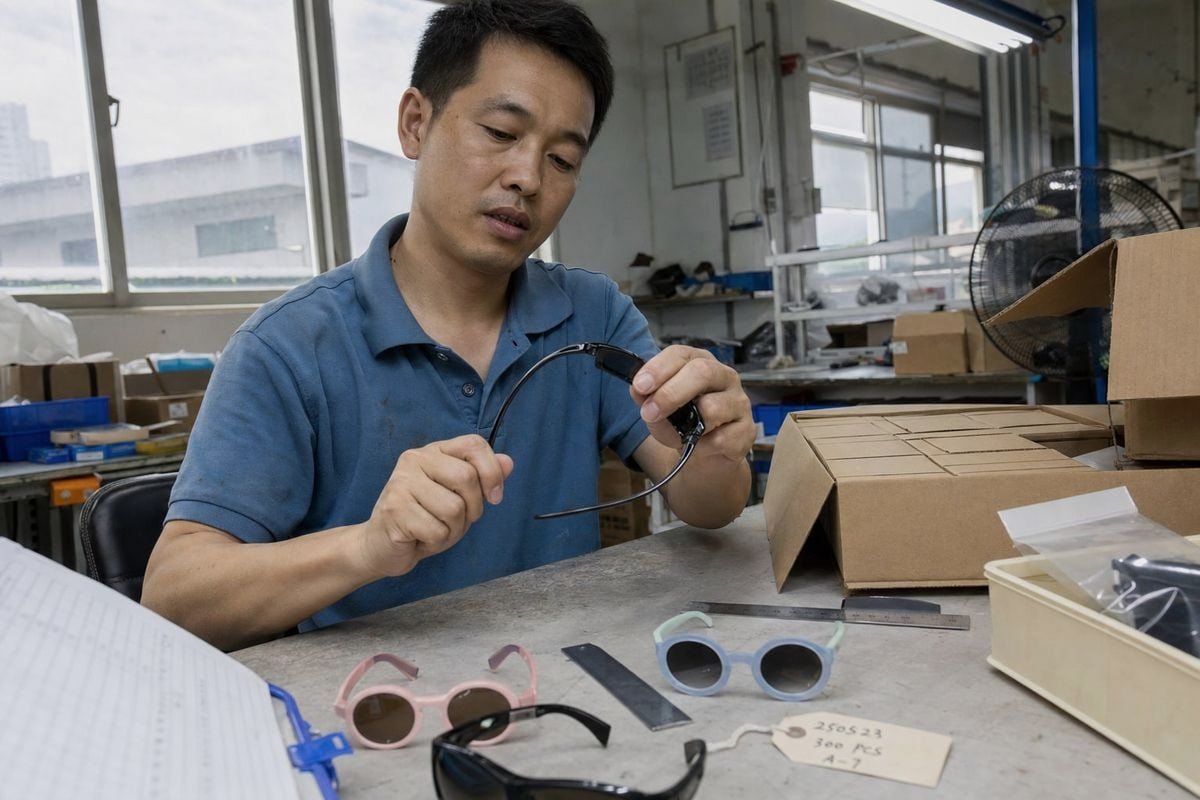
The reason suppliers swap TR90 for generic petroleum-based plastic is simple math. TR90 resin costs meaningfully more per kilogram, and a factory quoting far below market must recover margin somewhere. The frame material is the easiest place to hide it, because most buyers cannot tell the difference from a photo.
Physical tests you can run in minutes
Real TR90 and genuine TPEE frame material have distinct, testable behaviors. We run these same checks in our own incoming-material inspection, and you can repeat them on any sample without lab equipment.
| テスト | Genuine TR90 / TPEE | Downgraded generic plastic |
|---|---|---|
| 180° twist test | Springs back to shape instantly | Snaps, cracks, or stays bent |
| Weight in hand | Very light for its size | Noticeably heavier or oddly hollow |
| Hot-car simulation (60°C) | Stays dry and stable | Turns tacky, warps, or leaches oils |
| Scratch test on frame edge | Color runs through the material | White core shows under the surface |
| Surface finish | Smooth, no gate marks or bubbles | Rough nubs, flow lines, visible bubbles |
Coloration tells the truth
Quality frames use masterbatch coloration, where pigment is mixed into the raw resin before molding. Cheap frames are often surface-dyed. When a child sweats or scratches the temple, surface dye bleeds onto skin and the white core appears. In our workshop, we reject any batch showing this "white-core" effect, because it signals the resin itself was substituted, not just the paint.
Also inspect the hinges. Durable kids' frames use threaded metal barrel inserts so screws never strip. A common downgrade drives screws directly into soft plastic. The hinge loosens within weeks and cannot be repaired. That single detail often reveals the whole cost-cutting story.
What questions should I ask my factory to confirm the real material behind a low quote?
A procurement manager from Australia once asked us why our quote listed the resin brand, lens substrate, and hinge type line by line. My answer: vague quotes hide vague materials.
Ask the factory to name the exact resin grade and supplier, provide a Material Safety Data Sheet, confirm the lens substrate (polycarbonate, not acrylic or unspecified "PC-like"), specify hinge construction, and state which safety standards the finished product is tested against.

The right questions force specificity, and specificity is what cost-cutters avoid. In fifteen years of exporting children's eyewear from our factory, I have learned that an honest supplier answers material questions quickly and in writing. An evasive one changes the subject to price.
The seven questions that expose a downgrade
- What is the exact frame resin and grade? "TR90" alone is not enough. Ask for the resin manufacturer and grade number, plus the Material Safety Data Sheet.
- What is the lens substrate? ポリカーボネート 1, TAC, acrylic, and CP behave very differently. "Polarized" describes a film, not a material.
- Is the lens UV400, and can you show the transmittance test? A sticker is a claim. A spectrophotometer report is proof of UV400保護 2 基準。.
- Are the materials BPA-free and phthalate-free? Children chew temple tips. BPA-free certification 3 and lead-free paint requirements matter for any kids' product.
- How are the hinges built? Metal barrel inserts or screws driven into raw plastic?
- What is your lens bevel geometry? A proper V-bevel locks the lens into the frame groove. Flat-edged lenses pop out when the frame expands in summer heat.
- Can we audit or video-tour the workshop? A factory quality control audit — even remote — reveals whether 5S management and incoming-material checks actually exist.
Read how they answer, not just what they answer
When a supplier replies with documents, resin brand names, and tolerances, the low quote may be legitimate efficiency. When the reply is "same same as TR90" or "food-grade plastic" with no paperwork, assume a substitution. In our experience, the buyers who ask these questions before sampling save themselves an entire failed season.
Which lab tests or certificates prove my kids' sunglasses use genuine flexible, safe materials?
Before we ship any new style, our QC team sends samples out for third-party testing. That habit came from a hard lesson early on: buyer trust is built on reports, not promises.
Request ANSI Z80.3 or EN ISO 12312-1 test reports for optical and UV performance, impact resistance testing such as drop-ball results for polycarbonate lenses, CPSIA compliance for the US market, REACH regulation standards for the EU, plus BPA-free and phthalate-free chemical reports.
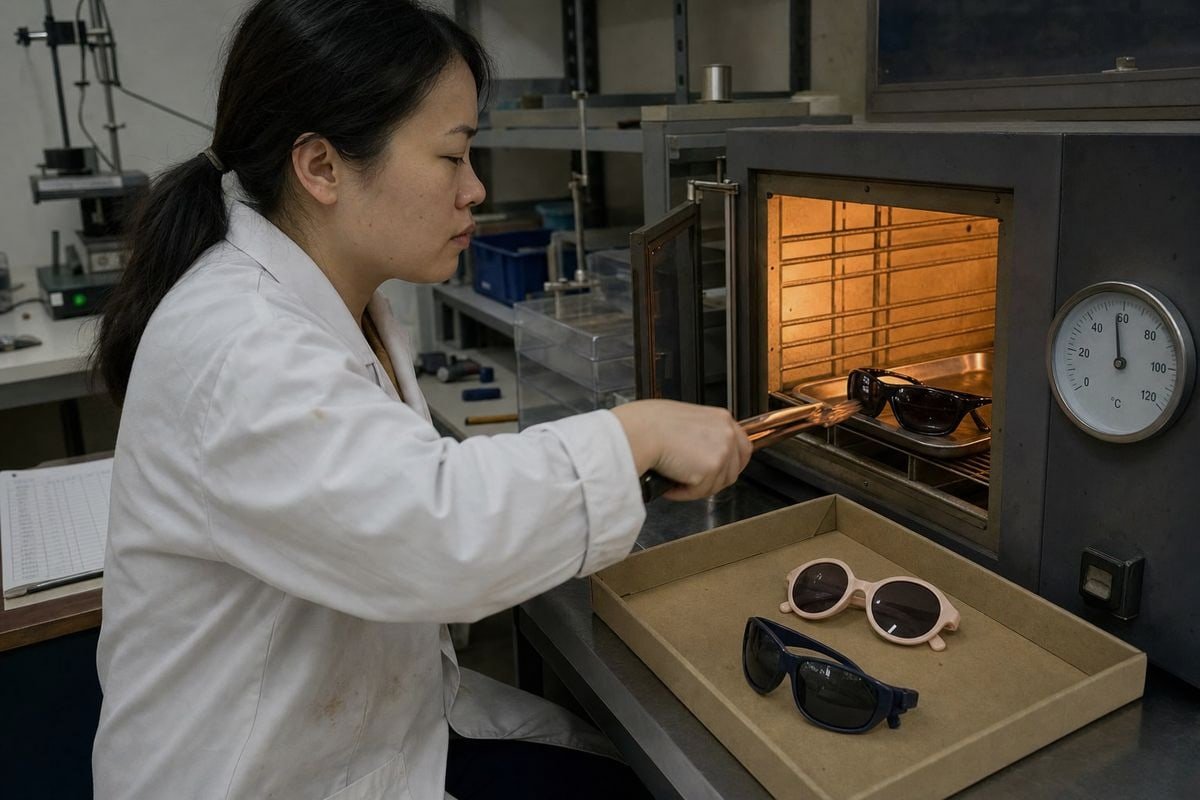
Certificates are only useful if you know which one proves which claim. Many buyers accept a single "UV400" sticker as proof of everything. In reality, safety for children's eyewear splits into three separate proof categories: optical safety, mechanical safety, and chemical safety. A genuinely safe product needs evidence in all three.
Match each claim to its proof
| Claim on the quote | Document that actually proves it | What a downgrade looks like |
|---|---|---|
| "UV400 protection" | Spectral transmittance report to EN ISO 12312-1 or ANSI Z80.3 4 | Dark tint with no UV filtering — worse than no sunglasses |
| "Shatterproof lens" | 耐衝撃性テスト 5 report (drop-ball or equivalent) | Brittle acrylic or CP lens that splinters on impact |
| "Safe for children" | CPSIAコンプライアンス 6 report, lead-free paint requirements, phthalate screening | Unscreened paints and plasticizers on mouth-contact parts |
| "Eco-friendly material" | REACH 規則 7 standards documentation, BPA-free certification | Generic resin with no chemical traceability |
| "Optical quality lens" | Optical clarity grade / refractive power test | Wavy, distorting lens that strains young eyes |
Why the standard matters more than the sticker
One consumer investigation found that a large share of marketplace kids' sunglasses failed UV tests and lacked required CE or UKCA markings entirely. Stickers are printed by the thousand; test reports carry lab names, dates, and sample photos you can verify. When we develop UV400 and polarized lens options for clients, the transmittance curve travels with the order file. Ask your supplier for the same. If the report cannot be traced to a named lab and a real sample, treat it as decoration.
How do I compare quotes fairly when materials and specs aren't clearly listed?
Two quotes for the "same" kids' sunglasses recently crossed my desk, thirty percent apart. Once we normalized the specs line by line, the cheap one was actually the expensive one.
Compare quotes fairly by forcing every supplier onto one spec sheet: frame resin, lens substrate, UV standard, hinge construction, coloration method, packaging, and required certificates. Then price the gaps. An unlisted spec should be treated as the cheapest possible version until proven otherwise.
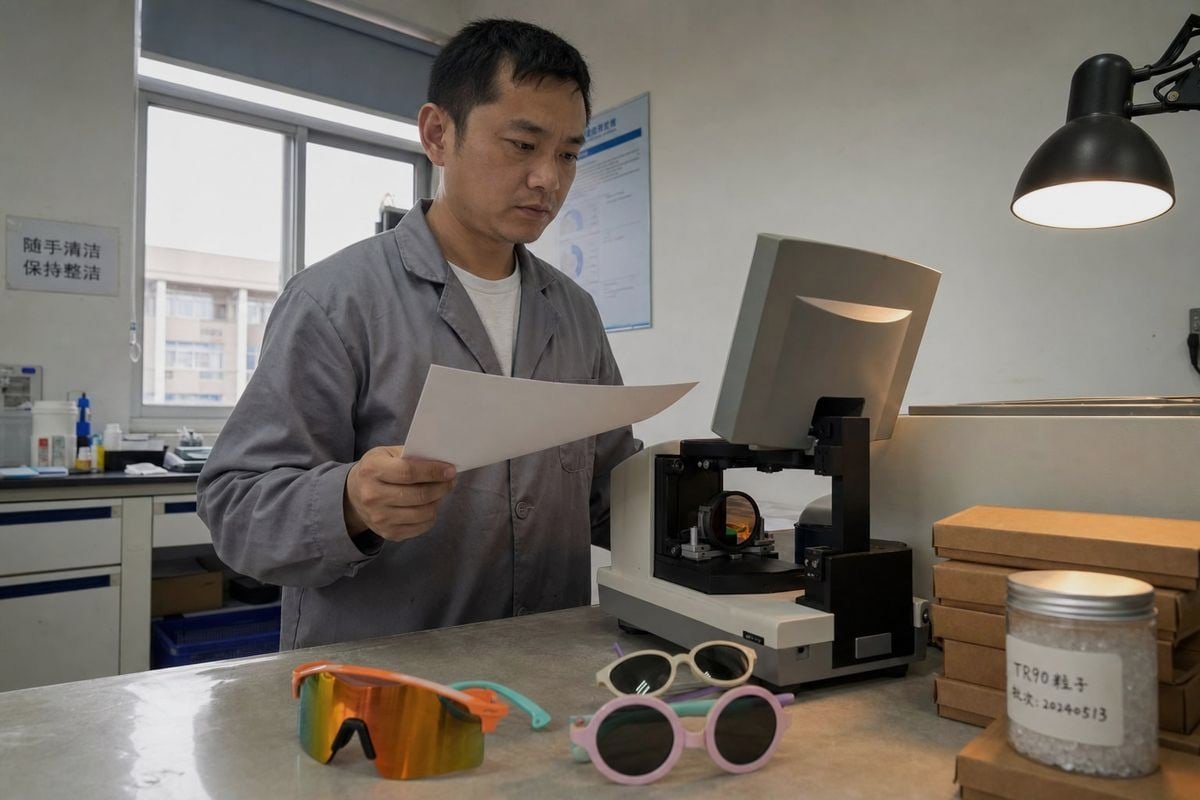
An unspecified quote is not a neutral quote. It is a quote that reserves the right to downgrade. The fix is a normalization exercise: you define the spec sheet, and every supplier must fill in the same blanks before you compare a single price.
Marketing language versus material reality
| What the quote says | What it might really mean |
|---|---|
| "Polarized lens" | TAC polarized lenses — glare reduction, but little impact protection |
| "PC frame" or "eco plastic" | Generic plastic, not TR90 or TPEE; stiff and brittle |
| "UV resistant" | No verified UV400 protection; tint only |
| "Fashion lens" | Non-optical acrylic with poor optical clarity grade |
| "Spring hinge" | Screws driven into bare plastic, no metal inserts |
Remember: polarization is about glare, not UV safety. TAC polarized lenses can be acceptable for casual adult styles, but polycarbonate vs acrylic lenses is the comparison that decides child safety, because polycarbonate offers roughly ten times the impact resistance of standard plastic and blocks 100% of UVA/UVB by material property.
A fair-comparison process
- Send all suppliers your own spec sheet with every field mandatory.
- Reject any quote returned with blanks or "similar to" language.
- Add the cost of missing certificates to the low quote — testing is never free.
- Order samples and run the flex, distortion, and heat tests yourself.
- Compare landed cost per compliant unit, not price per piece.
At our factory, buyers can also sidestep much of this risk by starting from our roughly 800 existing styles with documented materials, then customizing colors, logos, lenses, and packaging. Known materials plus written specs make every future quote comparable.
結論
Low quotes hide material downgrades in frames, lenses, hinges, and finishes. Verify resins, demand test reports, normalize specs, and test samples yourself — then a fair price becomes a safe price.
脚注
1. Explains material properties relevant to lens impact resistance claims. ↩︎
2. Background reference on UV protection standards and sunglasses lens technology. ↩︎
3. FDA guidance on BPA safety relevant to children’s product material claims. ↩︎
4. Reference for optical safety standards governing sunglasses lens performance. ↩︎
5. ISO standards body defines testing methods for impact resistance verification. ↩︎
6. Official source explaining US children’s product safety law referenced in article. ↩︎
7. EU chemical safety regulation authority explaining REACH compliance requirements. ↩︎

 English
  Español de México
  Deutsch
  Français
  日本語
日本語  العربية
  Português do Brasil