How to Verify Kids’ Semi-Rimless Frames Are Compatible With In-Store Edging Equipment?

Kids’ semi-rimless frames look great on shelves — until a retail lab cracks a lens during grooving. On our production line, we hear this complaint often, and it kills reorders fast.
To verify kids’ semi-rimless frames are compatible with in-store edging equipment, confirm the edger has a nylon cord grooving function, request OMA/VCA digital tracing files from the supplier, check minimum lens edge thickness of 2.0mm, and run a demo-lens trace and test cut before committing to a full order.
That is the short answer. Below, I break down each verification step so your retail partners never reject a frame at the fitting bench.
How can I confirm my supplier provides accurate groove and bevel specifications for semi-rimless frames?
A buyer from Melbourne once emailed me a photo of a chipped pediatric lens. The cause? Her previous supplier never documented groove depth specifications. Our team fixed it with one spec sheet.
Ask your supplier for a written technical data sheet listing groove width, groove depth, nylon cord diameter, bevel angle, and base curve. Then request OMA/VCA standard digital tracing files so any patternless lens edger can read the frame's internal geometry accurately.
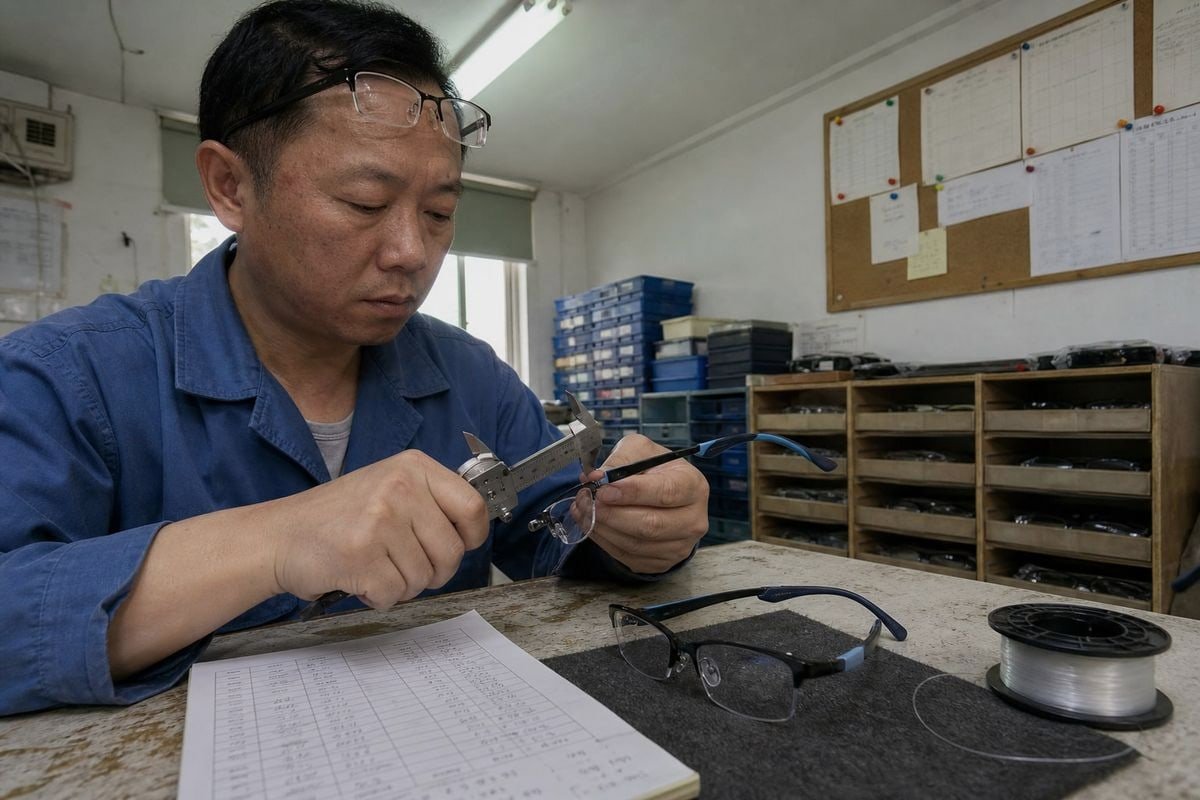
Documentation is the first filter that separates a serious factory from a trader reselling stock frames. In our 15 years making children's eyewear 1 in Taizhou, we have learned that vague answers about groove geometry almost always predict fitting problems at retail. So here is exactly what to demand, and why each item matters.
The five numbers that must appear on the spec sheet
A semi-rimless frame holds the lens with a nylon monofilament 2 seated in a groove cut into the lens edge. If the groove and cord do not match, the lens either pops out or sits under constant stress. Your supplier should supply these values without hesitation:
| Specification | Typical value for kids' frames | Why it matters |
|---|---|---|
| Groove width | 0.6mm | Must match the nylon cord diameter for secure retention |
| Groove depth | 0.4–0.6mm | Too shallow means pop-outs; too deep weakens the lens wall |
| Cord diameter | 0.55–0.6mm | Must seat snugly in the groove under tension |
| Bevel angle (top rim) | Per frame design | Ensures the lens sits flush in the brow bar |
| Base curve of demo lens | Usually 4–6 base | Guides lens lab matching and prevents wrap mismatch |
Why digital tracing files beat verbal promises
When we send OMA/VCA format files to a buyer's optical partners, their patternless lens edger imports the exact frame shape digitally. This removes operator guesswork. It also lets the retail lab verify the b-dimension measurement 3 — the vertical lens height — before any lens is blocked. Pediatric frames often have a b-dimension under 25mm, and small shapes leave little margin for tracing error. A supplier who cannot produce these files has probably never validated the frame against real optical lab finishing workflows. That is a red flag worth acting on before you place a purchase order, not after your retail partners start reporting remakes.
What testing steps should I request before ordering to ensure compatibility with our opticians' edging machines?
Before shipping any new semi-rimless style, our QC team runs it through a trace-and-cut trial with a partner lab. That habit came from one costly lesson early in our export history.
Request a demo-lens trace test, a full edging trial with a real prescription lens, a truing check on the frame front, a groove-fit tension test with the actual cord, and a wheel-diameter clearance verification on small pediatric shapes before placing your order.
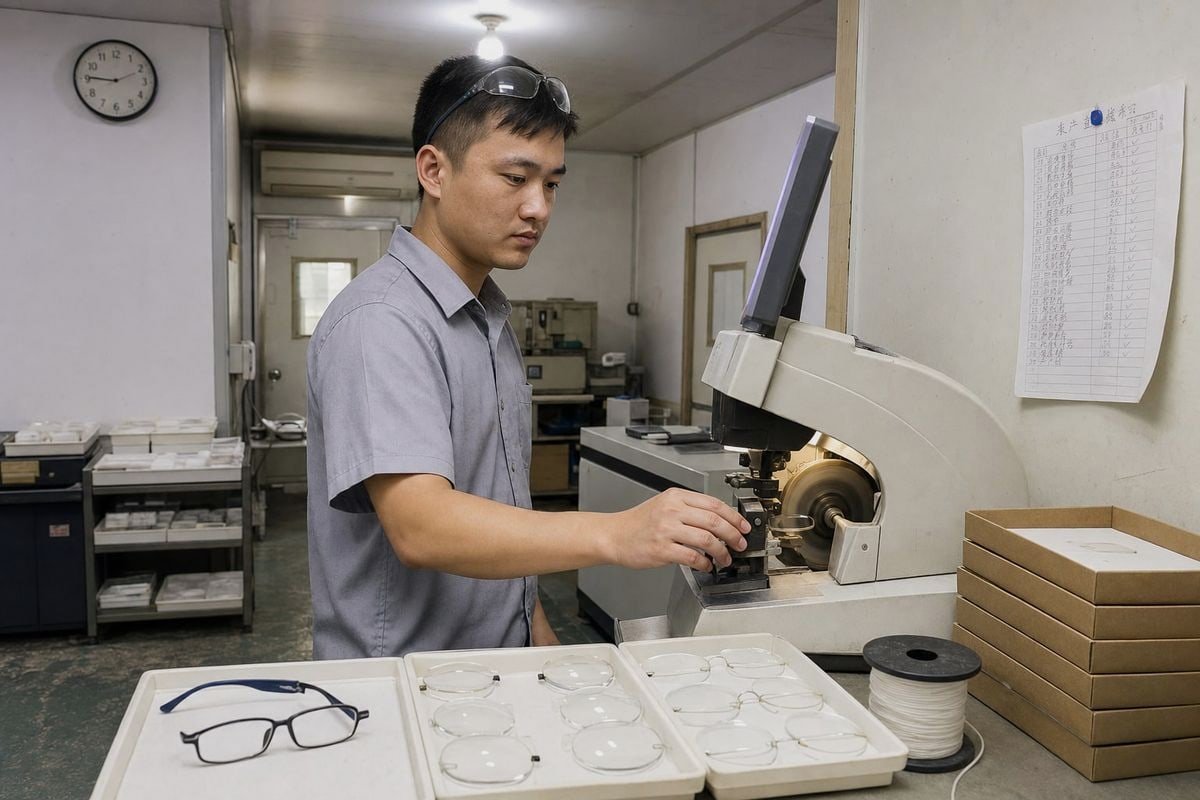
Testing before ordering costs you a sample fee and a week of time. Skipping it can cost you a container of frames your retail partners refuse to process. In our experience exporting to optical chains in more than 20 countries, buyers who insist on a structured pre-order trial almost never face fitting rejections later. Here is the sequence I recommend requesting, in order.
The five-step pre-order test protocol
- Truing check. The frame front must be aligned to a neutral factory standard before scanning. A bent demo frame produces an asymmetrical trace, and every lens cut from that trace inherits the error. Ask your supplier to confirm frames are trued before demo lenses are mounted.
- Demo-lens trace. The retail lab should trace the actual demo lens or frame, never a "similar" full-rim shape from memory. 3d frame tracing captures the base curve and wrap angle, which keeps the finished lens flush against the brow bar and prevents pop-outs.
- Test edging run. Cut a real lens in the intended material. Watch for chipping at the temporal corners, where tight radii stress the grooving wheel.
- Wheel-diameter clearance verification. Pediatric b-dimensions often run under 25mm. Confirm the edger's grooving wheel can navigate those tight corners without over-cutting.
- Cord tension and mount test. Thread the nylon line, mount the lens, and flex the frame. The lens should stay seated with no visible groove gap.
What a passing result looks like
| Test | Pass criteria | Common failure sign |
|---|---|---|
| Truing check | Symmetrical trace left vs. right | Mismatched lens shapes |
| Demo-lens trace | Trace matches supplied OMA file | Shape deviation over tolerance |
| Test edging | Clean edge, no chips | Corner chipping, burrs |
| Wheel clearance | Full groove in tight radii | Over-cut temporal corners |
| Mount test | Lens seats firmly | Lens rocks or pops out |
Ask for photos or video of each step. A factory confident in its supra frame mounting design will happily provide them.
Which frame material properties affect how safely semi-rimless designs handle in-store lens edging?
There is a trade-off we weigh on every new kids' style: lighter materials feel better on a child's face, but the frame still has to survive grooving heat, cord tension, and playground abuse.
Frame stiffness at the brow bar, heat resistance during dry grooving, groove-to-rim thickness ratio, and bridge flexibility all determine edging safety. Pair TR90 or TPEE frames with polycarbonate or Trivex lenses at a minimum 2.0mm edge thickness for reliable results.
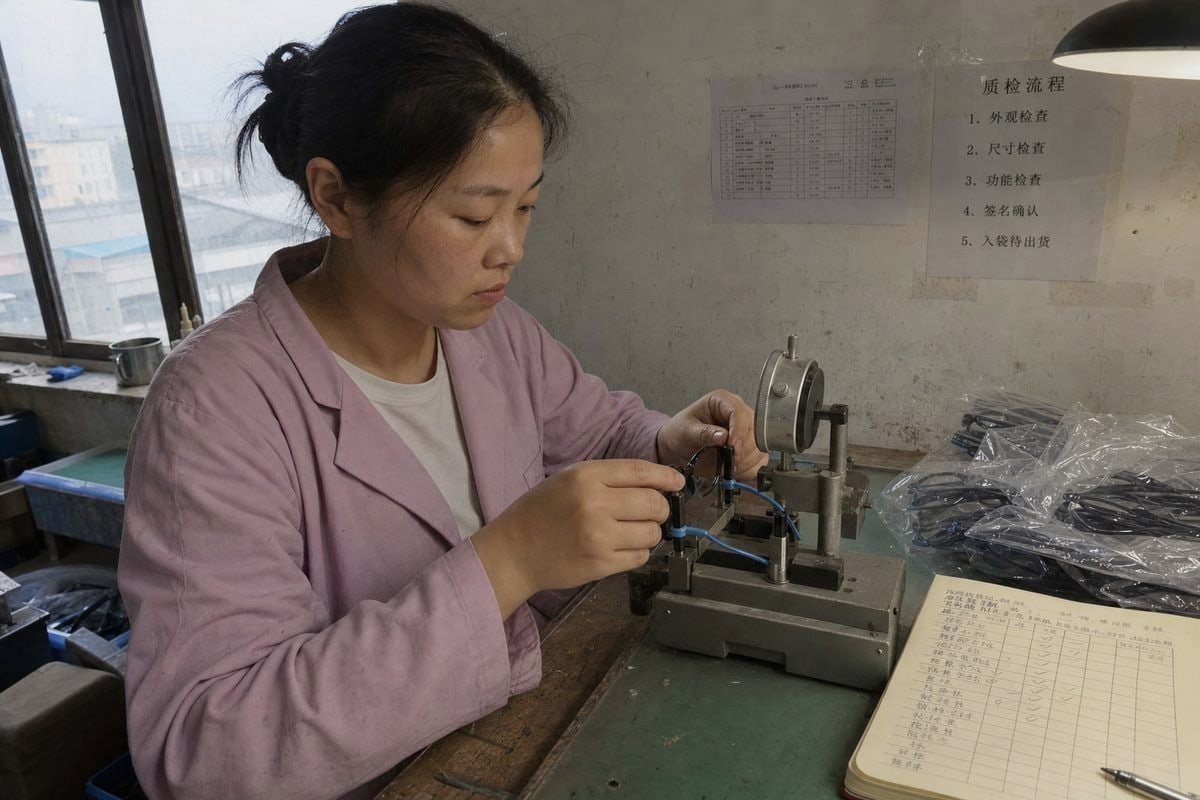
Material choice is where frame compatibility and lens compatibility meet. A frame can accept the semi-rimless style perfectly, yet the job still fails if the lens material or thickness is wrong for grooving. Our engineers see both sides daily, because we build TR90 fronts with flexible TPEE temples 4 across roughly 800 existing styles, and each one gets validated for retail processing before it enters our catalog.
Frame-side properties to verify
Groove-to-rim ratio. The frame's top rim must be thick enough — at least 1.5 times the groove width — to resist rim-splitting when the nylon cord reaches full tension. Thin, fashion-driven brow bars fail this test more often than buyers expect.
Thermal memory. High-speed dry grooving generates localized heat. Flexible materials like TPEE must resist permanent deformation from that heat. This is one reason we run thermal validation on flexible components rather than assuming flexibility equals durability.
Bridge flex. Manually stress the bridge and watch the groove line. If it yawns open significantly, the frame will suffer chronic lens retention problems during active play. Kids twist, drop, and sit on their glasses; the bridge must recover its shape every time.
Lens-side properties to verify
Lens edge thickness is the single most cited failure point in semi-rimless processing. Trade guidance sets roughly 1.5mm as an absolute floor, but for children's eyewear we recommend the safer end of the range:
| Lens material | Minimum edge thickness | Grooving behavior |
|---|---|---|
| Polycarbonate | 2.0mm | Excellent tensile strength for the cord; resists cracking |
| Trivex | 2.0mm | Superior impact resistance; grooves cleanly |
| Standard CR-39 | 2.2mm+ | More brittle; higher chip risk in grooved mounts |
| High-index resins | Case-by-case | Thin edges often fall below safe groove wall thickness |
Polycarbonate lens material 5 and Trivex impact resistance 6 make these two the default choice for pediatric semi-rimless work. Both give the groove wall enough strength to hold the cord without cracking, and both meet the impact demands of active children. Lighter is not always better: a lens edge too thin at the groove line trades comfort for structural failure.
How do I communicate technical requirements clearly to a manufacturer to avoid fitting issues at retail?
One lesson our sales team learned the hard way: buyers who send us a one-line email saying "make it fit standard edgers" always come back with problems. Buyers who send a structured brief almost never do.
Send a written technical brief covering groove dimensions, cord diameter, target lens materials, minimum edge thickness, b-dimension range, and edger models your retail partners use. Request OMA/VCA files, a pre-production sample, and an edging trial report as deliverables.
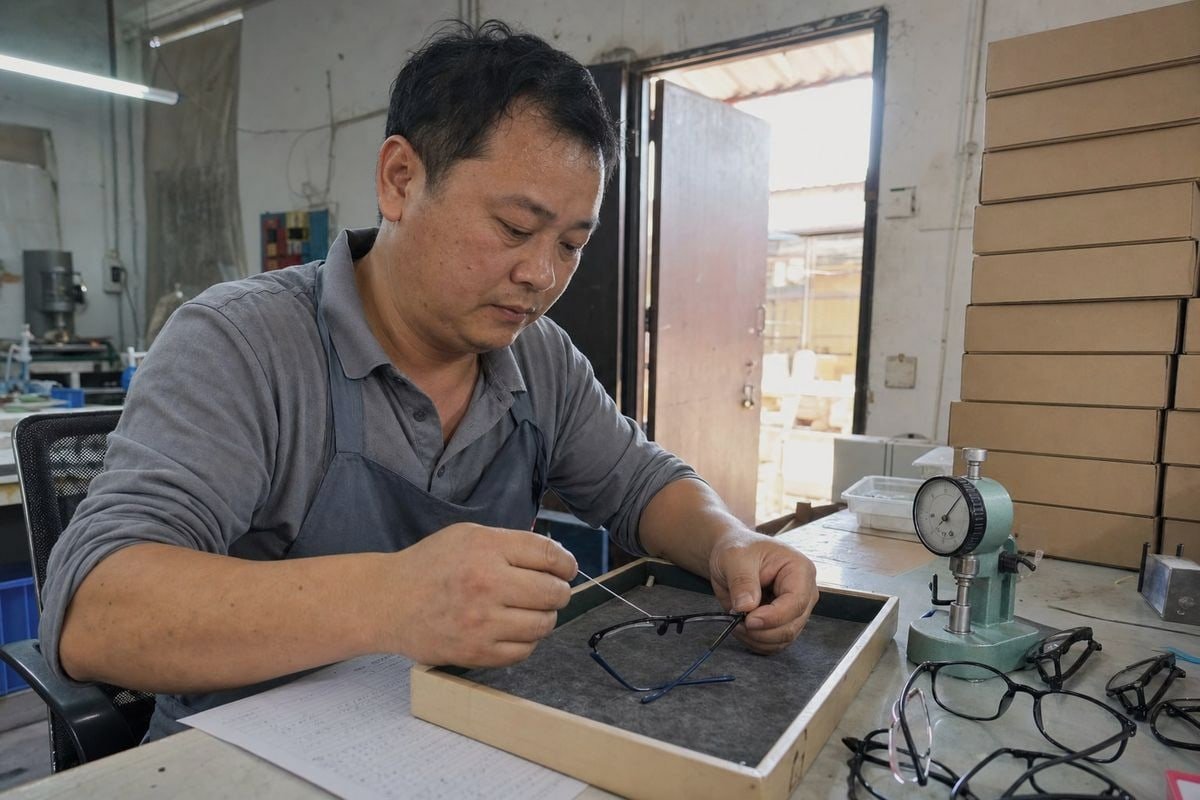
Clear communication is not about writing more words. It is about giving the factory the same numbers the retail lab will use. When a buyer from a Japanese kids' brand sends us their opticians' edger model and preferred lens materials up front, our engineers can confirm groove compatibility before we cut a single sample. That saves both sides weeks of back-and-forth.
Build your brief around the retail workflow
Think about the sequence the shop follows: verify the order form, check frame condition, trace, block, edge, groove, apply safety bevel 7ing, mount, and inspect. Your brief should give the manufacturer inputs for each stage. Specify that lenses need a manual safety bevel on both front and back edges to remove microscopic burrs automated finishing can miss — this matters more on children's eyewear, where a sharp point near the face is unacceptable.
A communication checklist that prevents remakes
- State groove width, depth, and cord diameter as numbers, not descriptions.
- List the exact edger brands and models your retail network operates, and ask whether the supplier has tested against a comparable patternless lens edger.
- Define your lens material policy — for example, polycarbonate or Trivex only, 2.0mm minimum edge thickness.
- Give the b-dimension measurement range for your pediatric sizes so wheel clearance can be checked early.
- Require OMA/VCA tracing files as a standard deliverable with every new style.
- Ask for photos of the truing, tracing, and mounting stages during sampling.
- Agree on tolerances in writing — how much shape deviation is acceptable before a frame is rejected.
Finally, name one technical contact on each side. When our buyers route questions through a single engineer instead of a general inbox, ambiguity disappears. Fitting issues at retail are almost always communication failures that happened months earlier at the sourcing stage.
Conclusion
Compatibility is earned through specs, trace files, material checks, and pre-order trials — not assumed. Verify these four areas, and your kids' semi-rimless frames will process cleanly at any retail lab.
Footnotes
1. FDA guidance on protecting children’s eyes supports safety context for pediatric eyewear design. ↩︎
2. Background on nylon material used as the retention cord in semi-rimless groove mounting. ↩︎
3. ISO defines standardized frame measurement conventions including lens height dimensions. ↩︎
4. Global sourcing platform where TPEE frame materials and manufacturers can be verified. ↩︎
5. Reference on polycarbonate properties that make it durable for kids’ eyewear lenses. ↩︎
6. Explains why Trivex is favored for impact-resistant children’s eyewear lenses. ↩︎
7. US consumer safety agency oversees product safety standards relevant to children’s eyewear edges. ↩︎
More Articles You Might Like

August 5, 2026
Bio-Based vs Regular Cellulose Acetate: What's the Difference for Kids' Frames?

August 5, 2026
How Recyclable Are Kids' Optical Frame Materials, and What Eco-Friendly Alternatives Exist?
August 5, 2026
Do Kids Optical Frames Whiten or Age in Storage, and How to Control Warehouse Conditions?
Looking for a Reliable Kids Eyewear Partner?
Explore 800+ ready styles and full OEM/ODM support tailored to your brand.
Get in Touch English
  Español de México
  Deutsch
  Français
  日本語
日本語  العربية
  Português do Brasil