How to Structure Kids’ Optical Frame Sizing to Minimize Overstock Risk?

Kids’ optical frame sizing is where I see buyers lose the most money. On our production line in Taizhou, I watch brands order ten sizes when five would sell. The extras sit, age, and quietly become deadstock that eats the margin the good sizes earned.
Structure kids’ optical frame sizing around 3–5 fit bands based on frame width, bridge width, and temple length — not age labels. Stock deep in core bands (44–48mm eye sizes), keep one size above and below at shallow depth, and route rare fits to special order.
That is the short answer. Below, I break it into four practical questions: how to pick your size range, which standards cut returns, how to forecast by age group, and how flexible MOQs reduce the risk of guessing wrong.
How can I determine the right size range for my kids' optical frame collection?
A buyer from Australia once sent us a size ladder with nine increments, each 1mm apart. Our engineers mapped them against pediatric facial morphology 1 data and found four sizes covered almost every child.
Determine your size range by mapping pupillary distance and face width to fit clusters, not ages. Most children fall into three to five bands — roughly 39–43mm lens widths for toddlers, 44–48mm for school age, and 47–50mm for pre-teens — so build core stock there.
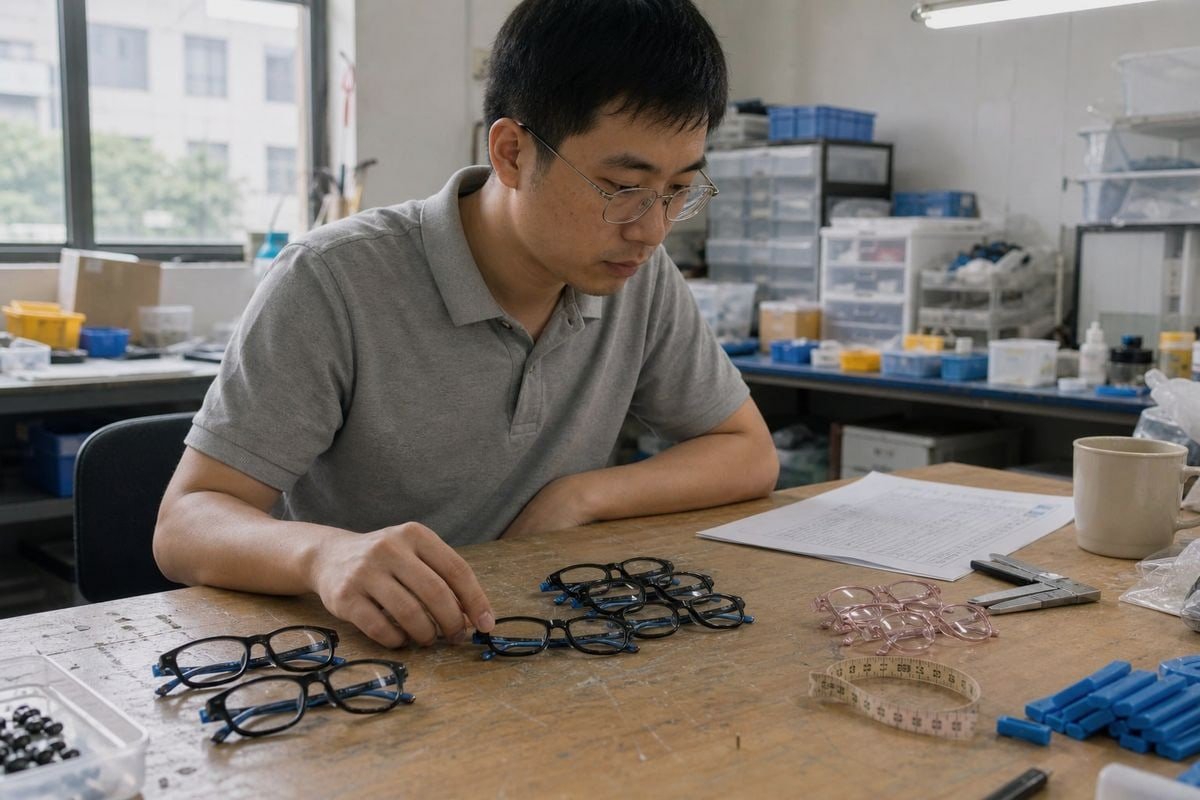
The biggest mistake I see in assortment planning 2 is treating every millimeter as a size. Children's faces vary, but they cluster. Pupillary distance measurement data shows toddlers usually sit around 40–46mm PD, younger children around 46–50mm, and older children around 50–54mm. Those clusters, not birthdays, should define your range.
Here is how we advise buyers to translate PD clusters into a workable ladder:
The three-bucket sizing framework
| Bucket | What it covers | Stock depth |
|---|---|---|
| Core | 44–48mm eye sizes fitting the largest share of your target age segment | Full depth, replenished continuously |
| Secondary | One size up and one size down from core (e.g., 42mm, 50mm) | Display quantity plus light backup |
| Fringe | Very narrow bridges, extra-long temples, outlier widths | Special order only, sample depth |
This is the "sell fewer sizes better" principle. If two adjacent sizes fit nearly the same PD and face-width band, they compete with each other on your shelf. One becomes the core SKU. The other becomes shallow stock or made-to-order. That single act of SKU rationalization often removes 20–30% of a proposed lineup before a purchase order is ever placed.
One more filter matters: your local population. A brand selling in Japan and a brand selling in Northern Europe will not share the same core band, because pediatric facial morphology differs by market. Ask your optical partners for their most-dispensed pediatric sizes before you lock the ladder. We keep roughly 800 existing styles across these bands precisely so buyers can test a range without committing to custom molds first.
What sizing standards should I follow to reduce return and exchange rates?
When we develop a new TR90 kids optical frame, the fit spec sheet is finalized before the color palette. That order of operations exists because returns almost always trace back to geometry, not styling.
Follow measurable fit standards: keep each pupil within 3–4mm of the lens center, ensure frame size plus bridge size does not exceed PD by more than 8mm, use 14–17mm DBL bridges, and specify child temple lengths of 120–125mm rather than adult 135–140mm.
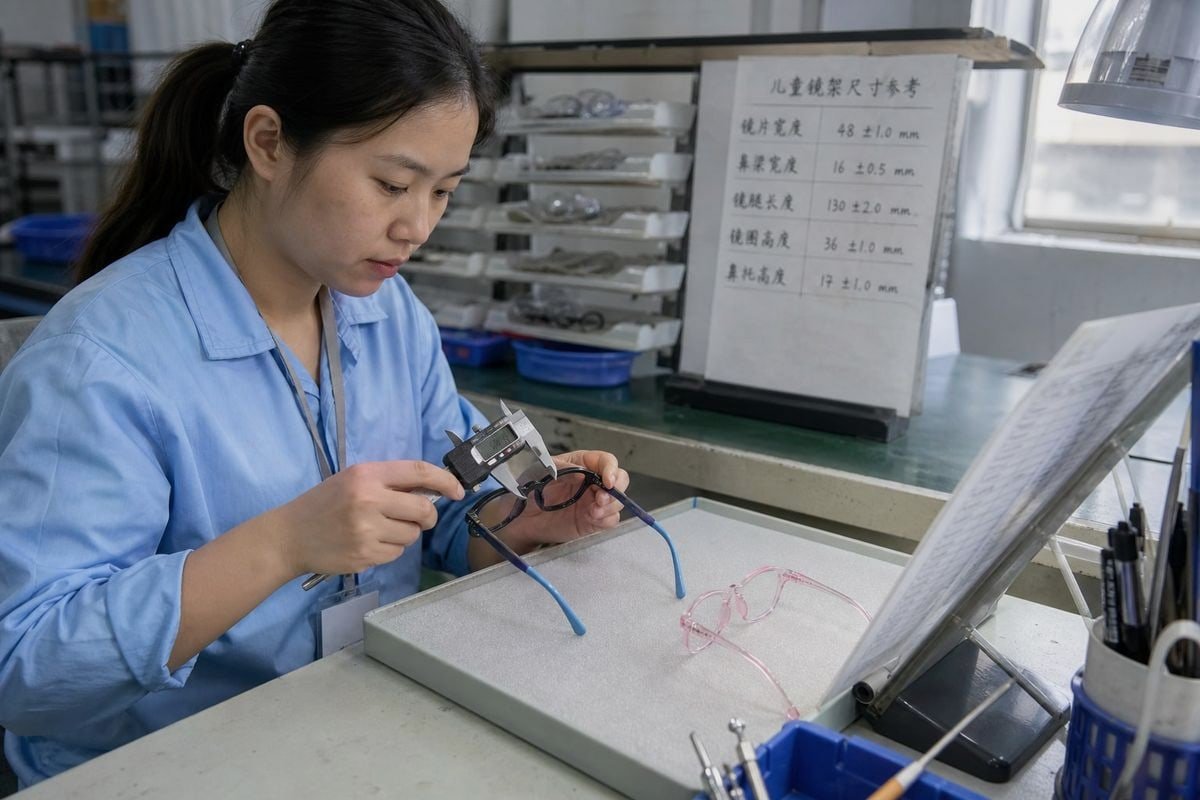
Returns in children's eyewear are rarely about taste. They are about a frame that slides, pinches, or puts the optical center 3 in the wrong place. So your sizing standards need hard numbers, not vibes.
The four dimensions that drive returns
| Dimension | Standard to follow | What goes wrong without it |
|---|---|---|
| Lens center vs. PD | Each eye no more than 3–4mm off-center; frame + bridge ≤ PD + 8mm | Optical distortion, headaches, prescription complaints |
| Bridge width (DBL) | 14–17mm for most children | Too wide slides down; too narrow pinches the nose |
| Temple length | 120–125mm for kids vs. 135–140mm adult | Adult temples bow out or hook poorly behind small ears |
| Frame width | Roughly matches face width; no cheek or lash contact | Frames look sloppy, slip, and get abandoned |
Here is the objection I hear most often: "Parents want to buy bigger so the child can grow into it." I understand the instinct, and it shows up in buyer size requests constantly. But professional fitting guidance is blunt on this point — an oversized frame fits poorly today, slides during play, and gets abandoned early. A frame the child refuses to wear is a return, an exchange, or a bad review. Growth is handled by replacement cycles, not oversizing.
Two design choices make your standards more forgiving. First, adjustable cable temples and flexible TPEE temple tips let one temple spec serve a wider head-size range — the curved silicone ear hooks we mold on our TR90 frames exist for exactly this reason. Second, spring hinge durability matters for exchanges too: a hinge that survives being yanked off sideways keeps a correctly sized frame in service instead of coming back broken. Optical frame materials do part of the sizing job for you when they flex instead of failing.
How do I forecast demand across different age groups without overordering?
The trade-off I weigh with every buyer is simple: age-based sizing charts are easy to plan with, but real faces do not read the chart. The trick is using both without trusting either too much.
Forecast by treating age-based sizing charts as planning bands, then weight orders by actual sell-through per fit band. Use a weighted pyramid — deep in core 44–48mm sizes, shallow on fringes — and apply CRM growth-cycle data to time replenishment.

Age charts are useful merchandising shorthand. A chart that maps 42–48mm PD to a 37–38 frame size, or 58–62mm PD to 47–52 sizes, gives you a starting skeleton. But children of the same age can differ by several millimeters in PD and face width. So the chart should shape your first order — never your fifth.
A weighted pyramid ordering process
- Start with planning bands. Assign every SKU to a fit band (toddler ~39–43mm, school age ~44–48mm, pre-teen ~47–50mm).
- Weight the first order like a pyramid. Full depth in the core band, half depth one band out, sample depth at the edges.
- Track sell-through rate analysis by fit band, not just by style. A cute style in a dead size band is still dead inventory. Bands that convert earn depth; bands that stall lose it.
- Set a six-month exit rule. Any size variant that has not moved in six months gets marked down, bundled, or dropped. This is the most reliable of all deadstock reduction strategies, because it forces a decision before stock loses all value.
- Use growth-cycle replenishment. If your CRM or your optical partners can tell you when a cohort of six-year-olds will migrate into the next size bracket, you can pre-order the receiving band instead of guessing.
Watch your inventory turnover ratio at the band level. In our experience exporting to 20+ countries, buyers who track turns per fit band reorder with confidence, while buyers who track only style-level sales keep repeating the same size mistakes. One exception is worth noting: some hard-to-fit combinations — very narrow bridges, for example — may deserve shelf space despite low volume, because they solve fit failures nothing else can. Stock them consciously, at controlled depth, only if your fitting data supports it.
Can working with a factory that offers flexible MOQs help me manage sizing risk?
Last year a European baby-brand buyer told me her previous supplier demanded 2,000 pieces per size per color. She had two sizes she believed in and three she wanted to test. The math forced her to over-commit on all five.
Yes. Flexible MOQs let you order core sizes deep, test secondary sizes shallow, and top up specific slow-moving variants in small batches. Mixed-size replenishment turns sizing from a one-time bet into an adjustable, data-driven process.
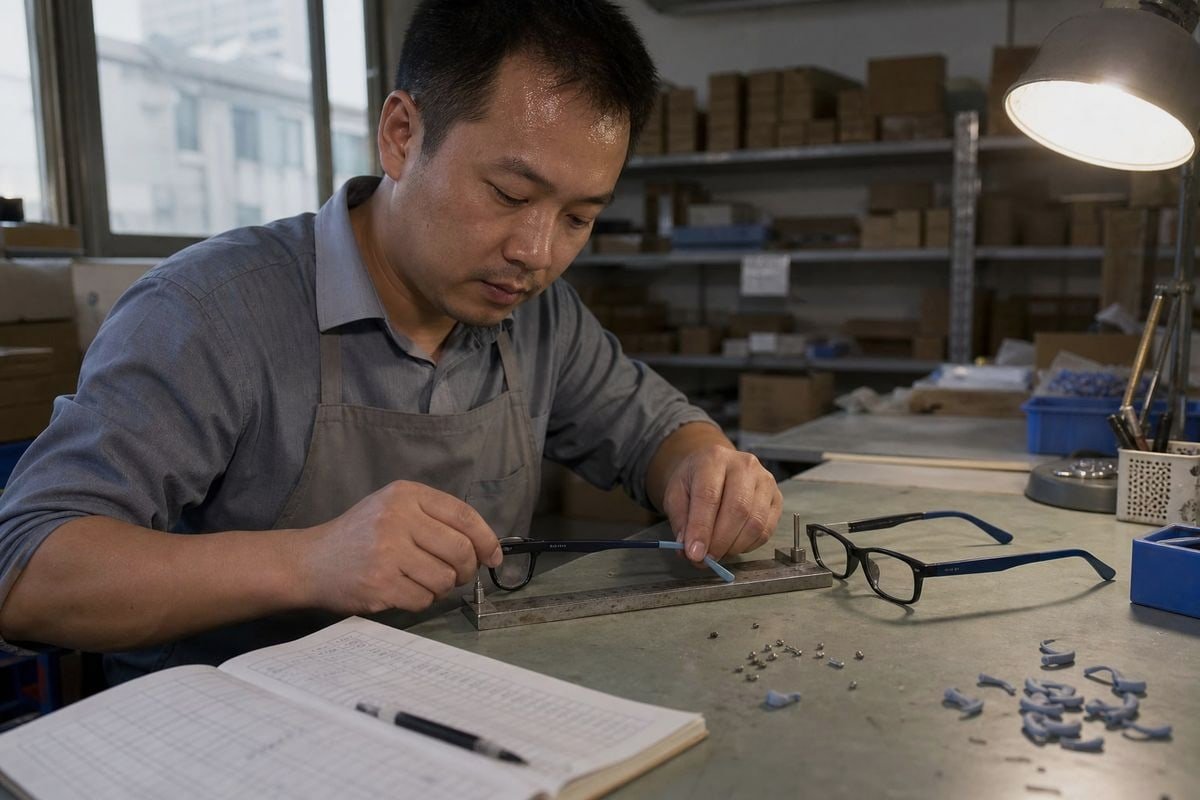
MOQ structure is inventory strategy in disguise. When a factory forces uniform quantities across every size, it transfers its production risk 4 onto your shelf. When it allows mixed-size orders, you can shape the weighted pyramid described above instead of flattening it.
What to negotiate with your manufacturing partner
| Term | Why it reduces sizing risk |
|---|---|
| Mixed-size MOQ (total pieces, not per-size) | Lets you go deep on 44–48mm cores and shallow on fringe sizes in one PO |
| Small-batch top-ups | Replenish only the size that is selling, instead of reordering the full ladder |
| Existing style library | Testing from ready styles avoids mold costs on unproven size bands |
| Shared color plates across sizes | One trend color can span your size ladder without separate minimums per variant |
This is where our own model was deliberately built for smaller and mid-size brands. Because we maintain around 800 existing styles in flexible TPEE and TR90 constructions, a buyer can assemble a first collection across three fit bands with no mold investment at all, prove which bands turn, and only then invest in custom OEM/ODM development — custom colors, logos, lenses, and retail-ready packaging — for the winners. A related trend worth asking any factory about is component thinking: some retailers now explore a decoupled temple-front model, stocking temples and fronts separately to create more fit combinations without multiplying finished SKUs. Flexible materials make this easier, since a TPEE temple tolerates more head-width variation per SKU than a rigid acetate one.
One caution: flexible MOQ should never mean flexible quality. Pediatric frames still need consistent tolerances on bridge width and temple length, batch after batch, or your carefully designed size bands drift. Ask how the factory controls dimensional consistency — our 5S-managed workshop checks these specs at incoming, in-process, and final inspection — before you celebrate a low minimum.
Conclusion
Overstock in kids' optical frame sizing comes from too many overlapping SKUs, not bad luck. Build fit bands, follow hard fit standards, order in a weighted pyramid, and partner with a flexible-MOQ factory. Sell fewer sizes — better.
Footnotes
1. Access to medical research and data regarding pediatric facial morphology and growth standards. ↩︎
2. Official guidance on retail assortment planning and inventory management for small businesses. ↩︎
3. Clinical explanation of the optical center and its role in correct vision and frame fitting. ↩︎
4. International standards for risk management and quality assurance in manufacturing and production processes. ↩︎
More Articles You Might Like

August 5, 2026
Bio-Based vs Regular Cellulose Acetate: What's the Difference for Kids' Frames?

August 5, 2026
How Recyclable Are Kids' Optical Frame Materials, and What Eco-Friendly Alternatives Exist?

August 5, 2026
Do Kids Optical Frames Whiten or Age in Storage, and How to Control Warehouse Conditions?
Looking for a Reliable Kids Eyewear Partner?
Explore 800+ ready styles and full OEM/ODM support tailored to your brand.
Get in Touch English
  Español de México
  Deutsch
  Français
  日本語
日本語  العربية
  Português do Brasil