How to Read UV Labels, Color Codes, and Age Ranges on Kids’ Sunglasses Tags?

Kids’ sunglasses tags confuse even experienced buyers. On our production line in Taizhou, I’ve seen samples with impressive-looking labels that hid weak lenses. One wrong tag can sink your brand.
To read kids’ sunglasses tags, check three things: the UV label (UV400 or 100% UVA/UVB protection is the gold standard), the lens color code or category (0–4, indicating darkness, not UV safety), and the age range (a fit guide only, not a protection claim).
Each of those three elements answers a different question. Below, I break down every part of the tag, one by one, so you can compare suppliers with confidence.
What Do the UV Protection Labels on Kids' Sunglasses Tags Actually Mean?
A buyer from Australia once sent me a competitor's tag that simply said "sun protection." Our lab check showed the lenses blocked barely any UV. That phrase means nothing, and I told her so directly.
UV labels state how much ultraviolet light a lens blocks. UV400 means the lens blocks all UVA and UVB rays up to 400 nanometers — the most complete consumer standard. "100% UV protection" means the same thing in shorthand, while vague phrases like "sun protection" guarantee nothing.

The UV label is the single most important line on any kids' sunglasses tag. Children's eyes let in more UV than adult eyes because their lenses are clearer and their pupils are larger. That makes pediatric eye health 1 the real reason this label exists. So let's decode the common wording you will see.
The UV Label Hierarchy
Not all UV claims are equal. Here is how I rank them when I review tags for our OEM clients:
| Label Wording | What It Means | Trust Level |
|---|---|---|
| UV400 | Blocks UVA and UVB rays up to 400 nm | Strongest, most specific |
| 100% UV protection | Shorthand for full UVA/UVB blocking | Strong, if brand is reputable |
| Blocks UVA and UVB | Covers both ray types, wavelength unstated | Acceptable with certification |
| UV protection | No stated level or wavelength | Weak — ask for proof |
| Sun protection / Fashion | No UV claim at all | Treat as unprotected |
Why Darkness Is Not Protection
Here is the myth I fight most often: dark lenses do not equal UV safety. UV blocking comes from the lens material and coating, not the tint. In fact, a dark lens with no UV filter is worse than no sunglasses at all. The dark tint makes a child's pupil dilate, which lets more unfiltered UV radiation reach the retina. This is why we build UV400 protection into the lens material itself on every pair we produce, whether the lens is nearly clear or fully mirrored.
Also look for supporting marks. CE mark certification 2 in Europe, ANSI Z80.3 3 standards in the US, and ISO 12312-1 compliance internationally all add confidence. But the UV statement itself is still the key line to verify.
How Do I Interpret Lens Color Codes When Comparing Suppliers?
When we developed a mirrored shield lens for a sports line — a gradient shifting from fiery orange to gold — the buyer assumed the vivid coating changed the UV rating. It didn't. Color and protection are two separate systems.
Lens color codes describe visible light transmission and visual function, not UV safety. Filter categories 0–4 indicate darkness: Category 3 lenses suit bright daily sun, Category 4 suits extreme glare like snow. Tint names (grey, amber, mirrored) indicate color perception and contrast, never UV performance.

Suppliers use two overlapping systems on tags: the numeric filter category and the tint name. You need to read both, but for different reasons.
Filter Categories 0–4
The category number tells you how much visible light passes through the lens. This is called visible light transmission 4, or VLT. It is a comfort and use-case measure, not a safety measure.
| Category | Light Transmission | Best Use for Kids |
|---|---|---|
| 0 | 80–100% | Fashion, overcast days |
| 1 | 43–80% | Low light, cloudy conditions |
| 2 | 18–43% | Average daylight |
| 3 | 8–18% | Bright sun, beach, everyday summer play |
| 4 | 3–8% | High-altitude snow, glacier — too dark for driving or daily wear |
For most children's lines, Category 3 lenses are the sweet spot. Category 4 is often too dark for safe everyday play.
Tint Names and What They Do
Tint color serves function, not just fashion. Smoke or grey tints keep color perception neutral, which is ideal for daily wear. Amber and brown tints boost contrast and depth perception, so they work well for sports styles like the wraparound shield frames we produce. Mirrored coatings reduce glare intensity but change nothing about UV blocking underneath.
Polarized lenses 5 for kids deserve a separate note. Polarization cuts reflected glare from water, sand, and roads. It improves comfort dramatically. But polarization is not UV protection. A polarized lens still needs its own UV400 rating. When buyers compare our polarized and non-polarized options, I always tell them: both block the same UVA and UVB rays; polarization only changes glare handling.
Why Do Age Range Labels Matter When I'm Sourcing Children's Sunglasses?
Fit failures taught me this lesson early in my fifteen years in eyewear. A beautiful frame that slides down a toddler's nose gets returned, reviewed badly, and abandoned in a drawer. Age labels exist to prevent exactly that.
Age range labels are fit and sizing guides, not safety certifications. A tag reading 0–2 or 3–5 indicates the intended head size and frame proportions. They help match frames to faces, but UV protection must always be verified separately on the same tag.
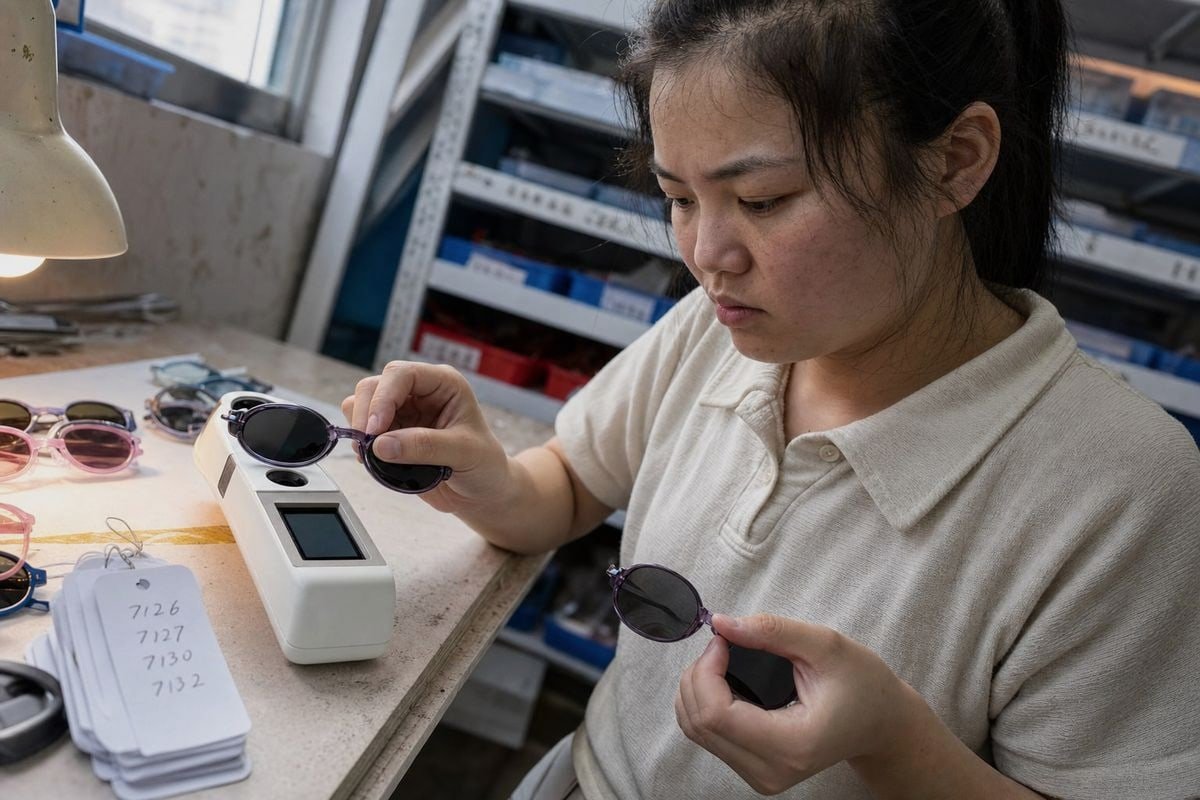
There is no universal industry code for age ranges on sunglasses tags. Each brand and factory sets its own convention. That is why I push buyers to look past the age number and check the millimeter measurements underneath it.
From Age Range to Real Measurements
An age range is a starting point. The precise fit comes from three numbers, usually printed on the inner temple or the tag:
- Lens width — the horizontal size of each lens in millimeters.
- Bridge width — the gap over the nose; too wide and the frame slides, too narrow and it pinches.
- Temple length — the arm length from hinge to tip; this controls whether the frame grips or gaps.
A rough guide we use when advising brands: roughly 0–2 years suits very compact frames with soft, flexible temples; 3–5 years suits small rounded frames like our two-tone periwinkle-and-teal styles; 6–10 years moves toward youth sport shapes; 10+ often overlaps with petite adult sizing.
Why Fit Is a Safety Issue Too
Fit affects protection, not just comfort. A frame that gaps at the sides lets UV leak around the lens edge. This matters most for wraparound and shield styles, where the whole point is coverage. It is also why "Low Bridge Fit" or "Alternative Fit" labels are emerging — they identify frames built for children with flatter nose bridges, preventing the glasses from resting on the cheeks and fogging up. Because active kids drop, bend, and sit on their glasses, we build most of our frames in TR90 with TPEE temples. The flexible material bends instead of snapping, which keeps a well-fitted frame wearable through daily abuse. An age label cannot tell you any of that, so treat it as one input, never the whole answer.
What Should I Check on a Supplier's Tag Before Placing a Bulk Order?
Sample reviews are where deals are won or lost. Before any bulk order ships from our workshop, our QC team checks every claim on the tag against the actual lens — because your brand name goes on that tag, not ours.
Before a bulk order, verify five things on the supplier's tag: a specific UV400 or 100% UVA/UVB claim, relevant certifications (CE, ANSI Z80.3, or ISO 12312-1), impact-resistant lens material, accurate size and age data, and access to batch test reports.
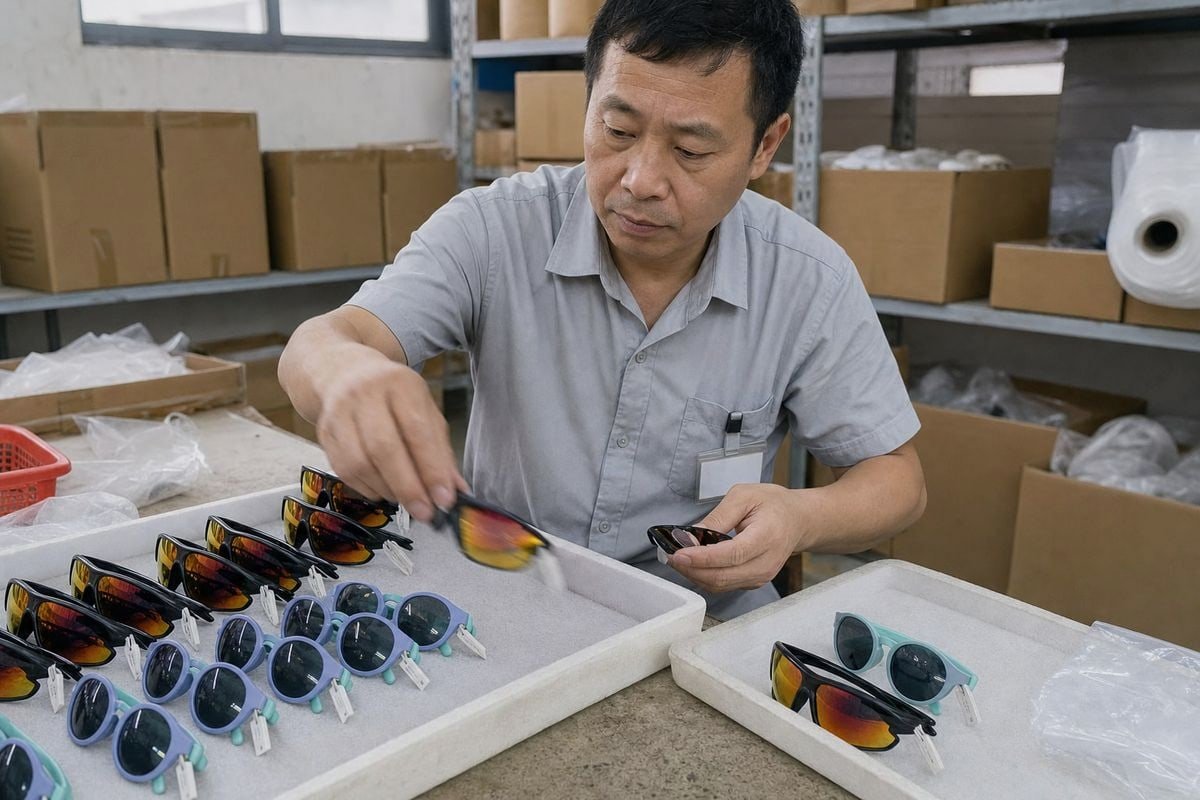
Think of the tag as the supplier's promise in miniature. If the tag is vague, sloppy, or inconsistent, the production behind it usually is too. Here is the checklist I recommend to every procurement manager who visits our factory.
The Pre-Order Tag Checklist
| Check Point | What to Look For | Red Flag |
|---|---|---|
| UV claim | UV400 or 100% UVA/UVB, stated explicitly | "Sun protection" with no rating |
| Certification | CE mark certification, ANSI Z80.3, ISO 12312-1 6 | No standard referenced at all |
| Lens material | Impact-resistant polycarbonate 7 or equivalent, shatterproof | Unspecified "plastic" |
| Optical quality | Optical Class 1 (zero distortion) | No optical class stated |
| Size data | Lens, bridge, and temple in millimeters plus age range | Age range only, no measurements |
| Traceability | QR code, NFC tag, or batch number linking to test reports | Untraceable generic packaging |
Beyond the Tag: Ask for Evidence
A tag is a claim. A test report is evidence. Ask your supplier for third-party UV transmission test results for the specific batch, not a generic certificate from years ago. Reputable factories will provide them without friction. Some premium tags now carry Smart Tag QR codes that link directly to digital batch-testing reports — a strong trust signal for retail buyers.
Also check the details that tags rarely mention. Backside anti-reflective coating prevents UV from bouncing off the inner lens surface into the eye, a real vulnerability in wide wraparound styles. Impact-resistant polycarbonate matters because children fall on their glasses; the lens must dent or pop out, never splinter. Finally, confirm the tag itself is retail-ready in your target market's language and format. We handle custom tags, packaging, and logos for brands in over twenty countries, and I can tell you: a compliant, well-designed tag shortens your path through customs and onto shelves.
Conclusion
Vague tags create real risk — returned stock, damaged trust, and unprotected young eyes. Read the UV label, the color category, and the sizing data separately, demand batch evidence, and partner with a factory that stands behind every line on the tag.
Footnotes
1. WHO fact sheet explains why UV exposure poses greater risk to children’s developing eyes. ↩︎
2. Official EU page explaining what CE marking requires and covers for consumer products. ↩︎
3. ANSI is the official body publishing the Z80.3 sunglasses safety standard referenced. ↩︎
4. Background on transmittance clarifies the VLT concept used to define lens categories. ↩︎
5. Explains the optical principle behind polarization referenced when discussing glare reduction. ↩︎
6. Comprehensive Wikipedia section explaining the international ISO 12312-1 standard for sunglasses and eye protection. ↩︎
7. Background on polycarbonate explains why this material resists shattering in children’s lenses. ↩︎
More Articles You Might Like

August 1, 2026
Should Factory Handle Kids Sunglasses Packaging & Labeling, or Use a Designated Supplier?

August 1, 2026
Own Warehouse vs Supplier Direct Fulfillment: Which Cuts Return Costs for Kids Sunglasses Brands?

August 1, 2026
Direct-to-Port Warehouse or Overseas Staging: Which Saves More on Kids Sunglasses Shipping?
Looking for a Reliable Kids Eyewear Partner?
Explore 800+ ready styles and full OEM/ODM support tailored to your brand.
Get in Touch English
  Español de México
  Deutsch
  Français
  日本語
日本語  العربية
  Português do Brasil