How to Prepare Product Data Sheets and Image Specs for Kids Optical Frames Orders?

Preparing product data sheets and image specs for kids optical frames orders sounds simple — until a container of wrong-color frames arrives at your warehouse.
To prepare product data sheets and image specs for kids optical frames orders, document the SKU, frame dimensions with tolerances, TR90 or TPEE material declarations, Pantone colors, safety compliance data, and packaging rules, then supply high-resolution, multi-angle, color-accurate images with clear file naming and version control.
That answer covers the essentials. Now let me walk you through each part, based on what actually works between a buyer’s desk and our factory floor in Taizhou.
What information should I include in a product data sheet for kids optical frames?
A few years back, a European buyer sent our team a one-line email: "Same as last time, but pink." That single sentence cost both sides two weeks of clarification calls Pantone colors 1.
A kids optical frames data sheet should include the product name, SKU, revision number, target age group, frame dimensions with units and tolerances, material composition, Pantone color codes, hinge and temple construction, weight target, safety compliance details, lens specification, and packaging instructions.

At its core, a product data sheet is a concise reference document. It differs from a full tech pack, which usually adds technical sketches, a bill of materials, and construction drawings. For children's frames, we advise our clients to build something in between: a lightweight, manufacturing-ready packet that a buyer, a QC inspector, and our production line can all read in under five seconds of scanning.
Baseline commercial identifiers
Every sheet must start with the exact frame variant. That means the model name, series, SKU 2 or Optical Product Code, and a revision number. If your retail channel requires UPC barcode integration, add the barcode field here too. When we produce a style from our catalog of roughly 800 existing designs, the SKU plus revision number is the only reliable way to confirm we are both looking at the same approved spec — not last season's version.
The core field checklist
| Field group | What to include | Why it matters for kids frames |
|---|---|---|
| Identity | Name, SKU, revision, barcode | Prevents outdated or mismatched specs |
| Sizing | Lens width, bridge, temple length, frame width, front height | Small errors ruin fit on small faces |
| Materials | TR90 3/TPEE declaration, hinge type, temple tips | Drives safety, comfort, and flexibility |
| Color | Pantone codes, finish (glossy/matte/translucent) | Avoids wrong-color shipments |
| Lenses | Demo, polycarbonate lenses 4, UV400, polarized | Optical and safety performance |
| Compliance | Required standards, test reports | Import clearance and buyer trust |
| Packaging | Case, cloth, inner box, carton marks | Retail-ready presentation |
Who reads the sheet
Write for multiple audiences. Your procurement manager scans for ordering rules. Our engineers read the dimension table. Your QC partner checks compliance fields. If the sheet is also used commercially, add price and stock data — but keep production sheets separate from e-commerce listings, or a product information management system will help you keep both synchronized without version drift.
One more point on the tension between completeness and brevity. Some teams want a dense five-page document; others want a pretty one-pager. In our experience, one to two pages is right — but only if every numeric field carries a unit and a tolerance. Brevity without tolerances is just ambiguity in a nicer layout.
How do I prepare accurate image specs so my supplier understands my design intent?
When our sample room receives reference photos, we can usually predict the project's smoothness within a minute. Six clean angles on a neutral background? Fast approval. One dark phone photo? Trouble ahead.
Prepare image specs by requiring high-resolution photos from at least six angles — front, side, three-quarter, folded, top, and inner-temple close-up — shot on a neutral background with true color, saved in an agreed file format, and named to match the SKU and revision.

Images do a job text cannot. A written note saying "two-tone navy and black rubber temple with light blue silicone ear hooks" is helpful. But a sharp side-view photo of that same temple — like the sporty rounded-rectangular style we run for active kids — removes all doubt about where the navy ends and the black begins. Visuals communicate construction faster than paragraphs, and they become the reference for pre-shipment approval.
The photo angle checklist
- Front view — confirms frame shape, lens shape, and bridge style.
- Full side view — shows temple design, hinge position, and any embossed dot or linear motifs.
- Three-quarter (45-degree) view — reveals how the front curves into the temples.
- Folded view — verifies hinge behavior and how flexible temples sit when closed.
- Inner temple close-up — captures engraved text, logo placement, and size markings.
- Detail shots — hinges, silicone temple tips, decorations, and any cable-style ear hooks.
For translucent materials, add one backlit shot. A semi-transparent blush-pink acetate-look frame reads completely differently under light than a solid pastel pink, and buyers returning products over color misrepresentation is a real and avoidable cost.
Image technical requirements
There is no universal eyewear pixel standard, so define your own e-commerce image guidelines in-house and apply them to production documents too. Here is the baseline we recommend to clients:
| Spec | Recommended practice |
|---|---|
| Resolution | High enough to zoom into hinge details without pixelation |
| Background | Plain white or neutral gray, consistent across all SKUs |
| Color | No heavy editing; shoot beside a Pantone reference where possible |
| Format | Agree on one format (and one for print if needed) |
| Naming | SKU + view + revision, e.g., OK123-side-rev2 |
| Storage | One shared folder or DAM as the single source of truth |
If you use virtual try-on technology on your storefront, share those renders with us as well. AR try-on data often reveals which shapes children's faces suit best, and that feedback can refine the next revision before tooling begins.
What technical details matter most when specifying TR90 or TPEE frame materials?
Material specification is where we spend the most time educating new buyers. After fifteen years of running TR90 and TPEE 5 through our injection lines, we know these two materials behave very differently — and the data sheet must reflect that.
When specifying TR90 or TPEE, state the exact material grade, flexibility requirements, weight target in grams, hinge construction, temple design, surface finish, and required material safety standards, plus whether the frame uses a rigid TR90 front with flexible TPEE temples.
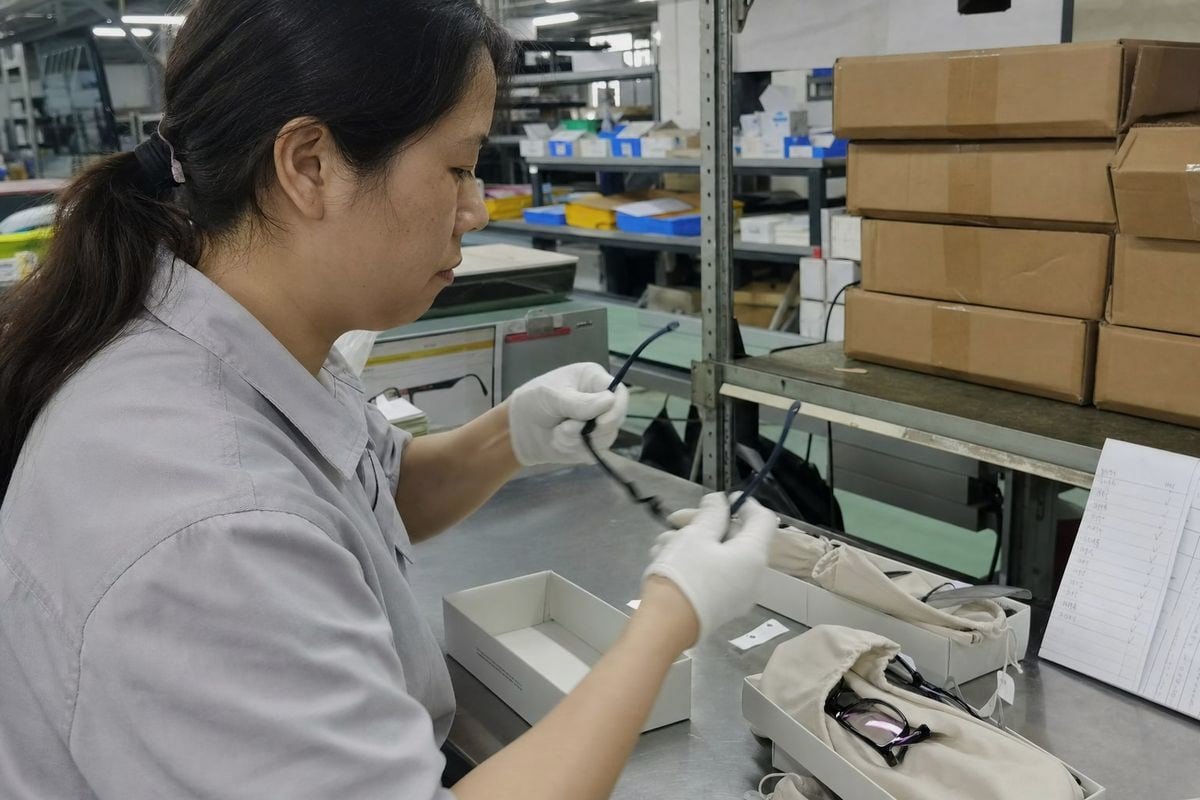
Both materials are lightweight, flexible, and far safer on a child's face than brittle plastics. But they are not interchangeable, and vague wording like "flexible plastic frame" on a data sheet invites the wrong substitution. Here is how the two compare in practice:
TR90 vs TPEE at a glance
| Property | TR90 | TPEE |
|---|---|---|
| Flexibility | Flexible, springs back to shape | Extremely flexible, near-unbreakable in normal use |
| Weight | Very light | Very light, slightly softer feel |
| Best use | Frame fronts, full frames | Temples, baby and toddler frames |
| Feel on skin | Smooth, rigid-comfortable | Soft, rubbery, gentle |
| Common combo | TR90 front + TPEE temples | Full TPEE for youngest wearers |
Many of our best-selling kids optical frames use exactly that hybrid: a TR90 front that holds the lens shape precisely, paired with TPEE temples that bend without snapping when a child pulls the glasses off one-handed. If you want this construction, your data sheet must say so explicitly — front material and temple material as two separate fields.
Safety and durability fields to document
Children's eyewear carries a higher documentation burden than adult fashion frames, and rightly so. Your sheet should record impact resistance testing requirements for the target market, whether lenses are demo-only or optical-grade polycarbonate lenses, and hypoallergenic declarations for any silicone temple tips or nose pads. For regulatory compliance eyewear headed to the US, buyers typically reference CPSIA and FDA requirements; other markets have their own standards, and sports styles may need ASTM F803. Do not list standards speculatively — include only the ones your target country or customer specification actually requires, and attach the corresponding third-party test reports.
Finally, document durability expectations qualitatively: hinge cycle expectations, temple bend behavior, and known stress points. Feedback from the field — where frames actually break in children's hands — should flow back into each revision of the sheet. That loop is how a data sheet stays a living document rather than a filing-cabinet artifact.
How can clear documentation help me avoid delays and errors in my optical frames order?
The costliest mistake I have seen was not a factory error at all. Two versions of the same spec sheet were circulating inside a client's team — one with a 125 mm temple, one with 130 mm — and nobody owned the master file.
Clear documentation prevents delays by giving the factory one approved, version-controlled source of truth, which eliminates wrong-color shipments, dimension mismatches, and compliance gaps, shortens sample approval cycles, and lets QC inspect against measurable, agreed criteria instead of assumptions.

Think of the data sheet as a contract in miniature. Every field is a promise both sides can verify. When that discipline is missing, errors do not appear immediately — they surface at pre-shipment inspection or, worse, at your warehouse, when the cost of correction is highest.
A simple governance workflow
- Collect — gather inputs from your designer, our engineering team, and your compliance advisor.
- Draft — assign one owner for each field so no data point is orphaned.
- Review — circulate to product development, manufacturing, and quality stakeholders before sign-off.
- Freeze — lock the revision, name it clearly, and archive superseded versions.
- Distribute — share one file location; never email loose attachments that fork into duplicates.
- Update — any change after sample approval triggers a new revision number, never a silent edit.
Kids' collections make this harder, not easier. A single style may span three sizes, six colors, and two seasonal variants — a small matrix that multiplies fast. This is exactly where a product information management system earns its keep, keeping product facts synchronized across your catalog, order documents, and online listings.
Common mistakes we see from the factory side
Missing SKUs on reference photos. Conflicting dimensions between the drawing and the table. Marketing copy where frame dimensions should be. Outdated revisions attached to new purchase orders. Cluttered one-pagers with no visual hierarchy. Each one is small; together they cause rework, resampling, and shipping delays measured in weeks. On our side, our 5S-managed workshop can only produce what the approved packet says — so the packet's accuracy sets the ceiling on the order's accuracy.
If you keep the sheet concise, put identifiers first, technical tables second, and supporting notes last, approvals move faster on both sides. Some of our smoothest repeat orders are approved within days precisely because the documentation leaves nothing to interpret.
Conclusion
Clear data sheets and disciplined image specs turn kids optical frames orders from guesswork into repeatable production. Document precisely, photograph thoroughly, control versions — and your frames arrive right the first time.
Footnotes
1. Provides information on the standardized color matching system. ↩︎
2. Explains the meaning and importance of a Stock Keeping Unit. ↩︎
3. Details the properties and uses of TR90 material in eyewear. ↩︎
4. Describes the benefits and uses of polycarbonate material for lenses. ↩︎
5. Replaced with a detailed guide on Thermoplastic Polyester Elastomer (TPEE) from a material science company. ↩︎
More Articles You Might Like

August 5, 2026
Bio-Based vs Regular Cellulose Acetate: What's the Difference for Kids' Frames?

August 5, 2026
How Recyclable Are Kids' Optical Frame Materials, and What Eco-Friendly Alternatives Exist?

August 5, 2026
Do Kids Optical Frames Whiten or Age in Storage, and How to Control Warehouse Conditions?
Looking for a Reliable Kids Eyewear Partner?
Explore 800+ ready styles and full OEM/ODM support tailored to your brand.
Get in Touch English
  Español de México
  Deutsch
  Français
  日本語
日本語  العربية
  Português do Brasil