How to Find Reliable Kids’ Sunglasses Suppliers From China?
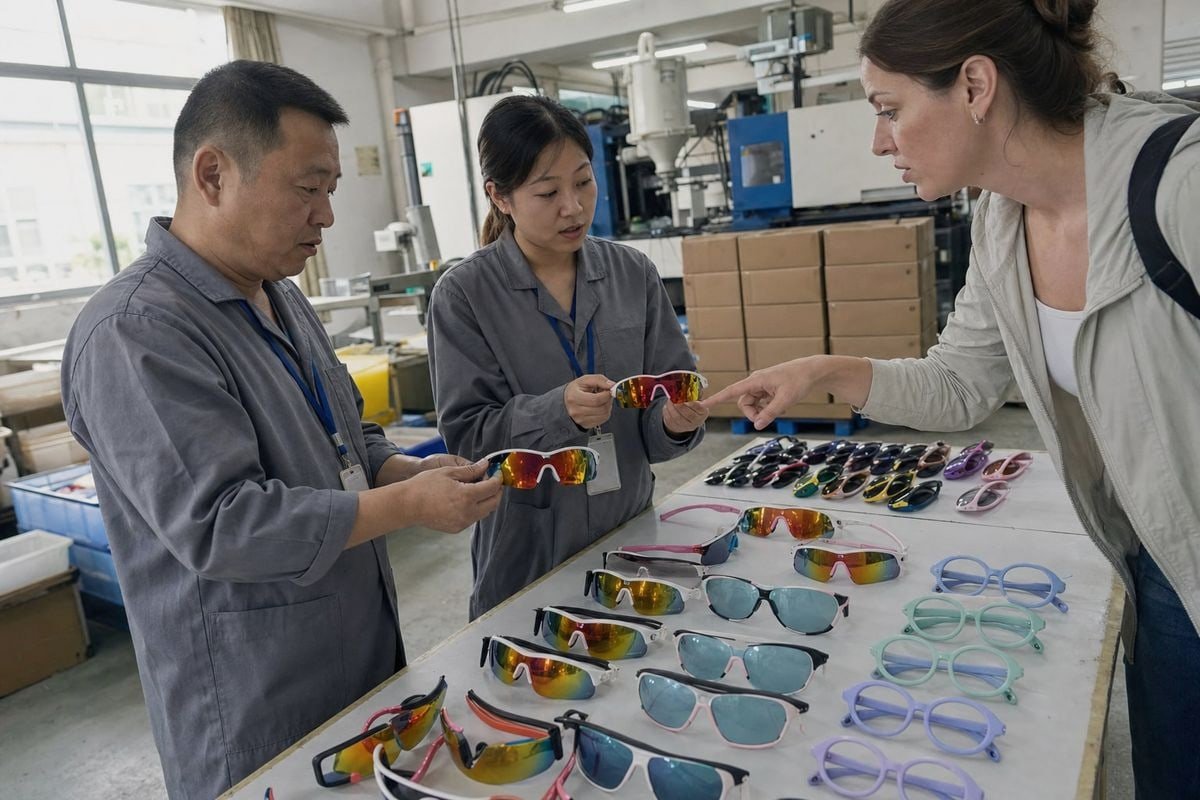
Finding reliable kids’ sunglasses suppliers from China is harder than it looks EN71-3 heavy metal migration 1. Every listing claims “factory direct” and “UV400,” yet many buyers still receive unsafe frames. Our Taizhou production line sees the fallout weekly — brands arriving after a bad first supplier burned their launch budget and their retail reputation.
To find reliable kids’ sunglasses suppliers from China, verify factory status through audits and video tours, request UV400 and EN71-3 test reports from accredited labs, confirm child-safe materials like TPEE, evaluate OEM/ODM depth with samples, and test communication before committing to any minimum order quantity.
That is the short answer. Below, I break down each verification step in detail, based on fifteen years of building children’s eyewear for brands in more than twenty countries.
How can I verify a kids' sunglasses supplier's safety and quality standards before ordering?
Last spring, a buyer from Australia sent me a competitor's "CE certificate" and asked if it looked right. It didn't — the issuing body did not exist. Our QC team sees forged documents more often than most importers expect.
Verify safety by requesting recent third-party test reports for UV400 protection, EN71-3 heavy metal migration, and ISO 12312-1 compliance, then confirm each certificate directly with the issuing lab's public database. Reliable suppliers provide these documents willingly and can explain exactly what each test covers.
Children's sunglasses are not fashion accessories with lower stakes. They are protective eyewear for developing eyes, and children's eyewear safety regulations treat them accordingly in most export markets. So your verification process needs to be stricter than it would be for adult accessories.
The core documents to request
Start with these four, and do not accept screenshots as proof:
| Document | What It Proves | Who Should Issue It |
|---|---|---|
| UV400 test report | Lenses block wavelengths up to 400nm | Accredited third-party lab (e.g., SGS, TÜV, Intertek) |
| EN71-3 report | No heavy metal migration from frames kids may chew | Accredited toy-safety testing lab |
| ISO 12312-1 2 report | Compliance with international sunglass safety standards | Recognized eyewear testing body |
| FDA and CE certification 3 records | Market access for the US and EU respectively | FDA registration; CE via Notified Body or self-declaration with test backing |
How to check the documents are real
A PDF proves nothing on its own. Take the report number and check it against the lab's public verification portal. Most major labs offer online lookup. If the supplier hesitates when you ask for the report number, treat that as your answer.
Also check the report date and the product reference. A three-year-old report for a different frame model tells you nothing about the batch you plan to order. In our experience exporting to Europe and Japan, serious buyers now request batch-specific testing on the first order, and we consider that a healthy sign — it means they understand UV400 protection 4 standards are only meaningful when tied to actual production.
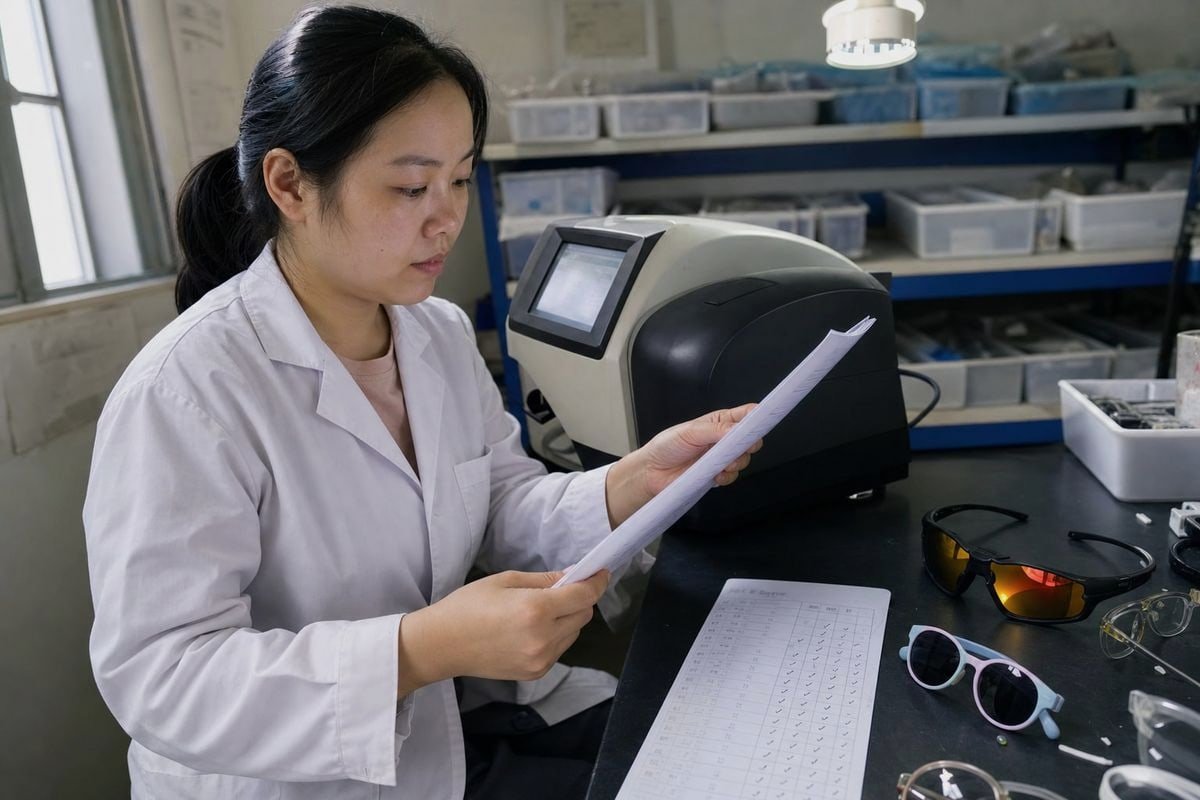
Finally, ask how the supplier tests in-house. A factory with a spectrophotometer for lens checks and a documented quality control inspection routine behaves very differently from one that only tests when a customer complains.
What should I look for in a China-based manufacturer's material and production capabilities?
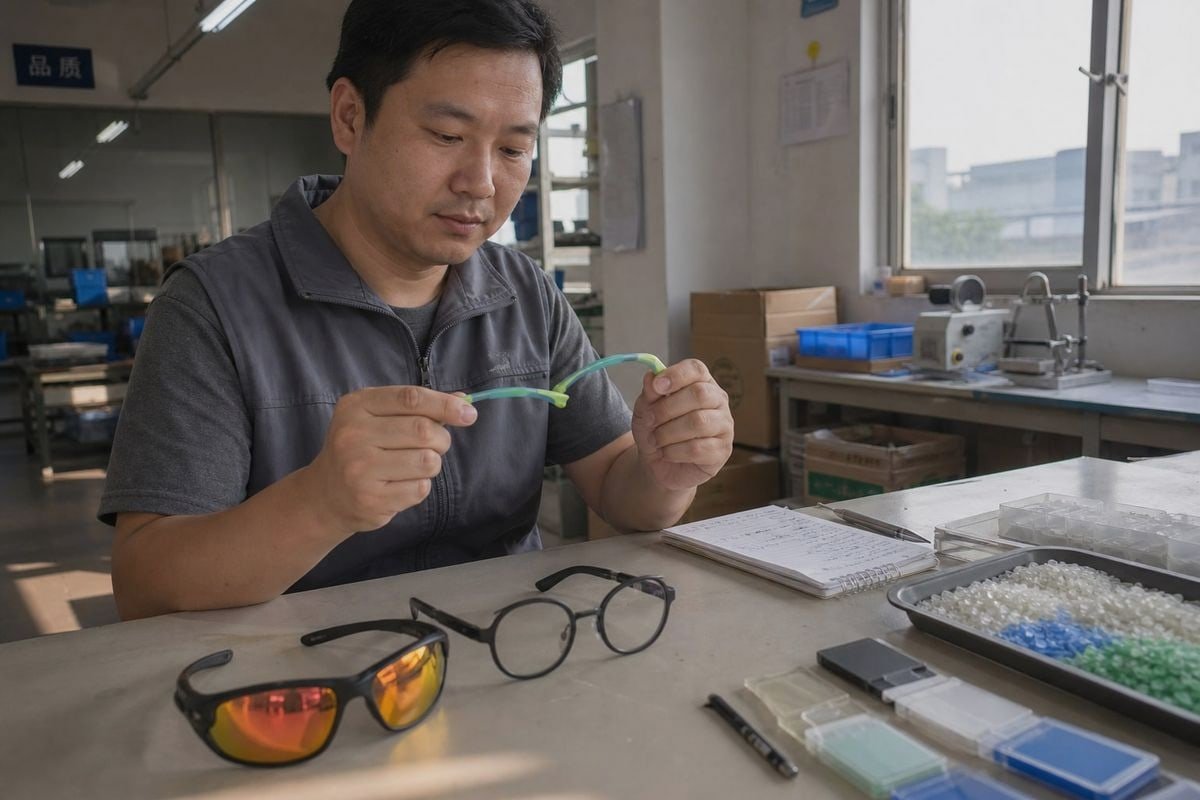
The trade-off I weigh most often in product development is flexibility versus cost. Standard PC frames are cheap and rigid; TPEE flexible frames cost more but survive being sat on, twisted, and chewed by a three-year-old.
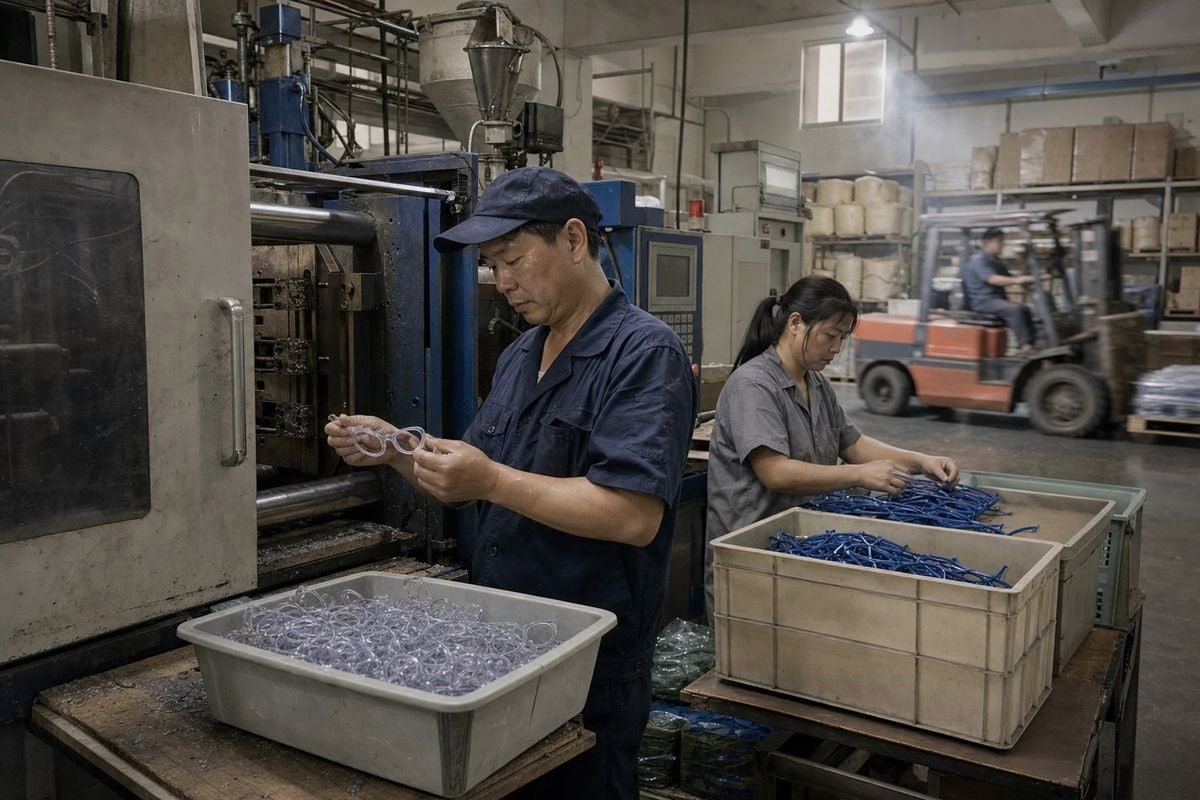
Look for child-specific materials like TPEE and TR90 rather than rigid PC, injection molding done in-house, polarized TAC lenses or verified UV400 lenses, age-graded frame sizing, and a managed workshop with documented quality control. Real manufacturers can show all of this on a live video tour.
Material choice matters more in kids' eyewear than in almost any other accessory category. Children fall, throw things, and put frames in their mouths. So the frame must be flexible, non-toxic, and light enough for a small nose bridge.
Materials compared
| Material | Flexibility | Safety Profile | Best Use |
|---|---|---|---|
| TPEE | Excellent — twists without snapping | Environmentally friendly, soft on skin | Baby and toddler frames, active kids |
| TR90 | Very good — high memory and impact resistance | Lightweight, hypoallergenic | Kids 3–12, optical frames and sunglasses |
| Food-grade silicone | Excellent | Non-toxic, chew-safe | 0–3 age group |
| Standard PC | Poor — can crack into sharp edges | Acceptable but rigid | Budget adult styles, not recommended for young kids |
Our own catalog leans heavily on TR90 frames with TPEE temples, because that combination gives structure at the front and forgiving flexibility where kids grab and pull. When a buyer asks why our quote is higher than a generic PC frame, this table is usually the explanation.
Production signals that separate factories from traders
Geography helps you shortlist. Taizhou, Wenzhou, Xiamen, and Shenzhen are the main eyewear clusters, and many Canton Fair 5 exhibitors in the eyewear halls come from these regions. But cluster location alone proves nothing. Ask for:
- A live video walkthrough of the injection molding 6 and assembly lines.
- The number of workers and years in operation — then check consistency across their website, marketplace profiles, and business license.
- Whether lenses are polarized TAC lenses or basic AC, and who supplies them.
- Their workshop management system. A 5S-managed floor tells you defects get caught early, not at your warehouse.
A trading company can forward photos. Only a factory can answer detailed questions about mold cavities, cycle times, and pediatric fit tolerances without pausing to ask someone else.
How do I evaluate a supplier's OEM/ODM support for custom branding and packaging?
A Japanese baby-brand buyer once told me she nearly signed with a supplier who promised "full customization" — until she asked to see a decorated sample and received a plain frame with a sticker on it. That single request saved her entire launch.
Evaluate OEM/ODM support by requesting decorated pre-production samples, confirming logo methods like pad printing or laser engraving, reviewing packaging options and retail-ready presentation, clarifying mold ownership for custom designs, and checking whether the supplier offers existing styles for low-risk private label launches.
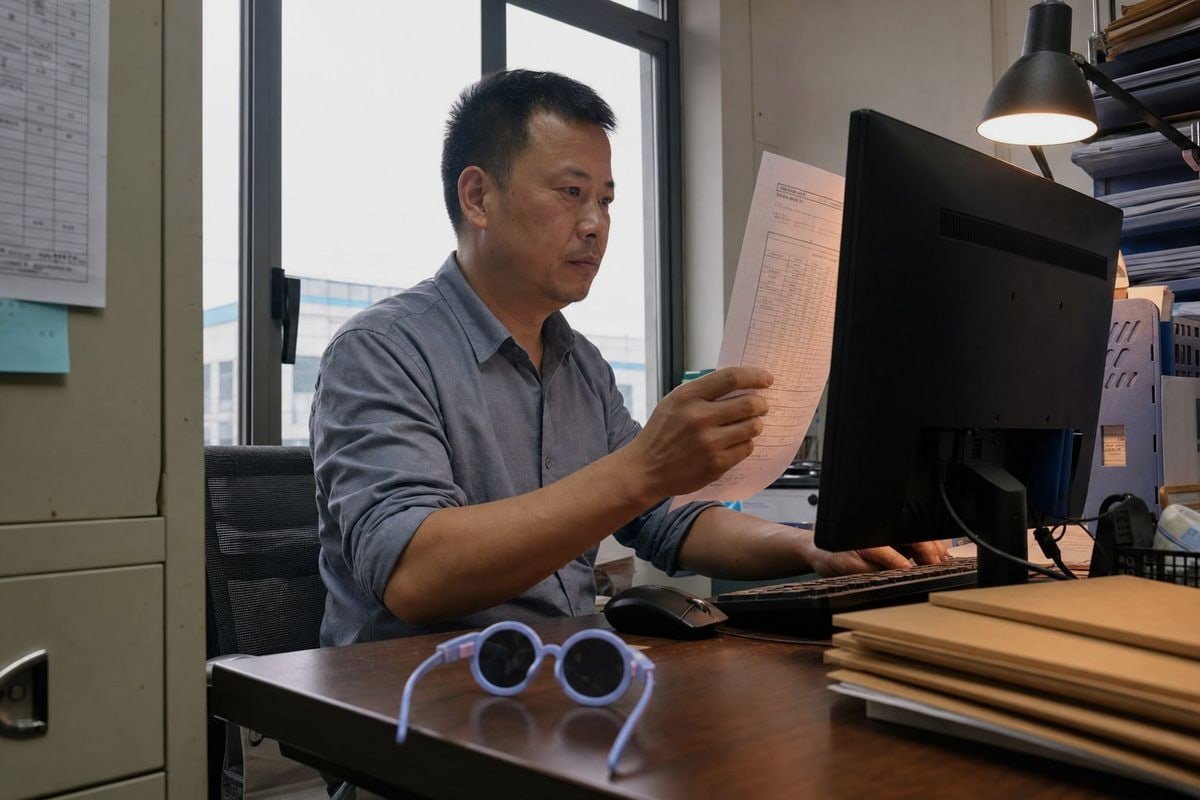
OEM private label manufacturing is where good factories earn their margin and where weak suppliers get exposed. Nearly every listing says "OEM/ODM welcome." The question is how deep that support actually goes.
Test the depth, not the claim
Real customization capability shows up in specifics. At our factory, a typical branding project covers custom Pantone-matched colors, logo application on temples and lenses, custom lens tints, and packaging from polybags up to full retail boxes with hangtags, pouches, and cleaning cloths. When you interview a supplier, walk through that same list and ask for photos of past projects at each level.
Two questions matter more than most buyers realize:
- Who owns the mold? If you pay for custom tooling, get mold ownership in writing. Otherwise your unique design can be sold to your competitors the day your order ships.
- Can you launch without a mold at all? A factory with a large existing style library — ours holds around 800 designs — lets a new brand pick proven frames, add branding, and test the market without heavy tooling investment. Some suppliers also support blank stock branding for micro-batches, which suits social media trend testing.
Packaging is part of the product
For children's brands, packaging carries safety messaging, age grading, and compliance marks. Ask whether the supplier can print required warnings and CE marks correctly for your market, and whether their packaging survives a drop test. A beautiful frame in a crushed box still generates returns. Reliable OEM partners treat retail-ready presentation as a quality control inspection point, not an afterthought.
What questions should I ask about MOQs, lead times, and communication before choosing a factory?
Early in my career, we lost a good European client because our lead-time estimate slipped by two weeks during peak season. That lesson shaped how we quote today: honest dates beat optimistic ones, every time.
Ask for the exact minimum order quantity per style and color, standard and peak-season lead times, sample turnaround, payment terms, and inspection policy. Then test communication by asking a technical question — a reliable factory answers precisely within one business day, in clear English, with documentation.
Price gets all the attention in China sourcing, but the deals that go wrong usually fail on MOQ misunderstandings, missed dates, or slow, vague communication. Ask these questions before you commit, and write the answers into your purchase order.
The essential question list
| Question | Why It Matters | A Good Answer Looks Like |
|---|---|---|
| What is the MOQ per style and per color? | Bulk wholesale pricing often hides per-color minimums | Clear numbers, with lower MOQs on existing styles |
| What is the lead time for repeat orders vs. new tooling? | New molds can add 30–45 days | Separate, dated estimates for each scenario |
| How fast can I get samples? | Slow samples predict slow production | 5–10 days for stock styles, tracked shipping |
| What are your payment terms? | Protects your deposit | 30% deposit / 70% before shipment, or Alibaba trade assurance 7 for platform orders |
| Do you accept third-party inspection? | Confirms confidence in their own quality | Immediate yes, with AQL levels agreed in advance |
| Who is my contact person? | You need one accountable name | A named salesperson with direct email and WhatsApp |
Judge quality of communication, not just speed
Fast replies are easy to fake. Precision is not. Send a technical question — for example, "What is the light transmission category of this lens, and can you share the test data?" A trader forwards your question to a factory and returns a vague answer days later. A real manufacturer replies with specifics.
Also agree on an inspection framework upfront. Request AQL-based quality control inspection reports before shipment, and reserve the right to bring in a third-party inspector. If a supplier resists a factory audit checklist or an independent inspection, that resistance tells you what the inspector would have found.
Conclusion
Reliable kids' sunglasses suppliers from China prove themselves through verified certificates, child-safe TPEE and TR90 materials, deep OEM/ODM support, transparent MOQs, and precise communication. Verify everything — then partner for the long term.
Footnotes
1. EN71-3 is the referenced toy-safety standard for heavy metal migration testing ↩︎
2. Authoritative Wikipedia section covering international sunglasses safety standards including ISO 12312-1. ↩︎
3. FDA regulatory overview supports the article’s mention of FDA registration for market access ↩︎
4. Background on UV400 and sunglasses protection standards discussed throughout the article ↩︎
5. Official site for the trade fair mentioned as a sourcing venue for eyewear exhibitors ↩︎
6. Explains the manufacturing process referenced for frame production verification ↩︎
7. Alibaba’s official trade assurance page referenced as a payment protection option ↩︎
More Articles You Might Like
Looking for a Reliable Kids Eyewear Partner?
Explore 800+ ready styles and full OEM/ODM support tailored to your brand.
Get in Touch English
  Español de México
  Deutsch
  Français
  日本語
日本語  العربية
  Português do Brasil