How to Clean TR90 & TPEE Kids Sunglasses Without Damaging Lenses and Coating?
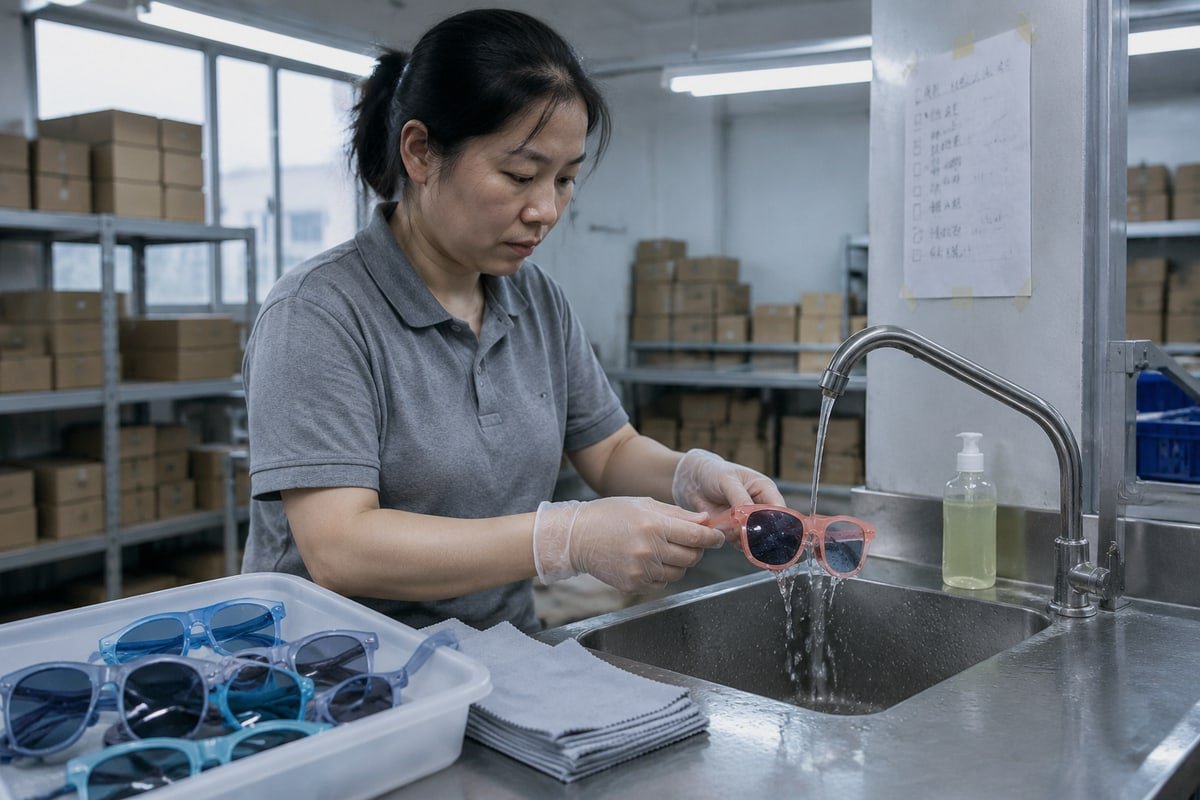
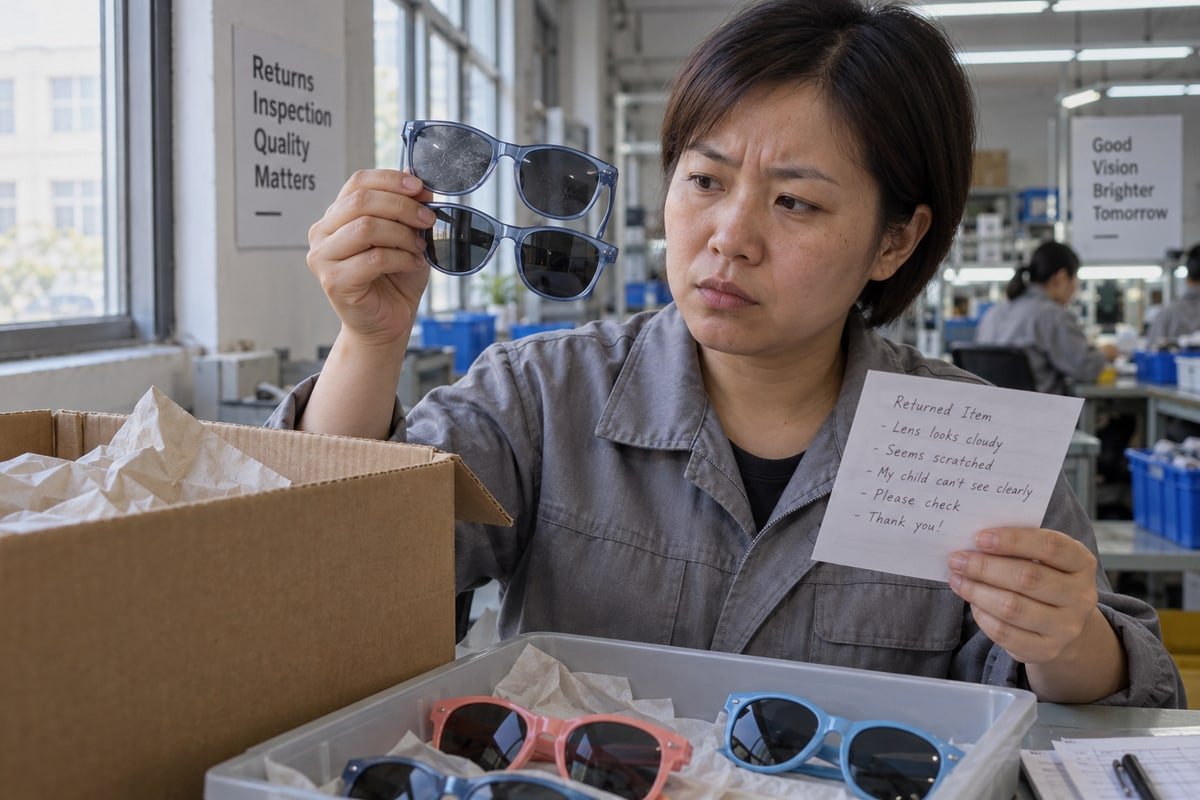
Cleaning TR90 and TPEE kids sunglasses 1 seems simple, until a parent sends back hazy, scratched lenses. On our Taizhou production line, we see that damage in return photos every month.
Clean TR90 and TPEE kids sunglasses by rinsing them under lukewarm water first, adding one drop of mild dish soap, rubbing gently with clean fingers, rinsing again, and drying with a microfiber cleaning cloth. Never dry-wipe gritty lenses, and avoid alcohol, ammonia, acetone, and hot-car storage.
That is the short answer. The rest of this guide explains why each step matters, which products quietly ruin coatings, and how to build a care routine your customers can actually follow.
What is the safest way I can clean TR90 and TPEE sunglasses without scratching the lenses?
During final inspection at our factory, every lens gets a rinse before wiping. That habit came from an early batch where dry-wiping dust left fine swirl marks.
The safest way to clean TR90 and TPEE sunglasses is to rinse off grit under lukewarm water, apply a drop of lotion-free mild dish soap, rub lenses and frame with fingertips, rinse thoroughly, then pat dry with a clean microfiber cleaning cloth. Rinsing first prevents sand from scratching the lens.
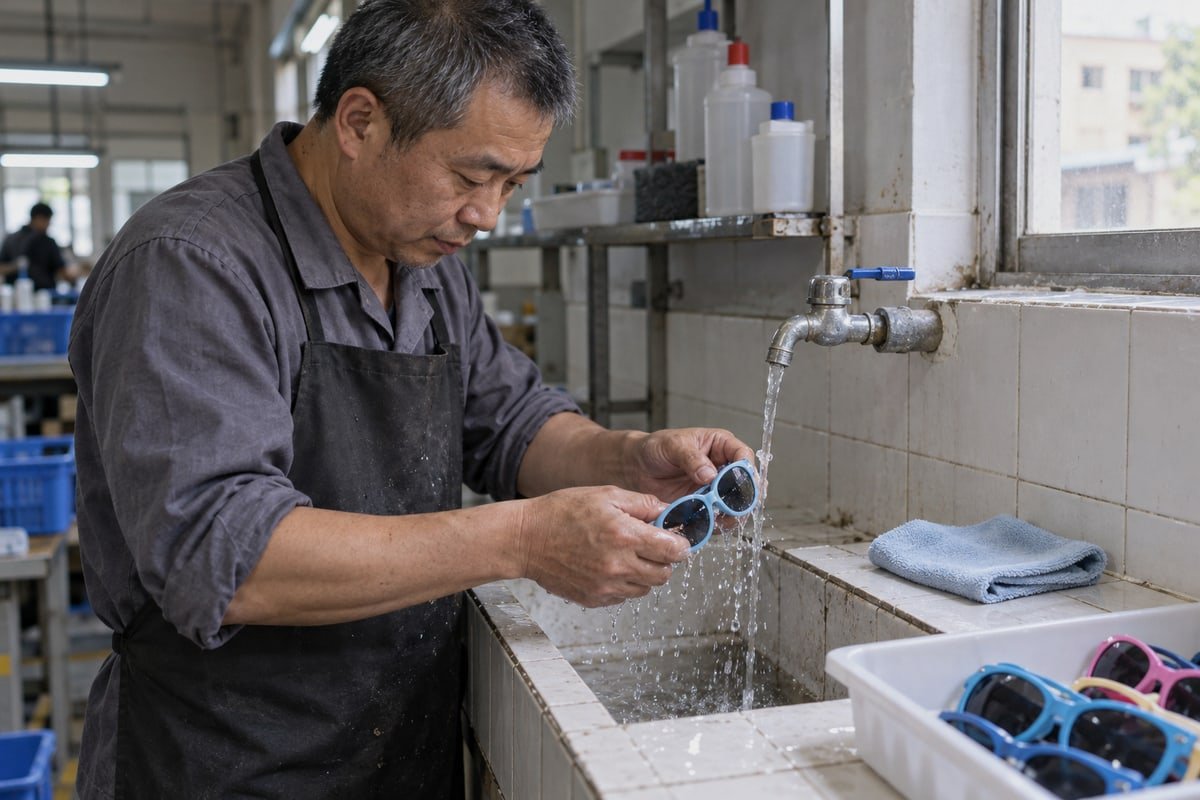
Kids' sunglasses live a harder life than adult eyewear. They go to the beach, the pool, and the playground. They get dropped in sand and smeared with sunscreen. Then a child grabs them by the lens and wipes them on a T-shirt. Each of those actions adds tiny scratches. Over a season, the lens looks cloudy even though the UV400 protection may still be intact.
Why TR90 and TPEE frames suit children
Both materials are flexible thermoplastics. TR90 is light and springs back after bending. TPEE is even softer and is often used for temples so the frame feels gentle on small ears. In our range, many styles pair a TR90 front with TPEE temples. Both are BPA-free material choices, which matters to the baby and kids' brands we supply. The good news is that both materials tolerate water and mild soap very well. The lens coating is the fragile part.
The five-step routine
- Rinse first. Hold the sunglasses under a gentle stream of lukewarm water. This floats off sand and grit. Skip this step and the grit acts like sandpaper under your cloth.
- Add soap. Use one drop of mild dish soap with no lotion or moisturizer. Lotion leaves a film that attracts fingerprints.
- Rub gently. Use your fingertips, not a cloth, on both sides of each lens. Work the soap along the rims and into the nose bridge.
- Rinse again. Remove all soap. Leftover soap dries into streaks.
- Dry with microfiber. Pat, do not scrub. Let stubborn drops air dry.
| Step | What it protects | Common shortcut that causes damage |
|---|---|---|
| Rinse first | Scratch-resistant coating on the lens | Wiping sand off dry |
| Mild soap | Polarized film and anti-reflective coating | Using hand soap with moisturizer |
| Fingertip rub | Lens surface and rim finish | Pressing hard with a rag |
| Second rinse | Clarity, no streaks | Skipping and wiping soap off |
| Microfiber dry | Coating surface | Paper towel or shirt hem |
Translucent frames, like the gradient coral or sky-blue fronts in our catalog, show soap film and fingerprints more than opaque ones. The routine above keeps them looking clear.
Which cleaning products should I avoid to protect the UV400 or polarized coating?
Every polarized lens we spec involves a trade-off: more coating layers give better glare control, but each layer adds a surface that harsh solvents can attack.
Avoid alcohol wipes, ammonia-based glass cleaners, bleach, acetone, and household window sprays, because these solvents degrade UV400 and polarized coatings, causing peeling, clouding, or dulling. Also avoid paper towels, tissues, and clothing, whose wood or rough fibers leave permanent micro-scratches on the coating.
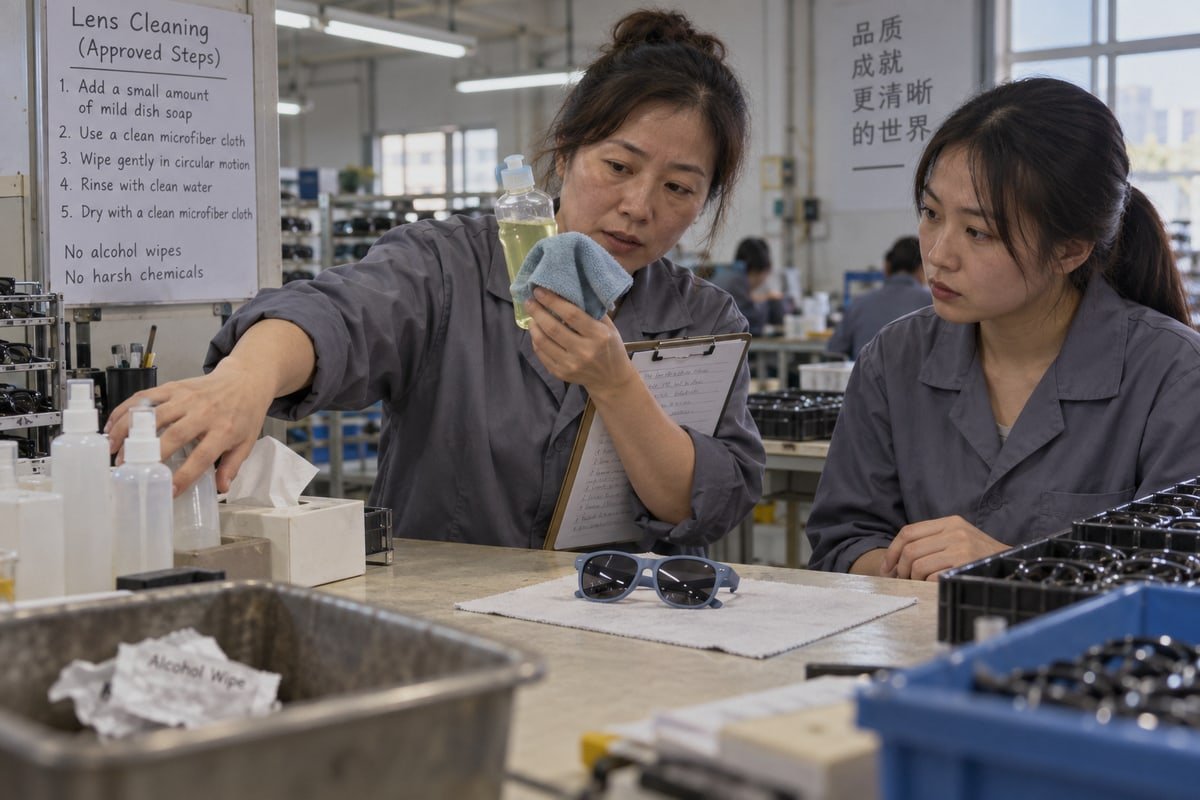
Parents reach for whatever is nearby. A glass cleaner under the sink. An alcohol wipe from the car. A tissue from a pocket. Each of these feels harmless. In our experience, this is where most coating failures start. The damage is slow. The lens looks fine after one wipe. After fifty wipes, the anti-reflective coating starts to peel at the edges, or the polarized film shows a milky haze.
Products to avoid and why
| Product | Why it damages the lens or frame | Safe alternative |
|---|---|---|
| Alcohol wipes | Dry out coating layers and can lift anti-reflective coating over time | Lukewarm water and mild dish soap |
| Ammonia glass cleaner | Reacts with coating chemistry, causes clouding | Coating-safe lens spray, if labeled as such |
| Bleach | Strips color from frame finish, attacks coatings | Soap and water |
| Acetone or nail polish remover | Dissolves thermoplastic surface and coatings | Never use on eyewear |
| Paper towels or tissues | Wood fibers scratch the scratch-resistant coating | Microfiber cleaning cloth |
| Abrasive sponges | Gouge lenses and dull TR90 finish | Fingertips or soft baby toothbrush |
Do you need a special lens spray?
Buyers often ask whether they should bundle a lens spray with our sunglasses. Some brands say spray is essential for coated optics. Others say soap and water is enough. Here is how we resolve it. Soap and water is the safest universal baseline. It works on every lens type we produce. A lens spray is useful for stubborn residue or for quick cleaning away from a sink. But only use one that states it is safe for anti-reflective and polarized coatings. Generic sprays are not all the same. If the label does not mention coatings, treat it as a risk.
What about ultrasonic cleaners?
Ultrasonic cleaner safety 2 is a real concern for flexible frames. Optical shops use these machines for metal frames. On TR90 and TPEE, the high-frequency vibration can stress the points where the soft frame grips the rigid lens. We do not recommend them for children's eyewear. Non-abrasive cleaners and a gentle hand do the job without that risk.
How can I remove stubborn dirt and sweat from flexible kids' frames without weakening the material?
A procurement manager from Australia once asked us why returned frames looked chalky at the nose pads. The cause was dried sunscreen and sweat, not a material defect.
Remove stubborn dirt and sweat by soaking the frame in lukewarm soapy water for a few minutes, then scrubbing nose pads, hinges, and temple grooves with a soft baby toothbrush. Rinse well and air dry. Skip hot water, hair dryers, solvents, and ultrasonic cleaners, which stress flexible thermoplastic frames.
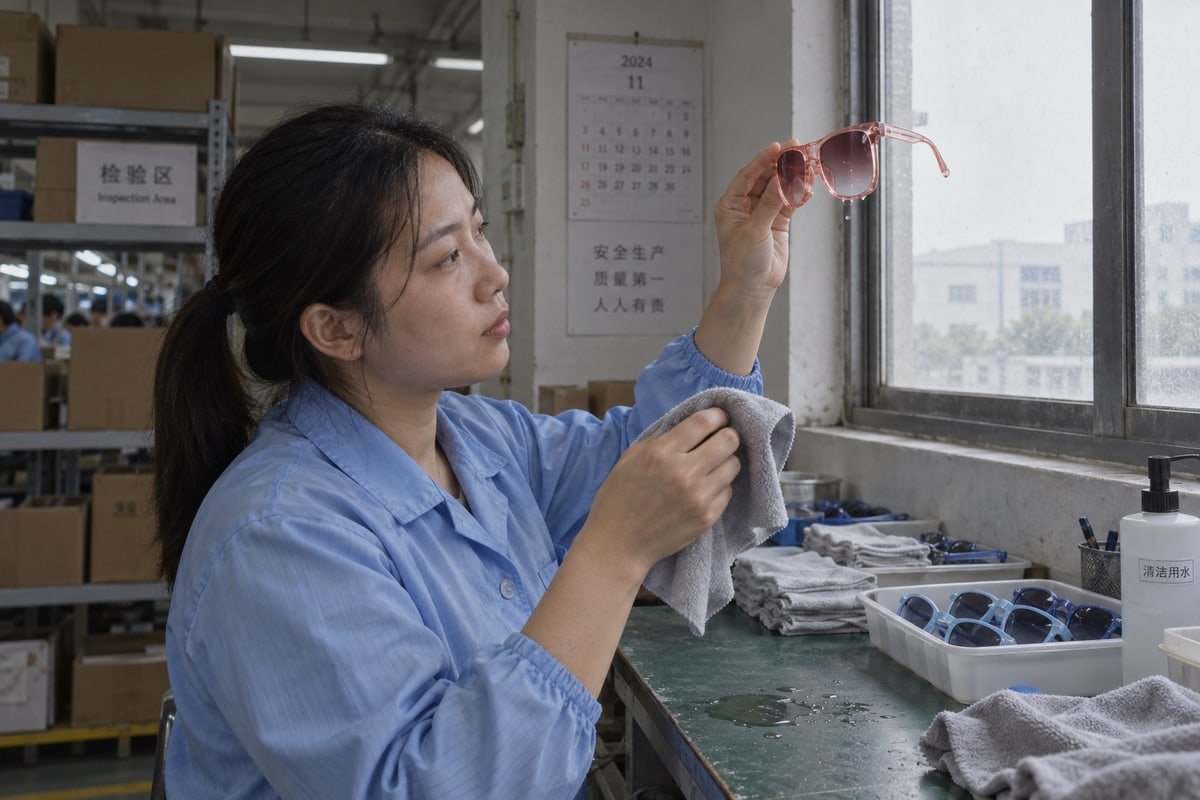
Sweat and sunscreen 3 are the two contaminants we hear about most. Sunscreen is oily and sticks to plastic. Sweat carries salt. Saltwater from the beach adds more. When these dry, they leave a white film in every crevice. On a chunky kids' frame with thick rims and rivet hinges, there are plenty of crevices. The film does not weaken TR90 or TPEE on its own. But it looks bad, and parents often try to scrub it off with something harsh. That is when real damage happens.
Cosmetic damage versus structural damage
This distinction helps brands handle complaints. TR90 is very stable. Even after exposure to a harsh cleaner, the frame usually keeps its shape and flexibility. What changes is the surface. Glossy finishes go dull. Translucent frames go slightly cloudy. This is cosmetic damage. Structural damage, like cracks at the hinge or a lens that pops out, is much rarer and usually comes from heat or force, not cleaning. When a buyer sends us a return photo, the first thing our QC team checks is which type it is. Cosmetic dulling is a care issue. Structural failure is a product issue.
A gentle deep-clean method
Fill a bowl with lukewarm water and a small amount of mild dish soap. Let the sunglasses sit for three to five minutes. This softens dried sunscreen. Then take a soft baby toothbrush. Brush the nose pad area, the hinge rivets, and the inside of the temple tips. These are the spots where sweat and skin oil build up. TPEE temples, in particular, are soft to the touch, so they collect more residue than a hard plastic arm. Rinse under running water. Shake off drops and let the frame air dry on a clean microfiber cleaning cloth.
| Symptom | Likely cause | Fix |
|---|---|---|
| White film at nose bridge | Dried sunscreen and sweat | Soak, soft brush, rinse |
| Sticky temple tips | Skin oil on TPEE | Soap soak, fingertip rub |
| Dull spots on gloss frame | Solvent or abrasive contact | Cannot reverse, stop harsh cleaning |
| Stiff hinge | Sand in rivet | Rinse, brush, air dry |
Good thermoplastic frame maintenance 4 is mostly about patience. Soak longer instead of scrubbing harder.
How often should I clean my kids' sunglasses to keep the coating and frame in good condition?
One lesson from fifteen years of eyewear work: coatings rarely fail from a single event. They fail from hundreds of careless daily wipes.
Rinse and wipe kids' sunglasses daily during active use, do a full soap-and-water clean weekly or after every beach, pool, or sunscreen-heavy day, and inspect hinges and coatings monthly. Store them in a hard case away from hot cars to keep the frame and coating in good condition.
Frequency matters less than method. A lens wiped gently every day will outlast one wiped roughly once a week. Still, a simple schedule helps parents. It also helps brands write clear care cards for packaging. We include care guidance in the retail-ready packaging we develop for many OEM clients, because a good product with bad care instructions still comes back as a complaint.
A practical care schedule
| Frequency | Action | Why it matters |
|---|---|---|
| Daily, after use | Rinse under lukewarm water, pat dry | Removes fresh sand and sunscreen before it dries |
| Weekly, or after water play | Full soap-and-water clean with brush | Clears salt and sweat from crevices |
| Monthly | Check hinge rivets, coating edges, lens seating | Catches early wear before it spreads |
| Every time | Return to a hard case | Prevents scratches and heat exposure |
Heat and storage risks
Heat is the biggest hidden threat to thermoplastic frames. A car dashboard in summer gets far hotter than the air outside. Prolonged exposure can soften TR90 and let the frame warp slightly. A warped frame no longer holds the lens evenly, which puts stress on the coating edges. Heat can also cause blooming, where plasticizers migrate to the surface and leave a cloudy film on the frame. A hard case in a bag, not the glove box, avoids most of this.
Reducing how often you wipe
Every wipe is a small risk to the anti-reflective coating and the polarized film. So fewer wipes mean longer coating life. Some parents apply a pH-balanced, anti-static lens treatment. It creates a light hydrophobic barrier that sheds water and repels dust and fingerprints. This is optional, and it must be labeled safe for coated lenses. For most families, the daily rinse habit alone cuts wiping in half. Good polarized lens care is really about doing less, more gently.
Conclusion
Scratched lenses and dull frames are usually care problems, not material failures. Rinse first, use mild soap, dry with microfiber, avoid solvents and heat, and your kids' sunglasses last.
Interested in sourcing the products mentioned in this article? See details and request a quote here:
Footnotes
1. ISO 12312-1 sets official UV and safety requirements for sunglasses including children’s eyewear. ↩︎
2. Background on how ultrasonic cleaning technology works and why it stresses delicate materials. ↩︎
3. CDC guidance on sun safety and sunscreen use provides authoritative context for these contaminants. ↩︎
4. Explains thermoplastic properties, supporting the heat-sensitivity and care claims made about TR90 frames. ↩︎
More Articles You Might Like


Looking for a Reliable Kids Eyewear Partner?
Explore 800+ ready styles and full OEM/ODM support tailored to your brand.
Get in Touch English
  Español de México
  Deutsch
  Français
  日本語
日本語  العربية
  Português do Brasil