How to Choose Kids’ Sunglasses Based on Face Shape?
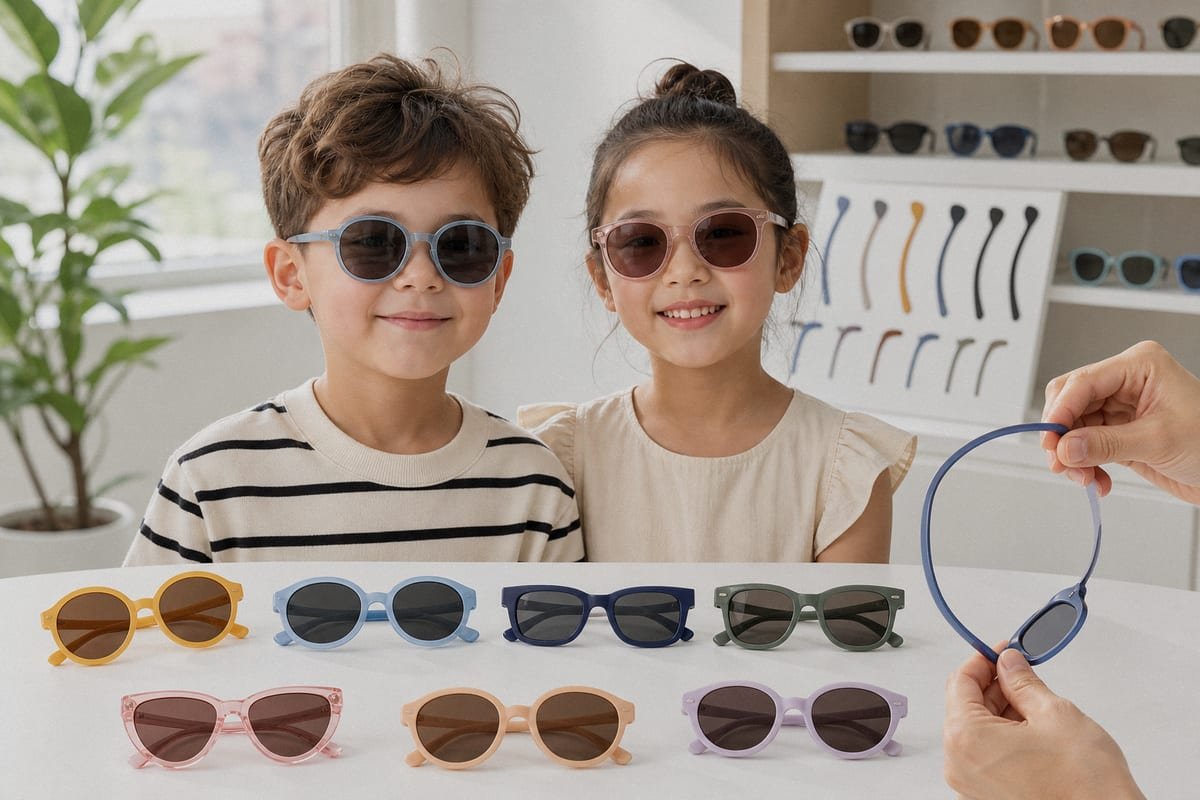
Choosing kids’ sunglasses based on face shape sounds simple, until a buyer sends back samples that slide, pinch, or sit crooked. On our production line in Taizhou, I have seen beautiful frames fail on real children’s faces. That gap between “looks cute” and “fits right” costs brands returns and reviews. The fix is a clear method: protection first, fit second, face shape third.
Choose kids’ sunglasses based on face shape by pairing angular frames with round faces, soft round frames with square faces, and almost any style with oval faces. Always confirm UV400 protection, impact-resistant lenses, and a snug, flexible fit before styling decisions.
In this guide, I will walk through each face shape, explain sizing for smaller faces, show why materials matter more than style, and share how brands can offer variety without mold costs.
How do I match sunglasses shapes to my child's round or oval face?
A buyer from Australia once asked me why her round-lens sample looked "off" on her son. His face was round too. That question taught me more than any style guide ever did.
Round faces look best in rectangular, square, or angular kids' sunglasses because straight lines add definition and contrast. Oval faces are the most versatile shape and suit nearly any frame, as long as the frame width matches the face and does not overpower it.
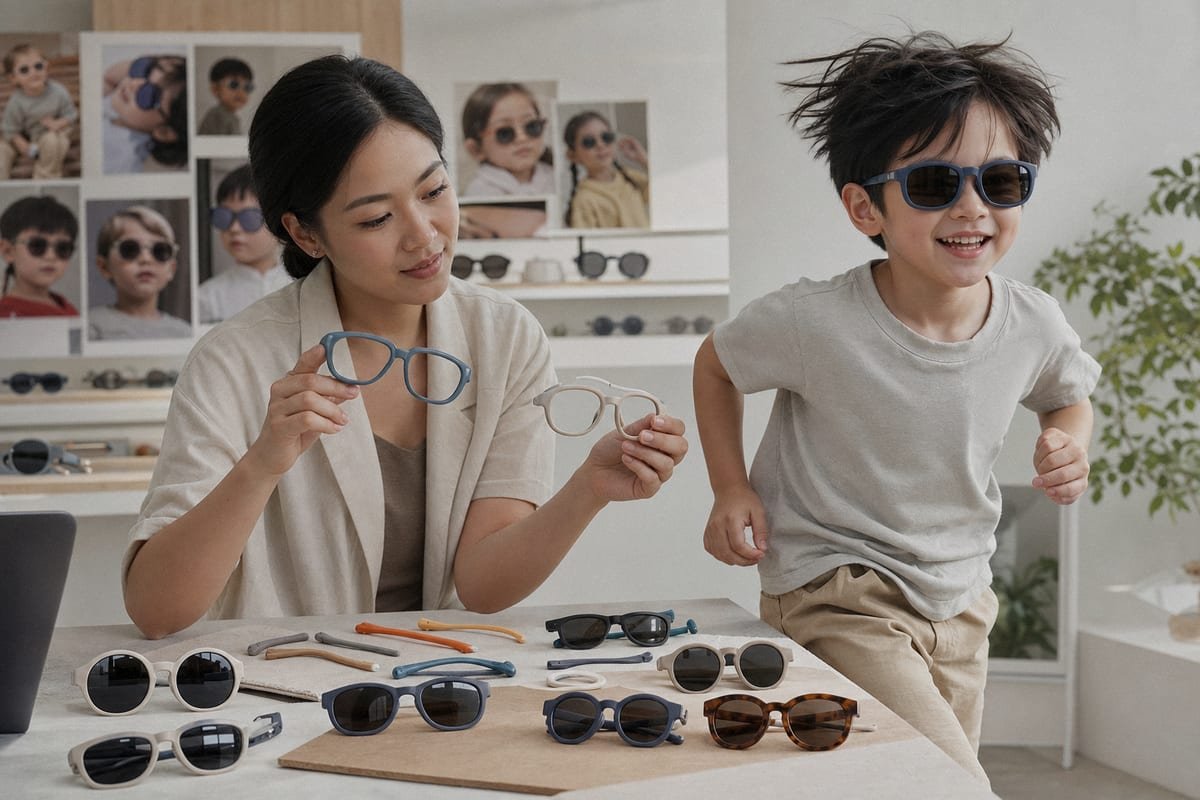
Face shape matching is really about contrast and balance. A round face has soft cheeks, a curved jawline, and roughly equal width and length. If you place a fully round frame on that face, everything blends into one soft circle. Angular frames break that up. They create visual edges the face does not naturally have. That is why square and rectangular styles get recommended for round faces again and again.
Oval faces work differently. They are longer than they are wide, with a gently narrowing chin. Because the proportions are already balanced, most frame shapes sit well. The only real risk is scale. A frame that is too wide or too tall will swallow a small oval face. Medium-sized frames keep the natural balance intact.
Quick reference for common face shapes
| Face Shape | Best Frame Styles | Styles to Avoid |
|---|---|---|
| Round | Rectangular, square, angular | Fully round, very curved lenses |
| Oval | Almost any medium-sized style | Oversized frames that overpower |
| Square | Round, oval, softly curved | Boxy, sharply angular frames |
| Heart | Aviator, bottom-heavy, light frames | Wide, top-heavy designs |
How to identify your child's face shape
Look at four things: forehead width, cheekbone width, jawline shape, and overall face length. A round face is about as wide as it is long. An oval face is longer, with soft edges. A square face has a strong, flat jawline. A heart face has a wide forehead and a narrow chin.
One honest caveat from my experience sampling frames for brands in over 20 countries: face-shape rules are a styling helper, not a law. Some stylists argue that actual frame width and lens height matter far more than shape rules. I agree with the balance view. Use face shape to narrow down styles. Then let fit make the final call. A "wrong" shape that fits well always beats a "right" shape that slides down the nose.
What frame styles work best for kids with smaller or narrower faces?
Sizing is where we spend the most engineering time at our factory. A two-year-old's nose bridge and a nine-year-old's are completely different structures, and one frame cannot serve both.
Kids with smaller or narrower faces need compact frames with a low, cushioned nose bridge, shorter temple arms, and a lens width matched to their pupillary distance. Age-specific sizing charts and deeper vertical lens height prevent slipping and stop UV light from leaking over the rim.
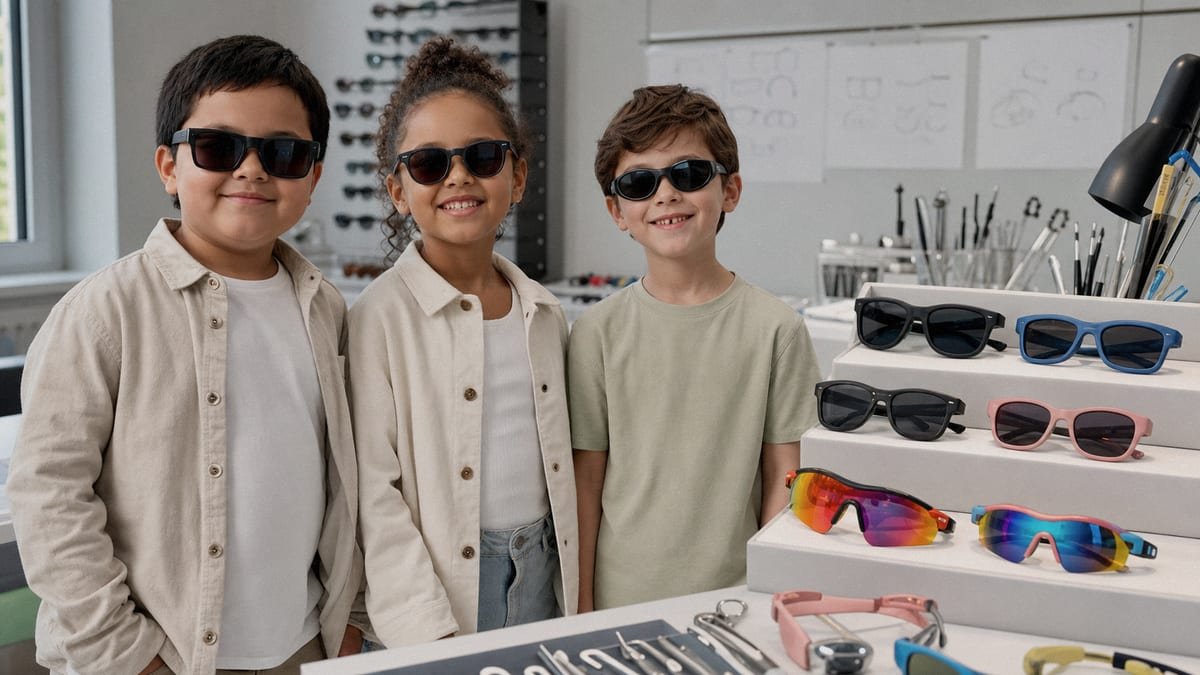
Children's faces are not scaled-down adult faces. Their nose bridges 2 are flatter and lower. The distance between their eyes and eyebrows is shorter. Their temples are narrower. So an adult frame shrunk by 20% still fits badly. This is why we design children's frames from child head-form data, not from adult molds.
The measurements that actually matter
A proper frame measurements guide for kids covers three numbers. Frame width should roughly match face width, so the sunglasses neither pinch the temples nor slide sideways. Temple length must be short enough that the arms hook properly behind small ears. Lens height should be deep enough to cover from near the brow line down past the lower orbital bone.
That last point deserves attention. Because children have a shorter eye-to-brow distance, shallow lenses leave a gap at the top. Sunlight sneaks in over the rim and hits the eye directly. Deeper lenses close that gap. This is a protection issue, not just a comfort issue, and it ties directly into long-term eye health and sun safety.
Age-based sizing at a glance
| Age Range | Typical Frame Width | Bridge Style | Temple Notes |
|---|---|---|---|
| 0–2 years | Very compact | Flat, soft, wide bridge | Short arms; strap option helps |
| 3–5 years | Small | Low bridge, cushioned | Short, flexible arms |
| 6–9 years | Medium-small | Standard kids bridge | Rubber tips reduce slipping |
| 10–12 years | Medium | Closer to adult geometry | Adjustable or grippy tips |
Bridge fit and comfort make or break a narrow-face frame. If the bridge floats above the nose, the whole frame tips forward. If it digs in, the child pulls the sunglasses off within minutes. We test our TR90 and TPEE frames on multiple bridge profiles for exactly this reason. For a brand buyer, the practical lesson is simple: order size-graded styles across age bands rather than one "universal" kids' size.
Why does flexible material matter more than shape when fitting active kids?
Fifteen years of eyewear production has taught me one blunt lesson: the prettiest frame in the world is worthless once a four-year-old sits on it.
Flexible materials matter more than shape because children twist, drop, and sleep on their sunglasses. TPEE and TR90 frames bend without snapping, shatterproof polycarbonate lenses resist impact, and a soft, forgiving fit keeps kids wearing them, which is what actually delivers UV protection.
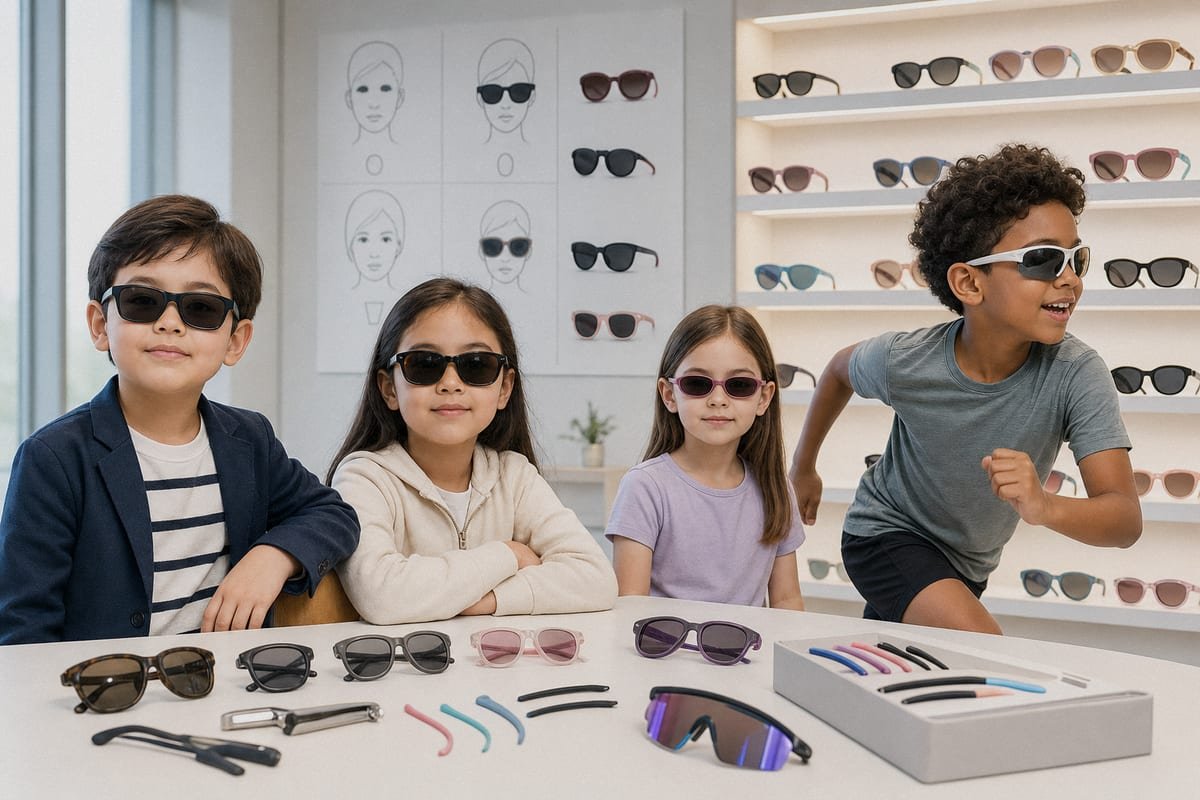
Think about how a child treats eyewear. They pull it off with one hand, stretching the temples outward. They shove it into a backpack under a water bottle. They fall while wearing it. A rigid frame fails under this treatment in one of two ways. It snaps, which ends its life. Or it breaks with a sharp edge, which is a safety hazard near a child's eyes.
Flexible materials solve both problems. TR90 is a lightweight nylon-based material with strong shape memory 3. TPEE goes even further; it behaves almost like flexible silicone frames, bending nearly flat and returning to shape. In our workshop we combine them, using TR90 fronts with TPEE temples so the frame holds its structure while the arms take the abuse. Both materials are also environmentally friendlier options than many cheap plastics, and they avoid the harsh chemical stabilizers that can irritate thin, sensitive skin.
Lens safety is non-negotiable
Impact-resistant lenses 4 matter just as much as the frame. Polycarbonate is the standard here because it does not shatter into fragments on impact. Pair that with true UV400 protection, and you have eyewear that protects rather than decorates. Polarized lenses for kids are a strong upgrade for beach, snow, and water settings, since they cut glare that plain tinted lenses cannot.
Why comfort beats style in real life
Here is the chain of logic I share with product managers. Sunglasses only protect eyes when worn. Kids only wear what feels comfortable. Comfort comes from lightweight, flexible materials and good bridge fit, not from lens shape. So the material decision, not the shape decision, determines whether your product actually does its job. Shape decides whether the parent buys it. Material decides whether the child keeps it on. A brand needs both, but if forced to rank them, material wins every time.
How can I offer multiple frame shapes without ordering custom molds for each?
Every few weeks, a startup founder emails Alan on our sales team with the same worry: they want round, angular, and wrap-around sports styles in their launch line, but three custom molds would destroy their budget.
Brands can offer multiple frame shapes without custom molds by selecting from a manufacturer's existing style library, then customizing colors, logos, lenses, and packaging through OEM/ODM services. This turns a mold investment of thousands of dollars per shape into a low-risk, fast-launch catalog strategy.
Custom injection molds 6 are expensive and slow. Each new shape typically means weeks of tooling, sample rounds, and a high minimum order to justify the cost. For an established brand with proven sellers, molds make sense. For a brand testing which shapes its market prefers, molds are a gamble.
The alternative is an existing-style library. Our factory maintains roughly 800 ready styles across kids' sunglasses and optical frames, precisely so buyers can cover every face shape from day one. A typical starter line might look like this: a soft pastel round frame for oval and square faces, an angular frame for round faces, and a wrap-around shield style for sports and maximum coverage. Two of our own examples show the range well — a periwinkle-and-mint round frame in flexible matte plastic for toddlers, and a bold wraparound shield with a mirrored orange-to-gold gradient lens built for active older kids.
Custom molds versus existing styles
| Factor | Custom Mold | Existing Style Library |
|---|---|---|
| Upfront cost | High tooling investment per shape | No mold cost |
| Lead time | Weeks to months | Days to sample |
| Minimum order | Large, to recover mold cost | Much lower |
| Design uniqueness | Fully exclusive | Shared base, customized finish |
| Market risk | High if the shape flops | Low; test and reorder winners |
What you can still customize
Choosing existing shapes does not mean generic products. Frame colors, temple color combinations, logo printing, lens tints, polarized or UV400 lens upgrades, and retail-ready packaging are all customizable. A soft amber or rose tint, for example, can serve children with sensory sensitivities by reducing visual overstimulation. Hybrid lens coatings that add blue light filtration 7 on top of UV protection suit kids who move between playgrounds and screens. The smart sequence is simple: launch on existing styles, learn which shapes sell in your market, then invest in a custom mold only for your proven bestseller.
Conclusion
Face shape helps you style kids' sunglasses, but protection, sizing, and flexible materials decide whether children actually wear them. Start with UV400 and fit, then match shapes, then scale smartly with existing styles.
Footnotes
1. National Eye Institute provides authoritative guidance on UV protection standards for eyewear. ↩︎
2. Explains nasal bridge anatomy relevant to why children’s frames need custom bridge geometry. ↩︎
3. Explains shape-memory polymer properties behind flexible TR90 frame materials. ↩︎
4. 2024 FDA consumer update confirming that all sunglasses must meet federal impact resistance standards. ↩︎
5. Background on polycarbonate’s impact-resistant properties used widely in children’s eyewear lenses. ↩︎
6. Alibaba.com is a major sourcing platform where brands compare custom mold versus existing-style manufacturing. ↩︎
7. National Eye Institute discusses blue light exposure and eye health relevant to lens coatings. ↩︎
More Articles You Might Like



Looking for a Reliable Kids Eyewear Partner?
Explore 800+ ready styles and full OEM/ODM support tailored to your brand.
Get in Touch English
  Español de México
  Deutsch
  Français
  日本語
日本語  العربية
  Português do Brasil