How to Assign Responsibility for High Return Rates on Kids Sunglasses?
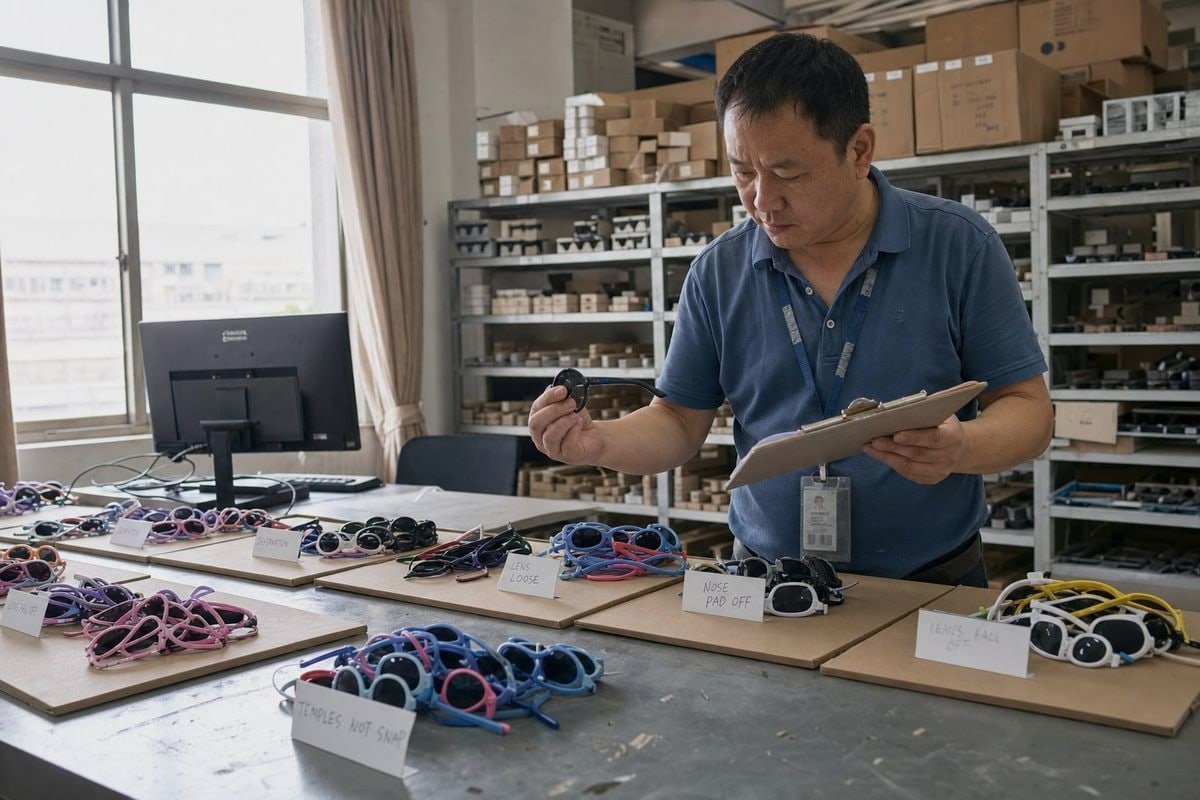
Assigning responsibility for high return rates 1 on kids sunglasses is painful. I have watched buyers blame their sales channel while our inspection reports pointed somewhere else entirely. Returns eat margins, damage brand trust, and strain supplier relationships. The fix starts with tracing each return to its true owner.
Assign responsibility for high return rates on kids sunglasses by mapping every return reason to the function that controlled it: sizing and durability belong to product and sourcing, misleading listings to merchandising, transit damage to fulfillment, and unclear rules to policy design. Use return-reason data, not assumptions, to assign ownership.
That sounds simple, but most brands never do it. They see one big return number and pick a scapegoat. Let me walk you through a better approach, step by step, based on what actually happens between a factory floor and a child’s face.
How can I identify whether design flaws or manufacturing defects are causing my returns?
A buyer once forwarded me photos of thirty returned frames, convinced our workshop had failed him. When our team examined them, every break sat at the same hinge point — a design issue, not a production one. That distinction changed everything about who paid and what got fixed.
Separate design flaws from manufacturing defects by checking failure patterns: design flaws repeat at the same point across all units and batches, while manufacturing defects appear randomly or cluster in specific production lots. Cross-reference return-reason codes with batch numbers to confirm which one you face.
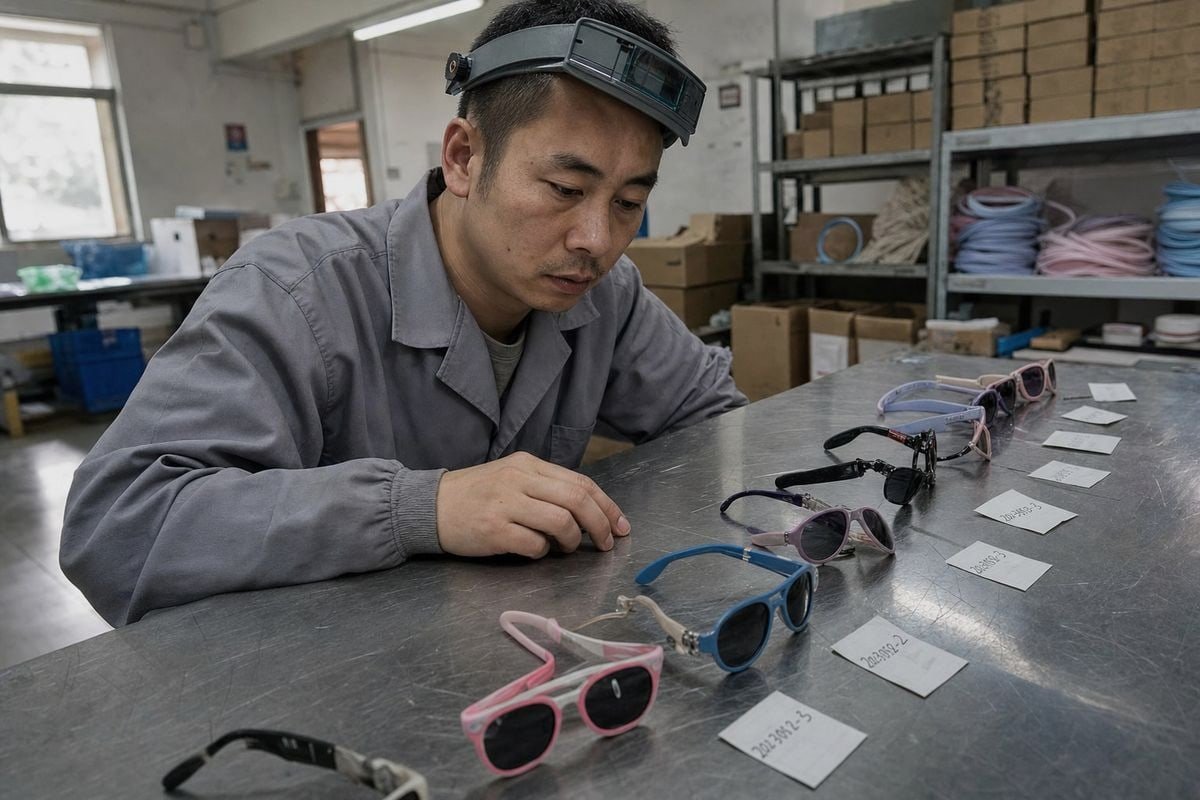
The difference matters because responsibility flows in opposite directions. A design flaw means the product concept itself was wrong for children — the frame is too rigid, the nose bridge sits wrong on a small face, or the temple length does not match the stated age range. A manufacturing defect means the design was fine, but execution slipped — a loose hinge screw, a lens with coating bubbles, or uneven injection molding on one production run.
Read the pattern, not the complaint
Customers describe symptoms, not causes. A parent writes "broke after two days." That tells you nothing about ownership. You need to ask three questions. First, where exactly did it break? Second, does the same failure appear across multiple batches? Third, does the failure match how a child actually uses the product?
Here is how we teach buyers to sort the evidence:
| Signal | Points to design flaw | Points to manufacturing defect |
|---|---|---|
| Failure location | Same spot on every unit | Varies unit to unit |
| Batch distribution | Spread across all batches | Concentrated in one lot |
| Timing of failure | After normal child use | Often on arrival or first use |
| Fix required | Re-engineering or material change | Tighter process control and inspection |
| Who owns it | Product development / sourcing decision | Factory quality control |
Kids-specific stress points
Children twist, sit on, and drop their sunglasses. In our fifteen years making children's eyewear 2, we have learned that hinges, nose bridges, and temple tips fail first. If your returns cluster at these points and the frame material is rigid, the design was never child-appropriate. That responsibility sits with whoever approved the sample — often the buyer's own product team, not the factory. If the failures are random and inconsistent, then production discipline is the problem, and the factory owns it.
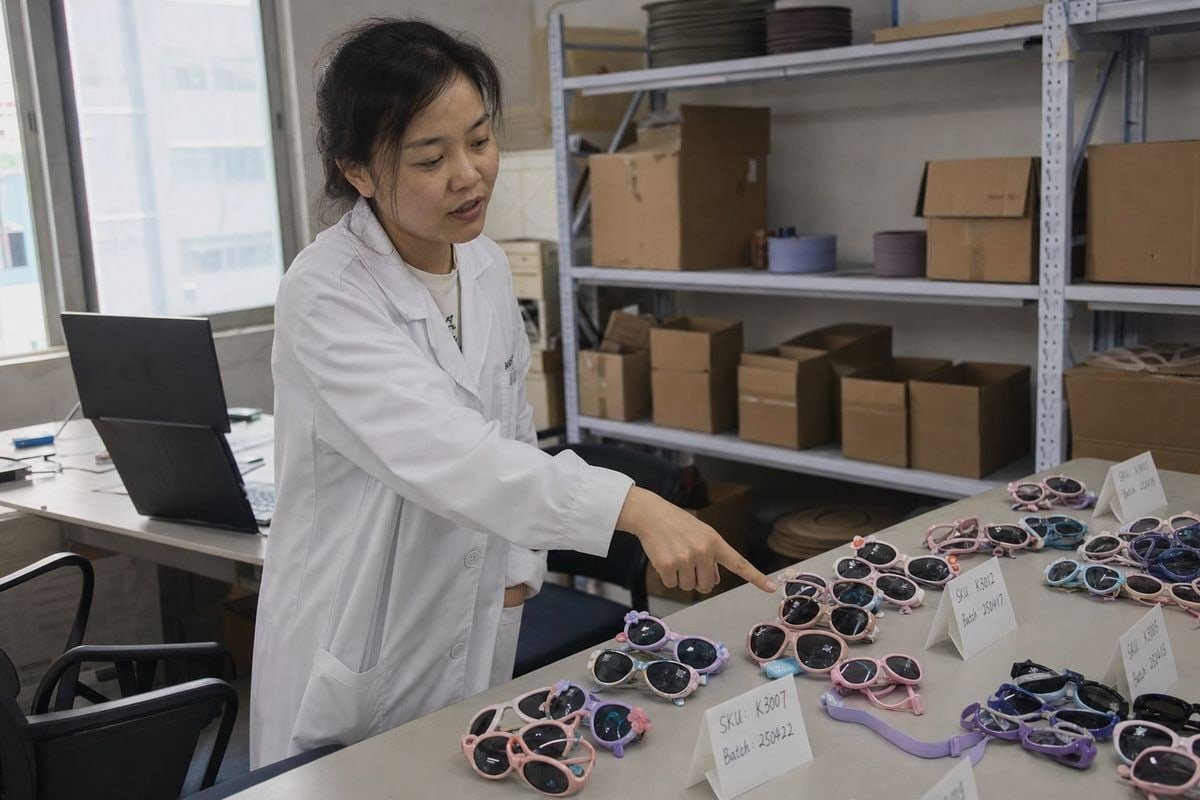
Segment your return data by SKU and batch before any dispute conversation. Data ends arguments faster than accusations do.
What role does my supplier's quality control process play in reducing return rates?
Every morning in our 5S-managed workshop 3, inspection happens before, during, and after assembly — because a defect caught at the hinge station costs cents, while the same defect caught by an angry parent costs a customer. That gap defines what supplier QC is really worth.
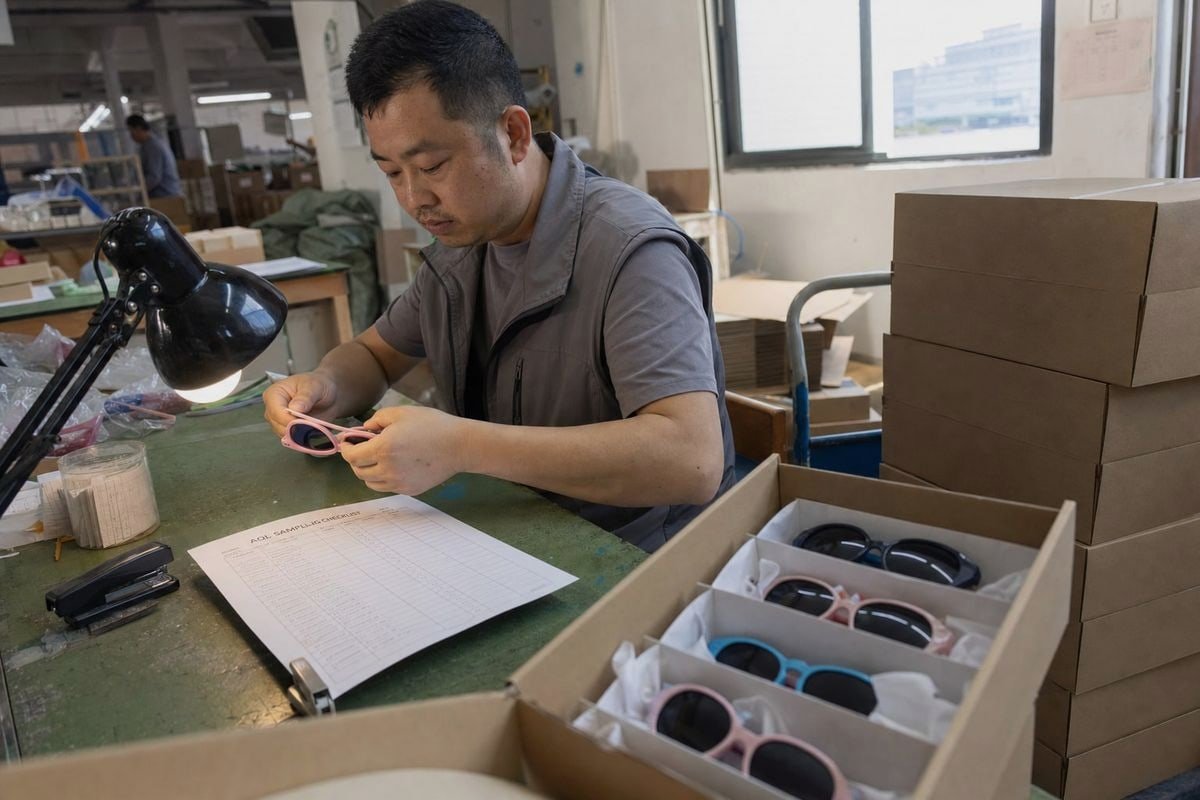
A supplier's quality control process directly determines your defect-driven return rate. Incoming material checks, in-process inspection, and pre-shipment AQL sampling catch loose hinges, lens flaws, and inconsistent sizing before shipment. Weak or absent QC pushes those failures downstream to your customers as returns.

Quality control is not a single checkpoint. It is a chain, and returns happen when any link is missing. When brands audit us, I always show them the full sequence rather than just the final inspection table, because final inspection alone catches problems too late to fix cheaply.
The three-stage QC chain
A supplier serious about children's eyewear runs checks at three stages:
- Incoming quality control. Raw TPEE and TR90 pellets, lenses, screws, and packaging get verified against specification before production starts. Bad material in means bad product out, no matter how careful the assembly.
- In-process quality control. Operators check hinge torque, lens fit, frame alignment, and surface finish during assembly. This is where random defects get caught while they are still fixable.
- Pre-shipment inspection. A sampled batch gets tested against an agreed acceptance standard 4 — checking UV400 5 lens performance, flex durability, dimensions against the size spec, and packaging condition.
What weak QC looks like in your return data
If your supplier skips these stages, your returns tell the story. "Broken on arrival" spikes mean no pre-shipment inspection. Inconsistent fit across the same SKU means no in-process dimensional checks. Lens coating peeling means no incoming material verification. Each of these return reasons is a receipt showing exactly which QC stage was missing.
Ask your supplier for their inspection records, not just their promises. A factory with real process control can show you checklists, defect logs, and rework rates. One that cannot is outsourcing its quality control to your customers — and your return rate is the invoice.
Should I be examining material choices like TPEE and TR90 before blaming my sales channel?
One trade-off comes up in nearly every development call we run: a buyer wants a lower unit price, and the cheapest path is downgrading from TR90 or TPEE 6 to generic PC or acrylic frames. Six months later, that same buyer is often asking why breakage returns doubled.
Yes — examine materials first. Rigid, brittle frame materials break under normal child handling and drive durability returns that no sales channel can prevent. Flexible TPEE and TR90 absorb twisting and impact, so material choice often explains high return rates before channel performance does.
Blaming the sales channel feels natural. The channel is where returns show up, so it looks like the source. But a channel only processes returns; the material decision created them months earlier, at the sourcing stage. Before you renegotiate with a retailer or marketplace, look at what the frames are actually made of.
Why material matters more for kids than adults
Adults handle eyewear with two hands and store it in cases. Children pull sunglasses off with one hand, bend the temples backward, sit on them, and stuff them into school bags. A material that survives adult use can fail within days on a child. This is exactly why our factory built its expertise around flexible materials rather than treating kids’ frames as shrunken adult frames.
| Property | TPEE temples | TR90 frames | Generic rigid plastic |
|---|---|---|---|
| Flexibility | Very high — bends and returns | High — twist-resistant | Low — snaps under stress |
| Weight | Very light | Light | Moderate |
| Impact behavior | Absorbs and recovers | Resists cracking | Cracks or shatters |
| Comfort on small faces | Soft, gentle pressure | Comfortable, stable | Pressure points common |
| Typical return driver | Rare breakage | Rare breakage | Frequent breakage returns |
The channel-blame test
Run this simple check. Compare return reasons across channels for the same SKU. If "broken" and "cracked" dominate everywhere, the material is guilty — the channel is just the messenger. If one channel shows high "not as described" or "wrong size" returns while others do not, then that channel's listing quality is the real issue. In our experience supplying brands across twenty-plus countries, breakage-driven returns almost always trace back to the material and construction spec, not to where the product was sold.
Material is a sourcing decision. If you chose price over child-appropriate flexibility, that ownership sits with procurement — and it is fixable.
How can I set clear OEM/ODM quality agreements with my manufacturer to prevent future disputes?
The smoothest long-term partnerships I have seen all started the same way: an uncomfortable, detailed conversation about quality standards before the first purchase order — not after the first return spike. Buyers who skip that conversation end up arguing about undefined expectations.
Set clear OEM/ODM quality agreements by documenting measurable specifications, an agreed AQL inspection standard, defect classifications, a return-rate threshold that triggers review, and remedy terms such as replacement or credit. Attach signed golden samples so both sides judge against the same physical reference.
A quality agreement is not about distrust. It is about removing ambiguity, because ambiguity is where disputes live. When a return spike happens — and eventually one will — a written agreement turns a blame fight into a lookup exercise. Both sides check the document, identify the owner, and apply the agreed remedy.
The five components every agreement needs
- Measurable product specifications. Frame dimensions with tolerances, material grades (specify TR90 and TPEE by name, not "flexible plastic"), lens standard such as UV400, hinge cycle expectations, and color references. If it cannot be measured, it cannot be enforced.
- Golden samples. Two signed, sealed approval samples — one held by each party. Every future dispute gets judged against this physical reference, not memory or opinion.
- Inspection standard and defect classes. Agree on an AQL sampling level and define what counts as critical, major, and minor defects for children's eyewear. A sharp edge is critical. A slight color shade variance is minor. Writing this down prevents both over-claiming and under-delivering.
- Return-rate thresholds and root-cause obligations. Define a defect-related return threshold that triggers joint investigation. Tie remedies to confirmed root cause: factory-caused defects get replacement or credit; design-approved or channel-caused returns do not.
- Remedy and escalation terms. Specify replacement timelines, credit mechanisms, and how disagreements get resolved — third-party inspection 7 is a common neutral referee.
Match the remedy to the root cause
| Confirmed root cause | Responsible party | Typical remedy |
|---|---|---|
| Production defect (loose hinge, lens flaw) | Manufacturer | Replacement or credit note |
| Approved design or material limitation | Buyer's product decision | Joint redesign, no chargeback |
| Transit damage | Packaging spec owner / carrier | Packaging revision, freight claim |
| Listing or sizing misrepresentation | Buyer's merchandising team | Content correction |
In our OEM/ODM 8 work, we welcome these agreements. They protect a serious factory just as much as they protect the brand, because they stop us being charged for failures we did not cause — and they force everyone to fix the real upstream problem.
Conclusion
High return rates on kids sunglasses are an accountability problem, not a mystery. Trace each return reason to its true owner — design, QC, materials, or agreements — then fix the upstream cause together.
Footnotes
1. Provides background on product return dynamics and their business impact for context. ↩︎
2. US consumer safety authority overseeing safety standards relevant to children’s products like eyewear. ↩︎
3. Background on the 5S lean manufacturing methodology referenced for workshop organization and QC. ↩︎
4. WTO’s technical barriers to trade rules govern acceptance standards applied to internationally traded goods. ↩︎
5. WHO explains UV radiation risks that justify UV400 lens protection standards for eyewear. ↩︎
6. Technical background on flexible thermoplastic elastomer materials used in children’s eyewear frames. ↩︎
7. ISO’s conformity assessment framework covers third-party inspection used to resolve quality disputes. ↩︎
8. Explains OEM/ODM manufacturing partnership models discussed in the supplier agreements section. ↩︎
More Articles You Might Like

August 1, 2026
Should Factory Handle Kids Sunglasses Packaging & Labeling, or Use a Designated Supplier?

August 1, 2026
Own Warehouse vs Supplier Direct Fulfillment: Which Cuts Return Costs for Kids Sunglasses Brands?

August 1, 2026
Direct-to-Port Warehouse or Overseas Staging: Which Saves More on Kids Sunglasses Shipping?
Looking for a Reliable Kids Eyewear Partner?
Explore 800+ ready styles and full OEM/ODM support tailored to your brand.
Get in Touch English
  Español de México
  Deutsch
  Français
  日本語
日本語  العربية
  Português do Brasil