What Are the Risks of Low-Cost Kids’ Sunglasses?
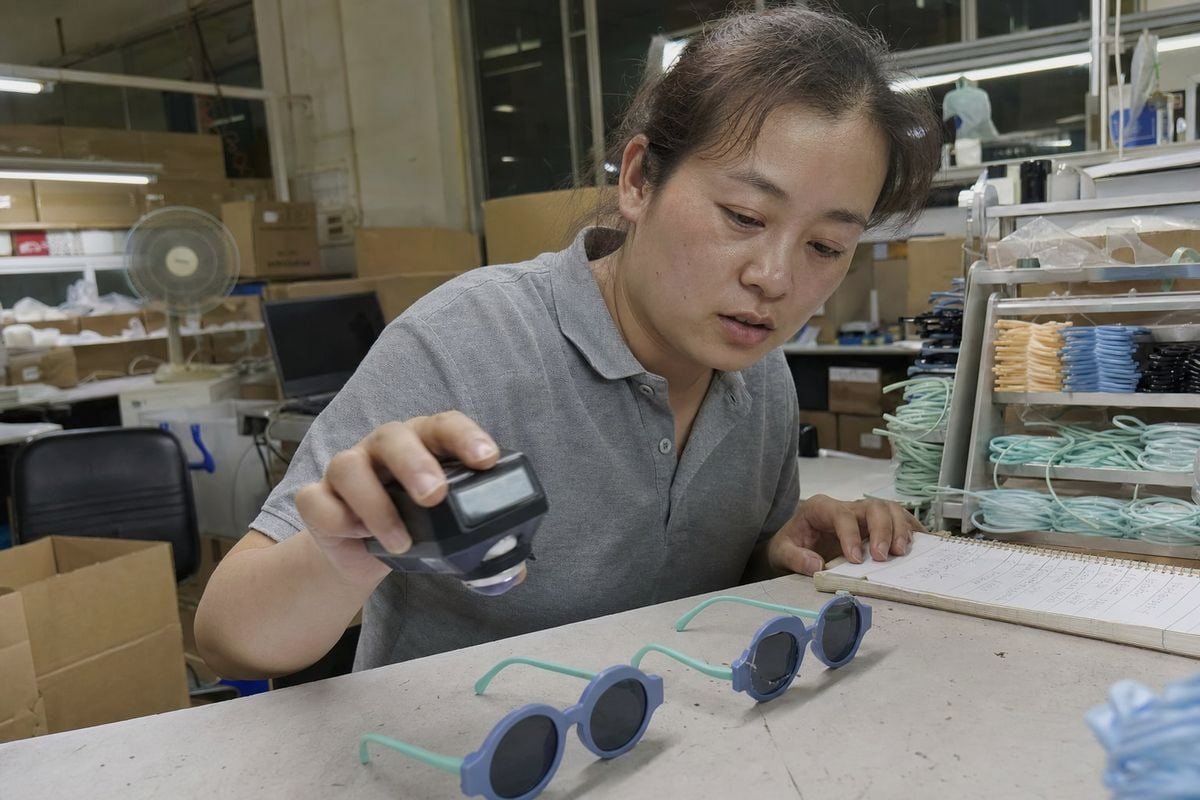
Low-cost kids’ sunglasses flood online marketplaces every summer, and on our production line in Taizhou, I see exactly what corners get cut to hit those prices cataracts, macular degeneration, pterygium 1. The problem is real: dark lenses without true UV filtering can dilate a child’s pupils and let more harmful rays reach the retina than wearing nothing at all. That thought keeps our QC team strict. Over fifteen years of making children’s eyewear, we have learned that “cheap” is not the enemy — “cheap and unverified” is photokeratitis 2. This article breaks down the real risks so you can source smarter.
Low-cost kids’ sunglasses carry four main risks: fake or inconsistent UV protection that lets dark lenses dilate pupils and increase UV exposure, brittle materials that snap or create sharp edges, optical distortion that strains developing eyes, and missing safety certifications that make claims impossible to verify.
Let me walk you through each risk in plain terms. I will also show you where the hidden costs pile up when a brand chooses the cheapest supplier it can find.
What safety hazards should I watch for in cheap kids' sunglasses?
Last year, a buyer sent us a competitor's sample that had failed her drop test on the first try. The lens popped out and left a sharp frame edge — a perfect example of what to avoid.
The main safety hazards in cheap kids' sunglasses are lenses that pop out or shatter on impact, brittle frames that snap into sharp fragments, small decorative parts that create choking risks for toddlers, and dark lenses that lack genuine UV filtering despite bold label claims.
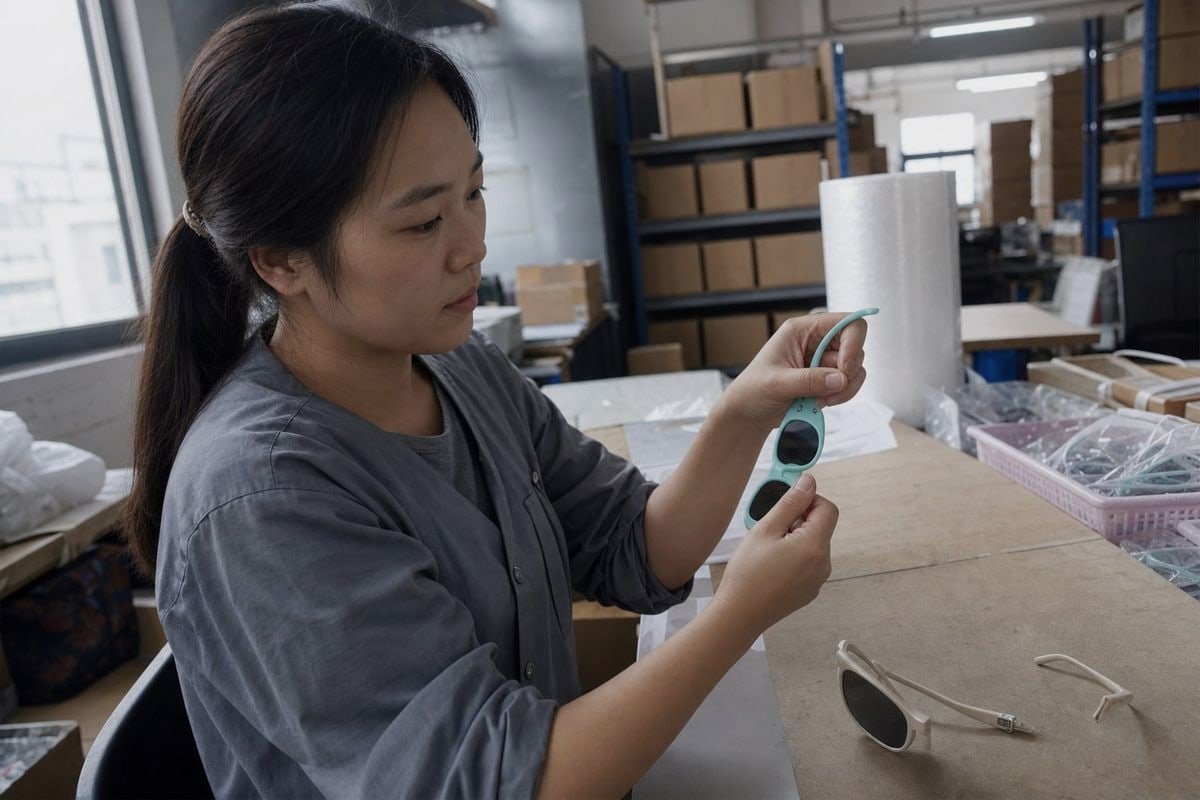
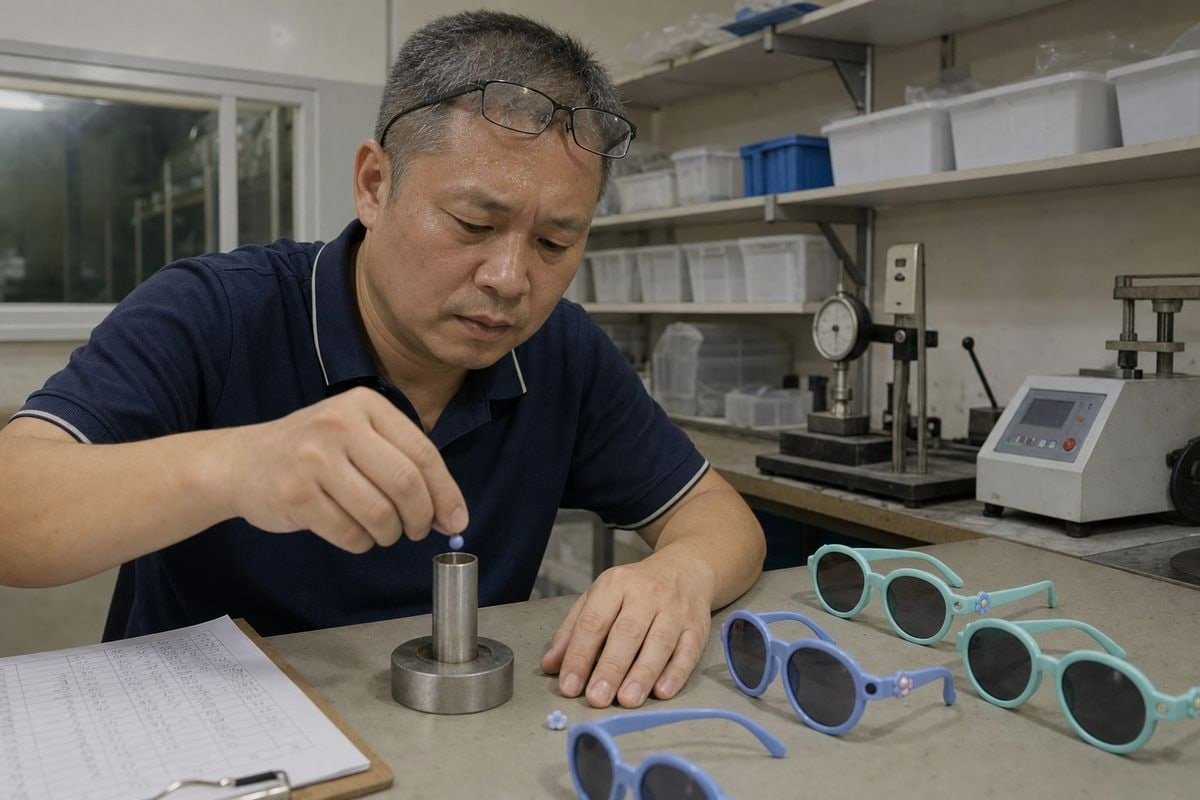
Children do not treat sunglasses gently. They drop them, sit on them, chew on them, and wear them while running, cycling, and climbing. So a hazard that seems minor for an adult product becomes serious for a child's product. In our workshop, every new style goes through flex tests and pull tests before we approve it, because we know how kids actually use eyewear.
Here are the hazards I check for first when a buyer sends me a "budget" sample to evaluate:
| Hazard | What causes it | Why it matters for children |
|---|---|---|
| Shattering lenses | Cheap acrylic instead of polycarbonate 3 or quality PC | Fragments can cut the eye area during falls or play |
| Snapping frames | Brittle, low-grade plastic with no flex | Broken frames leave sharp edges near the face |
| Loose small parts | Glued-on decorations, weak hinge screws, clip-on pieces | Choking risk for toddlers and babies |
| UV leakage | Tinted lenses without a true UV400 filter | Dilated pupils absorb more UV, not less |
| Poor fit | One generic adult mold shrunk down | Glasses slip off or press painfully on the nose |
The false-security problem
The most dangerous hazard is invisible. A consumer investigation in the UK found that roughly one in three children's sunglasses bought from major online marketplaces failed safety tests. Some pairs even had different UV protection in each lens — a clear sign of no quality control. Parents assume any dark lens protects. It does not. Tint controls brightness; a UV filter blocks radiation. They are separate things, and only one of them is visible to the eye.
How do low-cost materials affect comfort and durability for children?
Material choice is the trade-off I weigh most often when quoting a project. Shaving a few cents on raw plastic changes everything about how a frame feels and survives on a child's face.
Low-cost materials make kids' sunglasses stiff, heavy, and fragile. Brittle plastics pinch the temples, dig into the nose, and crack under normal play, while quality flexible materials like TPEE and TR90 bend without breaking, weigh less, and stay comfortable during hours of active wear.
Comfort is not a luxury feature for children’s eyewear. It is a safety feature. If sunglasses hurt, kids take them off. Then the UV protection everyone paid for goes into a backpack pocket, and the child's eyes get zero benefit. Our engineers learned this early: the best-tested lens in the world protects nothing if the frame is uncomfortable.
Why the base material decides everything
Cheap sunglasses typically use low-grade PC blends or recycled mixed plastics. These materials are rigid. Rigid frames concentrate stress at the hinges and bridge, so a normal twist — a child pulling them off with one hand — creates a crack. Compare that with the flexible materials we specialize in:
| Property | Cheap rigid plastic | TR90 4 | TPEE |
|---|---|---|---|
| Flexibility | Snaps under twisting | High, returns to shape | Very high, almost unbreakable in normal play |
| Weight | Heavier | Very light | Very light |
| Skin feel | Hard, can pinch | Smooth, comfortable | Soft, gentle on skin |
| Cold-weather behavior | Turns brittle | Stays flexible | Stays flexible |
| Typical lifespan with kids | Weeks to months | Seasons | Seasons |
At our factory, one of our most requested constructions is a TR90 front paired with TPEE temples. The front holds the lenses in stable alignment, while the soft temples flex around a child's head without pressure points. We run repeated bend cycles on temples during development because a hinge that loosens after fifty openings will loosen in a customer's hands too.
Durability protects the lens, too
There is a second-order effect people miss. A flimsy frame lets lenses shift, scratch, and pop loose. Scratched lenses scatter light and degrade vision. So poor frame material quietly destroys the optical performance you paid for, even when the lens itself started out fine.
Can low-quality UV protection actually harm my child's eyes?
When we calibrate lens orders with our suppliers, we test transmission across the UV spectrum, not just eyeball the tint. That habit exists because the answer to this question is yes.
Yes. Low-quality UV protection can actively harm children's eyes. Dark lenses dilate pupils, and if UV leaks through, the retina receives a higher dose than in open sunlight. Cumulative childhood UV exposure is linked to cataracts, macular degeneration, pterygium, and photokeratitis later in life.
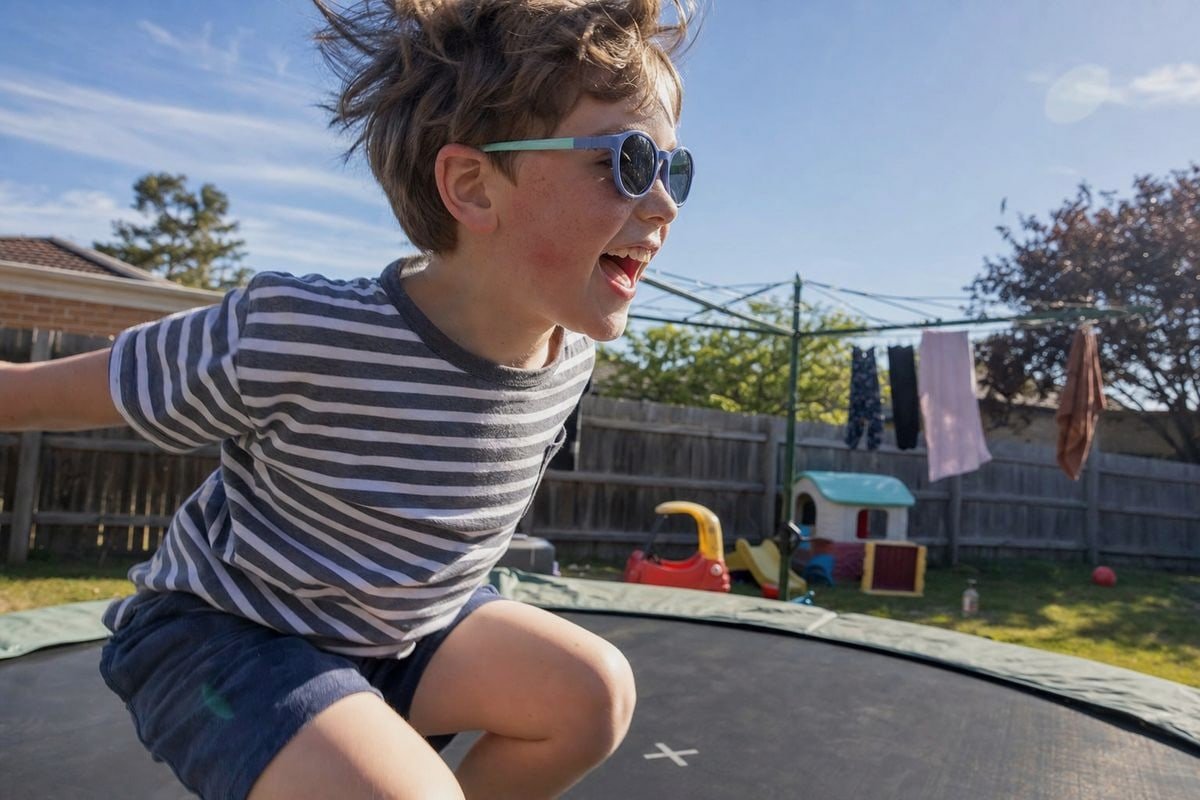
Children are not small adults when it comes to UV risk. Their eyes are still developing. The natural lens inside a child's eye is clearer than an adult's, so it transmits more UV light straight through to the retina. Kids also spend more hours outdoors than most adults, and eye damage from UV is cumulative — it adds up silently over decades. That is why eye-care professionals emphasize starting protection early. The damage a child avoids at age six is damage that never contributes to a cataract at age sixty.
How fake protection turns into real harm
The mechanism is simple:
- A dark lens reduces visible light, so the child's pupils dilate to compensate.
- A genuine UV400 filter would block wavelengths up to 400 nanometers, so dilation would not matter.
- A fake or degraded filter lets UVA and UVB pass through the enlarged pupil.
- The retina and internal lens receive a concentrated dose — more than they would with no sunglasses at all.
There is also a durability angle. Some budget lenses rely on a thin sprayed-on UV coating rather than UV-absorbing material mixed into the lens itself. Cheap coatings can degrade with heat, sweat, and sunlight — think of sunglasses left on a car dashboard in summer. The tint stays dark, so nothing looks different, but the protection silently fades. Quality polycarbonate, by contrast, absorbs UV as an inherent material property, which is one reason we favor it and verify every lens batch against the UV400 standard 5 before assembly.
A brand founder from Australia once told me she saved eight cents per unit with a bargain supplier — then lost an entire season to a recall. That conversation shaped how I quote to this day.
Choosing the cheapest sunglasses supplier creates hidden costs including product recalls, failed CE, UKCA, or marketplace compliance checks, high return and complaint rates, damaged brand reputation, replacement inventory expenses, and legal liability if a child is injured — costs that dwarf the cents saved per unit.
The unit price on a quotation is the most visible number, but it is rarely the most important one. In our experience exporting to buyers across more than twenty countries, the total cost of a children's eyewear program includes everything that happens after the container ships. When quality is unverified, those downstream costs explode.
Where the cents you saved come back to bite you
| Hidden cost | How it happens | Typical impact |
|---|---|---|
| Compliance failure | Missing or invalid CE/UKCA marking, no test reports | Products blocked at customs or delisted from marketplaces |
| Recall | UV claims fail independent testing after launch | Full inventory loss plus logistics and PR costs |
| Returns and complaints | Frames snap, lenses scratch, kids refuse to wear them | Margin erosion and poor reviews that suppress future sales |
| Reorder chaos | Cheap suppliers change materials batch to batch | Inconsistent color and quality across your own SKU |
| Legal exposure | A child injured by a sharp broken frame | Liability claims and lasting reputational harm |
| Lost trust | Retail partners see failed audits | Delisting from the accounts that took years to win |
Why "cheap" and "affordable" are not the same thing
Here is the nuance worth keeping. Not every inexpensive pair of children's sunglasses is dangerous. Polycarbonate is inherently UV-protective, and an efficient factory can produce a genuinely safe, tested pair at a reasonable price. The real dividing line is verification, not price alone. A certified, batch-tested pair at a fair cost is far safer than a stylish but untested pair at any price.
This is also why launching with existing tooling makes sense for new brands. From our library of roughly 800 existing styles, a buyer can pick proven, tested constructions and customize colors, logos, lenses, and packaging — no heavy mold investment, no gamble on unproven designs. Testing the market with lower financial risk should never mean testing it with lower safety.
A quick sourcing checklist
Before you sign any purchase order for kids’ sunglasses, confirm these points:
- Ask for UV400 test documentation for the actual lens batch, not a generic certificate.
- Verify CE, UKCA 6, or the relevant marking for your market, with traceable reports Marquage CE 7.
- Request pre-shipment samples and flex-test the frames yourself.
- Check hinges, nose areas, and decorations for small detachable parts.
- Visit the factory, or at minimum confirm you are dealing with a factory and not a trader.
- Ask how quality is controlled between reorders, not just for the first batch.
Conclusion
Cheap, unverified kids' sunglasses can dilate pupils while leaking UV, snap during play, and destroy brand trust. Demand tested UV400 lenses, safe flexible materials, and documented certification before buying.
Notes de bas de page
1. WHO fact sheet on UV radiation health effects supports the cited eye disease risks. ↩︎
2. NIH health information resource relevant to UV-related eye conditions mentioned in the article. ↩︎
3. Explains the material properties behind UV-blocking and impact-resistant lens claims. ↩︎
4. Wikipedia background on thermoplastic materials like TR90 used in flexible eyewear frames. ↩︎
5. Background on UV filtering standards referenced throughout the article’s core discussion. ↩︎
6. Official UK government guidance clarifies CE and UKCA marking requirements for compliant products. ↩︎
7. Official EU source clarifying the compliance marking referenced for sunglasses exports. ↩︎
Plus d'articles que vous pourriez aimer
1 août 2026
L'usine doit-elle gérer l'emballage et l'étiquetage des lunettes pour enfants, ou utiliser un fournisseur désigné ?
1 août 2026
Entrepôt propre vs. exécution directe par le fournisseur : lequel réduit les coûts de retour pour les marques de lunettes pour enfants ?

1 août 2026
Entrepôt direct au port ou staging outre-mer : lequel permet d'économiser le plus sur l'expédition des lunettes pour enfants ?
Vous recherchez un partenaire fiable en lunetterie pour enfants ?
Explorez plus de 800 styles prêts et un support OEM/ODM complet adapté à votre marque.
Contactez-nous English
  Español de México
  Deutsch
  Français
  日本語
日本語  العربية
  Português do Brasil