How Light Should Kids’ Sunglasses Be for Comfort?
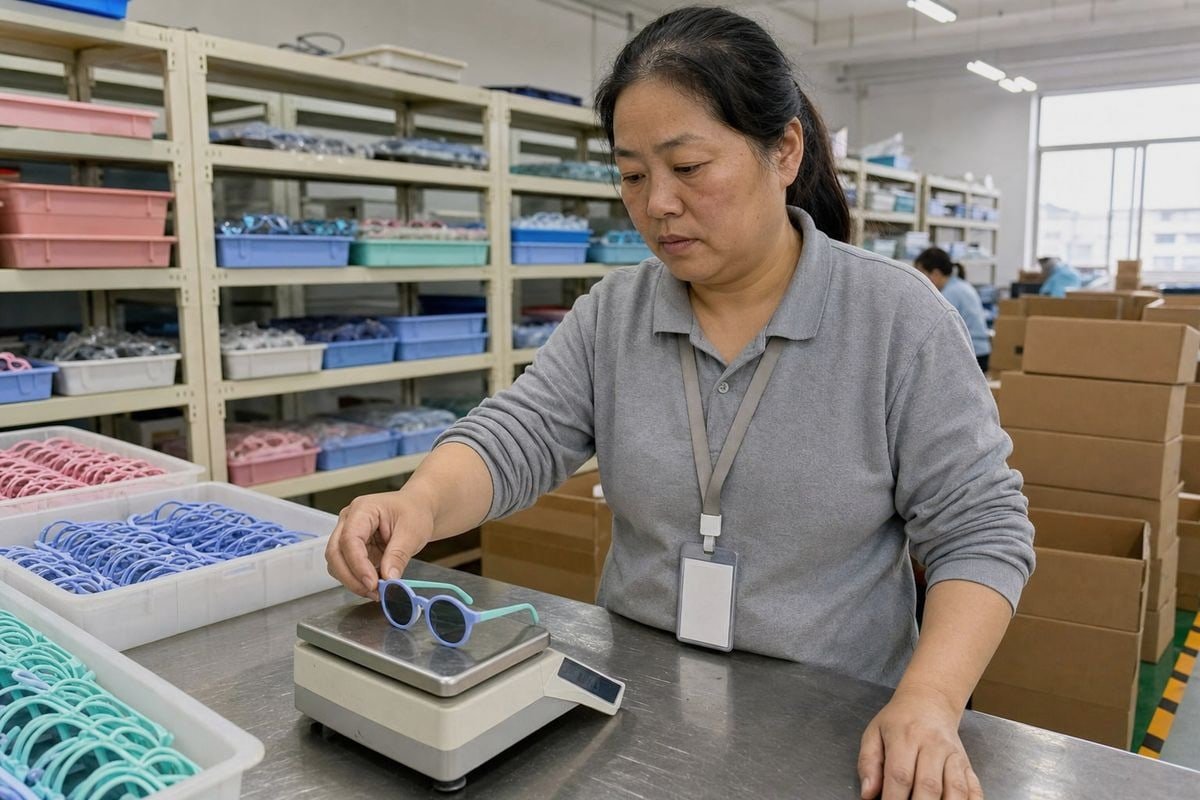
Kids’ sunglasses weight is the first spec I check on our production line in Taizhou. Too heavy, and children pull them off within minutes — and Protection UV 1 means nothing then.
Comfortable kids’ sunglasses should weigh roughly 12 to 20 grams. Toddlers do best under 15–16 grams, while school-age children tolerate 16–20 grams if the frame is flexible and well balanced. Lighter frames reduce pressure on the nose and ears, so kids keep them on longer.
That number range is the starting point, not the whole story. Below, I break down weight targets, materials, durability, and how to test comfort before you commit to a bulk order.
What weight range should I look for when sourcing comfortable kids' sunglasses?
A buyer from Australia once asked me why her previous supplier's 28-gram frames kept coming back in returns. The answer was simple: children refused to wear them.
Source kids' sunglasses in the 12–20 gram range. Aim for 12–16 grams for toddlers and sensory-sensitive children, 16–20 grams for everyday preschool and elementary wear, and up to 22 grams for sport styles that trade a little weight for grip and wraparound stability.
The market has already voted on this. Across the 800 or so existing styles in our catalog, the models that reorder most consistently sit inside that featherlight zone. Retail listings marketed as "comfortable" cluster around 12 g, 14 g, 16.4 g, 19 g, and 20 g. That is not a coincidence. It is the range where a child stops noticing the frame.
Weight targets by age and use case
| Age / Use Case | Target Weight | Pourquoi ça marche |
|---|---|---|
| Babies and toddlers (0–4) | 12–16 g | Weaker neck and facial muscles; low tolerance for pressure |
| Preschool and elementary (4–8) | 16–20 g | Stable fit matters as much as grams at this stage |
| Active kids / sports (8+) | 18–22 g | Slight extra weight is fine if grip and coverage improve |
| Sensory-sensitive children | 12–15 g | Soft-touch materials, no hard pressure points |
Why grams alone can mislead you
Weight distribution matters as much as total weight. A 19-gram frame with balanced temples and a wide, soft bridge can feel lighter on the face than a 15-gram frame that concentrates everything on the nose. When we develop a new style, we check where the mass sits, not just what the scale says. Front-heavy frames slide down small noses. Frames with balanced temple arms spread load toward the ears and feel almost invisible.
So use the 12–20 gram range as your sourcing filter, then judge balance, bridge design, and fit within it. Both steps matter.
How do TPEE and TR90 materials help reduce frame weight without sacrificing safety?
Fifteen years of working with flexible polymers taught our team one thing early: the material choice decides the weight ceiling before the design even starts.
TPEE and TR90 are low-density, flexible polymers that let frames stay strong at thin wall thicknesses. This cuts weight to the 12–20 gram range while the materials bend instead of snapping, eliminating sharp break points and making frames both lighter and safer for children.
Traditional en acétate 2 and metal frames need bulk to be strong. That bulk adds grams. TR90 3, a thermoplastic memory polymer, flips that equation. It holds its shape at thin cross-sections, so designers can slim down the front frame and temples without creating weak spots. The result is a frame that weighs less and survives more abuse.
TPEE goes a step further on the safety side. It is a soft, rubber-like elastomer 4. On our TR90-front, TPEE-temple combinations, the temples flex outward when a child yanks the frame off with one hand — which every child does. No snap, no sharp edge, no pinched skin. Both materials are also environmentally friendly options 5 compared with many legacy plastics, which matters to the European and Japanese brands we supply.
Comparaison des matériaux en un coup d'œil
| Le rétrécissement des montures en acétate est le problème caché des matériaux traditionnels. L'acétate perd lentement ses plastifiants, se contractant avec le temps. Ironiquement, un léger rétrécissement peut resserrer un verre — mais il rend également la monture cassante, et les fils de lunette cassants se fissurent au niveau de la gorge. Il faut également tenir compte de la contraction thermique différentielle : lorsqu'un enfant passe de la chaleur extérieure à la climatisation, la monture et le verre se contractent à des vitesses différentes. Les polymères flexibles absorbent cette inadéquation ; les matériaux rigides transfèrent le stress au siège du verre. | TR90 | TPEE | Propriété |
|---|---|---|---|
| Relative weight | Très léger | Très léger | Peut se fissurer ou se déformer |
| Flexibilité | High (memory return) | Very high (rubber-like) | Bas |
| Break behavior | Bends, resists snapping | Bends, almost unbreakable | Can crack into sharp pieces |
| Sensation sur la peau | Smooth, firm | Doux, adhérent | Hard |
| Best use in kids' frames | Front frame, full frames | Temples, baby frames | Fashion adult frames |
Why thin walls do not mean fragile frames
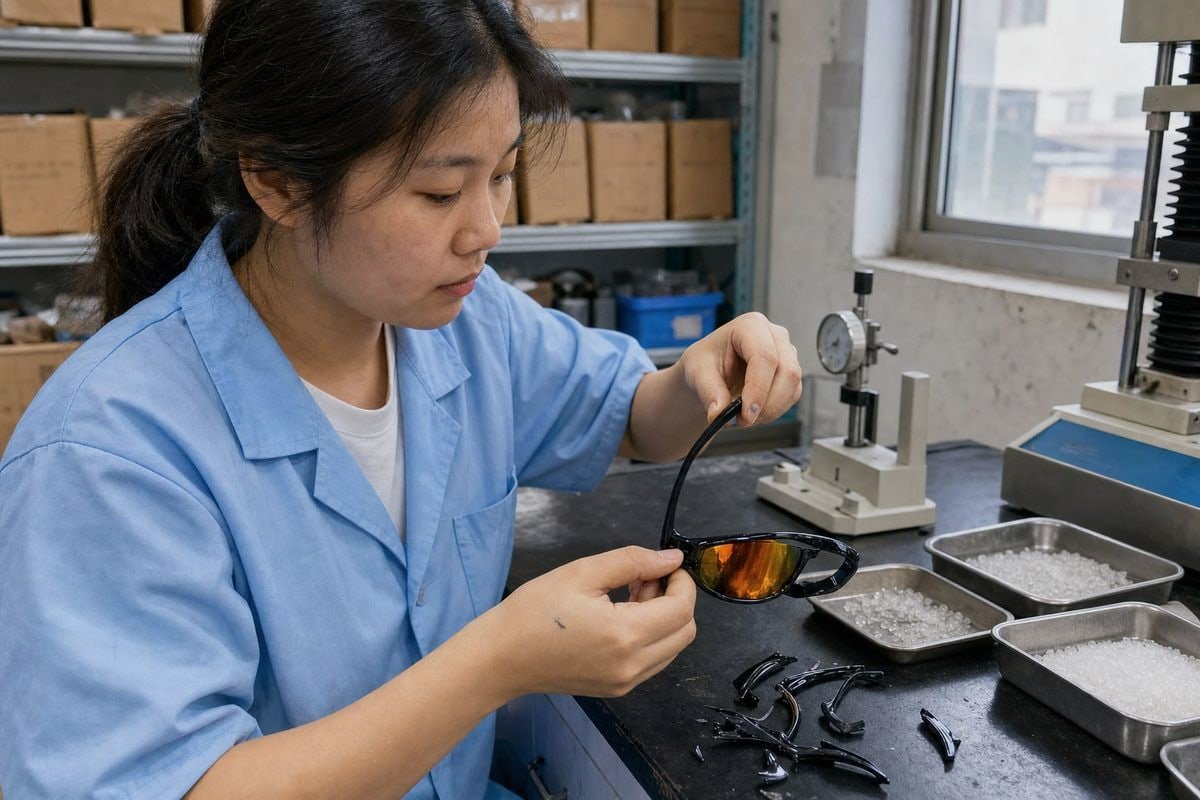
The key concept is strength-to-weight ratio 6. TR90 tolerates repeated flexing cycles that would fatigue and crack rigid plastics. So a 16-gram TR90 frame can outlast a 25-gram rigid frame in real child use. We pair this with flexible hinge designs and integrated soft nose areas, so no single point carries all the stress — or all the pressure on the child's face.
Can lightweight frames still stay durable enough for active children?
Durability is the trade-off I weigh on every new mold. Cut too much material in the wrong place, and a frame that scores well on the scale fails in the playground.
Yes. Lightweight frames stay durable when built from flexible polymers like TR90 and TPEE, with reinforced hinge zones, wraparound geometry, and even wall thickness. Flexibility, not bulk, is what survives drops, twists, and one-handed removal by active children.

The instinct to equate weight with toughness comes from adult eyewear, where heavy acetate signals quality. Children's eyewear works on opposite logic. A child will sit on their sunglasses, drop them on concrete, and twist the temples backward. A rigid heavy frame fails those tests by cracking. A flexible light frame absorbs the abuse and springs back.
Where durability actually comes from
Our sport-style wraparound models are a good example. The single-shield lens designs — the kind with a curved, aerodynamic silhouette that hugs the face — gain durability from their geometry, not extra grams. The continuous curve distributes impact across the whole frame front. Thick, sculpted temple arms taper into slim flexible tips, so the stress concentrates where the material can flex, not where it would snap.
Here is what we focus on during development and QC:
- Hinge zone reinforcement. The hinge is the most common failure point. We test repeated open-close cycles and outward temple flex on every new style.
- Even wall thickness. Sudden thick-to-thin transitions create stress risers. Smooth transitions keep a thin frame strong.
- Rétention des verres. A light frame must still grip the lens firmly through impacts and temperature swings.
- Temperature behavior. Plastics soften slightly in summer heat and stiffen in winter cold. We check fit stability across that range, because a frame sold in July still needs to fit in December.
In our Réalités du transit par mode 7, frames go through flex and drop checks before shipment. In our experience exporting to 20-plus countries, the styles with the fewest complaints are consistently the light, flexible ones — not the heavy ones.
How do I test frame comfort and fit before placing a bulk order with my manufacturer?
One lesson from years of OEM projects: buyers who test physical samples on real children almost never face returns later. Buyers who approve from photos sometimes do.
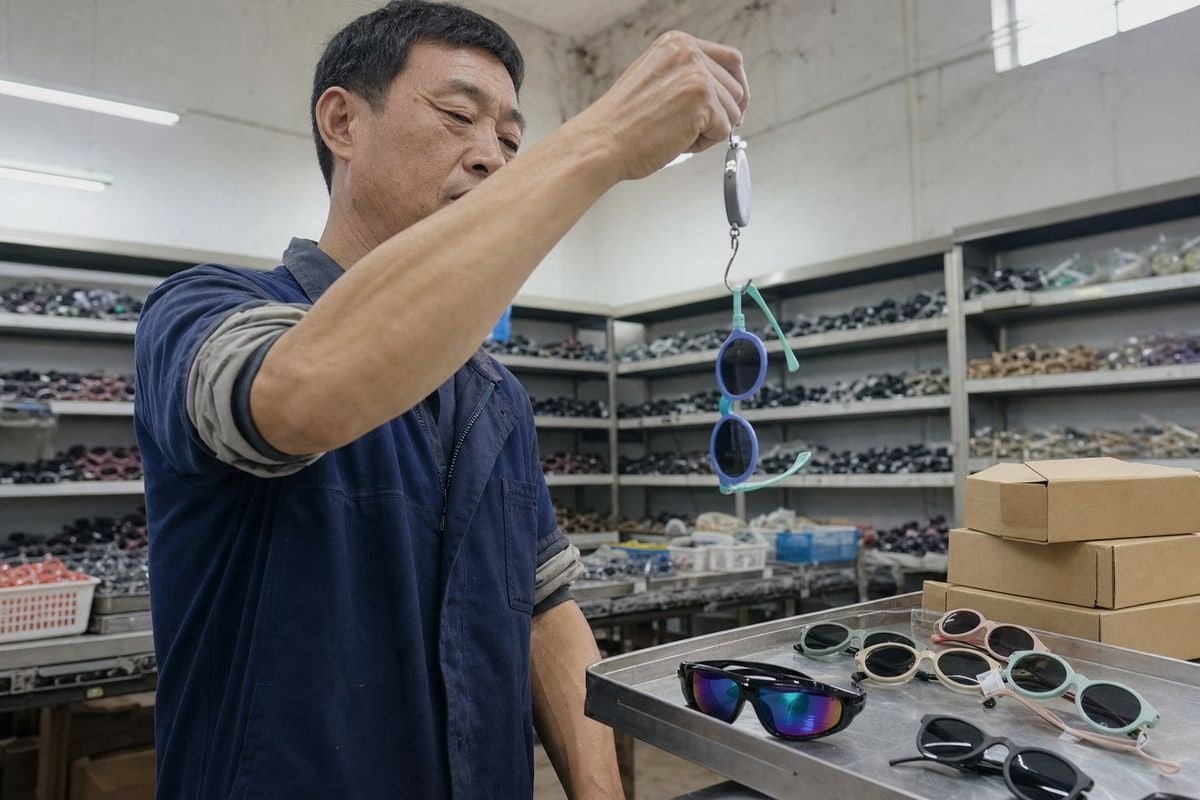
Request physical samples, weigh each frame on a gram scale, and test fit on children in your target age range. Check bridge pressure, temple grip, ear comfort, and slippage during movement over a 30-plus minute wear session before approving bulk production.
A feuille de spécifications tells you the weight. It cannot tell you whether a four-year-old will keep the frame on. So before any bulk order, run a structured sample evaluation. When we send pre-production samples to our brand customers, we encourage exactly this process, because catching a fit issue at the sample stage costs days — catching it after production costs a season.
A practical sample evaluation checklist
| Test | How to Do It | Critères de réussite |
|---|---|---|
| Weight check | Weigh on a 0.1 g kitchen or jewelry scale | Within 12–20 g for the target age |
| Bridge pressure | Look for red marks on the nose after 30 min of wear | No visible marks or complaints |
| Temple grip | Have the child run, jump, and look down | No slipping, no readjusting |
| Test de flexion | Bend temples outward past 90 degrees | Frame returns to shape, no whitening |
| Edge feel | Run a finger along all inner edges | Smooth, no sharp mold lines |
| Wear tolerance | Ask the child to wear them during normal play | Child forgets the frame is on |
Questions worth asking your supplier
Ask for the exact weight per style, the material of the front frame and temples separately, and how the hinge is constructed. Ask whether the bridge is integrated soft material or a hard molded ridge. And ask what fit feedback the factory has from other markets — small faces vary by region, and a supplier with export history across many countries can flag sizing issues before you discover them. On our side, we share this data openly with samples, because a comfortable fit at the sample stage is what turns a first order into a long-term program.
Conclusion
Kids' sunglasses only protect eyes when children keep them on. Heavy frames get rejected; 12–20 gram flexible TPEE and TR90 frames get worn. Source light, test fit, then order.
Notes de bas de page
1. Authoritative source explaining UV exposure risks that kids’ sunglasses aim to prevent. ↩︎
2. Background on cellulose acetate, the traditional eyewear material compared against TR90/TPEE. ↩︎
3. Background reference on thermoplastic polymers used to make TR90 frame material. ↩︎
4. Defines the rubber-like polymer class that TPEE belongs to for readers unfamiliar with the term. ↩︎
5. EPA resource on plastics sustainability relevant to claim about eco-friendly frame materials. ↩︎
6. Wikipedia explains this engineering concept referenced when comparing frame materials. ↩︎
7. Explains the 5S manufacturing methodology mentioned regarding quality control workshop practices. ↩︎
Plus d'articles que vous pourriez aimer



Vous recherchez un partenaire fiable en lunetterie pour enfants ?
Explorez plus de 800 styles prêts et un support OEM/ODM complet adapté à votre marque.
Contactez-nous English
  Español de México
  Deutsch
  Français
  日本語
日本語  العربية
  Português do Brasil